Services
Edge ai Consulting
How we scope, structure, and price consulting projects—and what your team can expect along the way.
By Ceri Nelmes
Tech Marketing Leader & Journalist | Building Brands at the Edge of What’s Next | Connect Tech & CTai Labs
Technical review: Rob Callaghan, Chief Product Officer, Connect Tech Inc.

Key Takeaways
- CTai LABS consulting starts with the use case, the existing system, and the outcome you need to achieve, not with a predetermined hardware or software package
- You do not need a finished specification to start, but the more you can share about your model, data, sensors, target environment, performance goals, and constraints, the faster the team can define a useful scope
- Engagements can begin with feasibility and architecture, an existing proof of concept, a trained model, or a partially integrated system, and can continue through deployment and production support
- Consulting cost is scoped to the work required. The main cost drivers are technical maturity, integration complexity, hardware and sensor requirements, validation requirements, deliverables, timeline, and the level of ongoing support
- CTai LABS is Connect Tech’s dedicated full-stack ai engineering team, backed by more than 40 years of embedded-system experience and NVIDIA® Elite Partner status
- The customer keeps their IP. CTai LABS works as an extension of the customer’s engineering team without taking ownership of the customer’s intellectual property
What should you know before engaging an Edge ai consultant?
If you are evaluating an Edge ai consultant, the useful questions are not only “Can you build this?” They are: What will you need from us? Who owns each part of the work? How will the project be scoped? What will we receive? How is cost determined? What technical credentials matter? How do we know when the engagement is successful? And what happens when the system leaves the lab?
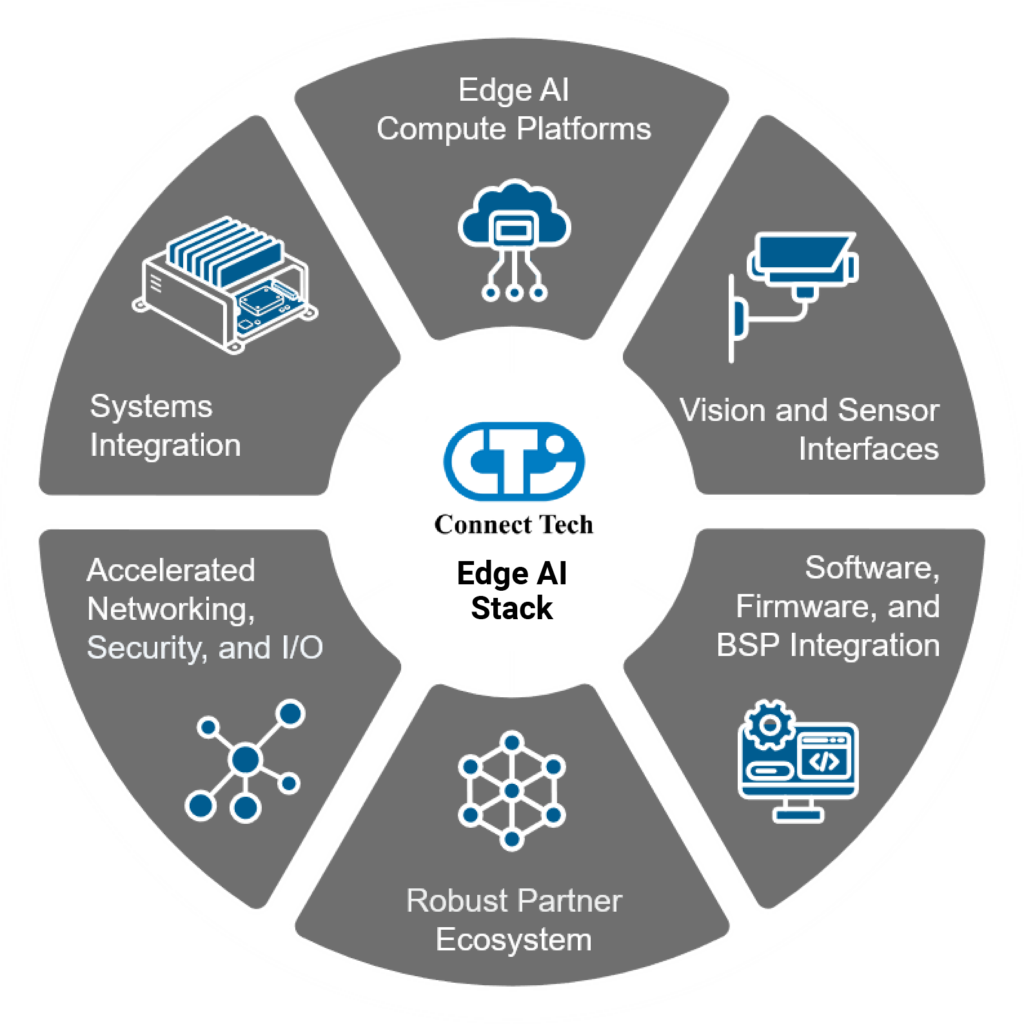
CTai LABS structures consulting around those questions. We work with your engineering team to define the problem, identify the production constraints, establish measurable goals, and determine which parts of the Edge ai stack need support. CTai LABS consulting can address individual layers or the wider CTI EdgeAI Stack, connecting compute, BSPs, sensors, software, optimization, and deployment into a system ready to deploy. The engagement can be narrowly focused on a specific technical blocker or extend across architecture, hardware and software integration, model optimization, validation, deployment, and production support.
When to bring CTai LABS into a project
- You have a use case and need help determining whether Edge ai is technically feasible.
- You have an idea. CTai LABS works end to end, from concept to deployment.
- You have a model or application but have not selected the target compute platform.
- You have selected hardware and need carrier, BSP, sensor, or software-stack support.
- Your proof of concept works, but performance, memory, power, thermals, or sensor integration are preventing deployment.
- You need to migrate an existing workload to a different module or software release.
- You have a working system and need validation, deployment engineering, an OTA strategy, or production support.
What we need from you to get started
A first conversation does not require a complete requirements document. It does require enough context for the engineering team to understand what you are trying to build and where the uncertainty sits. Edge ai platform selection and deployment depend on factors including workload requirements, sensor configuration, I/O, power budget, thermal constraints, and target performance (Texas Instruments, 2026). If some of the items below are unknown, that is acceptable. Identifying those unknowns can be part of the consulting scope.
| What to bring | Examples | Why it matters |
|---|---|---|
| The goal | What the system must detect, decide, generate, control, or automate | Defines the engineering outcome rather than a technology exercise |
| Current project state | Idea, dataset, trained model, PoC, existing application, or existing hardware | Shows where CTai LABS should enter the development cycle |
| Success criteria | Latency, FPS, accuracy, throughput, memory, power, uptime, response time, or fleet target | Gives the project measurable acceptance criteria |
| Models and software | Model format, framework, codebase, containers, ROS/ROS 2, APIs, and current JetPack version | Establishes compatibility and migration work |
| Data | Representative samples, formats, volumes, privacy restrictions, and labeling status | Determines what can be tested and validated |
| Sensors and I/O | Cameras, GMSL, MIPI CSI-2, FPD-Link III, LiDAR, radar, IMUs, CAN, and networking | Defines integration and bandwidth requirements |
| Physical environment | Power budget, ambient temperature, enclosure, size and weight, shock and vibration, and connectivity | Prevents a lab-only architecture from becoming the production design |
| Target timeline | Demo date, design freeze, field trial, certification milestone, and production target | Determines sequencing, resourcing, and scope |
| Compliance or customer requirements | Industry standards, security requirements, documentation, and validation evidence | Allows these constraints to be designed in rather than discovered late |
The first engagement: discovery and technical scoping
The first step is a technical discovery conversation. CTai LABS reviews the use case, the current architecture, what already works, what does not, and the constraints the final system has to meet. This is also where we identify assumptions that need to be tested before a larger development commitment is made.
From that discussion, the next step may be a focused feasibility exercise, an architecture and platform recommendation, a proof of concept, an integration scope, or a broader development engagement. The objective is to make the next engineering step explicit: the problem being solved, the work CTai LABS will own, the inputs required from the customer, the deliverables, and the criteria for completion.
How CTai LABS structures consulting work
Not every customer needs the same six-stage program. CTai LABS scopes the engagement around the maturity of the project and the technical gaps that need to be closed. A project may use one of these work packages or several in sequence.
| Consulting scope | Typical work | Typical output |
|---|---|---|
| Feasibility and architecture | Use-case review, workload sizing, module and carrier selection, sensor and I/O architecture, memory/power/thermal analysis, and software-stack planning. | Architecture recommendation, feasibility findings, risks, and next-step plan. |
| Platform and BSP enablement | Board bring-up, BSP configuration, drivers, JetPack migration, OS, and container environment. | Working target platform and documented software baseline. |
| Sensor and system integration | Camera, LiDAR, radar, IMU, CAN, networking, timing, and data-pipeline integration. | Integrated sensor pipeline on the target. |
| Model and application optimization | TensorRT conversion, quantization, memory optimization, throughput and latency tuning, and application integration. | Validated model and application performance on the target hardware. |
| Validation and deployment readiness | SIL/HIL/digital-twin testing where applicable, thermal/power validation, system testing, and deployment packaging. | Defined validation evidence and deployment-ready system artifacts. |
| Production support and evolution | BSP/software support, update planning, platform migration, and fleet or field support as scoped. | A support path for the deployed system. |
How goals and success criteria are defined
A consulting engagement needs an engineering definition of “done.” CTai LABS works with the customer to turn the business goal into measurable technical criteria. Depending on the system, that may include inference latency, frame rate, model accuracy, memory use, power draw, thermal behavior, boot time, sensor synchronization, network behavior, uptime, or successful operation under a defined test condition. Edge ai deployment research similarly treats accuracy, latency, power consumption, memory, and computational resources as interdependent deployment constraints rather than isolated model metrics (Cordova-Cardenas et al., 2025).
The goal is not to create an artificial benchmark that looks good in a lab. The acceptance criteria should reflect the environment in which the product will actually operate. Where requirements are not yet known, the first phase can be used to establish the performance envelope and recommend realistic targets.
How consulting cost is determined
- How much of the system already exists and how production-ready it is.
- The number and complexity of hardware, sensors, interfaces, and software components.
- Whether CTai LABS is optimizing an existing model or developing additional application logic.
- Platform migration or BSP and driver work.
- Performance, memory, power, thermal, and environmental requirements.
- The amount of validation, documentation, and test evidence required.
- Schedule and milestone requirements.
- Whether the engagement ends at a defined handoff or includes ongoing production support.
What credentials should you look for in an Edge ai consultant?
There is no single certification that proves a consultancy can engineer a production Edge ai system. The relevant evidence is a combination of platform credentials, embedded engineering depth, software expertise, and demonstrated ability to integrate the complete system.
Experienced ai architects
Experienced ai architects with demonstrated Edge deployment expertise.
NVIDIA ecosystem depth
Connect Tech is an NVIDIA Elite Partner, and CTai LABS works across the NVIDIA Jetson platform and production software stack.
Embedded hardware and BSP experience
CTai LABS is a department of Connect Tech, which has designed embedded systems since 1985 and maintains hardware, BSP, and software engineering capabilities.
Full-stack Edge ai capability
The team works across processor and platform selection, BSP and software bring-up, sensors, model optimization, and deployment rather than stopping at model development.
Production-oriented validation
CTai LABS can incorporate real target hardware, real sensors, power and thermal constraints, and SIL/HIL/digital-twin workflows where they fit the project.
A working internal reference platform
Data. Analytics. Vision. Execution. (D.A.V.E.) is one of Connect Tech’s autonomous mobile robots and is used to demonstrate and exercise the same types of perception, compute, control, and integration problems that customers bring to CTai LABS.
What credentials should you look for in an Edge ai consultant?
Consulting works best when ownership is explicit. CTai LABS does not need to replace the customer’s engineering team. It can operate as an extension of that team, taking responsibility for the Edge ai layers that require specialized platform and integration experience. The customer keeps their IP throughout the engagement.
| Customer typically owns | CTai LABS can own |
|---|---|
| Product vision, business requirements, domain knowledge, and customer-specific priorities | Edge ai architecture, platform selection, and engineering recommendations |
| Proprietary data, application logic, and internal systems | BSP and platform enablement, sensor integration, and NVIDIA software-stack work |
| Approval of success criteria and design decisions | Model optimization, target validation, and deployment engineering |
| Internal product roadmap and commercialization decisions | Defined technical deliverables and production support within the agreed scope |
What you receive at the end of an engagement
- Architecture recommendations and documented technical decisions.
- A defined hardware, BSP, and software baseline.
- Integrated and configured target hardware.
- Model or application optimization results and measured performance.
- Sensor and interface integration.
- System images, configurations, APIs, or deployment artifacts where included in the scope.
- Validation results and test evidence defined by the engagement.
- Documentation and handoff material.
- A production-support or next-phase plan when required.
What happens if the project changes?
Edge ai programs often reveal new information once the workload reaches real hardware. A model may require more memory than expected, a sensor may behave differently than its documentation suggests, or a thermal limit may change the usable power mode. Edge ai system sizing depends on the target workload and requires the hardware and software solution to be evaluated as a complete system (NVIDIA, 2022).
CTai LABS treats those findings as engineering inputs. If they materially change the agreed scope, the team identifies the impact, discusses options with the customer, and updates the plan rather than allowing the project to drift without visibility.
Why CTai LABS is structured differently from a general ai consultancy
General ai consulting can be excellent at data science, cloud systems, or model development. Edge ai adds a different set of constraints because the model has to coexist with embedded hardware, sensors, drivers, power, thermals, networking, and the production environment. Intel independently describes the main challenge of implementing Edge ai as coordinating the different elements of the system, including compute infrastructure, IoT devices, legacy equipment, hardware, and software. It also emphasizes right-sizing hardware to actual performance requirements and interoperability across heterogeneous infrastructure (Intel, 2026).
CTai LABS combines ai integration with Connect Tech’s embedded hardware, BSP, and software background. That allows the consulting conversation to start with the whole system: what the application needs to do, what the physical deployment allows, and how the NVIDIA platform should be configured to meet those requirements.
How to engage with CTai LABS’ ai Architects and Engineers
1.
Book a discovery call
Share the use case, current project state, target timeline, and the biggest technical question or blocker.
2.
Technical discovery
CTai LABS reviews the workload, system constraints, existing assets, and what information is still missing.
3.
Plan & Validate
Agree on the goals, responsibilities, inputs, deliverables, success criteria, timeline, and commercial structure for the initial phase.
4.
Execute and review
Engineering work proceeds against the defined milestones, with technical findings and decisions reviewed with the customer.
5.
Handoff, continue, or scale
At the end of the phase, the customer receives the agreed outputs. The next step may be internal continuation, another CTai LABS work package, deployment support, or production scale-up.
Questions to ask before you choose an Edge ai consultant
- Will the same organization work across hardware, BSP, sensors, model optimization, and deployment, or will those layers be handed between vendors?
- Can the consultant benchmark and validate the workload on the actual target hardware?
- Can they support the NVIDIA Jetson software stack as well as the ai model?
- How are success criteria established before development begins?
- What exactly will be delivered at the end of the engagement?
- How are scope changes handled when testing reveals a new constraint?
- What support is available after the first deployment?
- Does the consultant have embedded-system and production experience, or primarily cloud and model experience?
Book a Discovery Call
Bring us the use case, the system you have today, and the problem you need to solve. If you already have models, hardware, sensor specifications, performance targets, or test data, include them. If you do not, the discovery process can help identify what needs to be defined first.

ABOUT THE AUTHOR
Ceri Nelmes
Tech Marketing Leader & Journalist | Building Brands at the Edge of What’s Next |
Connect Tech & CTai Labs
Ceri Nelmes is Head of Marketing at Connect Tech and an experienced technology journalist and digital strategist. She covers the technologies and market shifts shaping embedded computing, Edge AI, Physical ai, robotics, autonomous systems, and the NVIDIA® ecosystem. Working with Connect Tech and CTai LABS subject-matter experts, she turns engineering developments into accurate, useful reporting for developers, technical buyers, business leaders, and the media.
 Learn More
Resources and Frequently Asked Questions
Sources
Connect Tech Inc. (2025, November 4). CTai LABS launched by Connect Tech: A new initiative for end-to-end Edge AI integration.
https://connecttech.com/ctai-labs-launched-new-initiative-end-to-end-edge-ai-integration/Connect Tech Inc. (2026). Product Guide 2026.
https://connecttech.com/wp-content/uploads/2026/07/Product-Guide-2026_Interactive.pdfCordova-Cardenas, R., Amor, D., & Gutiérrez, Á. (2025). Edge AI in practice: A survey and deployment framework for neural networks on embedded systems. Electronics, 14(24), 4877.
https://doi.org/10.3390/electronics14244877Intel. (2026). Edge AI.
https://www.intel.com/content/www/us/en/learn/edge-ai.htmlNVIDIA. (2022). An IT manager's guide to deploying an Edge AI solution. NVIDIA Technical Blog.
https://developer.nvidia.com/blog/?p=57735Texas Instruments. (2026). Getting started with Edge AI MPUs. GitHub.
https://github.com/TexasInstruments/edgeai/blob/main/edgeai-mpu/getting_started.mdFrequently Asked Questions
How much does Edge ai consulting cost?
Cost depends on scope. A focused feasibility or architecture engagement is different from a full hardware, sensor, model, and deployment program. CTai LABS scopes pricing after technical discovery, based on the starting point, deliverables, complexity, timeline, validation requirements, and support needs.
What do I need before the first call?
At minimum, be ready to describe the use case, what exists today, the intended deployment environment, and the outcome you need. Models, datasets, hardware details, sensor specifications, architecture diagrams, and performance targets are helpful when available, but they are not required to begin discovery.
Do we need a working proof of concept?
At minimum, be ready to describe the use case, what exists today, the intended deployment environment, and the outcome you need. Models, datasets, hardware details, sensor specifications, architecture diagrams, and performance targets are helpful when available, but they are not required to begin discovery.
Can CTai LABS work with our existing model and code?
Yes. Existing models, applications, and system components can be evaluated and integrated into the scope. The first step is understanding their current state and the requirements of the target deployment.
How long does an engagement take?
There is no single duration because a focused technical assessment and a full deployment program are materially different scopes. The timeline is defined after discovery and should be tied to explicit milestones and deliverables.
What certifications or credentials does CTai LABS have?
CTai LABS is a department of Connect Tech, an NVIDIA Elite Partner. Its advantage is broader than a single certification: the team combines NVIDIA platform expertise with Connect Tech’s embedded hardware, BSP, software, and production experience. Connect Tech is ISO 9001:2015 certified and uses a design-for-certification approach across standard and custom products. Its engineering teams have experience designing for requirements including MIL-STD-810 and DO-160 environmental requirements, as well as EMI/EMC requirements such as MIL-STD-461 on applicable rugged systems, along with FCC, CE, UL, and CSA requirements. Connect Tech also offers rugged systems tested or designed to applicable MIL-STD specifications, depending on the product and deployment requirements.
Who owns the project IP?
The customer does. You keep your IP throughout the CTai LABS engagement. CTai LABS works as an extension of your engineering team, providing the specialized Edge ai expertise required for the project without taking ownership of your intellectual property.
Can CTai LABS stay involved after deployment?
Yes. Production support, BSP and software support, update planning, migration work, and continued engineering can be included as part of the engagement or a follow-on scope.
Does CTai LABS only work with Connect Tech hardware?
CTai LABS is built around Connect Tech’s Edge-compute ecosystem and NVIDIA Jetson platforms. Technical discovery is used to determine the right fit for a specific project.