Industries
Healthcare: Edge ai Integration
Real-time medical imaging, sensor processing, and intelligent device integration
By Ceri Nelmes
Tech Marketing Leader & Journalist | Building Brands at the Edge of What’s Next | Connect Tech & CTai Labs
Technical review: Rob Callaghan, Chief Product Officer, Connect Tech Inc.

Key Takeaways
- CTai LABS integrates healthcare Edge ai from sensors and medical video through preprocessing, inference, application logic, workflow integration, validation, and deployment
- Work can begin with an idea, intended-use concept, instrument or camera interface, dataset, trained model, research prototype, or production software baseline
- NVIDIA® Holoscan and NVIDIA Jetson™ or IGX platforms can support real-time sensor and medical-imaging pipelines when the complete data path is measured on the target system
- Connect Tech carrier boards, camera platforms, and Edge systems provide production paths for compact devices, multi-sensor instruments, medical video, and advanced development programs
- Regulatory strategy, clinical evidence, intended use, risk management, and submission ownership remain with the customer and its qualified regulatory and clinical teams
- The customer retains its data, models, application, device design, and intellectual property
CTai LABS, a department of Connect Tech, helps medical-device teams, digital-health companies, imaging innovators, laboratories, and healthcare technology providers turn an Edge ai concept into an integrated, testable system. This page explains the path from cameras, imaging systems, physiological sensors, and connected devices through acquisition, synchronization, preprocessing, NVIDIA® Holoscan pipelines, model inference, application logic, data governance, workflow integration, verification evidence, and deployment on Connect Tech hardware. CTai LABS can start from an idea and an intended outcome, or join at any later point to select compute, bring up sensors, integrate existing algorithms, optimize inference, resolve a performance problem, establish traceability, or prepare a production-intent software and hardware baseline.
Engineer the complete medical data path
Healthcare ai is deployed inside a larger clinical, device, and information workflow. The technical system must preserve signal quality, time, patient or study context, provenance, model version, output meaning, user presentation, cybersecurity controls, and recovery behavior from the source through the approved consumer. A promising algorithm is one component. The production task is to connect it to a defined use, representative evidence, target hardware, and controlled lifecycle.
Recent peer-reviewed research reinforces the value and difficulty of Edge deployment. Rocha et al. (2024) reviewed Edge ai for the Internet of Medical Things and identified latency, privacy, security, interoperability, and resource constraints as core design issues. Mashmool et al. (2026) similarly found that healthcare Edge machine learning spans monitoring, diagnostics, and decision-support workloads while continuing to face data, infrastructure, privacy, security, and validation challenges. Gupta et al. (2024) examined community-driven radiological ai deployment and showed that implementation requires more than model development, including workflow, infrastructure, monitoring, and stakeholder coordination.
Where healthcare Edge ai programs stall
Robotics ai integration is not a software challenge with a hardware footnote. It is a hardware and software co-design problem, and the challenges appear in a consistent pattern across projects.

The intended output and user action are not bounded
Research analysis, device control, image enhancement, measurement, triage, decision support, and autonomous functions do not carry the same evidence or risk requirements. CTai LABS begins by mapping the input, output, user, environment, response time, authority boundary, foreseeable failure, data policy, and acceptance evidence. The customer and its qualified clinical, quality, safety, cybersecurity, and regulatory teams own the intended use, risk classification, clinical claims, and regulatory pathway.

Sensor quality and time are treated as software details
Medical video, imaging, physiological waveforms, laboratory instruments, and wearable devices can differ in format, dynamic range, sampling, compression, metadata, clocks, and transport behavior. CTai LABS can bring up the source, measure loss and jitter, establish synchronization and calibration, preserve study or device context, and create replayable test data. Signal-quality and source-health checks are integrated before an output is accepted by the application.

The model is optimized before equivalence is defined
Precision changes, operator fusion, memory layout, preprocessing, batching, and concurrency can improve performance while changing a model’s numerical output or task behavior. CTai LABS establishes a reference implementation and representative evaluation set, then applies NVIDIA TensorRT™ and CUDA® optimization where supported. Each change is checked for task-level equivalence, latency, throughput, memory, power, thermal behavior, and sustained operation on the target Connect Tech platform.

A research application has no controlled software lifecycle
A production-intent release needs versioned source, dependencies, models, configuration, build inputs, test assets, cybersecurity controls, update behavior, recovery, logs, and traceability. CTai LABS can establish these engineering controls around the technical system and deliver verification evidence. Formal quality-system, regulatory, clinical, and safety responsibilities remain with the customer and appropriately qualified parties.

Workflow integration is deferred
A useful result must reach the correct application, user, device, study, or record with defined timing and context. CTai LABS can integrate approved RESTful API endpoints, DICOM or program-specific imaging paths, device interfaces, data stores, user applications, and observability while keeping access, retention, consent, privacy, cybersecurity, and clinical authority within the program’s governance.

Figure 1. A healthcare Edge ai system preserves source quality, time, provenance, model identity, output context, and workflow controls across the complete data path.
Architecture Through Deployment
CTai LABS can enter at the earliest product definition or at a specific technical boundary in an established program. The engagement is sized to the customer’s current evidence, quality process, regulatory strategy, and development controls.
- Define the intended technical output, source, user, environment, timing, authority boundary, data governance, cybersecurity constraints, program risk ownership, and acceptance evidence.
- Select Connect Tech hardware, NVIDIA Jetson™ or IGX platform, cameras and sensors, video or instrument interfaces, storage, networking, power, thermal design, enclosure, and lifecycle requirements.
- Bring up the Board Support Package, devices, acquisition, clocks, calibration, metadata, recording, replay, health monitoring, logging, access controls, update, and recovery.
- Integrate NVIDIA Holoscan, CUDA, TensorRT, preprocessing, models, signal or image processing, application logic, user interface, and approved system interfaces.
- Verify representative data, functional requirements, task metrics, numerical equivalence, latency distribution, throughput, sustained load, source degradation, restart, update, and recovery behavior.
- Deliver the controlled release, software bill of materials, configuration and model lineage, interface documentation, test evidence, known limits, deployment procedure, and engineering handoff.
Define the assurance boundary before choosing the architecture
The same Edge ai technology can support exploratory research, an assistive workflow, or software that becomes part of a regulated device. The engineering and evidence plan must follow the intended use and risk, not the visual similarity of the application. The matrix below is an architecture discussion tool, not a regulatory classification.
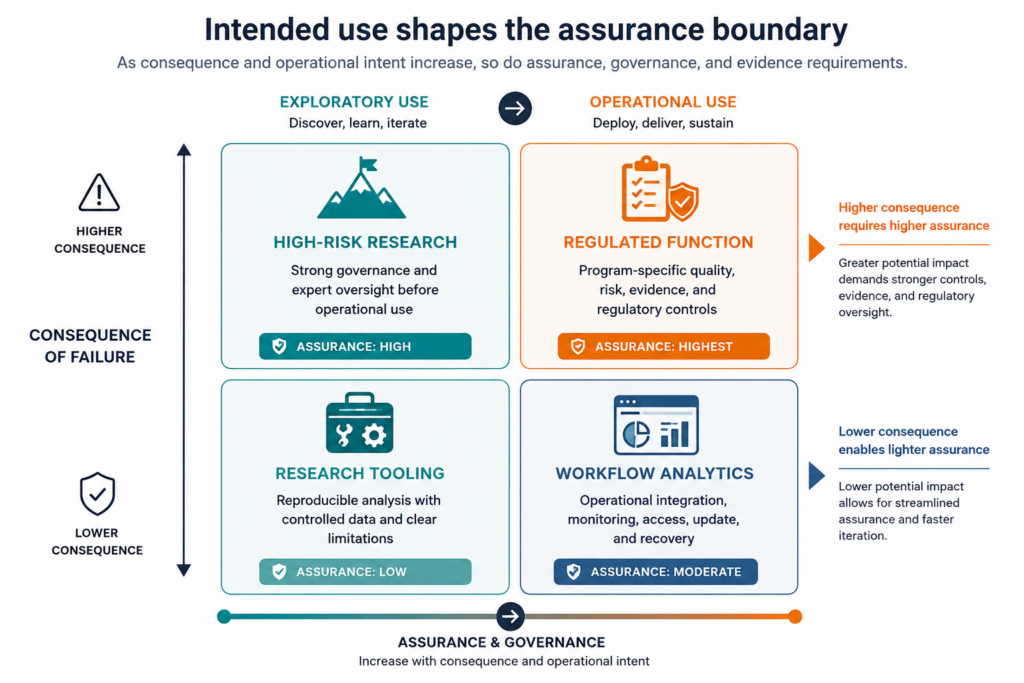
Figure 2. Intended use and consequence of error shape the engineering controls, evidence, and ownership around the Edge ai system.
Connect Tech hardware for healthcare Edge ai
Hardware is selected from sensor and video interfaces, workload, response time, data retention, mechanical envelope, power, thermal behavior, cybersecurity, serviceability, availability, and the customer’s product and quality requirements. CTai LABS uses Connect Tech platforms to move from development to a controlled production-intent configuration without implying that a component alone establishes medical-device compliance.
| Connect Tech platform | Best fit | Integration value |
|---|---|---|
| Hadron-DM or Boson with NVIDIA Jetson Orin NX™ | Compact instruments and connected medical devices | Small Edge platform options with MIPI CSI-2 camera paths, NVMe expansion, and local inference for constrained device envelopes. |
| Forge with NVIDIA Jetson AGX Orin™ | Multi-sensor imaging, laboratory, and development systems | High-speed networking, NVMe, camera expansion, and Jetson AGX Orin compute for concurrent acquisition, processing, inference, recording, and application integration. |
| SDI Vision Platform | Medical video sources using SDI | Direct SDI-to-MIPI CSI-2 integration path on supported NVIDIA Jetson systems for real-time video processing applications. |

Developing Holoscan Sensor Bridge Integration
CTai LABS is developing NVIDIA Holoscan Sensor Bridge integration capabilities for healthcare and medical-imaging programs that need a high-performance path from supported sensors into real-time processing pipelines. Contact CTai LABS to discuss an early program, sensor interface, or integration requirement.
Example healthcare Edge ai projects

Waiting-room scene analysis
A healthcare provider needs better visibility into defined waiting-room activity, occupancy patterns, queue conditions, or operational events from approved video sources. CTai LABS can adapt its Scene Analyzer Agent to ingest local video, identify and tag defined events, create searchable summaries, and capture relevant clips for review. The customer defines the permitted use, privacy controls, retention policy, access, and response workflow.

Operating-room scene analysis
An operating-room or procedure-room program needs structured awareness of defined workflow events, room activity, or equipment presence from approved video sources. CTai LABS can integrate local video acquisition, Scene Analyzer Agent processing, event tagging, clip capture, and controlled access to outputs. The customer and its qualified teams retain responsibility for clinical interpretation, patient-care decisions, privacy, and regulatory requirements.

Scene Analyzer Agent integration for healthcare environments
CTai LABS can adapt its existing Scene Analyzer Agent pipeline for approved healthcare environments. Video is ingested locally, relevant events are identified and tagged, clips can be retained for review, and users can search or ask grounded questions about recorded activity. This supports operational awareness while keeping clinical decision-making, governance, and workflow authority with the customer.
What CTai LABS can deliver
- Technical use and workflow definition, source-to-output architecture, authority and data boundaries, interface ownership, risk register, and acceptance matrix.
- Connect Tech platform and NVIDIA Jetson or IGX selection with sensor, video, network, storage, power, thermal, enclosure, service, and lifecycle requirements.
- Board Support Package and driver baseline, source bring-up, acquisition, time, calibration, metadata, recording, replay, health, access, update, and recovery.
- Integrated NVIDIA Holoscan application, preprocessing, signal or image processing, model runtime, TensorRT optimization, bounded logic, user application, and approved interfaces.
- Representative verification dataset, functional and task metrics, numerical-equivalence results, latency and throughput traces, sustained-load evidence, failure tests, and known limits.
- Versioned release, software bill of materials, model and configuration lineage, interface and test documentation, deployment procedure, lifecycle inputs, and knowledge transfer.
Your Physical ai Integration Partner
CTai LABS combines Connect Tech production hardware, in-house Board Support Package expertise, NVIDIA Holoscan integration, medical video and sensor engineering, Edge ai optimization, controlled software delivery, and system verification. The team can begin with an idea, contribute to one technical boundary, or carry the complete Edge ai integration from architecture through deployment while the customer retains its intellectual property and owns its clinical, quality, safety, cybersecurity, and regulatory decisions.

ABOUT THE AUTHOR
Ceri Nelmes
Tech Marketing Leader & Journalist | Building Brands at the Edge of What’s Next |
Connect Tech & CTai Labs
Ceri Nelmes is Head of Marketing at Connect Tech and an experienced technology journalist and digital strategist. She covers the technologies and market shifts shaping embedded computing, Edge AI, Physical ai, robotics, autonomous systems, and the NVIDIA® ecosystem. Working with Connect Tech and CTai LABS subject-matter experts, she turns engineering developments into accurate, useful reporting for developers, technical buyers, business leaders, and the media.
 Learn More
Resources and Frequently Asked Questions
Related
Continue into the integration, optimization, and technical resources that support real-time medical and digital-health Edge ai systems.
AI Integration Services. Full-stack architecture, software, model, system, and deployment engineering.
Explore AI Integration ServicesSystem & Sensor Integration. Bring-up, timing, calibration, drivers, and reliable sensor data paths.
Explore System & Sensor IntegrationAI Model Optimization. Task-preserving TensorRT and CUDA optimization on the target Edge platform.
Explore AI Model OptimizationEdge vs. Cloud ai Inference. Architecture tradeoffs for latency, data movement, availability, and lifecycle needs.
Explore Edge vs. Cloud ai InferenceThe Edge ai Memory Bandwidth Wall. Why data movement can constrain real-time Edge pipelines before compute does.
Explore The Edge ai Memory Bandwidth WallSources
Connect Tech. (2026, May 27). Tempo IGX Thor Edge ai robotics platform and functional safety.
https://connecttech.com/tempo-igx-thor-edge-ai-robotics-platform-functional-safety/Connect Tech. (n.d.). Forge carrier for NVIDIA Jetson AGX Orin. Retrieved August 21, 2026, from
https://connecttech.com/product/forge-carrier-for-nvidia-jetson-agx-orin/Connect Tech. (n.d.). Jetson SDI Vision Platform. Retrieved August 21, 2026, from
https://connecttech.com/product/jetson-sdi-vision-platform/Food and Drug Administration. (2025, January). Artificial intelligence-enabled device software functions: Lifecycle management and marketing submission recommendations.
https://www.fda.gov/regulatory-information/search-fda-guidance-documents/artificial-intelligence-enabled-device-software-functions-lifecycle-management-and-marketingGupta, V., Erdal, B., Ramirez, C., et al. (2024). Current state of community-driven radiological ai deployment in medical imaging. JMIR AI, 3, e55833.
https://doi.org/10.2196/55833Mashmool, A., Delzanno, G., Saadatfar, H., Ahmad, A., Koschke, R., Alizadehsani, R., Acharya, U. R., & D'Agostino, D. (2026). Edge computing in healthcare using machine learning: A systematic literature review. WIREs Data Mining and Knowledge Discovery, 16(1), e70069.
https://doi.org/10.1002/widm.70069NVIDIA. (2026). NVIDIA Holoscan SDK.
https://developer.nvidia.com/holoscan-sdkRocha, A., Monteiro, M., Mattos, C., Dias, M., Soares, J., Magalhães, R., & Macêdo, J. (2024). Edge ai for Internet of Medical Things: A literature review. Computers & Electrical Engineering, 116, 109202.
https://doi.org/10.1016/j.compeleceng.2024.109202Frequently Asked Questions
Can CTai LABS start with only a healthcare ai idea?
Yes. CTai LABS can begin from the intended technical outcome, user, source, environment, authority boundary, and desired milestone, then define the hardware, data, software, integration, evidence, and deployment path.
Does CTai LABS provide medical or regulatory approval?
No. The customer and its qualified clinical, quality, safety, cybersecurity, and regulatory teams own intended use, clinical claims, risk classification, evidence, submissions, approvals, and post-market responsibilities. CTai LABS delivers technical integration and engineering evidence within that program.
Can CTai LABS integrate NVIDIA Holoscan?
Yes. CTai LABS can build and optimize Holoscan pipelines for approved video, imaging, and sensor workloads, integrate them with Connect Tech hardware and application software, and measure the complete real-time data path.
Can existing medical video or sensors be used?
Yes. CTai LABS can assess compatible SDI, camera, imaging, physiological, instrument, and network interfaces, then integrate acquisition, metadata, time, calibration, health, recording, and replay according to program requirements.
How is healthcare ai optimization validated?
CTai LABS compares the optimized and reference implementations on representative governed data, then measures task behavior, numerical equivalence where applicable, latency, throughput, memory, power, thermals, sustained operation, and failure recovery on the target system.
Can the system operate on premises without a cloud dependency?
Yes. Acquisition, processing, inference, application logic, local storage, and approved interfaces can run on Connect Tech Edge hardware. Connectivity and external services are included only where the program requires them.
Who owns the healthcare application and intellectual property?
The customer retains its data, models, algorithms, application, device design, and intellectual property. Engagement deliverables and licensing boundaries are defined in the statement of work.
Ready to Build Smarter?
Let’s create the intelligent Edge AI solution that moves your business forward.