Resources
Deploying Physical ai at the Edge
A production Physical ai system has to make the model, sensors, embedded compute, software stack, thermals, and deployment lifecycle work as one system.
By Kara Price
Senior Marketing & Events Specialist, Connect Tech Inc.
Technical review: Rob Callaghan, Chief Product Officer, Connect Tech Inc.

Key Takeaways
- A model that runs correctly is not yet a deployable Physical ai system. Production success depends on the complete sensor-to-action path, including compute, I/O, memory, power, thermals, Board Support Package (BSP) and drivers, runtime behavior, application logic, and lifecycle management
- Physical ai deployment is a cross-stack integration problem. Decisions at one layer can change requirements elsewhere, including sensor bandwidth, model throughput, thermal headroom, carrier-board I/O, software compatibility, and enclosure design
- Production validation should measure the system under representative sensor load and sustained operating conditions. Inference-only benchmarks do not capture preprocessing, postprocessing, data movement, power modes, thermal throttling, or application overhead
- The deployment architecture should include update, rollback, monitoring, recovery, and support requirements before the first fielded system. A working unit on a bench proves integration progress, not fleet readiness
- CTai LABS acts as a Physical ai integration partner and extension of the customer’s engineering team, working across Connect Tech Edge hardware, sensor integration, BSP and software bring-up, NVIDIA® Jetson™ enablement, model and memory optimization, and deployment validation while the customer retains its product ownership and IP
A Physical ai model can be accurate, performant on a development workstation, and still be far from production. Once that model is attached to cameras, LiDAR, IMUs, networking, control systems, and an embedded compute platform, its performance becomes inseparable from the hardware and software around it.
That is the deployment gap. Physical ai systems have to perceive the real world, reason over incoming data, and produce an action or operational output inside the timing, power, memory, thermal, reliability, and environmental constraints of a physical product. NVIDIA® describes Physical AI as ai embodied in robots and other autonomous systems that operate in the real world, and its robotics architecture separates training, simulation, and on-robot inference into distinct compute layers (NVIDIA, 2025).
The production requirement is the complete sensor-to-action loop
For a robot, autonomous machine, or vision system, the useful performance number is rarely model latency by itself. The application receives physical-world data, moves it through capture and preprocessing, executes one or more models, performs postprocessing or sensor fusion, and then passes the result into control, storage, networking, or another application service.
NVIDIA’s TensorRT™ benchmarking guidance explicitly separates inference-only measurement from pipeline-level measurement and notes that preprocessing and postprocessing may belong in the system-level number depending on the application (NVIDIA, 2026a). For Physical ai, that system-level number is often the one that determines whether the product meets its deadline.
| Layer | Production responsibility | Typical CTai LABS contribution |
|---|---|---|
| Application and product logic | Robot behavior, analytics, customer workflow, proprietary logic, and user experience. | Integrate application interfaces while keeping the customer’s differentiating product logic and IP with the customer. |
| Model and inference runtime | Model architecture, precision, runtime, latency, throughput, memory, and quality. | Profile and optimize ai workloads on the target platform, including NVIDIA TensorRT™ where appropriate. |
| NVIDIA software stack | JetPack™, Jetson™ Linux, accelerated libraries, robotics, and vision frameworks. | Enable and validate the NVIDIA software environment, including NVIDIA Isaac™ workflows where they fit the application. |
| Board Support Package (BSP), drivers, and system software | Boot, kernel, device tree, interfaces, drivers, containers, and update path. | Board bring-up, BSP integration, driver work, software packaging, and platform support. |
| Sensors and I/O | Cameras, LiDAR, IMUs, radar, CAN, networking, triggering, synchronization, and data formats. | System and sensor integration across supported interfaces and the complete perception data path. |
| Carrier, power, and thermal | Carrier-board I/O, power delivery, cooling, enclosure, and mechanical constraints. | Match the compute platform to Connect Tech carrier/system options and validate sustained operation inside the physical envelope. |
| Compute platform | Module selection, memory capacity, memory bandwidth, accelerator capability, and lifecycle. | Right-size the NVIDIA Jetson platform and Connect Tech Edge system against the complete production workload. |
Figure 1. Physical ai deployment is a stack of interdependent engineering layers. CTai LABS can work across the integration layers while the customer retains the application, product strategy, proprietary logic, and intellectual property.
Six constraints determine whether the system is deployable
1.
Latency, jitter, and determinism
A production system needs a defined timing budget from sensor capture to the action that depends on the result. Average model latency can hide queueing, synchronization delays, memory transfers, preprocessing, postprocessing, or occasional long-tail responses. For motion-dependent or machine-control workloads, those variations can matter as much as average throughput.
The architecture should therefore define which decisions must remain local, what maximum end-to-end latency is acceptable, and what the system does when an input, process, or network dependency misses its deadline.
2.
Compute, memory, power, and thermals
Embedded deployment fixes resources that are easy to expand in a workstation or data center. The selected module establishes finite compute, memory capacity, memory bandwidth, and power modes. The carrier, cooling solution, and enclosure determine how much of that capability can be sustained in the real environment.
Model optimization is part of this system problem. NVIDIA’s current TensorRT guidance treats benchmarking and optimization as a measure-then-optimize loop and recommends controlling clocks, power, thermal throttling, and transfer behavior so performance results are reproducible (NVIDIA, 2026b). CTai LABS applies that principle on the target Edge platform, where the model competes with the operating system, sensor pipeline, decode, application services, and other workloads for the same resources.
3.
Sensor timing, interfaces, and data movement
Physical ai begins with physical inputs. Cameras and sensors are not peripheral details added after model development. Their interface, resolution, frame rate, synchronization, trigger behavior, calibration, and data format shape the compute and software architecture.
Connect Tech and CTai LABS support vision and sensor integration across GMSL2/3, MIPI CSI-2, FPD-Link III, SDI, HD-SDI, and HDMI, along with LiDAR, IMUs, radar, CAN, and other perception inputs as required by the platform. The integration work aligns those data paths with the model and application rather than treating sensor bring-up as an isolated task.
4.
BSP, drivers, and software compatibility
On NVIDIA Jetson, the software platform is not a single library. NVIDIA JetPack combines Jetson Linux with the accelerated software stack, while Jetson Linux itself includes the kernel, bootloader, NVIDIA drivers, flashing utilities, and platform support components (NVIDIA, 2026c). A camera driver, device-tree change, kernel dependency, runtime update, or framework version can therefore affect more than one layer of the deployed system.
This is one of the areas where a Physical ai integration partner can remove handoff risk. CTai LABS is backed by Connect Tech’s BSP and software engineering resources, so an application issue that crosses from model behavior into a driver, interface, boot, or platform problem does not have to be pushed between unrelated vendors (Connect Tech Inc., 2025).
5.
Reliability under sustained real-world operation
A short benchmark on an open development kit does not reproduce a sealed system running continuously in a vehicle, robot, factory, or remote installation. Production validation has to include the actual power mode, cooling approach, ambient conditions, sensor count, workload concurrency, storage and networking activity, and the duration required to expose thermal or resource behavior.
The goal is to establish operating headroom, not simply to record the fastest result. A deployment that meets its target only before thermal throttling, only with sensors disabled, or only with application services removed has not demonstrated the production requirement.
6.
Fleet lifecycle and support
A deployed system needs a lifecycle. That can include provisioning, image management, model and application updates, rollback, telemetry, health monitoring, security fixes, configuration control, and field support. NVIDIA’s Jetson platform provides OTA tooling within Jetson Linux releases, but the product still needs an update architecture and operational process that fit the customer’s fleet and risk model (NVIDIA, 2026c).
These requirements should influence architecture early. Storage layout, container strategy, recovery partitions, network assumptions, and version compatibility are much easier to design before a fleet exists than after units are already in the field.
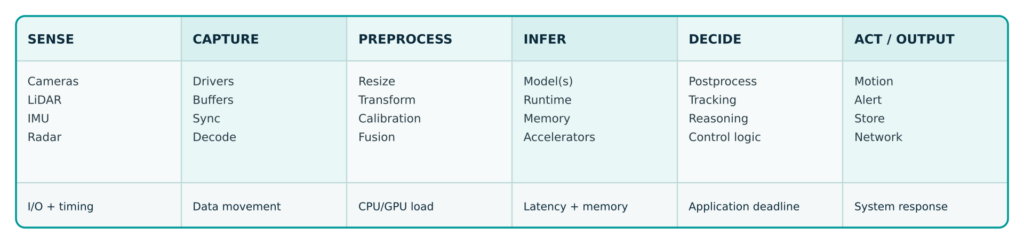
Figure 1. Physical ai deployment is a stack of interdependent engineering layers. CTai LABS can work across the integration layers while the customer retains the application, product strategy, proprietary logic, and intellectual property.
Why the model works' is a trap
A validated model proves that an important part of the system is ready. It does not prove that the deployment architecture is ready. The remaining work is not a fixed checklist that can always be completed independently. Integration changes propagate.
- A higher camera resolution can increase capture, preprocessing, memory-bandwidth, storage, and inference requirements at the same time.
- A model change can alter memory footprint, latency, runtime compatibility, and the power or thermal profile required to sustain the target frame rate.
- A BSP or JetPack update can affect drivers, containers, inference libraries, and application dependencies that were stable in the previous image.
- A smaller enclosure can change cooling and connector choices, which can force changes in the carrier, power budget, and sustained compute mode.
- Adding a second model or longer-context generative workload can turn available memory headroom into the new deployment constraint.
This is why CTai LABS approaches Physical ai as hardware-software co-design rather than a sequence of disconnected integrations. The target is a system configuration whose constraints have been measured together.
From prototype to production: what has to be proven
| Prototype question | Production question | Evidence to collect |
|---|---|---|
| Does the model run? | Does the complete pipeline meet latency and throughput targets under representative load? | End-to-end latency, tail latency, throughput, and sensor-rate stability. |
| Does it fit in memory? | Is there enough headroom for the OS, buffers, application services, concurrency, and updates? | Peak/steady memory, cache/workspace use, and free-memory headroom. |
| Does the dev kit stay cool? | Can the final thermal solution sustain the required power mode in the deployment environment? | Sustained clocks, temperature, power, and throttling behavior. |
| Can the sensor be read? | Are all sensors synchronized, calibrated, and stable at the production resolution and rate? | Dropped frames, trigger/sync behavior, timestamps, and calibration results. |
| Does the software boot? | Can the image be reproduced, updated, rolled back, and supported across production hardware? | Image/version control, recovery, OTA/update validation, and logs. |
| Does one unit work? | Can the system be provisioned, monitored, maintained, and supported as a fleet? | Provisioning workflow, telemetry, health checks, update policy, and support artifacts. |
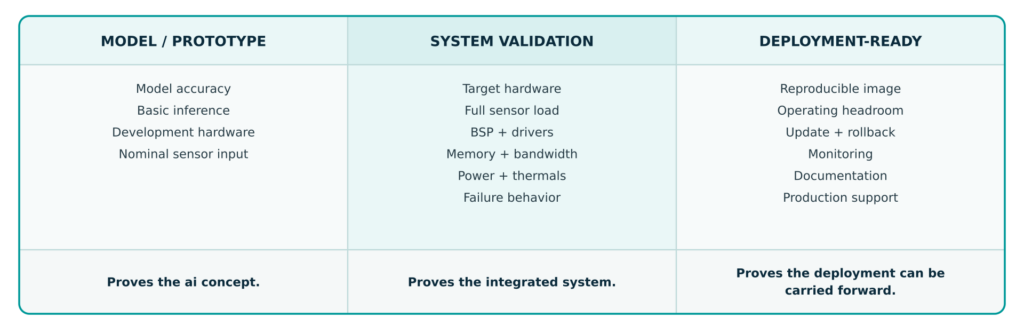
Figure 3. Moving from a working model to a deployable Physical ai system requires a separate validation phase across hardware, sensors, software, sustained performance, and lifecycle operations.
Where CTai LABS fits as your Physical ai integration partner
CTai LABS is Connect Tech’s dedicated full-stack ai engineering team. The engagement model is designed for customers that already own the product vision, domain knowledge, application requirements, and proprietary IP, but need deeper Edge platform and integration capability to get the system into production.
CTai LABS works as an extension of that engineering organization for the scope of the project or deployment. The team can enter at architecture, an existing prototype, a model that already works, a selected hardware platform, or a system that has stalled during integration. The customer keeps its IP and product ownership while CTai LABS takes on the cross-stack engineering required for the agreed deployment.
Architecture and platform right-sizing
CTai LABS can translate application requirements into a target compute and platform architecture, including NVIDIA Jetson module selection, Connect Tech carrier or system selection, I/O, memory, power, thermal, storage, networking, and lifecycle considerations. This is where ai Model Optimization, Memory Optimization, and Edge ai Memory Bandwidth analysis can inform whether the proposed hardware has enough performance and operating headroom.
System and sensor integration
Sensor architecture is treated as part of the ai system. CTai LABS can bring up cameras and perception devices, align interfaces and drivers, validate timing and synchronization, and integrate the data path into the inference and application pipeline.
BSP, software bring-up, and NVIDIA enablement
Backed by Connect Tech’s BSP and software teams, CTai LABS can work across Jetson Linux, board support packages, drivers, system images, containers, NVIDIA frameworks, and application dependencies. That allows issues to be followed across layer boundaries rather than stopping at the edge of a software vendor’s responsibility.
Model and memory optimization on the target
CTai LABS profiles the ai workload on the hardware intended for deployment, then optimizes against the actual latency, throughput, memory, power, thermal, and quality requirements. The work can include runtime selection, precision and quantization, NVIDIA TensorRT optimization, model and pipeline profiling, memory reduction, and validated module right-sizing.
Deployment validation and production support
The engagement can continue through image flashing, system bring-up, sustained-load validation, deployment packaging, update architecture, documentation, and production support. The objective is a configuration the customer’s team can carry forward, with measured limits and known operating conditions rather than a prototype that only works in the original lab setup.
A proof point: Physical ai across the complete workflow
CTai LABS and Connect Tech have demonstrated this cross-stack approach in a live Physical ai workflow built around NVIDIA’s three-computer architecture. At NVIDIA GTC 2026, the system captured real-world camera data on a Connect Tech Anvil-T5 with NVIDIA Jetson Thor, tracked spatial information at the Edge, streamed it into an NVIDIA Isaac Sim digital twin, used vision-language and language models to reason over events, and redeployed validated policies back to the Edge (Connect Tech Inc., 2026).
The value of that demonstration is the integration boundary it exercises: cameras, Edge compute, perception, simulation, model reasoning, local data flow, and redeployment operate as one workflow. It is the same class of boundary that has to be resolved when a customer’s Physical ai application moves from separate components into a production system.
When to bring in a Physical ai integration partner
- The model works, but the target Edge platform has not been selected or validated.
- The internal team is strong in product software, controls, robotics, or domain expertise but does not want to build permanent BSP, sensor, embedded ai, or platform-specialist capacity for one program.
- Sensor bring-up, driver issues, timing, or software-version dependencies are consuming application-development time.
- The prototype meets performance targets only under reduced sensor load, open-air cooling, a higher-memory module, or another configuration that will not ship.
- The program needs a reproducible deployment image, update path, validation plan, and production handoff rather than another demonstration.
- The organization wants to keep its product ownership and IP internal while adding a dedicated Edge ai engineering team for a defined project, migration, or deployment.
A practical deployment sequence
1.
Define production success
Capture the real use case, sensor set, timing requirements, environment, interfaces, power/thermal constraints, memory needs, quality threshold, and lifecycle expectations.
2.
Architect the complete system
Select the compute platform, carrier/system, sensor interfaces, BSP/software approach, runtime, thermal strategy, and validation plan as one architecture. This complete-system approach is reflected in the CTI EdgeAI Stack, where compute, carrier hardware, sensors, software, optimization, and deployment requirements are treated as one architecture rather than independent purchasing decisions.
3.
Bring up hardware, sensors, and software
Validate boot, drivers, I/O, sensor timing, data paths, application interfaces, and the NVIDIA software environment on the target hardware.
4.
Optimize and profile the ai workload
Establish a baseline, identify the limiting resource, and tune model/runtime/memory behavior against representative production inputs.
5.
Validate sustained system behavior
Run the complete sensor-to-action pipeline at the intended power mode and environmental conditions long enough to expose thermal, memory, timing, and stability behavior.
6.
Build the deployment path
Package the image and application, document configuration, define updates and rollback, add monitoring, and establish production support requirements.

ABOUT THE AUTHOR
Kara Price
Senior Marketing & Events Specialist, Connect Tech Inc.
Needs Description
Book a Demo
Bring the use case, model or prototype, target environment, sensor requirements, and the part of the deployment that is creating risk. CTai LABS can work with your engineering team to define the system architecture, close the integration gaps, and validate the Physical ai workload on the platform intended for production.
 Learn More
Resources and Frequently Asked Questions
Related
What is Physical ai? Start with the architecture and lifecycle of ai systems that perceive, reason, and act in the physical world.
Read: What is Physical ai? →Services. Explore CTai LABS engineering services across Edge ai consulting, integration, optimization, system and sensor work, and deployment.
See Services →Case Studies. See application stories that show how CTai LABS approaches real Edge and Physical ai engineering problems.
Explore Case Studies →ai Model Optimization. Optimize model and runtime performance against the target embedded platform and production workload.
See ai Model Optimization →Memory Optimization. Profile the complete workload, create operating headroom, and validate module right-sizing.
See Memory Optimization →Sources
Connect Tech Inc. (2025, November 4). CTai LABS launched by Connect Tech: A new initiative for end-to-end Edge AI integration.
https://connecttech.com/ctai-labs-launched-new-initiative-end-to-end-edge-ai-integration/Connect Tech Inc. (2026, March 16). Connect Tech and CTai LABS demonstrate a deployable Physical AI workflow running live: From real-world vision analytics to Digital Twin and back.
https://connecttech.com/connect-tech-ctai-labs-demo-deployable-physical-ai-workflow/CTai LABS. (2026a). Edge ai solutions.
https://ctailabs.ai/edge-ai-solutions/CTai LABS. (2026b). CTai LABS | EDGE ai Stack.
https://ctailabs.ai/NVIDIA. (2025, August 8). What is NVIDIA’s three-computer solution for robotics?
https://blogs.nvidia.com/blog/three-computers-robotics/NVIDIA. (2026a). Performance benchmarking. NVIDIA TensorRT documentation.
https://docs.nvidia.com/deeplearning/tensorrt/latest/performance/benchmarking.htmlNVIDIA. (2026b). Best practices. NVIDIA TensorRT documentation.
https://docs.nvidia.com/deeplearning/tensorrt/latest/performance/best-practices.htmlNVIDIA. (2026c). JetPack SDK downloads and notes. NVIDIA Developer.
https://developer.nvidia.com/embedded/jetpack/downloadsFrequently Asked Questions
What is required to deploy Physical ai at the Edge?
A deployable system needs more than a trained model. The complete architecture typically includes sensors and I/O, embedded compute, carrier/system hardware, power and thermal design, BSP and drivers, the NVIDIA and ai runtime stack, application integration, production validation, and a lifecycle plan for updates and support.
Why is a working ai model not enough for production?
Model validation does not include every production dependency. The deployed system still has to meet end-to-end latency, sensor timing, memory, power, thermal, software compatibility, reliability, and lifecycle requirements under representative operating conditions.
When should a team involve a Physical ai integration partner?
An integration partner is useful when the program crosses several specialist layers, such as Jetson platform architecture, BSP and drivers, sensor integration, model optimization, memory, thermals, and deployment, or when those layers are pulling the internal product team away from its differentiating work.
What does CTai LABS do in a Physical ai deployment?
Depending on scope, CTai LABS can cover architecture and platform selection, Connect Tech Edge hardware, BSP and software bring-up, sensor integration, NVIDIA Jetson enablement, ai model optimization, Memory Optimization, system profiling, deployment validation, and production support.
Does CTai LABS replace the customer's engineering team?
No. CTai LABS is designed to work as an extension of the customer’s engineering organization. The customer retains product ownership, domain knowledge, proprietary logic, and IP while CTai LABS adds the Edge platform and integration capability required for the engagement.
Can CTai LABS start with an existing model or prototype?
Yes. An engagement can begin from an existing model, dataset, prototype, hardware platform, sensor architecture, or defined use case. Discovery establishes what can be retained and which layers still require engineering or validation.
How should Physical ai performance be benchmarked?
Benchmark the complete production path as well as inference in isolation. Representative testing should include the intended sensor load, preprocessing and postprocessing, application services, model concurrency, memory use, power mode, thermals, and the end-to-end latency or throughput requirement.
What happens after the first system works?
The deployment still needs a reproducible image, configuration control, update and rollback strategy, monitoring, documentation, and support plan. CTai LABS and Connect Tech can continue supporting the platform and software stack as required by the program.
Ready to Build Smarter?
Let’s create the intelligent Edge AI solution that moves your business forward.