Built with NVIDIA
NVIDIA Isaac ROS Development
Accelerated ROS 2 perception, sensor integration, profiling, and production deployment on NVIDIA Jetson.
By Ceri Nelmes
Tech Marketing Leader & Journalist | Building Brands at the Edge of What’s Next | Connect Tech & CTai Labs
Technical review: Rob Callaghan, Chief Product Officer, Connect Tech Inc.

Key Takeaways
- NVIDIA® Isaac™ ROS is a collection of NVIDIA CUDA®-accelerated ROS 2 packages and ai models for robotics perception and autonomy, including hardware-accelerated modules and NITROS processing pipelines (NVIDIA, 2026a)
- Production Isaac ROS development is a graph-level integration problem. Camera ingest, type negotiation, memory movement, GPU acceleration, model inference, ROS 2 communication, and downstream nodes all affect end-to-end behavior
- NVIDIA Isaac Transport for ROS, or NITROS, uses ROS 2 type adaptation and negotiation to reduce unnecessary memory copies and enable accelerated data movement across compatible Isaac ROS graphs (NVIDIA, 2026b)
- CTai LABS develops and integrates Isaac ROS workloads on NVIDIA Jetson™, including sensor and driver bring-up, ROS 2 graph architecture, Isaac ROS package integration, NITROS, model optimization, profiling, and production validation
- For teams that need a pre-integrated ROS 2 and Isaac ROS software environment rather than a custom engineering engagement, Connect Tech’s ROS-Ready Launchpad provides a separate production-ready system image and support path (Connect Tech Inc., 2026)
NVIDIA® Isaac™ ROS gives robotics teams a way to bring GPU-accelerated perception, localization, mapping, depth, and ai capabilities into ROS 2 applications while preserving interoperability with the broader ROS ecosystem. NVIDIA describes Isaac ROS as a collection of CUDA®-accelerated computing packages and ai models designed for advanced robotics applications, with deployment on workstations and embedded NVIDIA Jetson™ platforms (NVIDIA, 2026a).
The production challenge is integrating those capabilities into the robot that actually has to ship. A package that runs in isolation still has to receive synchronized sensor data, negotiate message formats, coexist with existing ROS 2 nodes, fit the Jetson compute and memory envelope, meet the application’s latency budget, and remain stable under sustained operation.
CTai LABS provides NVIDIA Isaac ROS architecture and engineering support across the full deployment path. The team can work from an existing ROS 2 graph, an Isaac ROS proof of concept, a selected NVIDIA Jetson platform, or a robotics requirement that still needs architecture. The customer retains its robotics application, product ownership, and IP while CTai LABS operates as an extension of the engineering team for the integration and deployment scope.
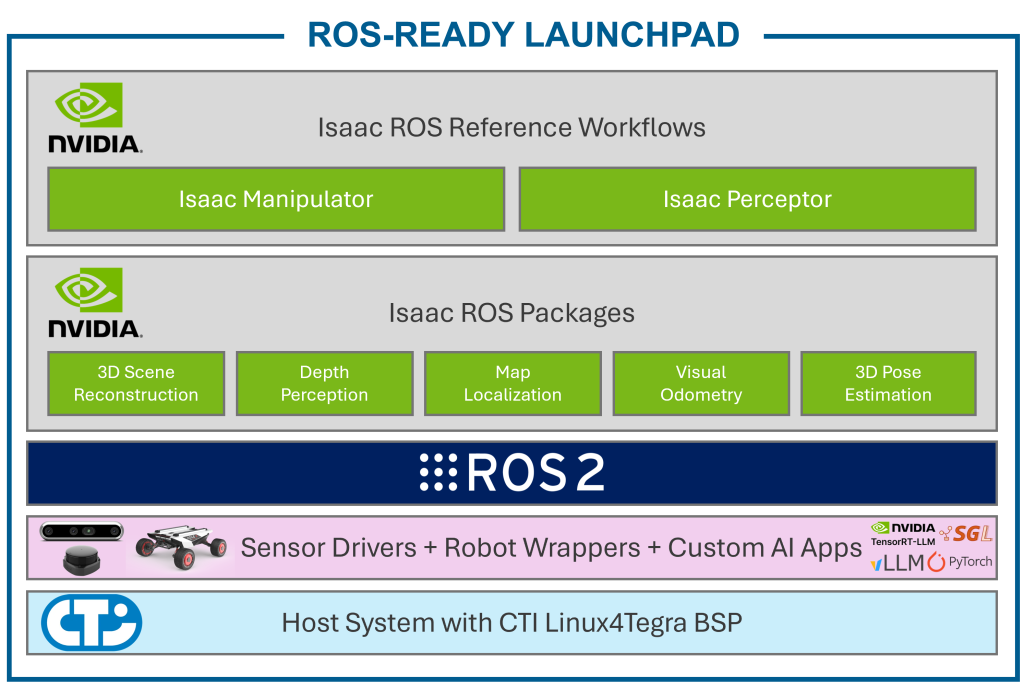
Isaac ROS development is more than adding accelerated nodes
Isaac ROS is modular by design. NVIDIA provides individual ROS 2 packages and complete accelerated pipelines for tasks such as visual SLAM, 3D reconstruction, stereo depth, object detection, pose estimation, and trajectory optimization (NVIDIA, 2026a). That modularity makes it possible to introduce acceleration into an existing ROS 2 system, but it also means the production graph has to be engineered around the data path.
A robotics pipeline can cross camera drivers, image transport, rectification, depth, inference, tracking, localization, mapping, planning, and control. If one boundary introduces a CPU copy, incompatible format, queueing delay, synchronization problem, or resource bottleneck, the performance of an accelerated node alone may not predict the performance of the robot (Kronauer et al., 2021).
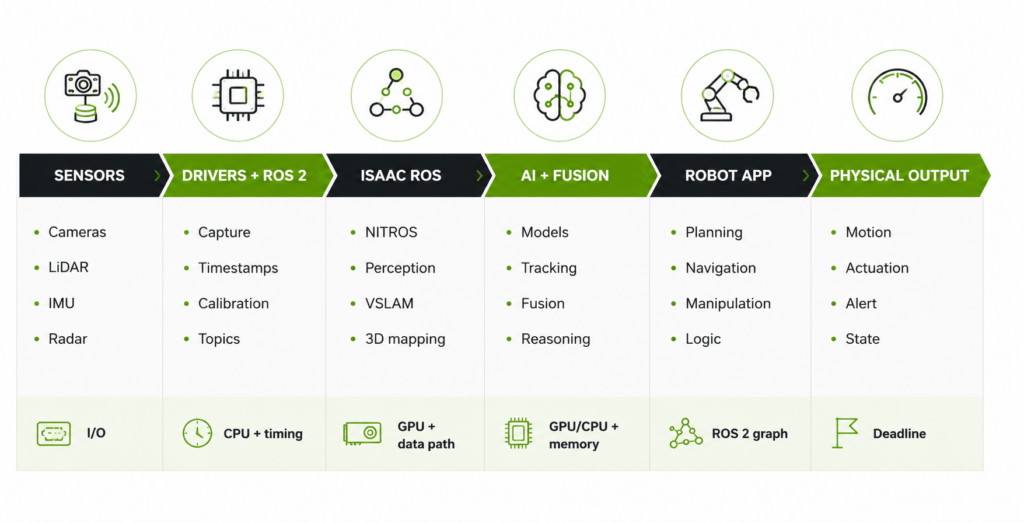
Figure 1. Isaac ROS sits inside a larger robotics data path. CTai LABS can work across the sensor, ROS 2, accelerated perception, ai, Jetson platform, and application boundaries required to make the graph behave as a production system.
What CTai LABS Isaac ROS development can cover
ROS 2 and Isaac ROS graph architecture
CTai LABS can assess an existing ROS 2 graph or design the accelerated perception path from the robotics requirement. The work can include package selection, node composition, topic and message design, quality-of-service settings, launch architecture, process boundaries, and the placement of Isaac ROS acceleration inside existing ROS 2 software.
The goal is to preserve ROS 2 components that already meet the application requirement, then introduce acceleration where it materially improves the production graph (NVIDIA, 2026a).
NITROS and data-movement optimization
NITROS is one of the most important architectural differences in an accelerated Isaac ROS pipeline. NVIDIA implements ROS 2 type adaptation and type negotiation so compatible nodes can operate in accelerator-friendly formats and reduce unnecessary CPU-to-accelerator memory copies (NVIDIA, 2026b).
That benefit depends on graph architecture. NVIDIA documents that zero-copy NITROS acceleration requires NITROS-accelerated nodes to run in the same process, and type negotiation has constraints around negotiating publishers (NVIDIA, 2026b). CTai LABS can use those requirements when composing the production graph, then profile whether the expected reduction in copies and CPU overhead is actually being realized on the target Jetson platform.
Camera, sensor, and driver integration
Robotics perception begins at the sensor boundary. CTai LABS can integrate supported camera and sensor paths across GMSL2/3, MIPI CSI-2, FPD-Link III, SDI, HD-SDI, and HDMI, along with LiDAR, IMUs, radar, CAN, networking, and application-specific interfaces.
For Isaac ROS, sensor work includes more than getting frames onto a ROS topic. Resolution, frame rate, timestamping, synchronization, calibration, image format, driver behavior, and transport choices affect the accelerated graph downstream. NVIDIA maintains an Isaac ROS camera ecosystem with validated camera and driver paths across GMSL, CSI, and FPD-Link devices, reinforcing the importance of matching the sensor path to the software pipeline (NVIDIA, 2026c).
Accelerated perception and robotics packages
CTai LABS can integrate Isaac ROS packages into application-specific perception pipelines, including capabilities such as Visual SLAM, nvBlox 3D reconstruction, DNN stereo depth, AprilTag detection, segmentation, pose estimation, and other supported Isaac ROS modules where they fit the robot’s requirements.
Package choice is only the first step. The complete graph has to be tested with the intended sensors, resolution, rate, model, map size, downstream consumers, and Jetson configuration. NVIDIA publishes package-level performance data, including results for current Jetson Thor platforms, but those measurements are reference points rather than substitutes for application-level validation (NVIDIA, 2026a).
ai model and TensorRT integration
Many robotics graphs combine classical perception, geometry, and learned models. CTai LABS can integrate and optimize the ai portions of the pipeline on Jetson, including precision and quantization work, NVIDIA TensorRT™, model/runtime configuration, preprocessing and postprocessing, and the interaction between inference and the surrounding ROS 2 graph.
This work can extend into ai Model Optimization when the model itself is the limiting factor, or Memory Optimization when model residency, buffers, concurrent nodes, or other application services are consuming the platform headroom required by the robot.
Jetson platform, BSP, and system integration
Isaac ROS deployment ultimately runs on a physical platform. CTai LABS can pair the robotics workload with the appropriate Jetson configuration and Connect Tech carrier or Edge system, then work across JetPack, BSP, drivers, I/O, power, thermals, storage, networking, and system software.
This is particularly valuable when the source of a robotics issue spans more than one part of the stack. A dropped-frame problem may involve the camera driver, a latency problem may involve memory movement or process composition, and an unstable deployment may involve power or thermals rather than the ROS package that first exposes the symptom.
Profiling, latency, and sustained-load validation
CTai LABS can profile the end-to-end robotics path rather than measuring one node in isolation. Useful measurements include sensor-to-output latency, per-node processing time, queueing, frame drops, CPU and GPU utilization, memory use, data-copy behavior, throughput, power, thermals, and behavior under sustained sensor load. ROS 2 research has also shown that communication configuration and large sensor payloads, including high-resolution images and LiDAR point clouds, can materially affect latency in robotic systems (Lee et al., 2025).
The production target should define the required rate and timing at the application boundary. A perception graph that produces excellent benchmark throughput but introduces unacceptable tail latency or misses synchronized sensor data still needs engineering.

Figure 2. End-to-end robotics latency is distributed across sensor capture, data movement, accelerated processing, ROS 2 communication, and downstream application logic. NITROS can reduce avoidable copies inside compatible accelerated graphs, but the full path still has to be measured.
NITROS changes the optimization question
In a conventional ROS 2 image-processing graph, data may be copied or converted as it moves between nodes and between CPU and accelerator memory (Knese et al., 2020). NITROS uses ROS 2 type adaptation and negotiation to let compatible Isaac ROS nodes exchange accelerator-friendly data and, in supported graph configurations, enable zero-copy behavior (NVIDIA, 2026b).
For high-resolution or multi-camera robots, avoiding unnecessary copies can reduce CPU overhead, power use, and processing delay. The practical question becomes which parts of the graph can remain in the accelerated path, where conversions are still required, and whether process composition and node compatibility preserve the intended data flow.
CTai LABS can inspect that graph boundary directly. Rather than assuming that installing Isaac ROS has accelerated the complete robot, the team can profile the path before and after graph changes and determine where the remaining latency, memory, or CPU pressure originates.
Isaac ROS package integration should follow the robot's job
| Robotics requirement | Relevant Isaac ROS capability examples | Integration questions |
|---|---|---|
| Localization and mapping | Visual SLAM; nvBlox | What sensors and calibration are available? What map representation and update rate does navigation need? |
| Stereo and depth perception | DNN Stereo Depth; depth processing | What baseline, resolution, frame rate, and depth range are required? Can the full stereo path sustain them? |
| Object and pose perception | DNN inference; pose estimation; AprilTag | Which model or detector meets the quality target, and what is the end-to-end latency after tracking or fusion? |
| Manipulation | cuMotion and perception components | How do perception updates, collision information, planning, and control deadlines interact? |
| Autonomous mobility | Visual SLAM, nvBlox, perception pipelines | How do localization, obstacle representation, sensor timing, and navigation consume the Jetson resource envelope together? |
CTai LABS versus ROS-Ready Launchpad
These offerings solve different problems. NVIDIA Isaac ROS Development is a CTai LABS engineering service for teams that need custom robotics architecture, integration, acceleration, debugging, optimization, or deployment work.
Connect Tech’s ROS-Ready Launchpad is a productized system image and support offering. It provides ROS 2 and NVIDIA Isaac ROS installed directly on the host, pre-configured NVIDIA SDKs and libraries, optimized sensor drivers and ROS wrappers, verified package compatibility, and update/support options (Connect Tech Inc., 2026).
| Need | NVIDIA Isaac ROS Development | ROS-Ready Launchpad |
|---|---|---|
| Starting point | Existing ROS 2 application, prototype, sensors, requirements, or partially integrated robot | Connect Tech Jetson platform that needs a prepared ROS 2/Isaac ROS environment |
| Primary value | Custom engineering across the robotics graph and deployment stack | Pre-integrated, tested software environment with support |
| Typical work | Architecture, custom integration, NITROS, sensors, models, profiling, debugging, optimization, validation | System image, package/dependency integration, sensor drivers/wrappers, updates, support |
| Best fit | The robot or workload needs engineering specific to the application | The team wants to reduce environment setup and maintain a standardized ROS 2/Isaac ROS base |
Why CTai LABS for NVIDIA Isaac ROS development
CTai LABS is a department of Connect Tech, an NVIDIA Elite Partner with deep experience across NVIDIA Jetson hardware, BSPs, sensors, and production robotics systems. Robotics software problems rarely respect organizational boundaries. Isaac ROS sits between sensors, ROS 2, accelerated libraries, ai models, Jetson hardware, BSPs, and the robot application. That cross-layer work is where the CTI EdgeAI Stack provides the broader system context. CTai LABS can integrate the accelerated robotics software with the underlying compute, sensor, BSP, and deployment environment rather than optimizing the ROS graph independently of the system around it. CTai LABS can draw on Connect Tech’s hardware and software engineering teams instead of treating each symptom as a separate vendor handoff.
Connect Tech already maintains robotics-specific ROS capabilities around Isaac ROS, including Visual SLAM, nvBlox, DNN stereo depth, pose estimation, and other perception components, alongside ROS-optimized Jetson hardware and sensor integration (Connect Tech Inc., 2025). ROS-Ready Launchpad extends that foundation with a production-ready host-based ROS 2 and Isaac ROS environment (Connect Tech Inc., 2026).
For custom development, CTai LABS adds the application-specific engineering layer: deciding how the graph should be composed, integrating the production sensors, optimizing the accelerated path, validating the Jetson resource envelope, and handing back a system configuration the customer’s robotics team can continue to own.
Typical Isaac ROS development engagements
- Moving a ROS 2 perception pipeline from CPU processing into Isaac ROS accelerated packages on Jetson
- Integrating Visual SLAM, nvBlox, stereo depth, detection, pose estimation, or other supported Isaac ROS components into an existing robot
- Bringing up production cameras and sensors and connecting their drivers, timestamps, calibration, and formats to the Isaac ROS graph
- Profiling a robotics application that has high CPU use, excessive memory copies, dropped frames, queueing, or end-to-end latency problems
- Refactoring compatible nodes into NITROS-accelerated process graphs and validating the effect on data movement and system performance
- Optimizing ai models and memory use so the robotics workload fits the selected Jetson platform with production headroom
- Migrating an Isaac ROS application between Jetson platforms, JetPack releases, or Connect Tech carrier/system configurations
- Preparing a validated ROS 2/Isaac ROS software and hardware configuration for production deployment
Typical NVIDIA Jetson consulting engagements
- Selecting the right Jetson module and Connect Tech carrier or system for a new Edge ai product.
- Moving an application from a Jetson developer kit into production hardware.
- Migrating from an earlier Jetson generation or JetPack release to Orin or Thor.
- Diagnosing an application that meets model benchmarks but misses end-to-end latency, memory, power, or thermal targets.
- Integrating cameras, LiDAR, IMUs, CAN, networking, storage, or other production I/O with the ai pipeline.
- Optimizing a workload to fit a lower-memory or lower-power Jetson configuration.
- Preparing a reproducible software image, validation plan, and production handoff for a Jetson-based deployment.
How an Isaac ROS development engagement works
1.
Map the robotics graph
Document sensors, drivers, ROS 2 nodes, Isaac ROS packages, models, topics, message formats, process boundaries, timing requirements, and the target Jetson platform.
2.
Establish the production baseline
Measure the current end-to-end path under representative sensor load, including frame rate, latency, CPU/GPU use, memory, drops, and the application’s downstream deadline.
3.
Integrate the accelerated path
Add or refactor Isaac ROS packages, NITROS-compatible graph sections, models, sensors, and platform dependencies while preserving required ROS 2 interoperability.
4.
Profile and optimize
Identify remaining copies, queueing, CPU/GPU bottlenecks, model constraints, memory pressure, and sensor or driver issues, then tune the graph and target system.
5.
Validate on the target robot
Run the complete workload at the intended sensor rates, power mode, thermal conditions, and application concurrency to confirm sustained behavior.
6.
Handoff and support
Document the validated graph, software image, package and driver dependencies, performance envelope, and the support or ROS-Ready Launchpad path required for production.
Production Isaac ROS development depends on more than selecting accelerated packages. The sensors, ROS 2 graph, NITROS data path, ai models, Jetson platform, BSP, memory, power, thermals, and application deadlines all must work together on the target robot. CTai LABS brings those layers into one engineering engagement, helping teams move from an existing ROS 2 application or proof of concept to a profiled, validated, and documented production configuration the customer’s engineering team can continue to own.
Book a Demo
As Your Physical ai Integration Partner, CTai LABS can assess the graph, identify the accelerated and system-level work required, and scope the path from the current robotics stack to a validated production configuration. Bring the ROS 2 graph, target robot or Jetson platform, sensors, Isaac ROS packages already in use, models, and the performance or integration problem the team is trying to solve.

ABOUT THE AUTHOR
Ceri Nelmes
Tech Marketing Leader & Journalist | Building Brands at the Edge of What’s Next |
Connect Tech & CTai Labs
Ceri Nelmes is Head of Marketing at Connect Tech and an experienced technology journalist and digital strategist. She covers the technologies and market shifts shaping embedded computing, Edge AI, Physical ai, robotics, autonomous systems, and the NVIDIA® ecosystem. Working with Connect Tech and CTai LABS subject-matter experts, she turns engineering developments into accurate, useful reporting for developers, technical buyers, business leaders, and the media.
 Learn More
Resources and Frequently Asked Questions
Related
Built with NVIDIA. Explore CTai LABS engineering across NVIDIA Jetson, CUDA, TensorRT, Isaac, and the wider Edge ai software stack.
Explore Built with NVIDIA →Robotics. See CTai LABS capabilities for autonomous machines, perception, sensor integration, Physical ai, and production robotics.
Explore Robotics →ROS-Ready Launchpad. Start from Connect Tech's production-ready ROS 2 and Isaac ROS system image with integrated drivers, libraries, and support.
See ROS-Ready Launchpad →NVIDIA Jetson Consulting. Right-size the Jetson platform and work across migration, BSPs, sensors, optimization, and production deployment.
See NVIDIA Jetson Consulting →System and Sensor Integration. Integrate cameras, perception devices, drivers, synchronization, and the complete sensor-to-inference data path.
See System and Sensor Integration →ai Model Optimization. Optimize model precision, runtime, latency, throughput, and memory behavior inside the robotics pipeline.
See ai Model Optimization →Sources
Connect Tech Inc. (2026a, June 1). JetPack 7.2 and Yocto: A production deployment milestone for Jetson AGX Orin and Orin NX.
https://connecttech.com/jetpack-7-2-yocto/Connect Tech Inc. (2026b, July 15). Connect Tech announces support for new NVIDIA Jetson T3000 and T2000 modules.
https://connecttech.com/2026-07-jetson-t3000-announcement/Cordova-Cardenas, R., Amor, D., & Gutiérrez, Á. (2025). Edge AI in practice: A survey and deployment framework for neural networks on embedded systems. Electronics, 14(24), 4877.
https://doi.org/10.3390/electronics14244877Fridous, V. M., Agarwal, A., Bhaskar, K. B., Nandagopal, V., & Sivakamasundari, N. (2026). Optimization and benchmarking of lightweight neural networks for efficient embedded AI deployment. Engineering Reports, 8(5), e70814.
https://doi.org/10.1002/eng2.70814NVIDIA. (2026a). Embedded systems developer kits & modules from NVIDIA Jetson.
https://www.nvidia.com/en-us/autonomous-machines/embedded-systems/NVIDIA. (2026b). Jetson FAQ. NVIDIA Developer.
https://developer.nvidia.com/embedded/faqNVIDIA. (2026c). NVIDIA Jetson modules. NVIDIA Developer.
https://developer.nvidia.com/embedded/jetson-modulesSonmez, D. (2026, July). We budgeted 64GB. Super Mode said otherwise. CTai LABS.
https://ctailabs.ai/edge-ai-solutions/Frequently Asked Questions
What is NVIDIA Isaac ROS development?
NVIDIA Isaac ROS development is the engineering work required to integrate NVIDIA-accelerated ROS 2 packages, ai models, NITROS pipelines, sensors, and Jetson hardware into a robotics application. The work can include architecture, package integration, sensor and driver bring-up, profiling, model optimization, and production validation.
Can Isaac ROS be integrated into an existing ROS 2 application?
NVIDIA Isaac Transport for ROS, or NITROS, is NVIDIA’s implementation of ROS 2 type adaptation and type negotiation for accelerated processing graphs. It can reduce unnecessary CPU-to-accelerator memory copies and enable zero-copy behavior in supported graph configurations (NVIDIA, 2026b).
What is NITROS?
NVIDIA Isaac Transport for ROS, or NITROS, is NVIDIA’s implementation of ROS 2 type adaptation and type negotiation for accelerated processing graphs. It can reduce unnecessary CPU-to-accelerator memory copies and enable zero-copy behavior in supported graph configurations (NVIDIA, 2026b).
Does NITROS automatically make every ROS 2 node faster?
No. NVIDIA states that Jetson modules are software compatible, but a JetPack change can require porting. Hardware pinouts and electromechanical footprints also vary between module families, so carrier, mechanical, power, and software compatibility must be checked for the specific migration (NVIDIA, 2026b).
Which Isaac ROS packages can CTai LABS work with?
The scope can include supported Isaac ROS capabilities such as Visual SLAM, nvBlox, stereo depth, AprilTag detection, segmentation, pose estimation, and other perception or robotics packages appropriate to the application. Package selection is based on the robot’s sensor and task requirements.
Can CTai LABS integrate our cameras and sensors?
Yes. CTai LABS can work across supported GMSL2/3, MIPI CSI-2, FPD-Link III, SDI, HD-SDI, and HDMI camera paths, as well as LiDAR, IMUs, radar, CAN, networking, and other application-specific I/O. Sensor timing, calibration, drivers, and formats are integrated with the ROS 2 and Isaac ROS pipeline. Check our camera partners and technology partners.
Can CTai LABS optimize ai models inside an Isaac ROS pipeline?
Yes. The work can include NVIDIA TensorRT, precision and quantization, model/runtime configuration, preprocessing and postprocessing, memory analysis, and benchmarking against the robotics application’s latency, throughput, quality, power, and thermal requirements.
What is the difference between this service and ROS-Ready Launchpad?
NVIDIA Isaac ROS Development is a custom CTai LABS engineering service. ROS-Ready Launchpad is Connect Tech’s productized system image and support offering with ROS 2, Isaac ROS, NVIDIA libraries, sensor drivers and wrappers, and verified dependencies already integrated on the host system (Connect Tech Inc., 2026).
Can CTai LABS help migrate an Isaac ROS application to a different Jetson platform?
Yes. CTai LABS can assess JetPack, BSP, drivers, sensor compatibility, package dependencies, models, process architecture, power and thermal requirements, and performance on the target Jetson platform, then validate the migrated robotics graph.
Does the customer keep its robotics IP?
Yes. CTai LABS works as an extension of the customer’s engineering team for the agreed engagement. The customer retains its application, proprietary robotics logic, product ownership, and intellectual property.
Ready to Build Smarter?
Let’s create the intelligent Edge AI solution that moves your business forward.