Built with NVIDIA
TensorRT Optimization
Inference profiling, precision tuning, engine building, runtime configuration, and deployment engineering with NVIDIA TensorRT.
By Doruk Sönmez, M.Sc.
AI Solutions Architect, CTai LABS/Connect Tech Inc.
Technical review: Rob Callaghan, P.Eng., Chief Product Officer, Connect Tech Inc.

Key Takeaways
- NVIDIA® TensorRT™ is an inference SDK that compiles trained neural networks into optimized engines for NVIDIA GPUs, with support for mixed precision, dynamic shapes, graph and kernel selection, and runtime execution (NVIDIA, 2026a)
- Effective TensorRT work begins with a reproducible baseline. NVIDIA recommends measuring latency, throughput, memory use, and per-operation behavior before changing precision, batching, CUDA® Graphs, or builder settings (NVIDIA, 2026b)
- Reduced precision can improve speed and memory efficiency, but FP16, BF16, FP8, INT8, FP4, and INT4 choices carry model- and hardware-specific accuracy tradeoffs that require validation (NVIDIA, 2026c)
- CTai LABS develops TensorRT engines, profiles inference behavior, tunes precision and shapes, resolves unsupported operators, manages memory and concurrency, and verifies results on the NVIDIA platform intended to ship
- TensorRT Optimization is deliberately tool-specific. Broader architecture changes, retraining, pruning, distillation, and model redesign belong in the separate ai Model Optimization service
CTai LABS provides NVIDIA® TensorRT™ Optimization as a focused engineering service for teams with a trained model, ONNX graph, existing engine, NVIDIA Jetson™ or GPU target, or application that is missing a latency, throughput, memory, or power objective. The work is centered on inference deployment. Customers retain their models, software, data, product ownership, and IP. NVIDIA TensorRT converts trained ai models into optimized inference engines for NVIDIA GPUs. The SDK applies graph transformations, kernel selection, precision controls, memory planning, and runtime features intended to reduce latency and increase throughput without requiring teams to rewrite an entire application around custom CUDA® kernels (NVIDIA, 2026a).
The difficult part is deciding which optimizations improve the target application. A model can benchmark well in a training framework yet behave differently after conversion because preprocessing, unsupported operators, tensor shapes, memory transfers, precision choices, batching, and host-side scheduling all affect the result. Peer-reviewed studies of TensorRT on Edge devices have documented meaningful gains from engine-level optimization while also showing that benefits vary by network structure and hardware (Jeong et al., 2022; Shafi et al., 2021).
TensorRT performance starts with measurement
TensorRT exposes many levers but changing them without a stable baseline makes it difficult to know whether performance actually improved. NVIDIA recommends a measure-first workflow using tools such as trtexec, TensorRT profiling, Nsight™ Systems, and hardware controls that keep clocks, thermals, synchronization, and transfer behavior consistent between tests (NVIDIA, 2026b).
A useful baseline captures more than frames per second. Depending on the application, the relevant measures may include median and tail latency, throughput, GPU utilization, CPU overhead, device memory, host-to-device copies, startup time, engine build time, power, thermals, or the effect of concurrent services. Comparative research on acceleration frameworks reaches a similar conclusion: runtime choice and precision can materially change speed and resource use, but results remain architecture- and platform-dependent (Ratul et al., 2025).
CTai LABS establishes the acceptance criteria first, then changes the engine configuration against those measurements. The result is a documented set of tradeoffs rather than a collection of benchmark flags.
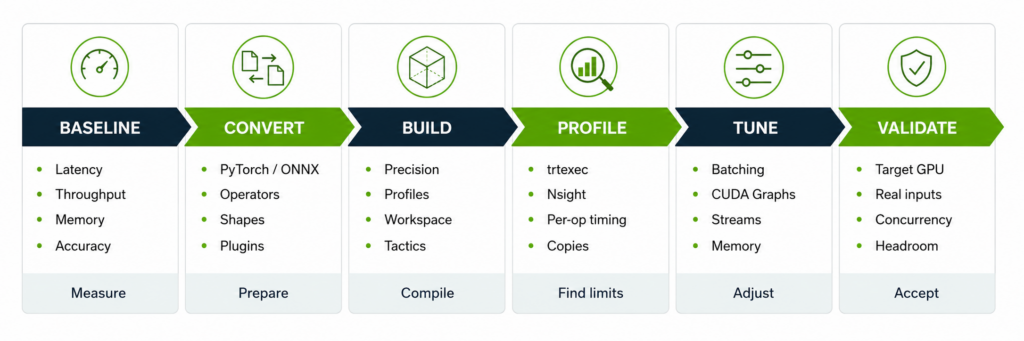
Figure 1. TensorRT work is iterative. CTai LABS establishes a baseline, prepares the model for the supported runtime, builds the engine, profiles limiting stages, tunes the relevant settings, and verifies the result on the target NVIDIA platform.
What CTai LABS TensorRT Optimization can cover
Model conversion and operator compatibility
Many TensorRT projects begin with PyTorch, TensorFlow, or ONNX. Conversion can expose unsupported operators, graph patterns, shape assumptions, plugin requirements, or preprocessing behavior that was hidden in the training environment. Engineering may include ONNX export review, graph cleanup, operator replacement, custom plugins, and validation that the converted network still produces the expected outputs.
The objective is not merely to create an engine file. A deployable engine needs a reproducible build process, known dependencies, supported input contracts, and a validation method that catches numerical or functional regressions after software changes.
Precision selection and quantization
TensorRT supports multiple numerical formats, including FP32, TF32, FP16, BF16, FP8, INT8, FP4, and INT4 where the model and hardware allow them (NVIDIA, 2026a). Lower precision can reduce memory traffic and increase Tensor Core utilization, but the effect on accuracy is application specific. NVIDIA explicitly recommends mixed-precision strategies when sensitive operations need wider accumulation (NVIDIA, 2026c).
Candidate formats can be compared against the customer’s metric, with calibration data, quantize/dequantize placement, and numerical behavior reviewed as needed. The selected engine should meet both the numerical requirement and the timing requirement. Quantization research and deployment studies likewise show that latency gains must be evaluated alongside task quality rather than treated as automatic (Cordova-Cardenas et al., 2025; Jeong et al., 2022).
Dynamic shapes and optimization profiles
Applications with changing batch sizes, image resolutions, sequence lengths, or other runtime dimensions need TensorRT optimization profiles. Each profile defines minimum, preferred, and maximum shapes, and the builder selects tactics that are valid across the declared range (NVIDIA, 2026a).
Overly broad profiles can increase memory demand or remove tactics available only for narrower shape ranges. Realistic input ranges can be grouped and benchmarked to determine whether one engine or multiple profiles better fits the application’s operating conditions.
Layer fusion, tactics, and builder behavior
TensorRT can fuse compatible operations and select kernels based on measured execution time during engine construction. Builder optimization level, timing caches, tactic choices, and Tensor Core alignment can all affect the resulting engine (NVIDIA, 2026b).
Profiling helps identify whether the limiting cost comes from a particular operator, reformat, synchronization point, data transfer, or host-side launch overhead. Graph or builder changes are made only where profiling shows a measurable benefit instead of applying every available optimization indiscriminately.
Batching, CUDA Graphs, and concurrency
Batching can improve throughput by increasing parallel work, while CUDA Graphs can reduce CPU launch overhead for suitable execution patterns. Multi-stream execution can improve utilization when independent work exists, although concurrency can also create contention and higher tail latency (NVIDIA, 2026b).
The correct strategy depends on whether the product values single-request response time, aggregate throughput, deterministic deadlines, or simultaneous model execution. Testing uses the same request pattern and service mix expected after deployment.
Memory planning and engine footprint
TensorRT engine performance depends on more than model weights. Workspace, activation tensors, execution contexts, optimization profiles, buffers, and concurrent engines all consume device memory. Dynamic shapes can change memory use substantially, particularly when minimum, preferred, and maximum dimensions span a wide range (NVIDIA, 2026a).
Memory work can characterize residency, bound builder and runtime allocation, reduce unnecessary buffers, and preserve enough headroom for camera ingest, ROS 2, application services, or other software sharing the GPU platform.
CTai LABS helps with Memory Optimization.
Preprocessing, postprocessing, and end-to-end latency
Inference time alone may not represent the customer-visible response. Image decode, resize, normalization, tensor copies, non-maximum suppression, tracking, tokenization, or downstream logic can dominate a supposedly optimized model. Shafi et al. (2021) demonstrated that TensorRT behavior varies across network components, reinforcing the value of measuring the complete request rather than relying on one aggregate engine number.
Where possible, preprocessing or postprocessing can be moved closer to the accelerator, fused, parallelized, or restructured. Any change is verified against the original functional output and the final response-time requirement.
Jetson, IGX, and discrete-GPU verification
An engine should be built and tested for the NVIDIA hardware and software environment intended to run it. GPU architecture, TensorRT version, CUDA version, power mode, thermals, and available memory can change tactic selection and observed timing. Serialized engines are not a universal interchange format across every hardware and software combination (NVIDIA, 2026a).
Benchmarking on NVIDIA Jetson, IGX, or supported discrete-GPU targets produces the engine-build, runtime-dependency, and acceptance records needed for a repeatable release process.
Profiling regressions across software updates
CUDA, TensorRT, JetPack™, drivers, model exports, and application libraries evolve. A new version can improve one operator while changing another, and builder timing can select different tactics when the environment changes. Reproducible tests make those shifts visible before they reach a field release.
The CTI EdgeAI Stack is relevant here because inference acceleration is one part of a deployable Edge compute platform. TensorRT tuning can be coordinated with the target hardware, sensor traffic, memory, software image, power, thermal design, and application services instead of being optimized in isolation.

Figure 2. TensorRT engine settings are connected. Precision, input shapes, memory, concurrency, data movement, and the target GPU all influence the configuration that should be accepted for deployment.
TensorRT Optimization versus ai Model Optimization
The two CTai LABS services solve related but different problems. TensorRT Optimization is for teams with a model that already meets the task requirement and needs NVIDIA-runtime expertise. ai Model Optimization has a wider scope when the model itself needs structural changes, retraining, pruning, distillation, architecture selection, or broader compression work.
| Need | TensorRT Optimization | ai Model Optimization |
|---|---|---|
| Starting point | Trained model, ONNX graph, existing TensorRT engine, or NVIDIA target | Model or ai application that needs broader efficiency changes |
| Primary focus | TensorRT engine build, precision, profiles, plugins, runtime, memory, and profiling | Model architecture, compression, quantization strategy, retraining, distillation, and deployment fit |
| Typical output | Validated TensorRT build and runtime configuration | Optimized model plus deployment recommendation |
| Best fit | NVIDIA inference runtime is the main engineering problem | Model design or resource demand must change before runtime tuning is enough |
A faster engine still must preserve the application result
Inference speed is valuable only if the optimized model continues to satisfy the customer’s quality target. Reduced precision can change numerical behavior, and graph transformations can expose edge cases in unsupported or custom operations. NVIDIA’s accuracy guidance calls out overflow, accumulation precision, and sensitive operations such as Softmax as areas requiring care when lower precision is introduced (NVIDIA, 2026c).
CTai LABS compares candidate engines against the original model using representative data and application metrics. Acceptance may include task accuracy, precision/recall, segmentation quality, numerical tolerance, output consistency, or another domain-specific measure supplied by the customer.
Typical TensorRT Optimization engagements
- Converting an ONNX or framework model into a repeatable TensorRT engine build
- Diagnosing an engine that is faster than the training framework but still misses the application latency target
- Comparing FP16, BF16, FP8, INT8, or other supported precision choices against accuracy and memory requirements
- Creating dynamic-shape optimization profiles for variable image, batch, or sequence dimensions
- Replacing unsupported operators or implementing TensorRT plugins
- Profiling reformat operations, host-device transfers, launch overhead, or expensive operators
- Tuning batching, CUDA Graphs, and multi-stream execution for latency or throughput goals
- Reducing device-memory use while preserving headroom for concurrent application services
- Rebuilding and regression-testing engines after TensorRT, CUDA, JetPack, driver, or model-export changes
- Validating the finished inference configuration on NVIDIA Jetson, IGX, or supported discrete-GPU hardware
How a CTai LABS TensorRT engagement works
1.
Define the acceptance target
Identify the model, target NVIDIA hardware, input shapes, request pattern, task-quality metric, latency or throughput objective, memory limit, concurrency, power mode, and relevant software versions.
2.
Capture the baseline
Benchmark the current framework or TensorRT engine with representative inputs and record end-to-end timing, GPU timing, memory, utilization, and accuracy.
3.
Build the candidate engine
Prepare the ONNX or framework export, resolve unsupported operators, establish precision and shape profiles, and create a reproducible engine build.
4.
Profile the limiting stages
Use TensorRT tools and NVIDIA profilers to locate expensive operations, reformats, transfers, launch overhead, synchronization, or memory pressure.
5.
Tune the relevant controls
Adjust precision, graph structure, profiles, batching, CUDA Graphs, streams, memory, plugins, or preprocessing only where the measurements indicate a benefit.
6.
Verify quality and sustained behavior
Run representative data, concurrent services, power and thermal conditions, and the customer’s quality metric to confirm the engine meets the acceptance criteria with usable headroom.
7.
Handoff and support
Document the build inputs, engine settings, dependencies, benchmark method, results, known limits, and rebuild procedure. The customer retains its model, application, data, product ownership, and IP.
Effective TensorRT optimization leaves the customer with more than a faster engine. CTai LABS ties model accuracy, precision, memory use, latency, throughput, and target-hardware behavior to measurable acceptance criteria, then documents a repeatable configuration the customer can carry forward. The result is NVIDIA inference software tuned for the actual application and hardware environment, with enough evidence to support deployment and future software updates.
CTai LABS uses these inputs to identify the highest-risk technical interfaces, define the required Edge ai architecture, select the appropriate Connect Tech hardware, and establish the shortest credible path from the current program stage to a deployment-ready system. If these inputs are not yet defined, CTai LABS can help develop them as part of the engagement, whether the work begins with an initial idea, a research prototype, or an existing healthcare application.
Book a Demo
Bring the trained model or ONNX graph, current benchmark, target NVIDIA hardware, representative inputs, required precision or accuracy, expected request pattern, software versions, and the latency, throughput, memory, or power objective. The engagement can establish the baseline, identify the TensorRT-specific engineering work, and define a measured route to a validated inference configuration.

ABOUT THE AUTHOR
Doruk Sönmez, M.Sc.
AI Solutions Architect, CTai LABS
Doruk is an AI Solutions Architect at CTai LABS, the Physical AI and Edge AI services division of Connect Tech Inc., an NVIDIA Elite Partner. An NVIDIA DLI Certified Instructor, he specializes in deploying vision-language models, agentic AI workflows, and accelerated video pipelines on NVIDIA Jetson platforms.
 Learn More
Resources and Frequently Asked Questions
Related
Built with NVIDIA. Explore CTai LABS engineering across NVIDIA Jetson, IGX, CUDA, TensorRT, Isaac, Metropolis, and the wider Edge ai software stack.
Explore Built with NVIDIA →ai Model Optimization. Use broader model compression, retraining, quantization, distillation, and architecture work when the model itself needs to change.
See ai Model Optimization →NVIDIA Jetson Consulting. Pair TensorRT work with Jetson architecture, BSPs, sensors, memory, power, thermals, and deployment engineering.
See NVIDIA Jetson Consulting →NVIDIA IGX Thor Consulting. Apply TensorRT within high-performance sensor, Holoscan, enterprise Edge, and safety-aware IGX Thor systems.
See NVIDIA IGX Thor Consulting →Sources
Cordova-Cardenas, R., Amor, D., & Gutiérrez, Á. (2025). Edge AI in practice: A survey and deployment framework for neural networks on embedded systems. Electronics, 14(24), 4877.
https://doi.org/10.3390/electronics14244877Jeong, E., Kim, J., & Ha, S. (2022). TensorRT-based framework and optimization methodology for deep learning inference on Jetson boards. ACM Transactions on Embedded Computing Systems, 21(5), Article 51.
https://doi.org/10.1145/3508391NVIDIA. (2026a). NVIDIA TensorRT documentation.
https://docs.nvidia.com/deeplearning/tensorrt/latest/NVIDIA. (2026b). TensorRT best practices.
https://docs.nvidia.com/deeplearning/tensorrt/latest/performance/best-practices.htmlNVIDIA. (2026c). TensorRT accuracy considerations.
https://docs.nvidia.com/deeplearning/tensorrt/latest/inference-library/accuracy-considerations.htmlRatul, I. J., Zhou, Y., & Yang, K. (2025). Accelerating deep learning inference: A comparative analysis of modern acceleration frameworks. Electronics, 14(15), 2977.
https://doi.org/10.3390/electronics14152977Shafi, O., Rai, C., Sen, R., & Ananthanarayanan, G. (2021). Demystifying TensorRT: Characterizing neural network inference engine on NVIDIA Edge devices. In 2021 IEEE International Symposium on Workload Characterization (IISWC) (pp. 226–237). IEEE.
https://doi.org/10.1109/IISWC53511.2021.00030Frequently Asked Questions
What is NVIDIA TensorRT?
NVIDIA TensorRT is an SDK for compiling and running deep learning inference on NVIDIA GPUs. It provides model parsing, graph optimization, kernel selection, mixed precision, dynamic shapes, plugins, memory management, and runtime APIs for low-latency and high-throughput inference (NVIDIA, 2026a).
What does TensorRT Optimization include?
The scope can include model conversion, ONNX review, engine building, precision selection, quantization, dynamic shapes, optimization profiles, plugins, memory analysis, batching, CUDA Graphs, concurrency, profiling, and target-hardware verification.
Can CTai LABS optimize an existing TensorRT engine?
Yes. An engagement can begin with an existing engine or build script. An existing engine or build script can be reproduced, profiled, and rebuilt or retuned when the evidence supports a change.
Does lower precision always make a model faster?
No. The benefit depends on the model, GPU, tensor shapes, operator support, memory behavior, and whether Tensor Cores are used effectively. Accuracy also must be checked when lower precision is introduced (NVIDIA, 2026c).
Can TensorRT handle dynamic input sizes?
Yes. TensorRT supports runtime dimensions through optimization profiles that define minimum, preferred, and maximum input shapes. Profile design affects available tactics and memory use, so realistic shape ranges should be benchmarked (NVIDIA, 2026a).
What is the difference between TensorRT Optimization and ai Model Optimization?
TensorRT Optimization is tool-specific engineering around NVIDIA inference compilation and runtime behavior. ai Model Optimization is broader and can include model redesign, retraining, pruning, distillation, compression, and other changes made before or alongside runtime tuning.
Can CTai LABS optimize TensorRT on NVIDIA Jetson?
Yes. Supported Jetson targets can be used for engine builds and benchmarks that account for JetPack, CUDA, memory, power mode, thermals, sensor processing, and other services sharing the device.
Do TensorRT engines need to be rebuilt after software changes?
Often, yes. Engine portability depends on the target GPU and TensorRT compatibility rules. Rebuilding and regression-testing after significant runtime, CUDA, driver, platform, or model-export changes is the safer release practice (NVIDIA, 2026a).
Does the customer keep its model and IP?
Yes. CTai LABS works as an extension of the customer’s engineering team for the agreed scope. The customer retains its model, application, training data, proprietary logic, product ownership, and intellectual property.
What should we provide to start?
Useful inputs include the model or ONNX graph, target NVIDIA hardware, current TensorRT and CUDA versions, representative data, input shapes, quality metric, baseline timing, concurrency, memory limits, and the required latency or throughput target.
Ready to Build Smarter?
Let’s create the intelligent Edge AI solution that moves your business forward.