Aerospace and Defense
Rugged AI Computing
for Aerospace and Defense
Mission-system compute, SOSA-aligned VPX, environmental engineering, and Edge ai integration
By Ceri Nelmes
Tech Marketing Leader & Journalist | Building Brands at the Edge of What’s Next | Connect Tech & CTai Labs
Technical review: Rob Callaghan, Chief Product Officer, Connect Tech Inc.

Key Takeaways
- CTai LABS integrates rugged ai compute around the mission workload, interfaces, environment, security boundary, lifecycle, and program evidence
- Work can begin with an idea, a capability requirement, an existing VPX chassis, a prototype payload, a platform migration, or a fielded compute node that needs focused engineering
- Connect Tech Graphite VPX, Sentry-X2, Sentry-X2 Mini, Anvil-RX, and Rogue-RX provide deployment paths for NVIDIA® Jetson™ modules
- Graphite VPX brings NVIDIA Jetson AGX Orin™ Industrial to a rugged 3U VPX form factor aligned with the SOSA™ Technical Standard
- NVIDIA CUDA® and TensorRT™ workloads are validated with sensor ingest, networking, storage, power, thermals, and security services active
- Program compliance depends on the ordered configuration, tailored methods, test evidence, and approving authority
CTai LABS helps aerospace and defense teams turn a mission-compute requirement, prototype payload, existing chassis, or platform migration into a deployment-ready Edge ai system on Connect Tech hardware. This page covers modular architecture, SOSA™ and OpenVPX™ alignment, NVIDIA® Jetson™ compute, sensor I/O, networking, storage, security, Board Support Package (BSPs) engineering, power, thermal design, environmental test planning, software release, and lifecycle support. CTai LABS can start with only a capability idea and constraints, or join at any point to select hardware, integrate a sensor path, optimize an application, migrate compute, diagnose a field limit, or produce the evidence required for the next program milestone.
Rugged ai compute is a mission-system architecture
A rugged computer must execute its assigned functions across the platform’s environmental, electrical, interface, cybersecurity, and lifecycle conditions. The architecture begins with data sources, response times, model and non-ai workloads, output consumers, degraded modes, update authority, maintenance concept, and program evidence. Compute throughput is one input to that architecture, not the final answer.
Open modular standards can reduce integration ambiguity when the platform already uses defined profiles. The Open Group describes the SOSA Technical Standard as a reference architecture spanning hardware and software for sensor systems. ANSI/VITA 65.0-2025 defines OpenVPX system profiles for modules, slots, backplanes, and development chassis. Connect Tech Graphite VPX places NVIDIA Jetson AGX Orin™ Industrial in a rugged 3U VPX single-board computer aligned with the SOSA standard, creating a path for Edge ai acceleration within a modular sensor architecture.
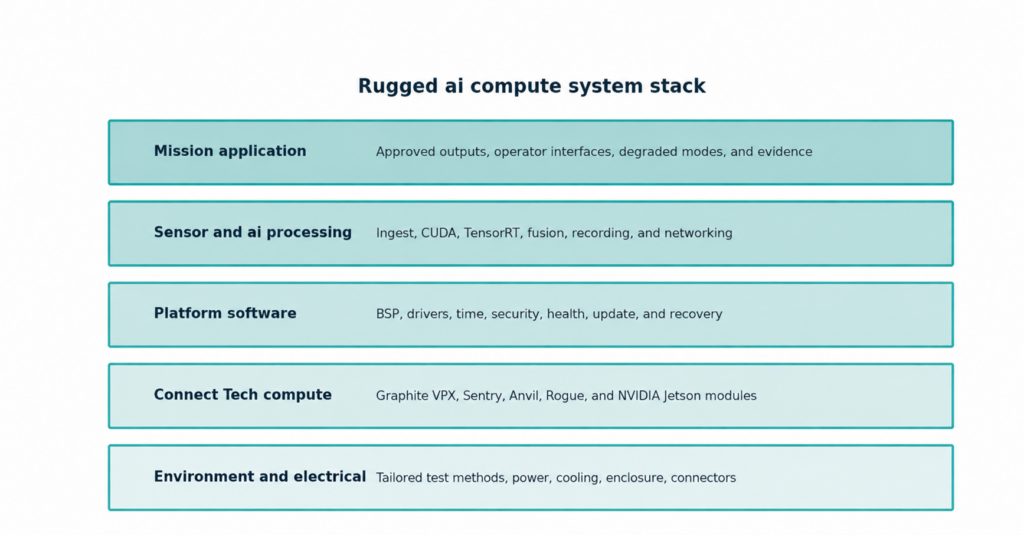
Figure 1. Rugged ai compute is integrated from the mission application down through platform software, modular interfaces, power and thermal design, and environmental evidence.
Choose the inspection method from the evidence available

Mission workload and data movement
CTai LABS maps camera, EO/IR, radar, LiDAR, navigation, communications, recording, operator display, and application services into data rates and timing chains. CPU, GPU, memory, Ethernet, PCIe, storage, and sensor I/O are sized together. NVIDIA TensorRT and CUDA can accelerate supported workloads, but the production test includes ingest, preprocessing, inference, postprocessing, encryption or security services, recording, and network traffic.

SOSA, VPX, and modular integration
A SOSA-aligned, slot, backplane, timing, data-plane, control-plane, utility-plane, cooling, chassis-management, security, and software interfaces still need to be matched. CTai LABS can assess an existing chassis or define a development path using Graphite VPX and a VPX development system, then integrate the application and validation baseline that will move to the target platform.

Environmental and thermal design
Shock, vibration, temperature, altitude, humidity, sand, dust, salt, fluids, and other exposures are tailored to the platform and lifecycle. CTai LABS separates test-method planning from blanket certification claims. Thermal engineering includes module power, workload duty cycle, conduction or enclosure path, local hot spots, ambient and altitude, and the performance evidence required before, during, and after exposure. Krišlauks et al. (2026) provide recent peer-reviewed evidence that enclosure, ambient, fan behavior, application workload, and Jetson power consumption are coupled.

Security and software lifecycle
The release can include a controlled Board Support Package and JetPack baseline, secure boot, device identity, storage protection, service separation, audit logging, vulnerability and dependency records, update, rollback, and recovery. NVIDIA documents Secure Boot as a chain of trust rooted in the Jetson platform. The exact security configuration, keys, provisioning process, and accreditation boundary are established with the customer and program authority.

Program support and ownership
Aerospace and defense programs often require configuration control, obsolescence planning, repeatable builds, long-term software support, and traceable changes. CTai LABS and Connect Tech coordinate the carrier or system hardware, in-house BSPs, application integration, and release evidence. The customer retains its mission application, data, models, system design, and intellectual property.
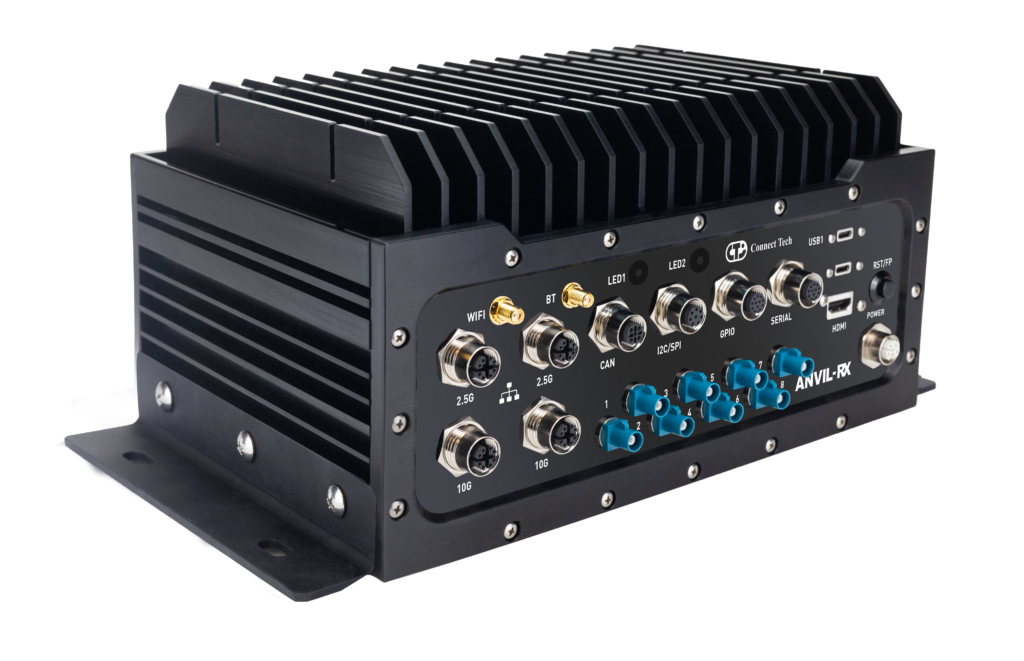
Anvil-RX Rugged System
Powered by NVIDIA® Jetson AGX Orin™
Fully IP67-Rated
Architecture Through Deployment
Bring your goal. Start with the outcome your rugged Edge ai program must achieve. CTai LABS, a department of Connect Tech, can begin with an early idea, an architecture decision, a working prototype, a difficult integration issue, or a system that needs to become deployment-ready.
What to bring:
- The required function, deployment environment, duty cycle, mounting, service interval, failure behavior, and applicable standards or customer methods.
- Sensor and model workloads, concurrency, latency, throughput, data retention, networking, and availability requirements.
- Current or proposed Connect Tech hardware, NVIDIA Jetson module, enclosure, connectors, cables, storage, wireless, input power, and cooling.
- Thermal logs, power measurements, failure reports, system images, models, application traces, photographs, and test evidence already available.
- The operating limits, qualification milestone, release, update, recovery, support, and lifecycle evidence the program requires.
CTai LABS uses these inputs to identify the highest-risk interfaces first and define the shortest credible path to a working, measurable system.
Connect Tech hardware for rugged ai computing
CTai LABS selects a Connect Tech carrier, system, or VPX module from the program’s mechanical, electrical, interface, cooling, and evidence requirements. Product capabilities and certification status are confirmed for the exact ordered configuration.
| Connect Tech platform | Program fit | Integration value |
|---|---|---|
| Graphite VPX with Jetson AGX Orin™ Industrial | SOSA-aligned 3U VPX sensor systems | Rugged ai acceleration in a modular OpenVPX architecture for programs with defined slot, backplane, data-plane, and cooling requirements. |
| Sentry-X2 with Jetson AGX Orin™ Industrial | MIL-rugged tactical Edge and video systems | Integrated compute with SDI, high-speed Ethernet, rugged connectors, and a controlled system configuration for sensor-processing workloads. |
| Sentry-X2 Mini with Jetson Orin™ NX | SWaP-constrained airborne and unmanned payloads | Compact IP67 MIL-rugged system with D38999 connectors, Ethernet, USB, and NVMe for bounded ai and sensor workloads. |
| Anvil-RX or Rogue-RX with Jetson AGX Orin™ | Ground vehicle and exposed compute | Sealed-system or rugged-carrier paths with camera, Ethernet, CAN, storage, and industrial I/O for mobile mission platforms. |
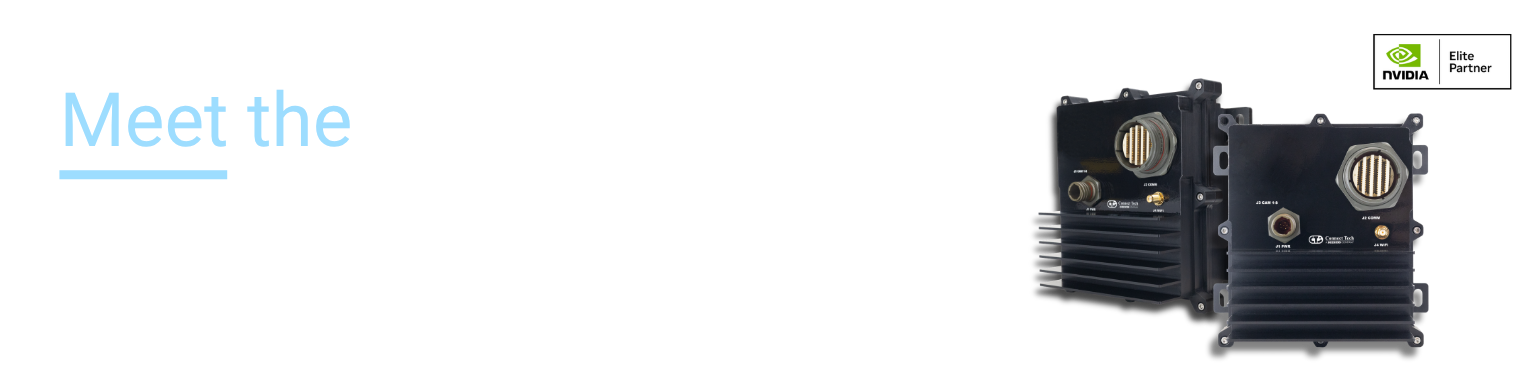
Example Rugged AI Computing Projects
SOSA-aligned VPX sensor processor
A program needs GPU-accelerated processing inside an existing 3U VPX architecture. CTai LABS maps the slot and backplane profiles, data and control planes, timing, cooling, security, and application workload to Graphite VPX, then brings up the Board Support Package, integrates the model and sensor pipeline, and validates interfaces and sustained performance in the development and target chassis.
Rugged vehicle-mounted ai computer
A ground platform must process cameras and vehicle data through temperature, vibration, dust, power variation, and intermittent network access. CTai LABS selects Anvil-RX, Rogue-RX, or Sentry-X2, integrates the sensors, CAN, networking, storage, and application, and produces a tailored functional and environmental evidence plan.
SWaP-constrained airborne processing node
An airborne payload needs local image and telemetry processing within tight size, weight, power, cooling, and connector limits. CTai LABS evaluates Sentry-X2 Mini and carrier-level options, profiles the target workload, defines data reduction and storage, integrates time and platform interfaces, and verifies the system across flight-representative duty cycles and environmental conditions.
What CTai LABS can deliver
- Mission workload, interface, timing, SWaP, environment, security, lifecycle, degraded-mode, standards, and acceptance requirements.
- Connect Tech Graphite VPX, Sentry-X2, Sentry-X2 Mini, Anvil-RX, Rogue-RX, or other platform recommendation with NVIDIA Jetson module and thermal architecture.
- Board Support Package and driver baseline, sensor and network bring-up, time, storage, security configuration, monitoring, logging, update, rollback, and recovery.
- Integrated ai, sensor-processing, recording, application, and mission-system interfaces with measured resource allocation and timing.
- Sustained-load, interface, power, thermal, degraded-mode, security-function, and tailored environmental evidence with documented limits.
- Controlled software release, configuration records, evidence package, deployment and service procedures, documentation, and knowledge transfer.
Your Physical ai Integration Partner
CTai LABS combines Connect Tech rugged compute, in-house Board Support Package engineering, ai optimization, sensor integration, modular architecture, and program-level validation. The team can begin with an idea, contribute one integration work package, or carry a rugged ai computing node from architecture through deployment while the customer retains its intellectual property.
Book a Demo
Bring your goal. Start with the outcome your rugged ai computing program must achieve. CTai LABS, a department of Connect Tech, can begin with an early idea, an architecture decision, a working prototype, a difficult integration issue, or a system that needs to become deployment-ready.
What to bring:
- The mission function, data sources and consumers, response-time needs, degraded modes, and next program milestone.
- Platform environment, SWaP, mounting, chassis or enclosure, slot and backplane profiles, cooling, input power, connectors, and interfaces.
- Current or proposed Connect Tech hardware, NVIDIA Jetson platform, sensors, networks, storage, security boundary, and software baseline.
- Interface-control documents, models, sample data, code, logs, performance traces, test methods, and existing evidence.
- Configuration-control, qualification, cybersecurity, release, service, support, and lifecycle requirements.
CTai LABS uses these inputs to identify the highest-risk interfaces first and define the shortest credible path to a working, measurable system.

ABOUT THE AUTHOR
Ceri Nelmes
Tech Marketing Leader & Journalist | Building Brands at the Edge of What’s Next |
Connect Tech & CTai Labs
Ceri Nelmes is Head of Marketing at Connect Tech and an experienced technology journalist and digital strategist. She covers the technologies and market shifts shaping embedded computing, Edge AI, Physical ai, robotics, autonomous systems, and the NVIDIA® ecosystem. Working with Connect Tech and CTai LABS subject-matter experts, she turns engineering developments into accurate, useful reporting for developers, technical buyers, business leaders, and the media.
 Learn More
Resources and Frequently Asked Questions
Related
Aerospace & Defense. Explore CTai LABS capabilities for rugged compute, ISR, unmanned systems, and airborne perception.
Explore Aerospace & Defense →ISR ai Integration. Integrate sensor data, ai models, and rugged Edge compute to support real-time intelligence, surveillance, and reconnaissance.
See ISR ai Integration →Unmanned Systems. Develop and integrate the compute, sensing, and ai systems required for autonomous and remotely operated platforms.
See Unmanned Systems →Drone Perception. Build onboard perception systems that help drones detect, interpret, and respond to their surroundings in real time.
See Drone Perception →Sources
Connect Tech. (n.d.). Graphite VPX. Retrieved August 21, 2026, from
https://connecttech.com/product/3u-vpx-agx-orin/Connect Tech. (n.d.). Sentry-X2 MIL-rugged system powered by NVIDIA Jetson AGX Orin Industrial. Retrieved August 21, 2026, from
https://connecttech.com/product/sentry-x2-mil-rugged-system-nvidia-jetson-agx-orin-industrial/Connect Tech. (n.d.). Sentry-X2 Mini rugged system powered by NVIDIA Jetson Orin NX. Retrieved August 21, 2026, from
https://connecttech.com/product/sentry-x2-mini-rugged-system-nvidia-jetson-orin-nx/Krišlauks, R., Tiscenko, D., Medvedevs, V., Ormanis, J., & Judvaitis, J. (2026). Ambient temperature impact on the thermal behavior and power consumption of the NVIDIA Jetson AGX Orin in an outdoor enclosure. Electronics, 15(11), 2467.
https://doi.org/10.3390/electronics15112467NVIDIA. (2026). Secure Boot. Jetson Linux Developer Guide.
https://docs.nvidia.com/jetson/archives/r38.4/DeveloperGuide/SD/Security/SecureBoot.htmlThe Open Group. (2025). Sensor Open Systems Architecture Technical Standard.
https://www.opengroup.org/sosa-technical-standard-v1VITA. (2025). ANSI/VITA 65.0-2025 OpenVPX system standard.
https://www.vita.com/StandardsFrequently Asked Questions
What is SOSA-aligned rugged ai computing?
It is a modular sensor-system architecture that applies SOSA-defined interfaces and profiles while integrating ai acceleration, platform software, cooling, security, and application evidence. Alignment of one module does not by itself establish compliance for the complete system.
What is SOSA-aligned rugged ai computing?
VPX defines a family of rugged module and backplane technologies. OpenVPX, standardized through ANSI/VITA 65, defines system-level profiles for modules, slots, backplanes, and development chassis to improve interoperability.
Can CTai LABS integrate an existing VPX chassis?
Yes. CTai LABS can assess the slot, backplane, data, control, timing, utility, cooling, management, and software interfaces, then integrate Graphite VPX and the target ai application where the profiles are compatible.
Is Connect Tech hardware MIL-STD-810H certified?
Certification status varies by product and configuration. CTai LABS confirms the ordered system and can help tailor methods, prepare the application, and document functional evidence for the program’s required testing.
Can the system operate without external connectivity?
Yes. CTai LABS can implement supported NVIDIA Jetson security features, provisioning, controlled releases, update, rollback, and recovery within the customer’s security and accreditation boundary.
Can CTai LABS support secure boot and controlled updates?
Yes. CTai LABS can implement supported NVIDIA Jetson security features, provisioning, controlled releases, update, rollback, and recovery within the customer’s security and accreditation boundary.
Who owns the mission application and models?
The customer retains its mission application, data, models, system design, and intellectual property. Engagement deliverables and licensing boundaries are defined in the statement of work.
Ready to Build Smarter?
Let’s create the intelligent Edge AI solution that moves your business forward.