
Aerospace and Defense
ISR AI Integration
Intelligence, surveillance, and reconnaissance multi-sensor ingest, Edge analytics, fusion, provenance, and operator-ready
By Ceri Nelmes
Tech Marketing Leader & Journalist | Building Brands at the Edge of What’s Next | Connect Tech & CTai Labs
Technical review: Rob Callaghan, Chief Product Officer, Connect Tech Inc.
Key Takeaways
- CTai LABS integrates ISR sensor data into traceable outputs that fit the mission system, operator workflow, connectivity, and program authority
- Work can start with an idea, a sensor shortlist, an existing full-motion-video path, a fusion algorithm, a VPX chassis, or a payload that needs performance or environmental validation
- Connect Tech Sentry-X2, Graphite VPX, Sentry-X2 Mini, and NVIDIA® Jetson™ carrier platforms provide compute and I/O paths for Jetson modules
- NVIDIA CUDA® and TensorRT™ can accelerate supported detection, tracking, enhancement, segmentation, and fusion workloads at the Edge
- Timestamp quality, calibration, coordinate frames, uncertainty, provenance, degraded modes, and operator review are engineered before automated outputs are trusted
- CTai LABS supports decision assistance and sensor exploitation within approved system boundaries; operational authority remains with the customer
CTai LABS helps aerospace and defense teams turn EO/IR, full-motion video, radar, LiDAR, navigation, RF, or other approved sensor data into a deployment-ready ISR ai pipeline on Connect Tech hardware. This page covers sensor ingest, Board Support Package (BSP) and driver work, time synchronization, calibration, metadata, NVIDIA® TensorRT™ inference, tracking, multi-sensor fusion, recording, dissemination, operator interfaces, provenance, degraded modes, security, validation, and release. CTai LABS can start with only a mission-information goal, or join at any point to select compute, bring up a sensor, integrate an existing algorithm, optimize data movement, repair timing, add traceability, or prepare a payload for the next test milestone.
ISR ai integration turns sensor data into traceable information
An ISR pipeline must preserve the relationship among source data, time, platform state, calibration, processing version, confidence, operator actions, and output. The ai model may detect, segment, classify, enhance, associate, summarize, or track. The mission system still needs to know which sensor and frame produced the result, how old it is, which transforms and model version were used, what uncertainty applies, and what happens when a source becomes unavailable.
Samadzadegan, Toosi, and Dadrass Javan (2025) reviewed more than 950 publications on multi-sensor and multi-platform remote-sensing fusion across visible, multispectral, hyperspectral, radar, LiDAR, thermal, and other data. Their review distinguishes pixel, feature, and decision-level fusion and shows why data type, spatial and temporal resolution, registration, and the intended output determine the method. The program implication is direct: fusion architecture begins with the mission information product and source characteristics, not a preferred algorithm.
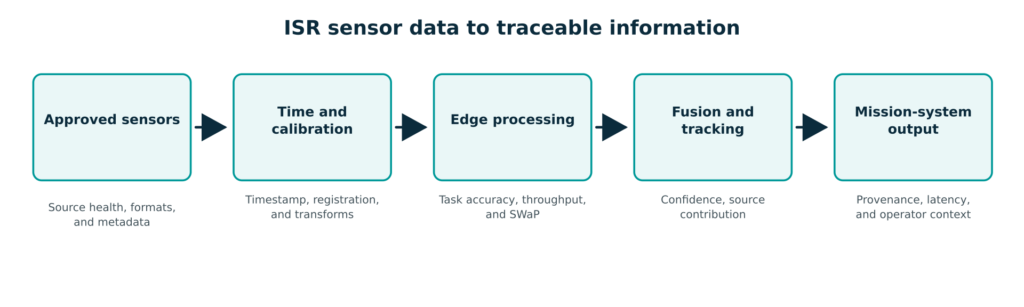
Figure 1. Intelligence, Surveillance, and Reconnaissance (ISR) integration preserves time, calibration, provenance, uncertainty, and operator context from sensor ingest through the mission-system output.
Engineer the sensor path before optimizing the model
Sensor ingest and metadata
CTai LABS can integrate SDI, GMSL, MIPI CSI-2, Ethernet, USB, and program-specific sensor paths supported by the selected Connect Tech platform. The work includes device and stream bring-up, formats, compression, metadata association, dropped-frame detection, health, recording, and replay. EO/IR and full-motion-video systems can also require platform position, attitude, field of view, gimbal state, and time to remain aligned with the imagery.

Time, calibration, and registration
A fused result is only as defensible as its temporal and spatial alignment. CTai LABS maps sensor clocks, exposure or scan time, transport delay, buffering, platform time, navigation data, transforms, and calibration. Offline replay and controlled targets can isolate timestamp, boresight, intrinsic, extrinsic, and registration errors before they appear as model or tracking failures.
Edge analytics and data reduction
Onboard processing can reduce bandwidth by producing alerts, tracks, regions of interest, embeddings, metadata, clips, or summaries from high-rate raw data. CTai LABS integrates and optimizes approved customer models or supported NVIDIA components on the target Jetson™ platform. The validation includes task accuracy, latency, memory, sustained throughput, power, thermals, and performance under concurrent recording and communications.

Fusion, tracking, and uncertainty
Pixel-level fusion combines registered measurements. Feature-level fusion combines learned or engineered representations. Decision-level fusion combines source outputs or tracks. CTai LABS selects the level from sensor characteristics, timing, bandwidth, calibration, training data, and traceability requirements, then implements confidence, association, track history, source contribution, stale-data handling, and degraded modes.

Human review and mission-system integration
CTai LABS can expose structured outputs, supporting evidence, confidence, provenance, and system health to the approved operator or mission system. The integration can support search, triage, cueing, reporting, and decision assistance within customer-defined authority. It does not replace the operational rules, legal review, safety controls, or human authorization required by the program.
Architecture Through Intelligence, Surveillance, and Reconnaissance Deployment
The engagement can begin with an information requirement, one sensor interface, a recorded dataset, an existing algorithm, a selected Connect Tech platform, or a complete payload that needs integration and test evidence.
- Define the information product, approved sources, consumers, latency, accuracy, confidence, provenance, bandwidth, connectivity, degraded modes, security, and acceptance evidence.
- Select the Connect Tech platform, NVIDIA Jetson module, sensor and network interfaces, storage, time source, power, thermal design, enclosure, and service concept.
- Bring up the Board Support Package, sensors, metadata, clocks, calibration, transforms, recording, replay, health monitoring, logging, and security configuration.
- Integrate and optimize enhancement, detection, segmentation, classification, tracking, fusion, data reduction, and operator or mission-system interfaces.
- Validate source quality, registration, task metrics, confidence, provenance, latency, throughput, sustained load, sensor loss, restart, recovery, and environmental conditions.
- Deliver the controlled release, calibration and configuration records, evaluation set, evidence package, known limits, deployment procedure, and handoff.
Connect Tech hardware for ISR ai integration
ISR platforms are selected from sensor interface, data rate, compute workload, storage, SWaP, environment, chassis, and security boundaries. Connect Tech provides enclosed tactical systems, VPX modules, and compact payload systems for different integration levels.
| Connect Tech platform | ISR fit | System value |
|---|---|---|
| Sentry-X2 with Jetson AGX Orin™ Industrial | Rugged full-motion-video and tactical Edge processing | SDI inputs and outputs, high-speed Ethernet, rugged connectors, storage, and Jetson AGX Orin Industrial compute in an integrated system. |
| Graphite VPX with Jetson AGX Orin™ Industrial | Modular SOSA-aligned sensor processing | 3U VPX ai compute for programs integrating Edge analytics into an existing OpenVPX sensor architecture. |
| Sentry-X2 Mini with Jetson Orin™ NX | SWaP-limited airborne and unmanned ISR | Compact IP67 MIL-rugged system with D38999 connectors, Ethernet, USB, and NVMe for bounded sensor and inference workloads. |
| Gauntlet or Anvil-T5 with Jetson Thor™ | High-rate multimodal processing in a suitable system integration | Jetson Thor compute and high-bandwidth camera and network paths for demanding concurrent models, subject to enclosure and program qualification. |

Example ISR AI Integration Projects
Full-motion-video Edge analytics
A platform must process several SDI streams, associate platform metadata, run approved detection and tracking, retain evidence clips, and forward structured outputs over limited bandwidth. CTai LABS integrates the data path on Sentry-X2, validates timestamp and metadata alignment, optimizes the model runtime, and documents task accuracy, output latency, source health, provenance, and degraded behavior.
Multi-sensor remote-sensing fusion
A program combines visible, thermal, LiDAR, radar, and navigation sources that differ in resolution, time, geometry, and coverage. CTai LABS defines the fusion level, establishes time and registration evidence, integrates feature or decision-level processing on Graphite VPX or another Connect Tech platform, and validates source contribution, uncertainty, and sensor-loss modes.
Communications-constrained airborne payload
CTai LABS deploys bounded local processing on Sentry-X2 Mini, produces approved metadata, clips, or summaries, buffers source evidence, and implements store-and-forward behavior. Validation covers mission-representative duty cycles, bandwidth loss, storage limits, time quality, thermal behavior, and recovery.
What CTai LABS can deliver
- Information-product, source, consumer, timing, confidence, provenance, bandwidth, degraded-mode, security, environment, and acceptance requirements.
- Connect Tech platform and NVIDIA Jetson module selection with sensor, SDI, camera, network, storage, time, power, thermal, enclosure, and chassis requirements.
- BSP and driver baseline, sensor and metadata bring-up, clocks, calibration, transforms, recording, replay, health, security, and recovery.
- Integrated enhancement, detection, segmentation, classification, tracking, fusion, data-reduction, and approved mission-system or operator interfaces.
- Source-quality, registration, task, confidence, provenance, timing, throughput, sustained-load, sensor-loss, recovery, and environmental evidence.
- Controlled release, model and data lineage, calibration and configuration records, evaluation set, known limits, deployment procedure, and knowledge transfer.
Your Physical ai Integration Partner
CTai LABS connects Connect Tech rugged compute, sensor and timing interfaces, Board Support Package engineering, Edge ai analytics, fusion, provenance, and validation in one ISR integration path. The team can begin with an idea, solve one sensor or algorithm boundary, or carry the approved sensor-to-information pipeline through deployment while the customer retains its intellectual property.
Book a Demo
Bring your goal. Start with the outcome your ISR ai integration program must achieve. CTai LABS, a department of Connect Tech, can begin with an early idea, an architecture decision, a working prototype, a difficult integration issue, or a system that needs to become deployment-ready.
What to bring:
- The information product, approved sensor sources, operator or system consumers, mission timing, and decision boundaries.
- Sensor formats, metadata, calibration, time sources, interfaces, data rates, bandwidth, storage, SWaP, environment, and connectivity modes.
- Current or proposed Connect Tech hardware, NVIDIA Jetson platform, VPX chassis, enclosure, security boundary, and software baseline.
- Recorded sensor data, models, algorithms, calibration files, interface-control documents, logs, traces, and evaluation evidence.
- Accuracy, confidence, provenance, latency, degraded-mode, cybersecurity, qualification, release, and lifecycle requirements.
CTai LABS uses these inputs to identify the highest-risk interfaces first and define the shortest credible path to a working, measurable system.

ABOUT THE AUTHOR
Ceri Nelmes
Tech Marketing Leader & Journalist | Building Brands at the Edge of What’s Next |
Connect Tech & CTai Labs
Ceri Nelmes is Head of Marketing at Connect Tech and an experienced technology journalist and digital strategist. She covers the technologies and market shifts shaping embedded computing, Edge AI, Physical ai, robotics, autonomous systems, and the NVIDIA® ecosystem. Working with Connect Tech and CTai LABS subject-matter experts, she turns engineering developments into accurate, useful reporting for developers, technical buyers, business leaders, and the media.
 Learn More
Resources and Frequently Asked Questions
Related
Aerospace & Defense. Explore CTai LABS capabilities for rugged compute, ISR, unmanned systems, and airborne perception.
Explore Aerospace & Defense →Rugged ai Computing. Design and integrate rugged Edge ai systems built to perform reliably in demanding aerospace and defense environments.
See Rugged ai Computing →Unmanned Systems. Develop and integrate the compute, sensing, and ai systems required for autonomous and remotely operated platforms.
See Unmanned Systems →Drone Perception. Build onboard perception systems that help drones detect, interpret, and respond to their surroundings in real time.
See Drone Perception →Scene Analyzer Agent. A pre-engineered Edge scene-understanding path that can inform bounded video-analysis workflows.
See Scene Analyzer Agent →Sources
Connect Tech. (n.d.). Graphite VPX. Retrieved August 21, 2026, from
https://connecttech.com/product/3u-vpx-agx-orin/Connect Tech. (n.d.). Sentry-X2 MIL-rugged system powered by NVIDIA Jetson AGX Orin Industrial. Retrieved August 21, 2026, from
https://connecttech.com/product/sentry-x2-mil-rugged-system-nvidia-jetson-agx-orin-industrial/Connect Tech. (n.d.). Sentry-X2 Mini rugged system powered by NVIDIA Jetson Orin NX. Retrieved August 21, 2026, from
https://connecttech.com/product/sentry-x2-mini-rugged-system-nvidia-jetson-orin-nx/NVIDIA. (2026). TensorRT documentation.
https://docs.nvidia.com/deeplearning/tensorrt/Samadzadegan, F., Toosi, A., & Dadrass Javan, F. (2025). A critical review on multi-sensor and multi-platform remote sensing data fusion approaches: Current status and prospects. International Journal of Remote Sensing, 46(3), 1327–1402.
https://doi.org/10.1080/01431161.2024.2429784The Open Group. (2025). Sensor Open Systems Architecture Technical Standard.
https://www.opengroup.org/sosa-technical-standard-v1Frequently Asked Questions
What sensors can CTai LABS integrate for ISR?
Pixel fusion combines registered measurements, feature fusion combines intermediate representations, and decision fusion combines source outputs or tracks. Selection depends on timing, registration, data rates, training data, and required traceability.
What sensors can CTai LABS integrate for ISR?
Pixel fusion combines registered measurements, feature fusion combines intermediate representations, and decision fusion combines source outputs or tracks. Selection depends on timing, registration, data rates, training data, and required traceability.
Can ISR analytics run without a network connection?
The intelligence, surveillance, and reconnaissance pipeline can associate outputs with source identifiers, timestamps, calibration and transform versions, model and software versions, confidence, processing history, and operator actions required by the program.
How is ISR provenance maintained?
The intelligence, surveillance, and reconnaissance pipeline can associate outputs with source identifiers, timestamps, calibration and transform versions, model and software versions, confidence, processing history, and operator actions required by the program.
Can CTai LABS integrate an existing customer model?
No. CTai LABS integrates approved analytics and decision assistance within customer-defined system and operator boundaries. Operational authority, legal review, and program controls remain with the customer.
Does CTai LABS automate operational authority?
No. CTai LABS integrates approved analytics and decision assistance within customer-defined system and operator boundaries. Operational authority, legal review, and program controls remain with the customer.
Who owns the ISR data, models, and application?
The customer retains its own data, models, mission application, system design, and intellectual property. Deliverables and licensing boundaries are defined in the statement of work.
Ready to Build Smarter?
Let’s create the intelligent Edge AI solution that moves your business forward.