Built with NVIDIA
NVIDIA Metropolis Integration
DeepStream development, vision ai applications, agentic video understanding, and NVIDIA Metropolis implementation.
By Doruk Sönmez, M.Sc.
AI Solutions Architect, CTai LABS/Connect Tech Inc.
Technical review: Rob Callaghan, P.Eng., Chief Product Officer, Connect Tech Inc.

Key Takeaways
- NVIDIA® Metropolis is an end-to-end collection of models, libraries, and blueprints for building, deploying, and scaling video analytics ai agents and applications from the Edge to the cloud (NVIDIA, 2026b)
- NVIDIA DeepStream provides the accelerated streaming foundation for many Metropolis applications, supporting multi-sensor ingestion, preprocessing, inference, tracking, metadata, and downstream analytics in GPU-accelerated pipelines (NVIDIA, 2026a)
- Production video analytics is a system-integration problem. Camera streams, codecs, preprocessing, model inference, tracking, metadata, networking, storage, application logic, latency, and available compute all influence end-to-end performance
- CTai LABS integrates NVIDIA Metropolis workloads across cameras and sensors, DeepStream, models, NVIDIA TensorRT™, application logic, Edge compute, networking, and production infrastructure
- Metropolis can support both conventional computer-vision pipelines and newer visual ai agents using NVIDIA Video Search and Summarization (VSS), vision language models, search, summarization, alerts, and video question answering (NVIDIA, 2026c)
- CTai LABS works as an extension of the customer’s engineering team throughout the integration and deployment scope, while the customer retains its application, product ownership, and IP
NVIDIA® Metropolis provides software building blocks for turning video and sensor data from physical environments into actionable information. NVIDIA currently describes Metropolis as a collection of models, libraries, and blueprints spanning video ingestion, accelerated vision processing, inference, analytics, and agentic ai across Edge, on-prem, and cloud infrastructure (NVIDIA, 2026b).
Metropolis brings a broad set of capabilities together, which also increases implementation complexity.
A deployed vision application may need to ingest multiple cameras, decode and synchronize streams, transform frames, execute one or more ai models, track objects, generate metadata, apply rules or reasoning, communicate with other services, retain selected video, and deliver an output within a defined latency budget. Compute, memory, network bandwidth, storage, power, and thermals all shape the final design.
Research into Edge video analytics identifies the same constraints. Processing video closer to the source can reduce network demand and latency, but engineers still have to balance model complexity, available compute, communication, data movement, privacy requirements, and application-specific performance targets (Badidi et al., 2023; Xu et al., 2023).
CTai LABS works across the full NVIDIA Metropolis video stack. An engagement can begin with cameras and requirements, an existing computer-vision application, a DeepStream proof of concept, a trained model, an NVIDIA platform, or a Metropolis application moving toward a deployable release. Across those starting points, CTai LABS serves as Your Physical ai Integration Partner, connecting NVIDIA Metropolis software with cameras, compute, models, applications, and field infrastructure.
Metropolis development is more than connecting a model to a camera
A video analytics demonstration can look deceptively simple: read a stream, run inference, draw detections, and display the result.
Deployed applications involve many more moving parts.
Live video may arrive over Real-Time Streaming Protocol (RTSP) or directly connected cameras. Frames may require decoding, format conversion, batching, inference, tracking, metadata generation, correlation with other sensors or business rules, and delivery to the application responsible for acting on the result.
Each stage consumes resources. High-resolution video produces substantial data volumes. Multiple concurrent streams increase decoding, memory, compute, and networking demands. Models compete for accelerator resources. Tracking introduces state, while video retention adds storage and bandwidth pressure. Research on Edge video analytics therefore treats processing placement, resource allocation, model optimization, and video transport as interconnected design decisions (Ma et al., 2024; Xu et al., 2023).
CTai LABS engineers and ai architects design these stages as one system so improvements in one component do not create new constraints elsewhere in the video flow.
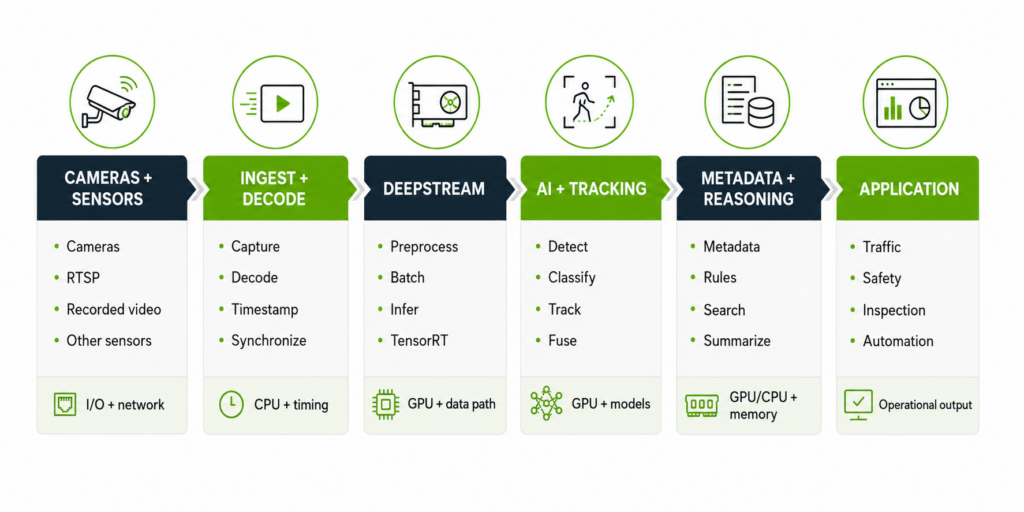
Figure 1. NVIDIA Metropolis applications span cameras, streaming, accelerated processing, ai models, metadata, Edge infrastructure, and the downstream application. CTai LABS evaluates the complete data path rather than treating inference as an isolated step.
CTai LABS capabilities for NVIDIA Metropolis
Video and sensor architecture
A Metropolis application begins with the physical environment. Camera and sensor requirements can be defined around field of view, resolution, frame rate, lighting, distance, motion, synchronization, retention, and analytics goals.
Supported inputs can include GMSL2/3, MIPI CSI-2, FPD-Link III, SDI, HD-SDI, HDMI, IP, and RTSP video, along with application-specific sensors and interfaces requiring additional context.
Camera selection directly affects downstream analytics. Resolution and frame rate influence decoding, memory movement, inference frequency, network traffic, and storage, while lens choice and placement determine whether the model receives useful visual information.
Multi-camera designs also need to account for timestamping, overlapping fields of view, calibration, identity tracking, network topology, and whether analysis occurs independently per camera or across a wider environment.
NVIDIA DeepStream development
NVIDIA DeepStream is a core component of the Metropolis software stack. NVIDIA describes it as a GPU-accelerated SDK for developing end-to-end, real-time streaming vision ai pipelines and agents. DeepStream 9.1 supports NVIDIA Jetson Orin™ and Jetson Thor™ through JetPack™ 7.2 and introduces agentic skills, multi-camera 3D tracking, and automated camera-calibration capabilities (NVIDIA, 2026a).
CTai LABS develops DeepStream applications around live video requirements, including stream ingest, hardware-accelerated decoding, multiplexing, frame preprocessing, model inference, detection, classification, segmentation, object tracking, metadata generation, message brokers, event recording, custom logic, and API connections.
DeepStream can keep significant portions of video processing GPU-accelerated, but end-to-end performance still depends on graph design. Fast inference alone cannot compensate for decoder limits, unnecessary frame conversion, memory movement, poor batching, synchronization issues, tracking overhead, network congestion, or slow downstream services.
Profiling across the DeepStream graph helps isolate the limiting stage instead of assuming the model is responsible.
ai model and NVIDIA TensorRT™ optimization
Metropolis applications can use detection, classification, segmentation, pose, re-identification, vision-language, and other model types depending on the application.
Existing customer models can be incorporated into the video application, or the model architecture can be reassessed against the requirement. Work may include model conversion, preprocessing and postprocessing, TensorRT engine generation, precision selection, quantization, runtime configuration, and benchmarking.
Performance targets should be defined at the application level. A detector may run at a high frame rate while tracking, metadata processing, video transfer, or downstream logic still adds unacceptable latency. Conversely, not every use case needs inference on every frame.
Frame sampling, batching, concurrency, input resolution, model precision, and tracking all change the relationship between compute use and application performance. Related work can extend into CTai LABS ai Model Optimization or TensorRT Optimization services when model execution becomes the limiting factor.
Multi-camera tracking and spatial analytics
Many video analytics applications need to understand what happens over time rather than generate independent detections from individual frames.
NVIDIA DeepStream 9.1 includes a multi-camera 3D tracking skill designed to follow objects across multiple camera views (NVIDIA, 2026a). Enabling the tracker is only one part of the implementation.
Multi-camera analytics may require camera calibration, overlapping or adjacent fields of view, timing consistency, object re-identification, spatial mapping, identity handoff, confidence thresholds, and application rules used to define a meaningful event.
Configuration and validation should use representative camera positions, traffic patterns, lighting, occlusion, and operating conditions.
Metadata, events, alerts, and application interfaces
Detections and observations usually need to become events, state changes, alerts, records, workflows, or machine-readable outputs.
DeepStream metadata can feed databases, APIs, message brokers, dashboards, automation platforms, or customer applications. Useful context may include object attributes, timestamps, camera identifiers, zones, trajectories, event states, confidence values, snapshots, and clips.
Keeping metadata and business logic behind a well-defined interface allows either side to evolve independently. Models, analytics rules, cameras, or compute resources can then change without forcing a rewrite of the downstream application.
Video Search and Summarization and visual ai agents
NVIDIA Metropolis now extends beyond conventional detection and tracking into visual ai agents.
The NVIDIA Blueprint for Video Search and Summarization (VSS) provides reference architectures combining accelerated vision microservices, vision language models, large language models, search, summarization, question answering, alert workflows, object tracking, and multimodal processing (NVIDIA, 2026c).
Some video applications therefore require a different design approach. Conventional computer vision might answer a predetermined question such as whether a vehicle crossed a line or an object entered a restricted zone. A visual ai agent can support broader interactions, including natural-language search, long-form summarization, event questions, alert review, and vision-language reasoning.
Visual-agent capabilities can be connected with video infrastructure, models, compute resources, data sources, and customer applications. Quality targets, response time, data retention, compute sizing, interfaces, and validation remain essential design considerations.
Edge, on-prem, and hybrid architecture
NVIDIA Metropolis supports video applications across Edge, on-prem, and cloud infrastructure (NVIDIA, 2026b). Placement depends on the deployment constraints.
Edge processing can reduce the volume of raw video sent upstream, shorten the distance between sensing and action, and support local operation when connectivity is constrained. Edge-video research identifies those advantages as particularly relevant for latency-sensitive or bandwidth-intensive applications (Badidi et al., 2023; Ma et al., 2024).
Centralized infrastructure can offer a larger shared compute pool, consolidated storage, fleet-level management, and additional resources for heavier analytics or agentic tasks. Many deployments benefit from a mix of local and centralized processing.
Local compute may handle ingest, decoding, initial inference, tracking, and event generation while sending metadata, selected clips, embeddings, or alerts to on-prem or cloud services for longer-term analysis. The appropriate split depends on latency, bandwidth, privacy, connectivity, and scale.
NVIDIA Jetson and accelerated Edge compute
For analytics close to cameras, NVIDIA Jetson provides one option for Metropolis and DeepStream. Larger Edge, server, or on-prem GPU platforms can support higher stream density, model concurrency, storage demand, or visual-agent capacity.
Compute selection should follow measured application demand. Relevant factors include camera count and format, decode requirements, model architecture and precision, inference frequency, tracking, analytics, metadata handling, background services, storage, and operating headroom.
Benchmarking on the target platform can connect the software workload to the broader CTI EdgeAI Stack when the project requires coordinated Edge compute, optimization, and infrastructure.
The objective is to establish a compute architecture with enough measurable headroom for the intended operating conditions, not simply to select the largest GPU available.
Networking, storage, and video retention
Video deployments can become networking and storage projects quickly. Camera count, codec, bitrate, frame rate, resolution, recording policy, and replication all affect infrastructure requirements. Prerecorded files on local storage may perform well while dozens of live streams expose very different bandwidth and I/O constraints.
Network and storage behavior should be profiled alongside ai execution. Decisions may include where raw video is retained, whether only event clips move upstream, how long metadata and embeddings are stored, whether continuous recording is required, and how the application behaves during network interruptions.
The infrastructure should support the ai application without becoming its limiting resource.
Profiling and sustained-load validation
Representative cameras and sustained loads should be used for benchmarking. Useful measurements include per-stream and aggregate frame rate, sensor-to-event latency, decode utilization, GPU and CPU use, memory consumption, model inference time, queueing, frame drops, tracking performance, network throughput, storage throughput, power consumption, thermal behavior, and application response time.
The most useful metric depends on the application objective. Traffic analytics may prioritize event-to-alert latency, inspection may prioritize detection quality at line speed, multi-camera deployments may prioritize aggregate stream density, and video search may prioritize ingestion throughput and query response time.
Measured targets established before optimization provide the basis for final validation.
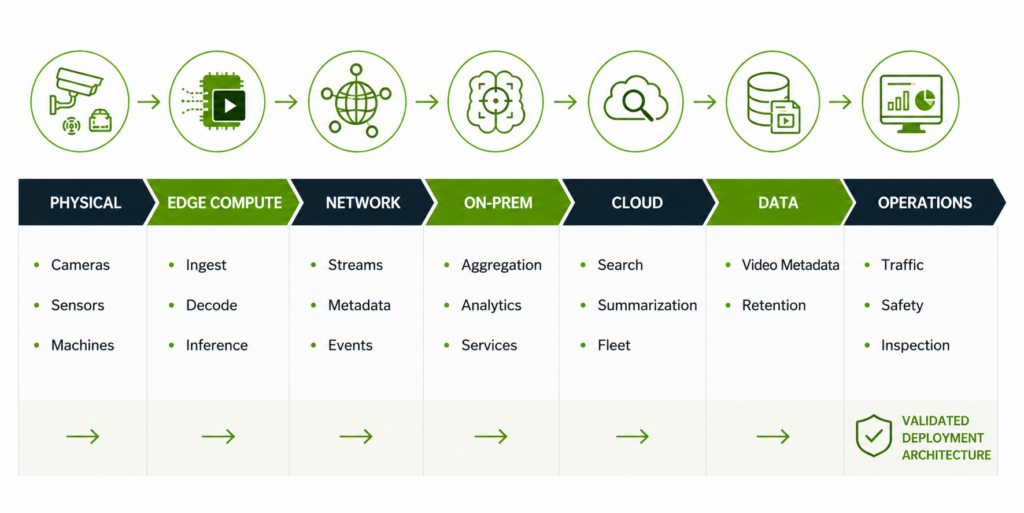
Figure 2. NVIDIA Metropolis can span Edge, on-prem, and cloud infrastructure. Processing placement should reflect latency, bandwidth, data, application, and operating requirements (Badidi et al., 2023; Ma et al., 2024).
Traditional video analytics and visual ai agents can coexist
The move toward agentic video analytics does not make conventional computer vision obsolete. Many operational requirements remain deterministic.
An application may need to count vehicles, detect entry into a defined zone, follow an object across a facility, measure dwell time, inspect a component, or signal when a known condition occurs. Detection, classification, segmentation, and tracking remain efficient tools for these predictable tasks.
Visual ai agents add flexible search, natural-language interaction, summarization, contextual reasoning, and event review over video content. NVIDIA’s current VSS architecture combines real-time video intelligence with downstream retrieval and agent workflows rather than treating the approaches as mutually exclusive (NVIDIA, 2026c).
A practical design may use conventional vision for continuous high-throughput processing and invoke larger vision-language models only when additional context is valuable.
The design decision is where deterministic high-rate processing is sufficient, where deeper reasoning adds value, and how both fit within available compute and latency limits.
Metropolis applications should be designed around the operational question
| Operational requirement | Possible Metropolis capability | Integration questions |
|---|---|---|
| Traffic flow and intersection analytics | Detection, classification, tracking, zones, counting | How many cameras and lanes? What accuracy and latency are required? Does analysis remain local or aggregate centrally? |
| Transit and mobility | Tracking, occupancy, event detection, multi-camera analytics | How are cameras synchronized and networked? What information has to move between locations? |
| Public-space monitoring | Detection, tracking, event rules, visual ai review | What events are relevant? How are false positives handled? What video and metadata should be retained? |
| Industrial safety | Detection, zones, PPE or behavior analytics, alerts | How quickly must the system respond? What happens after an event is detected? |
| Visual inspection | Classification, detection, segmentation | What defect size, line speed, image quality, and quality threshold define success? |
| Retail analytics | Counting, dwell, tracking, zone analytics | What data is needed downstream? Are identities persistent or anonymous? |
| Video search and investigation | VSS, embeddings, natural-language search, summarization | What video is indexed? What query accuracy and response time are required? |
| Agentic event review | Conventional CV plus VLM-based verification | Which alerts require a second-stage reasoning model, and what is the acceptable added latency? |
NVIDIA Metropolis Service versus Scene Analyzer Agent
CTai LABS provides custom Metropolis development for customers needing a tailored architecture, DeepStream implementation, camera and model work, Edge deployment, video infrastructure, application interfaces, or validation. Scene Analyzer Agent is a CTai LABS solution for use cases aligned with a prepared video-analytics and visual-agent architecture, including smart city, transportation, retail, and industrial-safety applications.
| Need | NVIDIA Metropolis Integration | Scene Analyzer Agent |
|---|---|---|
| Starting point | Existing applications, cameras, models, requirements, prototype, or custom architecture | Requirement aligned with the Scene Analyzer solution |
| Primary value | Application-specific engineering and integration | Accelerated solution starting point |
| Typical scope | Architecture, DeepStream, cameras, models, tracking, metadata, Edge compute, APIs, profiling, deployment | Scene and video understanding using the prepared solution architecture |
| Customization | Defined around the customer's system | Adaptation around the solution and use case |
| Best fit | The customer needs a Metropolis system engineered around unique requirements | The use case fits the Scene Analyzer solution pattern |
Customers can move between the two approaches. Scene Analyzer can provide a solution starting point, while a broader Metropolis engagement can address custom cameras, infrastructure, application interfaces, models, performance requirements, or field constraints.
Why CTai LABS for NVIDIA Metropolis
Video analytics spans far more than the model alone. A deployed application can involve camera hardware, drivers, codecs, networking, GStreamer, DeepStream, CUDA, TensorRT, ai models, tracking, databases, message brokers, storage, Edge compute, and customer software.
Dividing those components among vendors can make root-cause analysis difficult. A frame-rate problem may begin at video ingest, poor inference quality may originate with camera placement or preprocessing, high latency may come from data movement, and dropped streams may point to networking or decoder limits. Recorded video can also mask issues that appear only with live cameras, storage, and background services running together.
CTai LABS brings Connect Tech’s embedded hardware and software capabilities together with the broader CTI EdgeAI Stack, reducing handoffs across the project.
NVIDIA Metropolis provides the software foundation for interpreting activity in physical environments. CTai LABS connects those capabilities to cameras, compute, applications, and operational infrastructure.
Support can continue for the portion of development requiring specialized expertise, while the customer retains its application, proprietary logic, product ownership, data, and intellectual property.
Typical NVIDIA Metropolis engagements
- Moving a computer-vision proof of concept into a deployable DeepStream application
- Connecting multiple IP or directly attached cameras to GPU-accelerated video analytics
- Migrating an existing GStreamer or video-processing application to NVIDIA DeepStream
- Adding detection, classification, segmentation, tracking, or other ai models to live video
- Optimizing a DeepStream workload for NVIDIA Jetson or another NVIDIA GPU platform
- Diagnosing dropped frames, excessive latency, high CPU use, memory pressure, decoder limits, or stream-density problems
- Building multi-camera tracking or spatial analytics across a facility, intersection, transportation network, or public space
- Connecting video metadata and events to databases, dashboards, APIs, message brokers, or automation platforms
- Adding VSS-based search, summarization, question answering, or visual-agent functionality to an existing video application
- Combining conventional computer vision with vision-language models for alert verification or deeper event analysis
- Designing an Edge, on-prem, or hybrid architecture for large-scale video processing
- Validating sustained video analytics with representative cameras, networks, storage, power, and thermal conditions
How a CTai LABS Metropolis engagement works
1.
Define the operational requirement
Document what the application needs to observe, detect, understand, search, or trigger. Identify camera and sensor inputs, operating environment, outputs, latency and accuracy targets, retention rules, external services, and field constraints.
2.
Map the video and data flow
Document cameras, codecs, resolutions, frame rates, networking, ingestion, decoding, preprocessing, models, tracking, metadata, storage, and downstream applications. Record where each stage runs and where bottlenecks or missing connection points exist.
3.
Establish a baseline
Measure representative video streams and the current application where one exists. Profile latency, throughput, stream density, CPU/GPU use, memory, networking, frame drops, and analytics performance.
4.
Build the Metropolis application
Develop or refactor the DeepStream pipeline, connect models and TensorRT where required, bring up cameras, add tracking or analytics logic, and establish metadata and application interfaces. VSS or other visual-agent capabilities can be added where they fit the design.
5.
Optimize resource use
Identify limits across ingest, decoding, preprocessing, inference, tracking, memory, network traffic, storage, and application services, then tune the configuration against the defined operating requirement.
6.
Validate with representative conditions
Run the intended camera count, resolution, frame rate, models, network connection, storage configuration, application concurrency, power mode, and thermal conditions. Validate sustained operation rather than relying on a short demonstration.
7.
Handoff and support
Document the validated architecture, software dependencies, models, configuration, interfaces, performance envelope, release process, and known limits. The customer’s engineering team retains ownership of the application and IP, with CTai LABS available for optimization, rollout, or support as required.
Production NVIDIA Metropolis integration depends on more than choosing a model or enabling DeepStream. Cameras, ingest, accelerated processing, models, tracking, metadata, networking, storage, application logic, and compute all must meet the same operating requirement under sustained load. CTai LABS brings those layers together, helping teams move from a proof of concept or existing video application to a validated Metropolis deployment built around the customer’s cameras, infrastructure, and production goals.
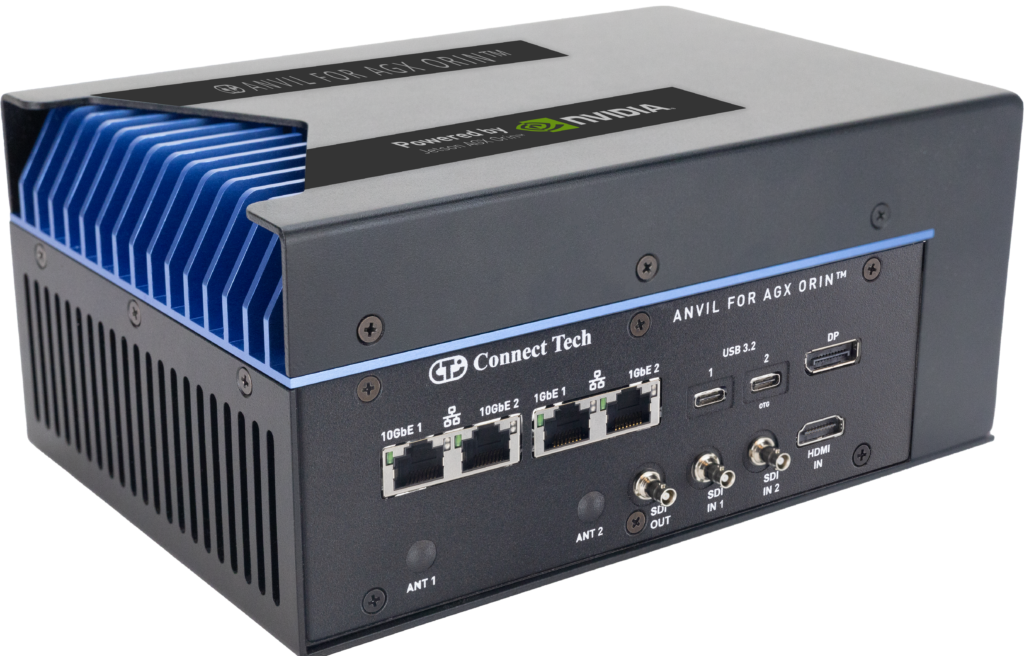
Anvil for Jetson AGX
Built for compute-intensive AI applications, Anvil delivers a rugged, power-efficient platform for autonomous vehicles, smart cities, and vision systems. With high-speed networking, optional camera inputs, expandable storage, and a wide input power range, it provides flexible connectivity for demanding Edge AI deployments.

Anvil-T5 for Jetson T5000
Built for autonomy, engineered for reliability, and powered by NVIDIA Jetson Thor, Anvil-T5 delivers the next leap in Edge AI performance. Designed to handle the most demanding robotic and autonomous workloads, it combines extreme compute capability with rugged, dependable engineering.

Forge (AGX201) with Jetson AGX Orin
The primary platform for logistics automation, warehouse AMRs, and industrial perception applications. Jetson AGX Orin delivers up to 275 TOPS at 15 to 60 watts. Forge provides dual 10GbE plus dual GbE, dual NVMe M.2, and a 155 by 125 mm footprint rated to -40C to +85C. Suited to applications where Jetson AGX Orin compute is sufficient and a compact, rugged carrier is required (Connect Tech, 2022; NVIDIA, 2025b).
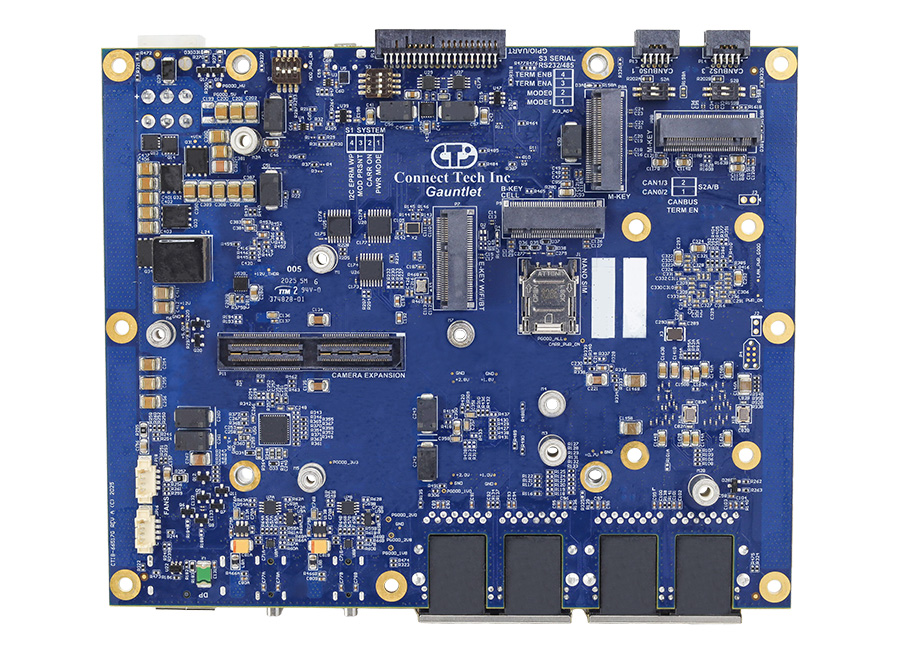
Gauntlet with Jetson Thor (T5000)
For inspection and monitoring applications requiring vision-language-action or multi-model inference, including Scene Analyzer Agent deployments and agentic process monitoring. Jetson Thor delivers 2,070 FP4 TFLOPS at 40 to 130 watts. Supports 16-lane MIPI CSI-2, GMSL3/2/1, FPD-Link III, and dual 10GbE (Connect Tech, 2025).
Book a Demo
Bring the video analytics requirement, camera or sensor architecture, existing application or DeepStream setup if one exists, ai models, expected stream count, target NVIDIA compute platform, and the performance problem the team is trying to solve. CTai LABS will assess the full video flow, identify the Metropolis components and specialist work required, and scope the route to a validated release.

ABOUT THE AUTHOR
Doruk Sönmez, M.Sc.
AI Solutions Architect, CTai LABS
Doruk is an AI Solutions Architect at CTai LABS, the Physical AI and Edge AI services division of Connect Tech Inc., an NVIDIA Elite Partner. An NVIDIA DLI Certified Instructor, he specializes in deploying vision-language models, agentic AI workflows, and accelerated video pipelines on NVIDIA Jetson platforms.
 Learn More
Resources and Frequently Asked Questions
Related
Built with NVIDIA. Explore CTai LABS engineering across NVIDIA Jetson, CUDA, TensorRT, Isaac, Metropolis, and the wider Edge ai software stack.
Explore Built with NVIDIA →Scene Analyzer Agent. Apply video analytics and visual ai to physical environments using a CTai LABS solution for smart cities, transportation, retail, and industrial safety.
Explore Scene Analyzer Agent →Smart Cities & Transportation. See CTai LABS capabilities for traffic, transit, public-space analytics, video intelligence, and connected infrastructure.
Explore Smart Cities & Transportation →NVIDIA Jetson Consulting. Right-size the NVIDIA Jetson platform and work across Edge architecture, sensors, optimization, migration, and field implementation.
See NVIDIA Jetson Consulting →TensorRT Optimization. Optimize inference precision, throughput, latency, memory use, and runtime behavior inside NVIDIA-accelerated applications.
See TensorRT Optimization →System and Sensor Integration. Connect cameras, perception devices, drivers, synchronization, networking, and the sensor-to-inference data flow.
See System and Sensor Integration →Sources
Badidi, E., Moumane, K., & El Ghazi, F. (2023). Opportunities, applications, and challenges of Edge-AI enabled video analytics in smart cities: A systematic review. IEEE Access, 11, 80543–80572.
https://doi.org/10.1109/ACCESS.2023.3300658Ma, H., Ji, B., Wu, H., & Xing, L. (2024). Video data offloading techniques in mobile Edge computing: A survey. Physical Communication, 62, 102261.
https://doi.org/10.1016/j.phycom.2023.102261NVIDIA. (2026a). DeepStream SDK. NVIDIA Developer.
https://developer.nvidia.com/deepstream-sdkNVIDIA. (2026b). NVIDIA Metropolis. NVIDIA Developer.
https://developer.nvidia.com/metropolisNVIDIA. (2026c). NVIDIA Blueprint for Video Search and Summarization (VSS). NVIDIA Documentation.
https://docs.nvidia.com/vss/latest/Xu, R., Razavi, S. N., & Zheng, R. (2023). Edge video analytics: A survey on applications, systems and enabling techniques. IEEE Communications Surveys & Tutorials, 25(4), 2951–2982.
https://doi.org/10.1109/COMST.2023.3323091Frequently Asked Questions
What is NVIDIA Metropolis?
NVIDIA Metropolis is a collection of models, libraries, and blueprints for building, deploying, and scaling video analytics ai agents and applications. Its current software stack spans video ingestion, streaming analytics, computer vision, synthetic data, and agentic video understanding across Edge, on-prem, and cloud environments (NVIDIA, 2026b).
What is NVIDIA DeepStream?
NVIDIA DeepStream is a GPU-accelerated SDK for developing end-to-end, real-time streaming vision ai pipelines and agents. It supports video and multi-sensor ingestion, preprocessing, ai inference, tracking, metadata, and application connections and is a core component of NVIDIA Metropolis (NVIDIA, 2026a).
Can CTai LABS connect an existing computer-vision model with DeepStream?
Yes. Customer models can be connected with DeepStream across preprocessing, postprocessing, TensorRT, precision and quantization, model execution, tracking, metadata, and the surrounding video application.
Can CTai LABS work with existing cameras?
Yes. An engagement can begin with an existing camera network or directly connected camera architecture. Assessment covers resolution, frame rate, codec, synchronization, networking, drivers, data formats, and the connection between camera ingest and Metropolis processing.
Can Metropolis run at the Edge?
Yes. NVIDIA Metropolis supports Edge, on-prem, and cloud use. Video ingestion, inference, tracking, analytics, storage, and agentic processing can be placed according to latency, bandwidth, compute, privacy, and application requirements (NVIDIA, 2026b).
Can CTai LABS optimize the number of video streams a platform can process?
Yes. Stream density depends on the complete workload, including codec and resolution, decode resources, preprocessing, model architecture, precision, inference frequency, tracking, memory, and downstream processing. Profiling shows which resources limit the required stream count.
Does NVIDIA Metropolis support multi-camera tracking?
Yes. NVIDIA DeepStream 9.1 includes a multi-camera 3D tracking skill. Camera calibration, synchronization, spatial mapping, identity handling, and validation against the actual environment may also be required (NVIDIA, 2026a).
What is NVIDIA Video Search and Summarization?
The NVIDIA Blueprint for Video Search and Summarization, or VSS, provides reference architectures for building vision agents and ai-powered video analytics applications using accelerated vision microservices, vision language models, and large language models. Current VSS architecture includes real-time video intelligence, indexing and retrieval, summarization, and question-answering workflows (NVIDIA, 2026c).
Do we need VSS for every Metropolis application?
No. Many video analytics requirements are well served by conventional detection, classification, segmentation, tracking, and event processing. VSS is useful when the application requires natural-language search, video summarization, question answering, visual reasoning, or agentic workflows.
What is the difference between NVIDIA Metropolis and Scene Analyzer Agent?
CTai LABS provides a custom NVIDIA Metropolis service built around the customer’s cameras, software, models, infrastructure, and operating requirements. Scene Analyzer Agent is a CTai LABS solution for video and scene-understanding applications aligned with its prepared architecture.
Does the customer keep its IP?
Yes. CTai LABS works as an extension of the customer’s technical team for the engagement. The customer retains its application, proprietary models and logic, product ownership, data, and intellectual property.
What should we provide to start a Metropolis engagement?
Useful inputs include the video-analytics objective, existing cameras and sensors, resolutions and frame rates, current software, models, target NVIDIA hardware, required outputs, latency and accuracy requirements, network and storage architecture, operating environment, and any existing benchmark or test results.
Ready to Build Smarter?
Let’s create the intelligent Edge AI solution that moves your business forward.