Industries
Industrial Automation:
ai Integration
Machine vision, defect detection, and predictive maintenance that runs on the factory floor, not in a cloud that goes down when the line cannot.
By Kara Price
Senior Marketing & Events Specialist | Content Strategy | Campaign Execution | Connect Tech Inc.
Technical review: Rob Callaghan, Chief Product Officer, Connect Tech Inc.

Key Takeaways
- CTai LABS delivers ai integration for industrial automation: machine vision systems, real-time defect detection, predictive maintenance pipelines, and Scene Analyzer Agent deployments
- All running on-prem on Connect Tech solutions with NVIDIA® Jetson™ modules
- The same team that designs the hardware writes the board support package (BSP) and integrates the ai stack on top of it
- Inference runs at machine speed, survives the factory floor, and never routes production data to an external server
- On-prem, deployment-ready system, not a proof of concept requiring a cloud dependency to function
Industrial automation is moving ai out of isolated pilots and into the production systems that inspect products, monitor equipment, and act on factory-floor data in real time. Machine vision, quality inspection, and predictive maintenance depend on more than model accuracy. The deployed system has to ingest production sensor data, sustain inference within the available compute and thermal envelope, connect to existing operational technology, and continue operating without a cloud dependency.
For manufacturers, that means the question is no longer whether to deploy ai on the factory floor. It is whether the hardware and integration stack can support the ai workloads being built. CTai LABS combines ai architecture and model integration with Connect Tech’s embedded hardware, BSP, sensor, thermal, and deployment expertise to engineer those requirements as one production system.
How CTai LABS integrates ai for industrial automation
CTai LABS approaches industrial automation deployments the same way it approaches every vertical: one team owns the hardware, the BSP, the sensor pipeline, the ai stack, and the validation. The structural position inside Connect Tech means the engineer who writes the BSP is the same engineer who integrates the camera pipeline and validates the vision model against production data.
The Scene Analyzer Agent, one of CTai LABS’ pre-engineered solutions, is directly applicable to industrial inspection: a real-time scene understanding agent that combines vision and spatial reasoning to interpret what a deployed system is seeing, flag anomalies, and generate structured outputs for downstream decision-making. It runs on-prem on Connect Tech Edge hardware without cloud dependency and can be integrated into a production line monitoring system as a validated starting point rather than a greenfield build (CTai LABS, 2026b).
The ScrapGuard™ case study documents this approach applied to a real customer engagement in a recycling facility, where a CTai LABS-built Edge ai vision system detects high-risk materials on a fast-moving conveyor belt and triggers an automated response before the material reaches the shredder. The integration challenges in that engagement, conveyor-speed camera pipeline, on-prem inference, and deterministic response timing, are representative of industrial automation requirements broadly, and ScrapGuard™ has since evolved into an open framework built on what that work uncovered (CTai LABS, 2026a).
The industrial ai opportunity and the deployment gap
The industrial ai market is large and growing quickly by any measure. IoT Analytics puts the global industrial ai market at USD 43.6 billion in 2024, growing at a 23 percent CAGR to USD 153.9 billion by 2030 (IoT Analytics, 2025). The Edge ai in industrial automation market specifically, the segment most relevant to factory-floor deployments, was valued at USD 6.14 billion in 2025 and is projected to reach USD 41 billion by 2033 at a 27.25 percent CAGR (Kings Research, 2026). Hardware led the Edge ai in industrial automation market with USD 4.71 billion in revenue in 2025, reflecting that compute at the factory edge is the constraint that determines whether an industrial ai system can deploy reliably (Kings Research, 2026).
The growth of the market does not mean industrial ai deployments are moving smoothly into production. The Edge AI and Vision Alliance reports that around 70 percent of Industry 4.0 projects stall at the pilot stage (Edge AI and Vision Alliance, 2025). The transition exposes constraints that may not be visible during model development: production data can change model behavior, an inference workload validated on a workstation has to fit the compute, memory, power, and thermal envelope of an embedded system, and factory-floor cameras and sensors require their own drivers, synchronization, and data pipelines. Moving beyond the pilot therefore requires the model, embedded platform, sensor architecture, and software stack to be engineered and validated together. Gartner also identifies semi-autonomous ai agents and closed-loop Digital Twins as technologies expected to play a growing role in manufacturing operations through 2030 (Gartner, 2025). As those systems take on more operational responsibility, the underlying Edge infrastructure has to support increasingly complex ai workloads while maintaining the performance, reliability, and integration requirements of the production environment.
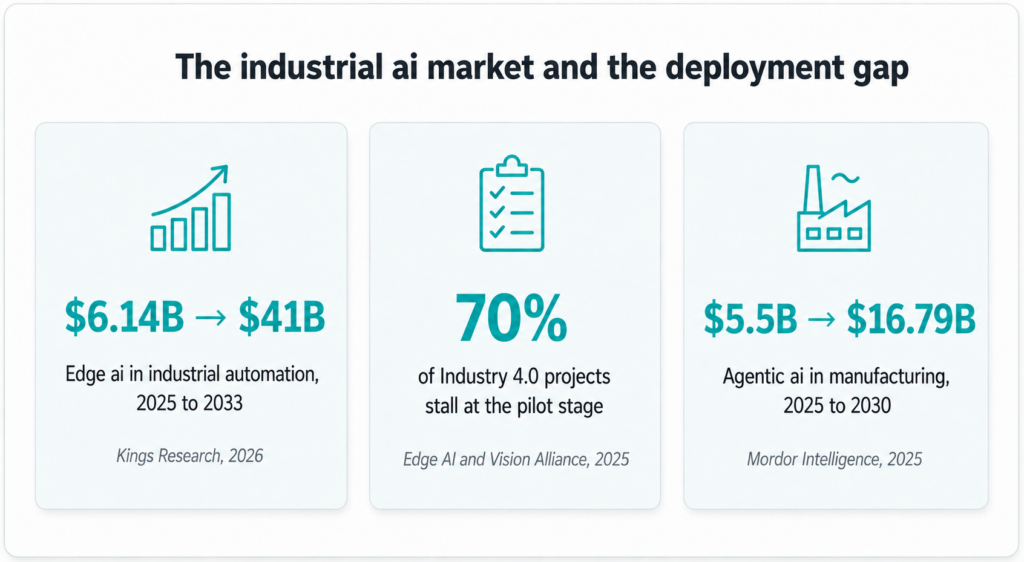
Figure 1. The industrial ai market and the deployment gap. Edge ai in industrial automation is projected to grow from USD 6.14 billion in 2025 to USD 41 billion by 2033 (Kings Research, 2026), while around 70 percent of Industry 4.0 projects stall at the pilot stage (Edge AI and Vision Alliance, 2025). Agentic ai in manufacturing is projected to grow from USD 5.5 billion in 2025 to USD 16.79 billion by 2030 (Mordor Intelligence, 2025).
What makes industrial ai integration hard on the factory floor
Industrial ai deployments introduce integration constraints that are easy to avoid in cloud-based or laboratory environments. Production systems must align ai workloads with sensor interfaces, embedded compute, BSPs and drivers, power and thermal limits, networking, and the physical conditions of the factory floor. Bringing ai architects and embedded engineers into the same deployment workflow allows those dependencies to be addressed together, reducing integration handoffs and helping shorten the path from development to production.

Multi-camera machine vision at production speed
Defect detection and quality inspection require multiple high-resolution camera streams running parallel inference pipelines at production line speed. MIPI CSI-2 and GMSL2 camera buses deliver the bandwidth these pipelines require, but bring-up on these buses requires BSP work. Camera synchronization across multiple inspection points adds a timing coordination layer that must be resolved before any vision model is tuned against production data.

Thermal and environmental tolerance
Factory floors are not controlled environments. Dust, vibration, temperature swings, and condensation are production conditions. The hardware must be rated for them from the start, not hardened after a field failure. Connect Tech carriers operate at -40°C to +85°C and are designed for industrial ingress requirements. Thermal management is engineered into the platform selection, not addressed after the model is deployed.

On-prem data processing requirements
Production data does not leave the facility. Defect images, process sensor readings, and predictive maintenance telemetry are operational IP. Industrial deployments require on-prem inference by policy, not preference, which means the ai stack must run within the facility’s power and network infrastructure without cloud dependency.

Integration with existing production systems
Machine vision systems and predictive maintenance pipelines connect to PLCs, SCADA systems, MES platforms, and historical databases through industrial protocols that most ai integration teams have not worked with. The RESTful API layer and the protocol adaptation work are part of the integration, not an afterthought.
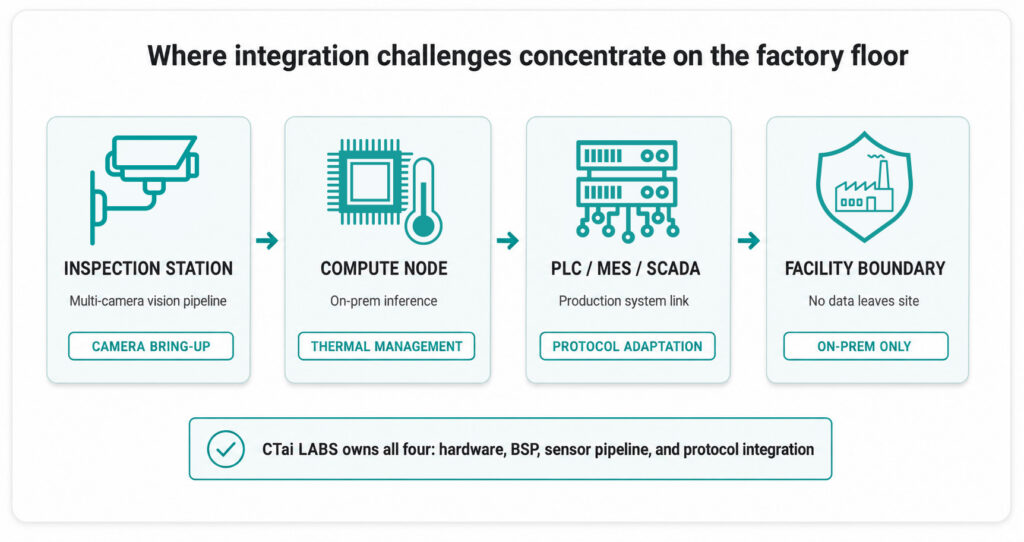
Figure 2. Where industrial AI integration challenges concentrate on the factory floor.
Capabilities for industrial automation
The table below maps CTai LABS’ industrial ai integration capabilities to what each one delivers on the factory floor.
| Capability | What CTai LABS delivers |
|---|---|
| Machine vision pipeline | Multi-camera bring-up across MIPI CSI-2 and GMSL2, synchronized streams for parallel inspection, and TensorRT-optimized inference for real-time defect detection at production line speed. |
| Scene Analyzer Agent | Real-time scene understanding and anomaly detection running on-prem. Structured output for PLC/MES integration. Applicable to quality inspection, process monitoring, and safety compliance. |
| Predictive maintenance | Sensor data ingestion from vibration, temperature, and process sensors, with inference pipelines that flag anomaly patterns before equipment failure. Runs on-prem on Connect Tech Edge hardware. |
| Thermal and rugged integration | Platform selection and ThermiQ™ thermal solution engineering matched to the factory environment. -40°C to +85°C rated carriers. Designed for industrial ingress from the architecture stage. |
| Production system integration | RESTful API and industrial protocol adaptation connecting the Edge ai system to existing PLC, SCADA, MES, and historian infrastructure. |
| SIL/HIL/Digital Twin validation | Full validation pipeline before production deployment, including Software-in-the-Loop, Hardware-in-the-Loop, and Digital Twin testing against production process data. |
Connect Tech hardware for industrial automation
Platform selection for an industrial deployment is driven by goals, camera count, inference workload, thermal environment, and form factor. Primary Connect Tech platforms for industrial automation:
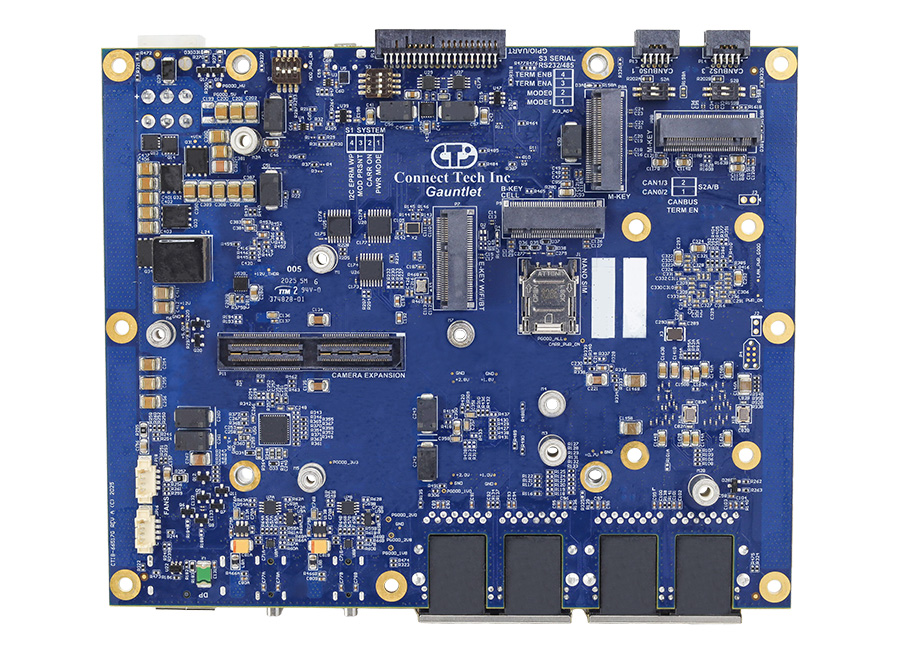
Gauntlet with Jetson Thor (T5000)
For inspection and monitoring applications requiring vision-language-action or multi-model inference, including Scene Analyzer Agent deployments and agentic process monitoring. Jetson Thor delivers 2,070 FP4 TFLOPS at 40 to 130 watts. Supports 16-lane MIPI CSI-2, GMSL3/2/1, FPD-Link III, and dual 10GbE (Connect Tech, 2025).

Forge (AGX201) with Jetson AGX Orin™
The primary platform for high-throughput machine vision and multi-camera inspection. Jetson AGX Orin delivers up to 275 TOPS at 15 to 60 watts. Forge provides dual 10GbE plus dual GbE, dual NVMe M.2, DisplayPort, and a 155 by 125 mm footprint rated to -40°C to +85°C. Well-suited to parallel inspection pipelines and process monitoring applications where Jetson AGX Orin compute is sufficient (Connect Tech, 2022).

Rogue-RX (AGX203) with Jetson AGX Orin Industrial
For mobile or semi-fixed industrial deployments where ruggedized connectors and wide-input power are requirements. Positive-lock I/O, 2x 10GbE, small form factor, rated to -40°C to +85°C (Connect Tech, 2024b).
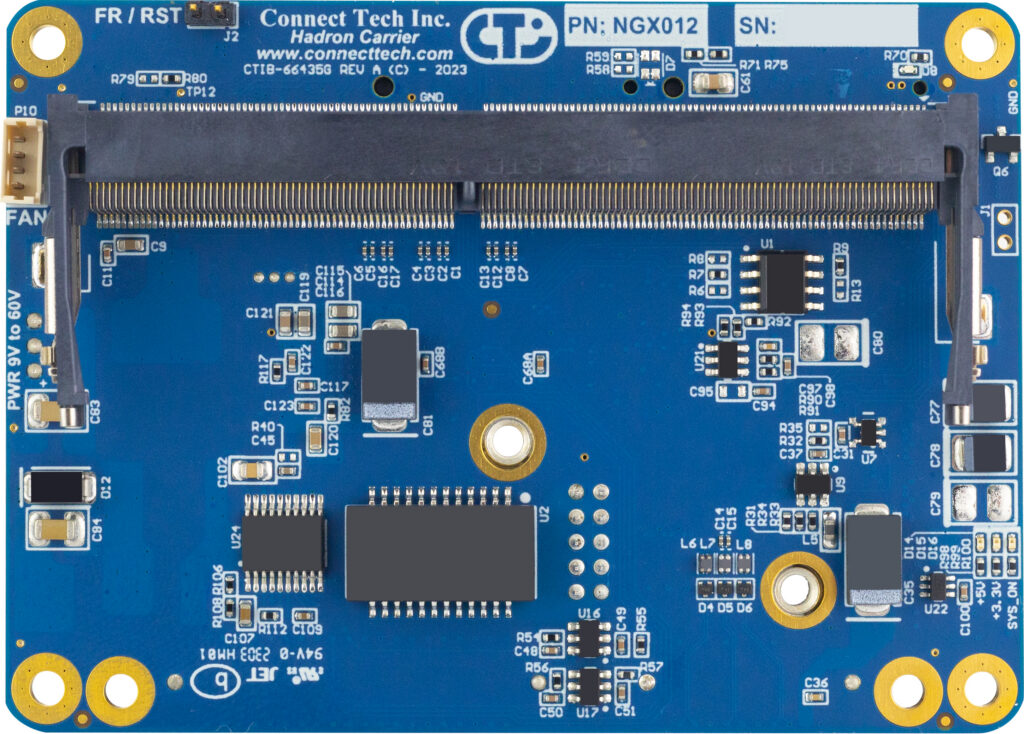
Hadron and Super Hadron with Jetson Orin™ NX and Orin™ Nano
For compact, single- or dual-camera inspection points where a full AGX Orin footprint is not needed. Hadron-DM packs dual 4-lane MIPI CSI-2 camera inputs, a wide 9 to 60 volt input range, and rugged locking I/O into an 82.6 by 58.8 mm, 56 gram footprint, rated to -25°C to +85°C. Well-suited to distributed inspection points and space-constrained enclosures across a production line where each station does not need Gauntlet or Forge class compute (Connect Tech, 2024a).

Anvil-T5 for Jetson T5000
Built for autonomy, engineered for reliability, and powered by NVIDIA Jetson Thor, Anvil-T5 delivers the next leap in Edge AI performance. Designed to handle the most demanding robotic and autonomous workloads, it combines extreme compute capability with rugged, dependable engineering.
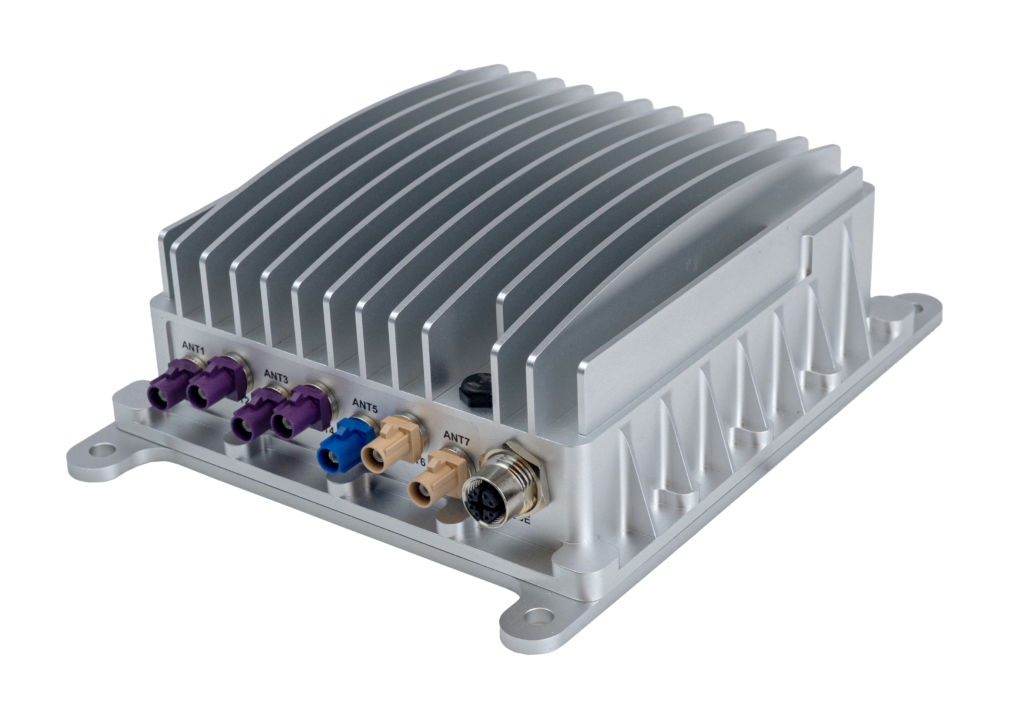
Falcon Vehicle System with Jetson Orin NX
Built for harsh vehicle environments, Falcon is a compact, IP67-rated Edge AI system powered by NVIDIA® Jetson Orin™ NX. Four GMSL2 camera inputs, vehicle-native T1 Ethernet, and two CAN interfaces support camera, sensor, and vehicle integration. Fanless operation and a +9V to +36V input range make it well suited to autonomous heavy equipment and outdoor mobile robotics.
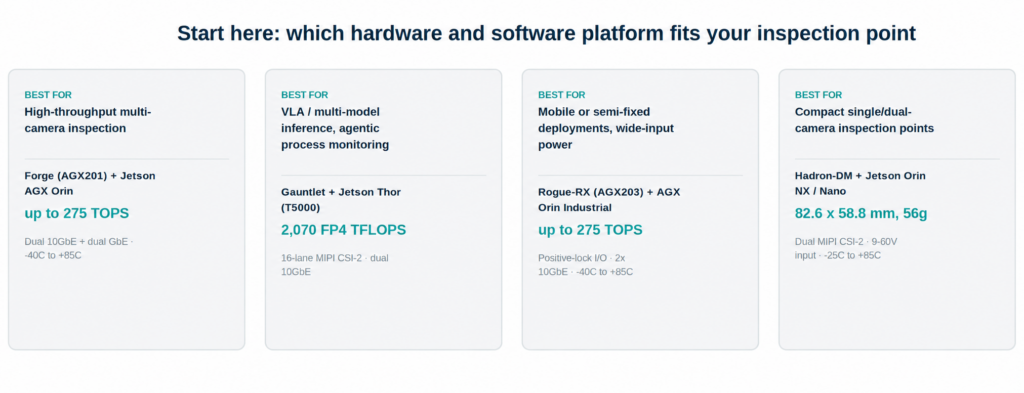
Figure 3. Start here — which platform is best suited?
Industrial automation ai: deeper by topic
The following spoke pages are in development for a future phase. Each covers one industrial automation integration topic in technical depth.

Machine Vision AI
Camera pipeline bring-up, MIPI CSI-2 and GMSL integration, and vision model deployment for industrial inspection.

Quality Inspection and Defect Detection
Real-time defect detection architectures, model training against production data, and validated inspection pipelines.
Predictive Maintenance
Sensor data ingestion, anomaly detection model integration, and maintenance alert architecture on Connect Tech Edge hardware.
Rugged Edge ai
Hardware selection, thermal design, and deployment architecture for industrial environments with extreme temperature, vibration, and ingress requirements.

ABOUT THE AUTHOR
Kara Price
Senior Marketing & Events Specialist | Content Strategy | Campaign Execution |
Connect Tech Inc.
Kara Price is a technology writer covering Edge AI, robotics, and embedded computing for Connect Tech and CTai LABS. Trained in journalism at Humber College with a BA in Communication Studies from Wilfrid Laurier University, she has spent over a decade writing for technical audiences, including four years as a proposal writer in architecture and engineering and ten years publishing product and technical announcements at Connect Tech, an NVIDIA Elite Partner. She is Senior Marketing and Events Specialist at Connect Tech.
 Learn More
Resources and Frequently Asked Questions
Related
Scene Analyzer Agent. Pre-engineered scene understanding and anomaly detection solution for industrial monitoring, running on Connect Tech hardware.
See Scene Analyzer Agent →ScrapGuard™ Case Study. A real customer Edge ai vision engagement for a recycling facility. Real conveyor-speed inspection on Connect Tech hardware.
See ScrapGuard Case Study →ai Integration Services. The full-stack engagement model from architecture through deployment-ready handoff and production support.
See ai Integration Services →Industries We Typically Serve. CTai LABS verticals, but we can integrate for most businesses.
See Industries →Services. The full range of CTai LABS engagements, from proof of concept through consulting and dedicated engineering teams.
See Services →Sources
Connect Tech. (2022, May 25). Product launch: Introducing Forge, first carrier board for NVIDIA Jetson AGX Orin.
https://connecttech.com/product-launch-introducing-forge-first-carrier-board-for-nvidia-jetson-agx-orin/Connect Tech. (2024a). Hadron-DM carrier board for NVIDIA Jetson Orin NX.
https://connecttech.com/product/hadron-dm-carrier-for-nvidia-jetson-orin-nx/Connect Tech. (2024b, March 1). Rogue-RX: Empowering AI in rugged conditions.
https://connecttech.com/rogue-rx-empowering-ai-rugged-conditions/Connect Tech. (2025, May 13). Connect Tech leads market with Jetson Thor carrier powered by NVIDIA Blackwell.
https://connecttech.com/connect-tech-leads-market-jetson-thor-carrier-nvidia-blackwell/CTai LABS. (2026a). Recycling explosion detection (ScrapGuard).
https://ctailabs.ai/case-studies/recycling-explosion-detection/CTai LABS. (2026b). Scene Analyzer Agent.
https://ctailabs.ai/edge-ai-solutions/scene-analyzer-agent/Gartner. (2025, December 10). Manufacturing predicts 2026: AI agents, digital twins and the race to autonomous operations.
https://www.gartner.comEdge AI and Vision Alliance. (2025, December 1). Why Edge AI struggles towards production: The deployment problem.
https://www.edge-ai-vision.com/2025/12/why-edge-ai-struggles-towards-production-the-deployment-problem/IoT Analytics. (2025, September 9). Industrial AI market: 10 insights on how AI is transforming manufacturing.
https://iot-analytics.com/industrial-ai-market-insights-how-ai-is-transforming-manufacturing/Kings Research. (2026, May). Edge AI in industrial automation market size and forecast 2026–2033.
https://www.kingsresearch.com/report/edge-ai-in-industrial-automation-market-3059Mordor Intelligence. (2025). Agentic AI in manufacturing and industrial automation market size and forecast 2025–2030.
https://www.mordorintelligence.com/industry-reports/agentic-artificial-intelligence-in-manufacturing-and-industrial-automation-marketNVIDIA. (2025). Jetson AGX Orin product specifications; Jetson Thor T5000 product specifications.
https://www.nvidia.com/en-us/autonomous-machines/embedded-systems/Frequently Asked Questions
What industrial ai workloads does CTai LABS integrate?
Machine vision and defect detection, quality inspection, predictive maintenance camera, Scene Analyzer agent deployments, and process monitoring. All integrations run on Connect Tech carrier boards with NVIDIA® Jetson™ modules, within the facility’s power and network infrastructure, without cloud dependency.
Can the ai system connect to our existing PLC or MES?
Yes. As part of the scope, CTai LABS builds the RESTful API layer and handles the protocol adaptation that connects the Edge ai system to existing PLC, SCADA, MES, and historian infrastructure, etc. Integration is part of the engagement scope, not a separate project.
What camera interfaces does CTai LABS support for machine vision?
MIPI CSI-2 and GMSL2/3 are the primary camera buses for industrial vision applications on Connect Tech hardware. FPD-Link III is also supported. Camera bring-up across multiple synchronized streams is performed by the same team that wrote the BSP. For single- or dual-camera inspection points where a full Jetson AGX Orin platform is not needed, Hadron-DM provides dual 4-lane MIPI CSI-2 in a compact, rugged footprint.
How is production data kept on-prem?
The ai inference stack runs entirely on the Connect Tech Edge platform within the facility. No production data is routed to an external server as part of the CTai LABS integration. The deployment architecture is designed for on-prem data processing from the first architecture review, helping organizations keep sensitive production data, proprietary processes, and operational information within their own environment. Customer data, applications, and IP remain confidential and under the customer’s control throughout the engagement.
What is the Scene Analyzer Agent and how does it apply to manufacturing?
The Scene Analyzer Agent is a pre-engineered CTai LABS solution that combines vision and spatial reasoning to interpret a live scene, flag anomalies, and generate structured outputs for downstream systems (CTai LABS, 2026b). It applies directly to quality inspection, process monitoring, and safety compliance on the production line, and is available as a validated starting point for industrial monitoring deployments.
Does CTai LABS handle thermal design for factory environments?
Yes. Thermal is engineered in from the architecture stage, not addressed after an on the floor failure. CTai LABS selects and integrates ThermiQ™ cooling matched to the module and power mode. Connect Tech carriers are rated to -40°C to +85°C. The thermal solution is part of the platform selection, not an afterthought.
What is the ScrapGuard case study and what does it demonstrate?
ScrapGuard is a CTai LABS Edge ai vision system built for a real customer engagement in a recycling facility that detects high-risk materials on a fast-moving conveyor belt and triggers an automated response before the material reaches the shredder (CTai LABS, 2026a). It demonstrates real-time industrial inspection on Connect Tech hardware, running on-prem, at production speed, saving downtime and injuries. The full case study is available on the CTai LABS Case Studies page.
How long does an industrial ai integration engagement take?
Timeline depends on inspection complexity, camera count, existing system integration requirements, and validation depth. Industrial clients have tighter go-to-market timelines with CTai LABS because all scoping through to testing and deployment is created in-house. CTai LABS scopes the timeline during the discovery and architecture stage. Deployments with well-defined inspection requirements and standard camera interfaces move faster than greenfield builds with legacy protocol integration.
Ready to Build Smarter?
Let’s create the intelligent Edge AI solution that moves your business forward.