CTai LABS
Frequently Asked Questions
Bring your goal. CTai LABS helps connect the engineering needed to move it forward.
CTai LABS, a department of Connect Tech Inc.
CTai LABS, a department of Connect Tech, helps you develop and integrate Physical ai and Edge ai systems, from hardware and sensors through software, model optimization, validation, and deployment. An engagement can begin with an idea, architecture question, dataset, trained model, prototype, or existing system that needs improvement. These frequently asked questions explain the capabilities, project considerations, and technical decisions involved in turning your application into a working system.
About CTai LABS and Connect Tech
What does CTai LABS do?
CTai LABS provides engineering services for Physical ai and Edge ai systems. The work connects compute hardware, cameras, sensors, embedded software, ai models, application logic, and deployment requirements. You can engage CTai LABS for a defined technical problem or for engineering across multiple stages of a product program.
How is CTai LABS connected to Connect Tech?
CTai LABS is a department of Connect Tech. Connect Tech provides the embedded hardware foundation, more than 40 years of experience, and in-house engineering and manufacturing capabilities, while CTai LABS integrates the ai and application layers around that foundation. This connects software decisions with the hardware and operating conditions of the intended product.
What makes CTai LABS different from a general ai consultancy?
CTai LABS focuses on ai that must operate within physical systems. Its engineering scope includes sensors, interfaces, embedded software, compute limits, power, cooling, and system validation alongside model behavior. Connect Tech’s in-house capabilities help resolve problems that cross the boundary between hardware and software. Projects are built for real-world Physical ai applications, not just simulated environments where many projects may fail.
What is the CTI EdgeAI Stack?
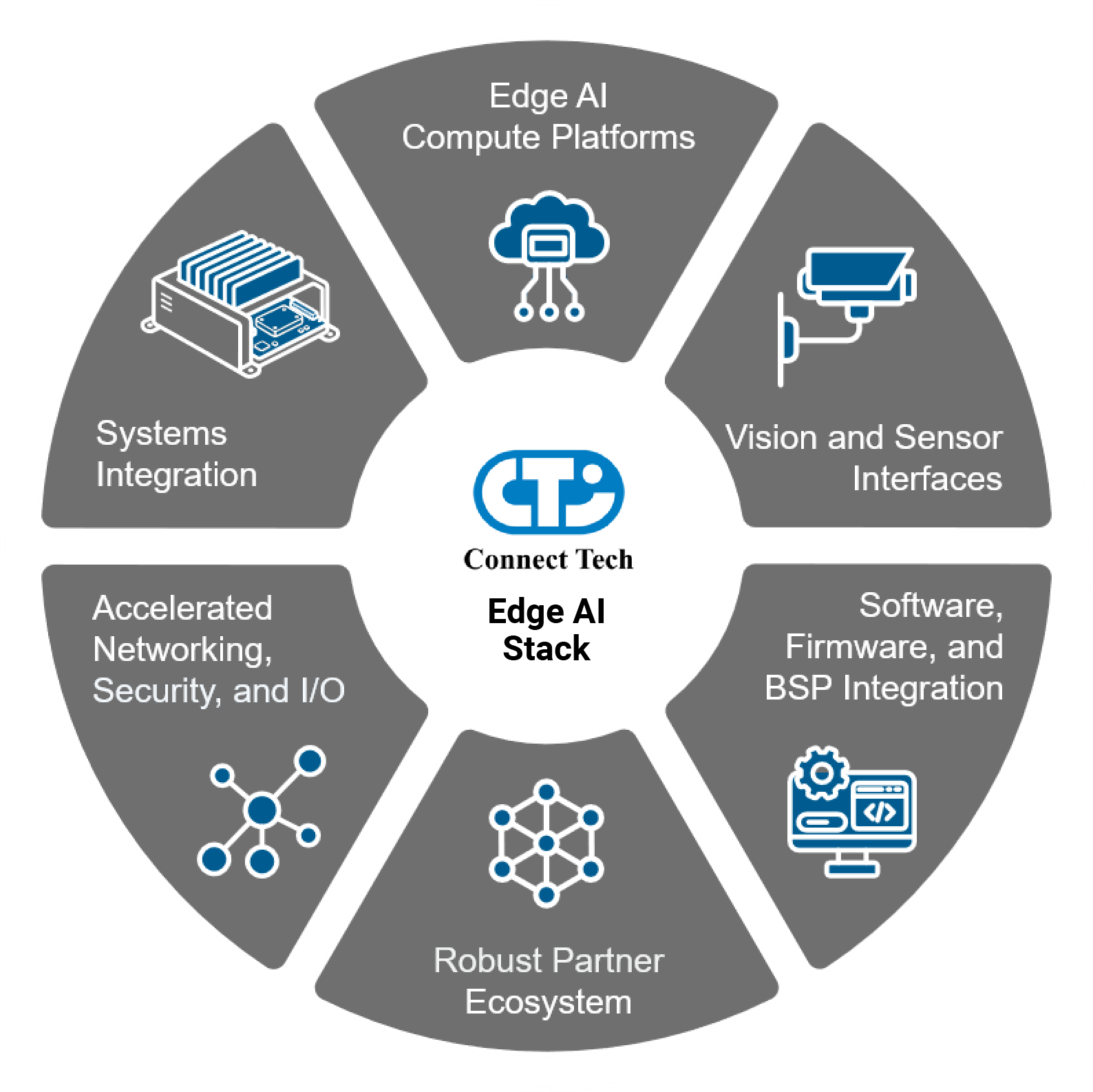
The CTI EdgeAI Stack brings together the compute platforms, sensor interfaces, embedded software, networking, security, and I/O needed for Edge ai systems. CTai LABS helps integrate those layers around your application. The relevant configuration depends on what the system must sense, process, communicate, and do.
Who is CTai LABS for?
CTai LABS works with engineering and product teams developing robotics, industrial vision, autonomous systems, and other sensor-rich applications. It is relevant to teams defining a new product, moving beyond a prototype, or resolving a deployment constraint. The starting point can be a business goal or a specific engineering issue.
Does CTai LABS replace our engineering team?
CTai LABS can work alongside your engineering team on the parts of the system that need additional integration expertise. You retain your product direction, domain knowledge, and intellectual property. Responsibilities and technical interfaces are defined around the work required for the engagement.
Is CTai LABS an NVIDIA Elite Partner?
Connect Tech holds the NVIDIA Elite Partner designation; CTai LABS is its ai engineering department. That relationship provides context for CTai LABS’ NVIDIA platform expertise. The practical value for your project comes from applying that expertise to hardware selection, software integration, optimization, and validation.
Further reading: About CTai LABS | NVIDIA ecosystem
Who is on the CTai LABS team?
Rob Callaghan, P.Eng. is the Chief Product Officer and Doruk Sonmez is the ai Solutions Architect. Each project is supported by large engineering teams across CTai LABS and Connect Tech.
Getting Started and Working Together
Can CTai LABS help if we only have an idea?
Yes. CTai LABS can start with the outcome you want to achieve and help identify the requirements, system architecture, and technical questions that need to be resolved. You do not need a finished specification, selected platform, or working prototype to begin discussing the project.
Can CTai LABS join a project that is already underway?
Yes. CTai LABS can join during architecture, prototyping, integration, optimization, validation, or deployment preparation. The first task is to understand the existing system and the problem blocking progress. That creates a basis for focused work without assuming the whole application needs to be rebuilt.
What should we bring to the first conversation?
Describe the use case, what exists today, the intended operating environment, and the outcome you need. Models, sensor specifications, hardware details, diagrams, logs, and performance targets are useful when available. If key inputs are missing, identifying those gaps can become part of the initial engineering work.
Do we need to know which service to request?
No. Start with the problem you need to solve, such as unreliable camera streams, excessive memory use, slow inference, or uncertainty about production hardware. CTai LABS can help determine which engineering disciplines are involved and where an initial assessment would provide the most useful evidence.
Can CTai LABS work with our existing model and software?
Yes. Existing models, code, robotics software, and application components can be assessed as part of an engagement. CTai LABS examines their current behavior, dependencies, and compatibility with the intended platform. The scope can then focus on the changes needed for integration or deployment.
Can we start with one technical problem?
Yes. A defined problem, such as sensor bring-up, model conversion, memory pressure, or a platform migration, can provide a focused starting point. The work still considers the surrounding system because a local change can affect timing, resource use, interfaces, or application behavior elsewhere.
What if our requirements are still changing?
Begin by separating known requirements from assumptions and open questions. CTai LABS can help establish a baseline and identify which uncertainties need measurement or prototyping. As new findings emerge, their effect on architecture, deliverables, and project scope can be assessed before further work is defined.
Further reading: Edge ai consulting | Full-stack engineering
Project Scope Costs and Deliverables
How much does a CTai LABS project cost?
Project cost depends on the engineering work required. Relevant factors include the starting condition, hardware and sensor complexity, software dependencies, performance targets, and validation requirements. A focused assessment and a complete integration program have different scopes, so pricing needs to be tied to defined deliverables.
How long does a project take?
The timeline depends on scope, available inputs, hardware readiness, integration dependencies, and the evidence required at completion. A model optimization task differs from a program involving custom hardware and multiple sensors. Milestones should reflect the specific work and decisions needed to move your system forward.
Can a project be divided into phases?
A phased approach can separate feasibility, architecture, integration, optimization, and validation into defined work packages. This is useful when an early result will determine the next engineering decision. Each phase should have a clear question to answer, expected outputs, and criteria for evaluating the result.
What will we receive at the end of an engagement?
Deliverables depend on the agreed scope. They can include architecture recommendations, configured hardware, integrated sensor pipelines, optimized models, software configurations, measured performance results, and handoff documentation. The scope should identify what your team will be able to use, test, integrate, or deploy when the work is complete.
How is project success measured?
Success is measured against the requirements of your application. Criteria can include detection quality, response time, throughput, memory use, power, thermal behavior, sensor synchronization, and recovery from faults. CTai LABS can help turn a broad goal into technical measures that can be tested on the intended system.
How can CTai LABS help reduce development time?
CTai LABS connects ai integration with Connect Tech’s hardware and embedded engineering capabilities. That can reduce repeated handoffs, expose platform constraints earlier, and make it easier to trace problems across the system. The effect on your schedule depends on the project’s starting point and dependencies.
Can CTai LABS guarantee a particular performance improvement?
A useful performance target must be tied to a defined workload, hardware configuration, and test method. Improvement cannot be assumed before the current system is measured. CTai LABS can establish a baseline, identify constraints, and evaluate changes against the quality and operating requirements that matter to your application.
Further reading: Edge ai consulting | ai integration services
Understanding Physical ai and Edge ai
What is Physical ai?
Physical ai enables machines to interpret information from the physical world and use it to inform decisions or actions. Robotics, autonomous equipment, and vision-guided automation are examples. CTai LABS connects the sensing, compute, software, and integration layers needed to apply those capabilities to a defined task.
What is Edge ai?
Edge ai runs ai processing on or near the equipment producing the data. A robot, industrial computer, or local vision system can process sensor inputs without sending every input to a remote service. Platform selection depends on the required response time, workload, power, memory, and operating environment.
How are Physical ai and Edge ai different?
Physical ai describes the system’s interaction with the physical world. Edge ai describes where processing happens. They often overlap: a robot may use local ai to interpret its surroundings and inform navigation. An Edge ai application can also analyze data without directly controlling physical equipment.
What is Agentic ai in a physical system?
Agentic ai uses models and software tools to carry out steps toward a defined goal. In a physical system, those steps might include interpreting observations, retrieving context, or proposing a task. Permissions, validation, and the interface to machine control must be designed around the intended application.
When does local ai processing make sense?
Local processing can suit applications with response-time requirements, limited connectivity, large sensor streams, or a need to keep processing on-site. The decision also depends on device resources and operational needs. CTai LABS can assess where inference should run within the complete architecture.
Can Edge ai and cloud systems work together?
Yes. A hybrid architecture can keep time-sensitive processing near the equipment while using remote systems for functions such as analysis or model distribution. The design needs to define which operations depend on connectivity and what happens when that connection is unavailable.
Does every Physical ai application need a language model?
No. Some tasks are better served by a focused vision model, a state estimator, or conventional application logic. Language and vision-language models can add value when the task requires interpretation or interaction beyond a fixed output. Model selection should follow the application’s quality and resource requirements.
Further reading: Edge and cloud inference | CTai LABS resources
What ongoing support does CTai LABS have?
When the project is scoped, CTai LABS and Connect Tech will define the appropriate approach based on your requirements. CTai LABS and Connect Tech also provide Board Support Packages (BSPs) to support platform bring-up, hardware integration, and deployment.
Full Stack Engineering and Integration
What does full-stack ai engineering include?
Full-stack ai engineering connects the layers needed to operate an ai application on its target system. Work can span architecture, compute hardware, board support software, sensors, inference, application logic, and validation. CTai LABS considers how those layers behave together within your deployment requirements.
Why is model development only one part of the system?
A model depends on the data it receives and the software and hardware that execute it. Image capture, preprocessing, memory movement, scheduling, and downstream application logic can all affect the final result. A useful model benchmark therefore needs to be connected to measurements of the complete application.
What is a board support package (BSP)?
A board support package, or BSP, provides platform-specific software needed to operate the hardware. It can include boot configuration, operating-system components, drivers, and device configuration. The correct BSP and software baseline are part of bringing up sensors and applications on a Connect Tech platform.
Can CTai LABS integrate ai with existing equipment?
CTai LABS can assess how an ai pipeline should exchange information with existing machines and control systems. The work depends on available interfaces, timing requirements, and the action the receiving system must perform. Integrating a detection output requires more than establishing a network connection.
Can CTai LABS help with PLC and industrial interfaces?
Industrial integration can include connecting application outputs to PLCs and other control interfaces within the agreed scope. Requirements should define message content, response timing, acknowledgement, and fault handling. The machine’s control and safety design determines how an ai output is allowed to influence operation.
Can CTai LABS help move an application from x86 to Jetson?
Yes. Migration work can assess software dependencies, processor architecture, drivers, interfaces, model execution, and performance on NVIDIA® Jetson™. CTai LABS can help adapt and validate the application on a Connect Tech platform. The amount of change depends on the original implementation and target configuration.
Further reading: x86 to Jetson migration
How does CTai LABS investigate an integration problem?
Investigation starts with a reproducible symptom and a known system configuration. Logs, recordings, timing measurements, and resource traces help identify where behavior changes across the data path. The goal is to isolate the cause and verify a correction against the application’s requirements.
Further reading: Full-stack engineering | System and sensor integration
Hardware and Platforms
How is the right compute platform selected?
Platform selection starts with the workload and deployment constraints. Relevant factors include model size, sensor inputs, memory, response time, power, cooling, physical space, and interfaces. CTai LABS connects those requirements with Connect Tech hardware options and evaluates the resulting configuration against the intended application.
Can CTai LABS help select Connect Tech hardware?
Yes. CTai LABS can work with Connect Tech’s hardware expertise to identify an appropriate platform and interface configuration. Connect Tech products such as Forge, Rogue, Hadron, and Boson provide different integration options. Selection needs to use the specifications of the exact product and module combination.
Does CTai LABS work with other platforms?
Yes. CTai LABS works across a range of embedded and Edge computing platforms, including Toradex, Qualcomm, x86, COM Express, and other custom embedded architectures. Platform selection is based on the requirements of the application, including compute performance, power, environmental constraints, sensor and I/O needs, software compatibility, and the path to production.
Should we choose Jetson Orin or Jetson Thor?
The choice depends on your workload, memory needs, software compatibility, power budget, and product constraints. A newer platform is not automatically necessary for every application. Benchmarking representative workloads helps establish whether a particular Jetson configuration meets the required performance with sufficient operating headroom.
Further reading: Jetson Orin vs Jetson Thor
When should we consider NVIDIA IGX?
NVIDIA IGX is relevant to sensor-rich industrial and medical platforms with requirements extending beyond inference performance. CTai LABS can assess the platform alongside networking, software, timing, and system assurance needs. The decision should be made at system level, including the surrounding Connect Tech hardware.
Does a development kit represent the finished product?
A development kit is useful for evaluating software and proving a concept. A production design also needs the appropriate interfaces, power system, cooling, mechanical integration, and deployment software. CTai LABS can help identify the engineering gaps between a development setup and the intended product configuration.
Can CTai LABS work with customer-selected sensors and software?
Yes. Customer-selected components can be assessed for integration into the system. Compatibility depends on interfaces, drivers, timing, compute requirements, and the chosen platform. Technical discovery establishes which components fit the architecture and where additional engineering or a different configuration may be needed.
How are rugged deployment requirements handled?
Rugged requirements begin with the actual environment, including temperature, vibration, dust, moisture, power quality, and connectivity. These inputs guide the choice of Connect Tech hardware and system design. Environmental ratings and test claims must refer to the specific product and configuration being considered.
Further reading: Jetson Orin and Jetson Thor | NVIDIA IGX consulting
Cameras Sensors and Perception
Can CTai LABS help select cameras and sensors?
Yes. Sensor selection can be considered alongside the task, scene, mounting location, operating environment, and compute platform. Image quality, field of view, timing, interfaces, and data rates all influence the design. The objective is to acquire the information the application needs within the system’s constraints.
What does camera integration involve?
Camera integration can include electrical and software interfaces, drivers, capture configuration, synchronization, calibration, and data delivery to the application. Connecting a camera is only the starting point. The pipeline must preserve the image quality and timing needed for perception on the target Connect Tech hardware.
Further reading: Connect Tech Supported Cameras Table
Can CTai LABS integrate multiple cameras?
Yes. Multi-camera work can include camera placement, synchronized capture, calibration, data transport, and concurrent processing. Camera count alone does not establish feasibility. Resolution, frame rate, buffering, model workload, and available resources must be evaluated together on the selected system.
What is the difference between perception and sensor fusion?
Perception interprets observations, for example by identifying objects or estimating scene geometry. Sensor fusion combines complementary measurements to estimate a state such as position or motion. A robot can use both, with perception results contributing to a broader estimate of its surroundings and behavior.
Which sensors can be considered for fusion?
CTai LABS’ sensor-fusion work can consider cameras, LiDAR, radar, GNSS, IMUs, encoders, and other application-specific measurements. The selection depends on the state the system needs to estimate. Timing, coordinate frames, calibration, and uncertainty must be addressed before combining the measurements.
Why do synchronization and calibration matter?
Sensors can observe different moments or describe measurements in different coordinate frames. If those differences are not handled correctly, the combined result can be misleading even when individual sensors work properly. Synchronization and calibration connect the observations to a consistent interpretation of the scene or motion.
Can CTai LABS help when perception works in the lab but fails in the field?
Yes. Investigation can examine representative recordings, lighting changes, motion, occlusion, camera settings, and system performance. The issue may involve the model, sensor configuration, data coverage, or integration. Corrective work should be validated against the conditions that caused the original failure.
Further reading: Sensor integration | Sensor fusion
Robotics Autonomy and Simulation
What robotics engineering can CTai LABS provide?
CTai LABS can work across robotics software, perception, sensor fusion, compute integration, and deployment validation. The engagement can focus on one subsystem or the interactions between several. Robot behavior needs to be evaluated on the intended hardware and within the environment where it will operate.
Can CTai LABS develop or improve a ROS 2 system?
Yes. Our extensive experience in ROS 2 work includes architecture, interfaces, sensor integration, launch behavior, performance profiling, and validation. CTai LABS can begin with a new design or an existing software graph. The work connects application behavior with the resources and timing constraints of the robot’s compute platform.
How does NVIDIA Isaac ROS fit into a project?
NVIDIA Isaac™ ROS provides accelerated components that can support robotics perception and related processing. CTai LABS can assess where those components fit an existing or new ROS 2 architecture. Compatibility and performance must be evaluated within the full application rather than assumed from an isolated component.
Can CTai LABS help with autonomous mobile robots?
Yes. Autonomous mobile robot work can include sensing, localization, perception, software integration, compute selection, and system testing. Requirements depend on the environment, payload, motion, and intended interaction with people or equipment. Each capability needs to be integrated into the robot’s overall operating architecture.
Can CTai LABS contribute to humanoid robot development?
CTai LABS can contribute to the compute, sensing, perception, software, and integration layers of a humanoid program. The appropriate scope depends on the robot’s existing architecture and development stage. Application-level ai must be coordinated with the robot’s motion-control and safety requirements.
How are simulation and digital twins useful?
Simulation can help test software behavior and explore scenarios before or alongside physical testing. Digital twins can connect representations of equipment or environments with engineering workflows. CTai LABS can incorporate NVIDIA Isaac Sim and Omniverse where they support the project’s specific development and validation needs.
Further reading: Physical ai Evaluation Kit
Can simulation replace testing on the real robot?
No. Simulation is useful for repeatable scenarios, but physical sensors, contacts, timing, and environmental conditions can differ from the simulated environment. Validation on the real platform is needed to assess those differences. The test plan should connect simulation results with evidence from the intended operating conditions.
Further reading: ROS 2 development | Simulation and digital twins
Models Memory and Performance
Can CTai LABS optimize a trained model for Edge deployment?
Yes. CTai LABS can assess a trained model within its target application and hardware configuration. The work can address model execution, preprocessing, memory, and runtime behavior. A useful optimization preserves the required output quality while improving a constraint that matters to the deployed system.
What does TensorRT optimization involve?
NVIDIA TensorRT™ optimization can include model conversion, engine configuration, precision choices, shape handling, profiling, and runtime integration. CTai LABS evaluates these choices on the intended NVIDIA platform. The result must be assessed against both inference behavior and the application’s quality requirements.
Does reduced precision always preserve accuracy?
No. Reduced precision can change model outputs, and its effect depends on the model, data, and implementation. Validation should compare the optimized model with the baseline using representative inputs and task-specific measures. A speed improvement is useful only if the resulting behavior still meets the requirement.
What uses memory besides the model?
Memory is also consumed by the operating system, application services, sensor buffers, intermediate tensors, runtime allocations, and caches. Concurrent workloads can increase the combined requirement. CTai LABS profiles the complete system to identify where memory is used and how much headroom remains during operation.
Can memory optimization help us use a smaller module?
It can, when measurement shows that the complete workload fits reliably within the smaller configuration. CTai LABS can investigate unnecessary allocations, buffering, runtime settings, and concurrency. A lower-memory option needs validation for the customer’s application; a result from another workload does not establish that fit.
Can multiple ai models run on the same device?
Multiple models can share a device when the combined workload fits its compute, memory, power, and timing limits. Their interaction matters: a configuration that runs each model separately may behave differently when they run together. CTai LABS can measure that combined behavior on the target platform.
Why is inference speed different from end-to-end response time?
Inference speed measures one part of the pipeline. End-to-end response time also includes acquisition, preprocessing, queues, data transfers, postprocessing, and communication with the receiving application. CTai LABS can profile that full path to identify which stage limits the response the system needs to deliver.
Further reading: TensorRT optimization | Memory optimization
Industries and Applications
Which industries does CTai LABS work with?
CTai LABS works primarily with robotics and logistics, industrial automation, aerospace and defense, and construction, agriculture, and mining. It covers smart cities and transportation, healthcare, retail, and autonomous vehicles, but can work with almost any application. The engineering scope is defined by the application and operating requirements within each industry.
How can CTai LABS help industrial automation teams?
Industrial work can connect cameras, ai inference, embedded compute, and existing equipment for inspection or process monitoring. Requirements will define the target condition, operating speed, acceptable errors, and downstream response. Integration and validation establish how the result will be used in the production workflow.
Can ai be used for quality inspection and defect detection?
Yes. Vision applications can be developed to identify defined defects or departures from an expected condition. Feasibility depends on whether the defect is observable, how images are captured, and the available examples. Testing should measure missed defects and false detections under representative production conditions.
Can CTai LABS help with predictive maintenance?
CTai LABS can help connect equipment measurements, local processing, and application logic for condition monitoring and predictive-maintenance workflows. The useful approach depends on available signals and the maintenance decision being supported. Data quality and evidence linking a signal to a meaningful condition are central to the design.
What matters for construction, agriculture, and mining applications?
These applications often combine changing outdoor conditions with vibration, contamination, constrained connectivity, and vehicle interfaces. The architecture must account for sensing, power, rugged hardware, and the required decision or action. CTai LABS can help connect those requirements to a suitable Connect Tech compute foundation.
Further reading: Construction, agriculture, and mining: Physical ai integration
Can CTai LABS contribute to aerospace and defense systems?
CTai LABS’ scope includes Edge ai integration for rugged sensing, perception, and unmanned-system applications. Work needs to be defined around the mission workload, platform interfaces, and operating environment. Product-specific environmental and assurance requirements must be addressed explicitly rather than inferred from a broad industry label.
Further reading: Aerospace & defense: Edge ai systems
How do healthcare, retail, and smart city projects differ?
Each setting changes the operating constraints and the consequences of an output. Healthcare projects may involve regulated device workflows, while retail and smart-city systems have different installation, data, and operational requirements. CTai LABS’ role is to connect the ai pipeline with the application’s defined technical requirements.
Further reading: Industries | Machine vision | Healthcare | Retail
Evaluation Kits and Solution Examples
What is the role of a CTai LABS evaluation kit?
An evaluation kit provides a starting point for exploring a defined capability using a connected hardware and software configuration. It can help your team assess a workflow before specifying a broader product program. Suitability depends on how the kit’s configuration relates to your sensors, application, and deployment requirements.
What is ROS-Ready Launchpad?
ROS-Ready Launchpad provides an established starting point for ROS 2 and Isaac ROS development on Connect Tech hardware. It helps teams begin from an integrated software baseline. Your robot’s sensors, application logic, interfaces, and validation requirements still determine the additional engineering needed.
What does the Physical ai Evaluation Kit demonstrate?
The Physical ai Evaluation Kit demonstrates a local workflow connecting physical sensor inputs, simulation, and ai processing. It gives teams a way to explore the relationship between real environments and digital representations. Its value is in evaluating that workflow against the goals of your robotics or autonomous-system program.
What is Scene Analyzer Agent?
Scene Analyzer Agent is an on-device video intelligence application that turns camera observations into searchable scene information. It combines vision-language processing, stored context, and retrieval to support questions about observed activity. CTai LABS can connect this type of pipeline with customer cameras, compute, and application requirements.
What does long-term memory mean for a robot?
Long-term robot memory preserves useful context from earlier observations so it can be retrieved for later tasks. CTai LABS’ published solution connects vision-language models, retrieval, and ROS 2 navigation within a local pipeline. Retrieved context needs to be interpreted alongside the robot’s current environment and navigation constraints.
What is ScrapGuard?
ScrapGuard™ is a CTai LABS application example focused on identifying hazardous objects in scrap material through a multi-stage perception pipeline. The published case study describes development and testing using customer scrap data on Connect Tech hardware. It documents development validation rather than a completed plant-wide deployment or a universal accuracy result.
Can a published solution be deployed unchanged in our application?
A published solution provides a technical starting point, but your inputs and operating conditions determine the required adaptation. Cameras, scene characteristics, interfaces, models, and acceptance criteria may differ. Evaluation should establish which parts transfer and which need further engineering before use in your environment.
Further reading: Physical ai Evaluation Kit | ScrapGuard case study
Data Ownership and Deployment Readiness
Who owns the intellectual property in a CTai LABS engagement?
You can keep your intellectual property. CTai LABS works with your data, models, application, and product requirements to deliver the agreed engineering work. The project scope defines the technical outputs and handoff material needed for your team to continue developing or integrating the system before starting the engagement.
Does Edge ai require sending our data to the cloud?
No. An Edge ai architecture can perform inference and store selected information locally. Whether an application uses remote services depends on its design and dependencies. Data flows should be mapped explicitly, including telemetry, remote access, update mechanisms, and any external services used by the application.
Does running locally automatically make a system secure?
No. Local processing can reduce the need to transfer data, but security still depends on the complete system. Access control, software configuration, network exposure, storage, and update practices remain relevant. Those requirements should be defined alongside the application architecture rather than inferred from the location of inference.
What does deployment-ready mean?
Deployment-ready means the agreed configuration has been integrated, measured, and documented against defined acceptance criteria. The meaning is specific to the project and its intended operating conditions. A successful prototype demonstration alone does not establish readiness for every installation or environment.
How is the system validated before handoff?
Validation should use the intended hardware, representative inputs, and defined test conditions. Depending on scope, it can examine output quality, timing, sustained load, memory, power, thermal behavior, and recovery from faults. Results should identify the tested configuration so your team can understand and reproduce the evidence.
Does a platform with safety features certify our finished product?
No. Platform features and component-level evidence do not automatically establish certification of a complete device or machine. Product assurance depends on the intended use, system design, and applicable requirements. Your qualified safety, quality, and regulatory teams need to define the formal assurance path.
What should be included in the engineering handoff?
A useful handoff identifies the hardware and software configuration, how to build or run the delivered system, and the tests used to evaluate it. Depending on scope, it can include source or configuration files, deployment artifacts, interface documentation, and measured results. Deliverables should be explicit before the work begins.
Further reading: Full-stack engineering | NVIDIA IGX consulting
Your Physical ai Integration Partner
Bring the system you have today and the outcome you need next. CTai LABS can help connect your application with the hardware, sensors, software, and validation required to move it forward. Start with an idea, a technical constraint, or a defined development program.
 Learn More
Resources and Frequently Asked Questions
Related
CTai LABS Services. Engineering services for platform selection, integration, model optimization, and development.
Explore Services →
CTai LABS Solutions. Solution examples connecting sensing, local ai, robotics, and application workflows.
Explore Solutions →
CTai LABS Industries. Application requirements across robotics, industrial, rugged, and other environments.
Explore Industries →
CTai LABS Resources. Technical guidance on platform choices, memory, inference, and deployment.
Browse Resources →
Scene Analyzer Agent. On-device video analysis and searchable scene information.
Explore Scene Analyzer Agent →
Long-Term Memory for Robots. Local memory and retrieval connected with robotics navigation.
Explore Long-Term Memory for Robots →
Ready to Build Smarter?
Let’s create the intelligent Edge AI solution that moves your business forward.