Case Study
Long-Term Memory for
Robots | Natural-Language Navigation
Agentic ai for Smarter, Natural-Language Navigation
By Doruk Sönmez, M.Sc.
AI Solutions Architect, CTai LABS, a department of Connect Tech Inc. NVIDIA DLI Certified Instructor
Review: Kara Price, Senior Marketing & Events Specialist, Connect Tech Inc, ConnectTech.com

Key Takeaway
- Why Choose CTai LABS for Long-Term Robot Memory: CTai LABS integrates VLMs, LLMs, and RAG to build a spatial memory for ROS2 navigation within a local Edge ai pipeline built around the customer’s robotics platform and deployment requirements
- Long-term memory: the robot builds a persistent, queryable memory of its environment, so it can recall locations and context over extended periods instead of reacting only to immediate sensor data
- Natural language interaction: an integrated LLM and RAG pipeline lets operators assign tasks in plain language instead of coded commands or waypoints
- Robust navigation: Nav2 and SLAM turn retrieved memory into precise, obstacle-aware movement toward the goal
- Runs locally: the whole solution stack including VLM, LLM, retrieval, and database is deployed on-device on Connect Tech Edge ai systems, keeping inference and memory on the robot
- Built on ROS2: the entire pipeline, VLM captioning, vector memory, RAG retrieval, and Nav2 navigation, runs as ROS2 nodes on CTI’s ROS-Ready Launchpad
What Is Long-Term Memory for Robots?
A key challenge in advanced robotics is giving robots access to useful context from what they have observed over extended periods. Conventional navigation and perception systems can maintain maps and system state, but they are not inherently designed to build a semantic memory that can be queried and reasoned over in natural language. That becomes important when a robot needs to recall where it encountered an object or location, connect a current task with previous observations, or act on a natural-language request.
CTai LABS addresses this with an Agentic ai capability that gives robots long-term memory, built on Connect Tech’s ROS-Ready Launchpad and Edge ai systems. The approach integrates Vision-Language Models, Large Language Models, and Retrieval-Augmented Generation with ROS2, and is based on NVIDIA®’s ReMEmbR research on building and reasoning over long-horizon spatio-temporal memory for robots (Anwar et al., 2025; NVIDIA, 2024). As the robot navigates, it builds a persistent memory of what it has seen and where, and that memory becomes something it can be asked about and act on later, in natural language.
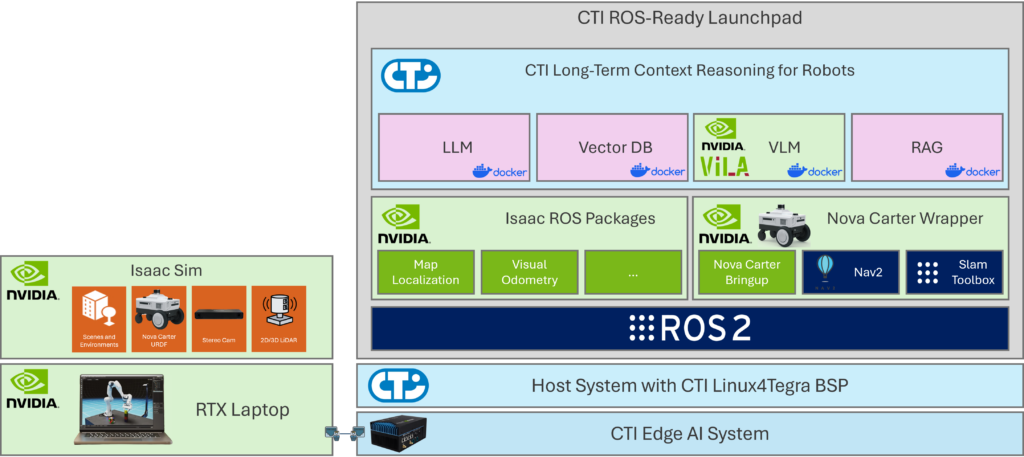
CTai LABS built this capability as an integrated robotics pipeline on Connect Tech’s ROS-Ready Launchpad. The team connected VLM-based scene captioning, ROS 2 memory nodes, vector storage, RAG, local LLM inference, and Nav2/SLAM into a working system that allows a robot to remember what it has observed, answer natural-language queries about that history, and navigate to a retrieved location. Rather than presenting ReMEmbR as a standalone research concept, CTai LABS adapted the underlying approach into a deployable Edge ai workflow running locally on Connect Tech hardware.
How Agentic ai Memory and Navigation Work
- Scene captioning with a Vision-Language Model. As the robot moves through its environment, a VLM generates captions for the scenes it encounters. These descriptive summaries capture the essence of what the robot sees, providing rich, contextual information about the surroundings rather than a raw image or point cloud.
- Memory building with ROS 2. The captions, along with their associated positional and rotational data, are embedded and saved in a vector database using a ROS 2 node. This database becomes the robot’s long-term memory, allowing it to recall and understand its environment even after extended periods of operation.
- Intelligent retrieval with RAG. When a task is assigned, such as finding the elevator, the robot uses an Agentic Retrieval-Augmented Generation application to embed the question and perform a similarity search through its memory database. The relevant data is then processed by a large language model deployed locally on Connect Tech Edge ai systems, which generates the positional data needed to guide the robot.
- Seamless navigation with Nav2 and SLAM. The resulting positional and rotational data is fed into the Nav2 stack, enabling the robot to navigate to the goal position while avoiding obstacles using Simultaneous Localization and Mapping algorithms (Open Navigation, n.d.).
Together, these four stages give the robot access to contextual information about its environment, combining spatial awareness, long-term memory, and language-based reasoning in a single pipeline. Each stage is decoupled as its own ROS 2 node, so the VLM captioning model, vector database, RAG retrieval logic, and Nav2 stack can each be updated or swapped independently as a deployment’s requirements evolve.
What This Capability Accomplishes
The CTai LABS implementation turns long-term robotic memory from a research concept into a working ROS2-based Edge ai pipeline. The implementation also reflects the CTI EdgeAI Stack approach, bringing Edge compute, robotics software, sensor data, ai models, memory, and deployment requirements together as one integrated system. This capability is built on Connect Tech’s ROS-Ready Launchpad, which provides a production-ready environment with ROS2, NVIDIA Isaac™ ROS, NVIDIA libraries, sensor drivers, and ROS wrappers (Connect Tech, 2026). Adding long-term contextual memory to that stack means a robot is no longer limited to reacting to what is directly in front of it. It can draw on everything it has previously observed, correlate that history with a natural-language request, and translate the result into a concrete navigation goal.
The VLM captioning, vector memory, LLM/RAG reasoning, and navigation pipeline run locally on Connect Tech Edge ai hardware, keeping the reasoning loop and operational data on the robot without requiring a cloud connection.
This also changes how a robot can retain contextual knowledge over time. As the robot continues to operate, new captioned observations can be added to its memory database, allowing its semantic memory to evolve as it encounters new locations, objects, and events. That memory complements the robot’s navigation and localization stack by giving the Agentic ai layer a growing record of what the robot has observed and where.
Benefits for Customers

Long-term memory
By building a contextual memory of its environment, the robot can recall locations and contextual information from previous observations and use that history when responding to new tasks.

Natural language interaction
The integration of the LLM and RAG pipeline allows the robot to understand and execute commands in natural language, making it easier for operators to interact with the robot and assign tasks without specialized programming.

Robust navigation
Nav2 and SLAM translate retrieved positional information into obstacle-aware navigation toward the requested goal.

On-device inference
Running the LLM locally on Connect Tech Edge ai systems keeps the reasoning loop fast and keeps sensitive facility and operational data from having to leave the robot.

Built on a production-ready robotics foundation
The pipeline runs as ROS2 nodes on top of CTI’s ROS-Ready Launchpad, so customers gain long-term memory and natural-language task assignment without replacing their existing robotics software stack.
Applications of Long-Term Memory for Robots
- Warehouse and facility navigation. Robots that patrol or resupply the same facility repeatedly can recall specific locations, landmarks, and past observations. This makes contextual information from previous observations available when assigning repeat tasks such as restocking, delivery, or inspection.
- Service and hospitality robotics. Front-facing robots in offices, hotels, or campuses can be asked in plain language to find a room, department, or previously visited location without needing a pre-programmed waypoint for every possible destination.
- Security and facility patrol. Patrol robots can build a long-term record of what they observed and where, supporting natural-language queries about past conditions in a space and more consistent, memory-informed patrol routes.
- Industrial and manufacturing floors. Robots operating on a plant floor can retain contextual knowledge of equipment locations, work cells, and observed changes over time, making that information available to the Agentic ai layer when new tasks are assigned.
- Research and robotics development. Teams building on ROS 2 can use this pipeline as a ready-made foundation for spatio-temporal memory experiments rather than building VLM captioning, vector memory, and RAG retrieval from scratch.
Ready to Give Your Robots Long-Term Memory?
Bring your robotics use case to CTai LABS, Your Physical ai Integration Partner. Our team can integrate VLMs, long-term spatial memory, RAG, local LLM inference, and ROS2 navigation around your robot, sensors, environment, and deployment requirements. Built on Connect Tech’s ROS-Ready Launchpad and Edge ai systems, the solution keeps reasoning and operational data local while giving robots access to contextual information from what they have previously observed.

ABOUT THE AUTHOR
Doruk Sönmez, M.Sc.
AI Solutions Architect, CTai LABS
Doruk is an AI Solutions Architect at CTai LABS, the Physical AI and Edge AI services division of Connect Tech Inc., an NVIDIA Elite Partner. An NVIDIA DLI Certified Instructor, he specializes in deploying vision-language models, agentic AI workflows, and accelerated video pipelines on NVIDIA Jetson platforms.
 Learn More
Sources and Frequently Asked Questions
Sources
Anwar, A., Welsh, J., Biswas, J., Pouya, S., & Chang, Y. (2025). ReMEmbR: Building and reasoning over long-horizon spatio-temporal memory for robot navigation. 2025 IEEE International Conference on Robotics and Automation (ICRA).
https://arxiv.org/abs/2409.13682Connect Tech. (2026). ROS-Ready Launchpad: Accelerate robotics development.
https://connecttech.com/ros-ready-launchpad/NVIDIA. (2024, September 23). Using generative AI to enable robots to reason and act with ReMEmbR. NVIDIA Technical Blog.
https://developer.nvidia.com/blog/using-generative-ai-to-enable-robots-to-reason-and-act-with-remembr/Ready to Build Smarter?
Let’s create the intelligent Edge AI solution that moves your business forward.