Services
x86 to Jetson Migration
How to move from x86 to NVIDIA® Jetson™ without losing time on avoidable integration problems.
By Doruk Sönmez, M.Sc.
AI Solutions Architect, CTai LABS/Connect Tech Inc.
Technical review: Rob Callaghan, P.Eng., Chief Product Officer, Connect Tech Inc.

Key Takeaways
- Migrating from x86 to NVIDIA Jetson™ means moving from a general-purpose CPU-centric architecture to an ARM-based SoC with an integrated GPU, unified memory, and a dedicated ai accelerator stack, within a power envelope x86 platforms cannot match for Edge ai workloads
- CTai LABS, a department of Connect Tech, manages the migration as a full-stack service: workload assessment, platform selection from Connect Tech’s solutions portfolio, BSP and driver bring-up, ARM64 software porting, and model optimization with TensorRT™
- CTai LABS tests and documents the hardware and software configuration to support deployment and help shorten migration timelines
- CTai LABS addresses integration issues early to reduce the risk of delays during an Edge ai migration
Why the migration conversation is happening now
The pressure to migrate off x86 for Edge ai workloads is not a trend. It is the result of several converging realities that make x86 increasingly hard to justify for inference-heavy, sensor-dense deployments in constrained environments.
Power is the most immediate driver. In x86 systems that rely on a discrete GPU, both the CPU and GPU contribute to the system power and cooling budget. By comparison, NVIDIA® Jetson AGX Orin™ delivers up to 275 TOPS in a configurable 15-to-60-watt envelope, while Jetson Thor™ (T5000) delivers up to 2,070 FP4 TFLOPS at 40 to 130 watts. NVIDIA reports 7.5 times the ai compute and 3.5 times the energy efficiency for Jetson Thor compared with AGX Orin (NVIDIA, 2025a; NVIDIA, 2025c). For battery-powered, vehicle-mounted, or thermally sealed deployments, the integrated Jetson power envelope can materially change the product architecture.
Memory architecture is the second driver. In a typical x86 system with a discrete GPU, CPU and GPU memory are physically separate, so data movement across the host-device boundary can add overhead. Jetson uses shared physical memory for the CPU and integrated GPU, which can allow some copies to be avoided when buffers and access patterns are designed appropriately. For sensor-heavy pipelines moving data between preprocessing and inference, that architecture creates an opportunity to reduce unnecessary data movement rather than guaranteeing lower latency by itself (Celantur, 2025; NVIDIA Developer Forums, 2023).
The third driver is the NVIDIA software stack. NVIDIA JetPack™ is the official software stack for Jetson and supports accelerated frameworks and SDKs including TensorRT™, NVIDIA® Isaac™ ROS, DeepStream, and Holoscan. For teams building around those tools, Jetson provides the native deployment environment rather than requiring the same software to be adapted around a separate x86 host architecture (NVIDIA, n.d.).
The fourth driver is form factor and environmental tolerance. Adding a discrete GPU to an x86 architecture can increase board area, cooling requirements, and enclosure complexity. Connect Tech Jetson platforms span compact carrier boards such as Rogue-RX (AGX203), with a 92 by 107 mm form factor and wide-temperature support, through sealed Anvil-RX systems for rugged deployment. That integration can simplify the path to a smaller, sensor-rich Edge ai system when the workload fits Jetson (Connect Tech, 2025a; Connect Tech, 2025c).
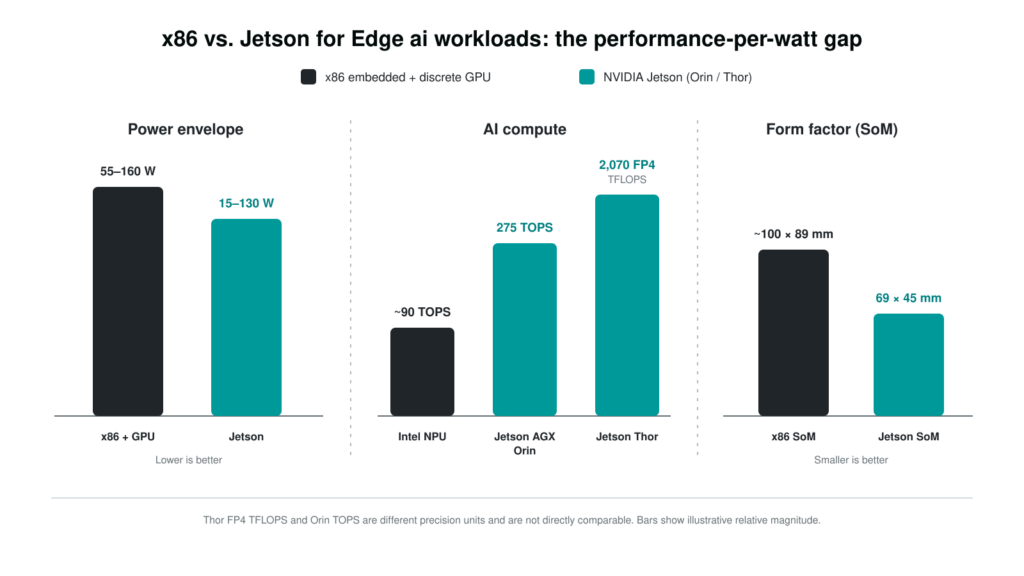
Figure 1. x86 vs. Jetson for Edge ai workloads: the performance-per-watt gap at the hardware level.
When x86 is still the right answer
Migration for its own sake is not a recommendation. There are workloads and environments where x86 remains the correct platform, and a migration that does not improve on the current system is not a good project.
x86 retains clear advantages in CPU-centric workloads, legacy application environments, and anywhere that requires broad OS compatibility (Windows, specific Linux distributions, real-time kernels) or deterministic single-core CPU performance for PLC-adjacent control tasks. Jetson runs Jetson Linux on ARM64, with NVIDIA providing the BSP, kernel, drivers, and flashing tools that underpin JetPack. That is a capable and well-maintained environment, but it is not a drop-in replacement for an x86 Windows or custom Linux deployment without software porting work (NVIDIA, 2025b).
Intel’s latest embedded processors also include onboard NPUs and OpenVINO support, which covers a class of vision inference workloads without requiring a discrete GPU or an architectural change. For teams already in the Intel embedded ecosystem with lightweight inference requirements, that path may have a lower migration cost than a full platform switch (Intel, 2025).
The honest migration conversation starts with the workload, not the platform. The decision table below maps the specific characteristics that favour each architecture.
| Workload characteristic | Stay on x86 | Move to Jetson |
|---|---|---|
| Primary compute type | CPU-centric: legacy control loops, protocol processing, PLC-adjacent workloads with high single-core demand | GPU-accelerated: deep learning inference, computer vision, sensor fusion, LLM inference at the edge |
| Power envelope | Adequate power available; thermal management not a design constraint | Tight power budget (15 to 130 W); sealed or fanless enclosure; battery or vehicle power |
| ai software stack | OpenVINO on Intel NPU; PyTorch/ONNX on x86; no requirement for CUDA/TensorRT | TensorRT, Isaac ROS, CUDA, DeepStream, Holoscan; NVIDIA Jetson ecosystem required or preferred |
| Legacy software dependency | Strong: production code requires x86 ISA; recompilation not feasible | Low to moderate: team can manage ARM64 cross-compilation or rebuild natively on target |
| Camera and sensor I/O | Standard USB/GigE cameras; no GMSL, FPD-Link III, or MIPI CSI-2 requirement | MIPI CSI-2, GMSL2/3, FPD-Link III, LiDAR, IMU, CAN: sensor buses that map directly to Jetson I/O |
| Deployment environment | Benchtop, rack, or climate-controlled industrial environment | Mobile, vehicle-mounted, outdoor, rugged, SWaP-limited, or high-vibration environment |
| Time horizon | Stable production with no near-term ai capability expansion | Adding ai inference, expanding sensor count, or moving from cloud ai to On-Prem Edge ai |

Figure 2. Platform selection by workload and environment: where x86 and Jetson each fit.
What x86 to Jetson migration actually involves
The architectural differences between x86 and ARM64 Jetson create a set of migration tasks that are predictable but not trivial. Teams that underestimate them are the ones whose migrations stall.
Instruction set and software porting
x86 code compiled for AMD64 does not run on ARM64 natively. The migration requires either recompilation from source (straightforward for well-maintained codebases, complex for legacy or third-party dependencies), cross-compilation toolchain setup, or Docker-based cross-platform container builds. Third-party libraries that lack ARM64 builds require either finding alternatives or building from source (Develeap, 2025; Celantur, 2025).

OS and BSP bring-up
Jetson platform bring-up differs from a conventional x86 PC workflow. The operating system and Jetson Linux BSP are flashed to the target platform, while carrier-specific configuration and drivers expose board-level I/O such as camera interfaces, CAN, and other peripherals. On Connect Tech hardware, CTai LABS can work directly with the BSP and board design rather than treating platform enablement as a separate vendor handoff (Connect Tech, 2025c; NVIDIA, 2025b).

CUDA and GPU memory model adjustment
Teams coming from x86 with a discrete GPU are accustomed to explicit cudaMemcpy operations between CPU and GPU memory. On Jetson, unified memory means those transfers can be eliminated or restructured. This is a performance opportunity, but it requires code changes to take advantage of it, and it changes assumptions about memory management throughout the pipeline (NVIDIA Developer Forums, 2023).

Model optimization for the target platform
A model that ran adequately on an x86 system with a discrete GPU may need TensorRT conversion, INT8 or FP16 quantization, and power-mode tuning to meet the target Jetson performance envelope. Optimization is often necessary to realize Jetson’s efficiency in a production workload, and the final configuration should be validated on the target module rather than assumed from desktop benchmarks (NVIDIA, n.d.).
Sensor and I/O re-integration
Camera and sensor connections that used USB or GigE on x86 may be redesigned around MIPI CSI-2, GMSL2/3, or FPD-Link III on the Jetson target. These interfaces can support the bandwidth, synchronization, cabling, and ruggedization requirements of production vision systems, but they also introduce carrier-board, driver, and bring-up decisions that must be validated as part of the migration (Connect Tech, 2025c).

Figure 3. The five technical stages of an x86 to Jetson migration.
How CTai LABS manages the migration
CTai LABS runs x86 to Jetson migrations as a full-stack engagement, covering every stage from workload assessment through a deployment-ready, validated system. The structural advantage is that CTai LABS is a department of Connect Tech, which designs and manufactures the carrier boards the Jetson modules run on. The same organization can address carrier selection, BSPs, thermal design, sensors, software, model optimization, and validation. x86 to Jetson migration fits naturally within the broader CTI EdgeAI Stack by treating those layers as one deployment architecture.

Workload assessment and platform selection
Before any porting work starts, CTai LABS characterises the x86 workload: compute profile, memory bandwidth, sensor requirements, power budget, environmental constraints, and software dependencies. That assessment drives the hardware selection, which Connect Tech carrier and which Jetson module, and flags the porting risks specific to the existing codebase.

BSP bring-up and driver work
Connect Tech writes and maintains BSPs for its own carrier boards. CTai LABS does BSP bring-up on the target platform, including camera drivers, CAN, serial I/O, and any custom interfaces the migration requires. This is the stage that most third-party migration projects outsource to a party with no access to the board design, which is where integration problems accumulate.

Software porting and ARM64 validation
Source code recompilation, cross-compilation toolchain setup, dependency resolution on ARM64, and container build restructuring where the deployment uses Docker. Validation at each layer before proceeding, not after the full stack is assembled.

Model optimization
TensorRT conversion and quantization of the ai model against the specific Jetson module and power mode. The model is optimized to the platform’s actual thermal envelope, not a nominal specification. Optimization is validated against the real sensor pipeline, not a synthetic benchmark.

Full integration and validation
End-to-end system validation through SIL, HIL, and Digital Twin testing against the production success metric defined at the start of the engagement. The handoff is a documented, validated platform, not a development board with a partially ported codebase.
For teams migrating from x86 to Jetson Thor specifically, Connect Tech’s Rogue-T5 (AGX302) and Anvil-T5 both ship with validated BSPs and EdgeAI Stack support, which compresses the bring-up phase significantly. Customers already deploying the Rogue family with Jetson AGX Orin can move to Jetson Thor within a familiar architectural framework (Connect Tech, 2026).
For the x86 migration guide with step-by-step porting details, dependency checklists, and Docker cross-compilation instructions, see the CTai LABS Migration Guide.
Connect Tech platforms for x86 migration
The right carrier board for the migration depends on the x86 workload profile, the Jetson module required, and the deployment environment. The table below maps common x86 migration scenarios to Connect Tech platforms.
| Product | Part # | Module | Migration sweet spot | Form factor / environment |
|---|---|---|---|---|
| Anvil-T5 | ESG (system) | Jetson Thor T5000 | Teams migrating compute-intensive x86 workloads to Jetson Thor: multi-camera autonomy, humanoid robotics, and next-generation perception. Ships with a pre-flashed JetPack 7.0 BSP. | Rugged system; GMSL3/2, FPD-Link III, and SDI; active cooling to 60°C |
| Rogue-T5 | AGX302 | Jetson Thor T5000 | Developers moving from x86 to Jetson Thor who want a compact carrier with a production-ready BSP and EdgeAI Stack support. Third CTI Thor release. | Small form factor; 2× 10GBase-T and 1× 2.5GBase-T; CAN 2.0b ×4; GMSL3/2/SDI; −40°C to +85°C |
| Rogue-RX | AGX203 | Jetson AGX Orin | Rugged x86 replacements for mobile, rugged, and vehicle-mounted platforms where locking connectors and wide-input voltage are non-negotiable. | 92 × 107 mm; positive-lock I/O; 2× 10GbE; 16-lane MIPI CSI-2; −40°C to +85°C |
| Anvil for AGX Orin (Anvil-RX) | ESG635 | Jetson AGX Orin | IP67-rated full-system replacement for x86 boxes in AMR, agriculture, and industrial environments. M12 and sealed PC connectors. | IP67+; M12 and sealed connectors; mission-critical rugged system |
| Boson | NGX012 | Jetson Orin NX / Nano | Migrating lightweight x86 vision nodes to a compact multi-camera Edge ai platform. FPD-Link III and CAN FD integration. | Compact; FPD-Link III; CAN FD; onboard deserializers; multi-camera bus |
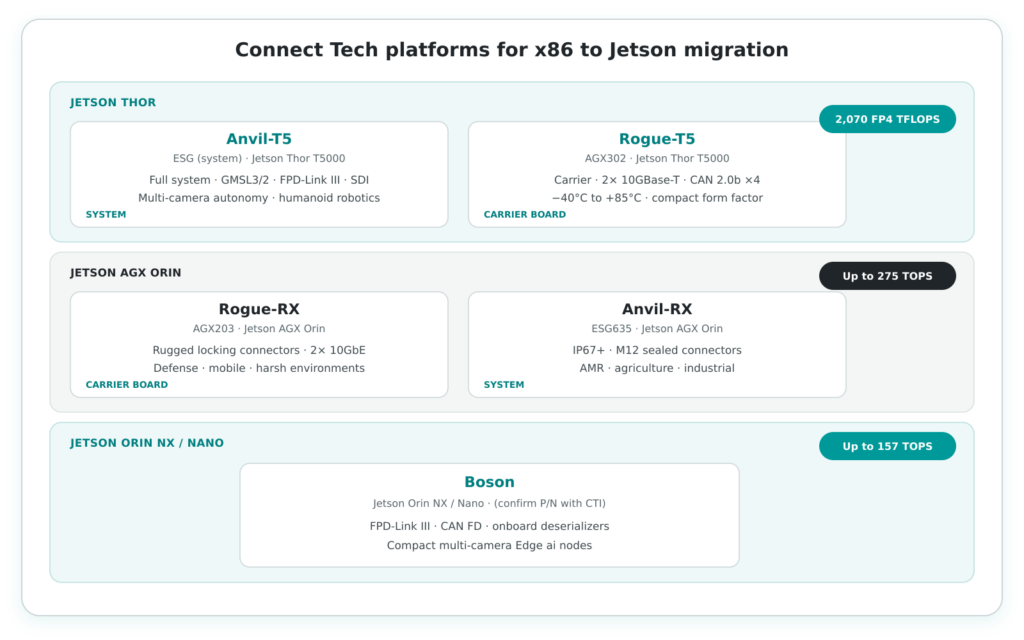
Figure 4. Connect Tech carrier boards and systems for x86 to Jetson migration, mapped by compute tier and deployment environment.
What a completed migration delivers
A migration managed by CTai LABS delivers a deployment-ready Jetson platform, not a development board with an incomplete port. Specifically:
- A validated ARM64 software stack, recompiled and tested against the target carrier and Jetson module.
- A BSP and driver set written and maintained by the team that manufactured the carrier board.
- An ai model optimized with TensorRT for the target Jetson module and power mode, validated against the real sensor pipeline.
- Full sensor integration across MIPI CSI-2, GMSL2/3, FPD-Link III, LiDAR, IMU, and CAN as required by the migrated system.
- SIL/HIL/Digital Twin validation records confirming performance against the pre-agreed production success metric.
- A documented, reproducible hardware and software configuration and a production support path into fleet deployment.
For the business, a managed migration delivers a shorter time-to-market than an in-house effort, lower risk of mid-migration stalls caused by BSP or driver gaps, and a validated system that does not require re-engineering the first time it meets a real-world deployment condition.
Migrating from x86 to NVIDIA Jetson is a full-stack architecture change, not a processor swap. The software, BSP, sensors, I/O, memory behavior, model runtime, power, thermals, and validation plan all need to move together. CTai LABS manages those layers as one migration program, helping teams turn an existing x86 workload into a documented, production-ready Jetson deployment built around the real operating environment.
Book a Demo
Talk to a migration engineer or ai architect about your specific x86 workload, timeline, and target platform.

ABOUT THE AUTHOR
Doruk Sönmez, M.Sc.
AI Solutions Architect, CTai LABS
Doruk is an AI Solutions Architect at CTai LABS, the Physical AI and Edge AI services division of Connect Tech Inc., an NVIDIA Elite Partner. An NVIDIA DLI Certified Instructor, he specializes in deploying vision-language models, agentic AI workflows, and accelerated video pipelines on NVIDIA Jetson platforms.
 Learn More
Resources and Frequently Asked Questions
Sources
Celantur. (2025, January 27). Edge AI learnings: CPU architectures, GPU capabilities, and challenges with NVIDIA Jetson.
https://www.celantur.com/blog/edge-ai-cpu-gpu-jetson-architecture/Connect Tech. (2025a). Anvil-RX rugged system for NVIDIA Jetson AGX Orin (ESG635).
https://connecttech.com/ftp/pdf/ESG635_Anvil-RX_spec_sheet.pdfConnect Tech. (2025b). Anvil-T5 edge system with NVIDIA Jetson Thor.
https://connecttech.com/product/anvil-t5-edge-system-with-nvidia-jetson-thor/Connect Tech. (2025c). Rogue-RX carrier board for NVIDIA Jetson AGX Orin (AGX203).
https://connecttech.com/product/rogue-rx-carrier-board-for-nvidia-jetson-agx-orin/Connect Tech. (2026, March 10). Connect Tech’s EdgeAI Stack and Rogue family continues to deliver; Rogue-T5 is the latest addition for developers.
https://connecttech.com/connect-tech-rogue-t5-edgeai-stack-continues-to-deliver/Develeap. (2025, September 30). Why teams are moving AI workloads to Jetson, and how to start (Part 1).
https://www.develeap.com/why-teams-are-moving-ai-workloads-to-jetson-and-how-to-start-part-1/Intel. (2025). Robotics AI Suite: ROS 2, OpenVINO, and Intel Core Ultra for Edge robotics.
https://builders.intel.com/intel-technologies/software/edge-ai-suites/robotics-ai-suiteNVIDIA. (n.d.). JetPack software stack for NVIDIA Jetson. NVIDIA Developer.
https://developer.nvidia.com/embedded/jetpackNVIDIA. (2025a). Jetson AGX Orin: Performance specifications.
https://www.nvidia.com/en-us/autonomous-machines/embedded-systems/jetson-orin/NVIDIA. (2025b). Jetson Linux (L4T): BSP, kernel, and drivers for NVIDIA Jetson modules.
https://developer.nvidia.com/embedded/linux-tegraNVIDIA. (2025c). Jetson Thor T5000: Performance specifications.
https://www.nvidia.com/en-us/autonomous-machines/embedded-systems/jetson-thor/NVIDIA Developer Forums. (2023). Memory architecture differences in x86 and SoC GPUs: Jetson Orin Nano.
https://forums.developer.nvidia.com/t/memory-architecture-differences-in-x86-and-soc-gpus/258135Frequently Asked Questions
Can I run my existing x86 code on Jetson without recompiling?
No. x86 (AMD64) binaries do not run on ARM64 natively. Code needs to be recompiled for ARM64, cross-compiled using a toolchain, or run inside a cross-platform Docker container. The complexity depends on your dependency stack: well-maintained open-source codebases recompile with relatively little friction; legacy or proprietary dependencies with no ARM64 build may require substitution or source-level porting.
What happens to CUDA code written for a discrete x86 GPU?
CUDA code written for x86 plus a discrete GPU will largely run on Jetson, since Jetson’s GPU is CUDA-compatible. However, the unified memory architecture on Jetson means that explicit cudaMemcpy calls between CPU and GPU memory can be restructured or eliminated, which is a performance opportunity. Some CUDA Compute Capability features available on high-end discrete GPUs may not be available on Jetson’s integrated GPU. Validate against the specific Jetson module’s compute capability before assuming full portability.
How long does an x86 to Jetson migration typically take?
Timeline depends on codebase complexity, the number and type of third-party dependencies, sensor re-integration requirements, and validation depth. CTai LABS scopes the timeline during the initial workload assessment. Migrations with mature codebases, minimal dependency complexity, and standard sensor interfaces move faster than legacy codebases with proprietary dependencies and custom sensor buses.
Which Connect Tech carrier should I choose for a Jetson Thor migration?
For full system deployments with multi-camera vision requirements, Anvil-T5 ships pre-flashed with the latest JetPack BSP and supports GMSL3/2, FPD-Link III, and SDI. For compact carrier-only deployments, Rogue-T5 (AGX302) provides 2x 10GBase-T plus 2.5GBase-T Ethernet, four CAN 2.0b channels, and wide-temperature operation. Teams already on the Rogue platform with Jetson AGX Orin can move to Rogue-T5 within a familiar architectural framework.
Does CTai LABS handle the BSP for Connect Tech boards?
Yes. CTai LABS is a department of Connect Tech, which writes and maintains the BSPs for its own carrier boards. That means the team doing the BSP bring-up for your migration is the same team that has access to the board design. Integration issues that would stall a third-party migration get resolved at the source.
What is the difference between Rogue-RX and Rogue-RX XP?
Rogue-RX (AGX203) and Rogue-RX XP (AGX207) are distinct Connect Tech products for Jetson AGX Orin. Rogue-RX is a rugged carrier with positive-lock connectors for harsh and mobile environments. Rogue-RX XP is a separate product with an extended power input range. Confirm which product fits your deployment with CTI sales before specifying either.
Can I migrate just the ai model, or does the full stack need to move?
CTai LABS can scope the migration to the layer where the work is needed. If the existing software stack runs on the target platform but the model needs TensorRT optimization for Jetson, the engagement can start there. If the full stack needs to move, including BSP, sensor integration, and application code, the engagement covers all of it. The scope is defined at the workload assessment stage.
Where can I find a step-by-step migration guide?
CTai LABS publishes a detailed x86 to Jetson Migration Guide covering dependency checklists, Docker cross-compilation instructions, BSP bring-up steps, and TensorRT model conversion. See the Resources section of ctailabs.ai for the current guide.