Built with NVIDIA
NVIDIA IGX Thor Consulting
Turn NVIDIA IGX Thor into a measured, supportable production Edge ai system
By Ceri Nelmes
Tech Marketing Leader & Journalist | Building Brands at the Edge of What’s Next | Connect Tech & CTai Labs
Technical review: Rob Callaghan, Chief Product Officer, Connect Tech Inc.
Key Takeaways
- CTai LABS provides NVIDIA® IGX Thor™ consulting from platform assessment and architecture through sensor bring-up, NVIDIA Holoscan development, ai acceleration, timing analysis, safety-aware design, validation, and deployment handoff
- The team can begin with an idea, an intended-use concept, an NVIDIA IGX selection question, a trained model, a sensor interface, a Holoscan graph, an existing prototype, or a product already moving toward production
- NVIDIA IGX Thor combines Blackwell GPU compute, 128 GB LPDDR5X memory, high-speed networking, enterprise software, and safety-oriented hardware for medical, industrial, robotics, and other sensor-rich systems (NVIDIA, 2026a)
- Peer-reviewed Holoscan research shows that shared GPU resources, operator dependencies, buffering, and concurrent graphics can change end-to-end response time, so timing must be verified at the application level (Sinha et al., 2024; Schowitz et al., 2024; Schowitz et al., 2025)
- Connect Tech Tempo IGX provides a production hardware path around the NVIDIA IGX T5000 module with GMSL3 vision, 10GBASE-T1 networking, vehicle and industrial I/O, storage, and a design intended to support a functional-safety path (Connect Tech, 2026a)
- Platform safety capabilities do not certify a finished device or machine. The customer and its qualified regulatory, quality, safety, and certification teams retain responsibility for the complete product and formal assurance program
- The customer retains its data, models, application, device or machine design, and intellectual property
CTai LABS, a department of Connect Tech, helps product and engineering teams turn NVIDIA® IGX Thor™ capability into a complete Edge ai system that can be integrated, measured, supported, and handed over for production. NVIDIA IGX Thor Consulting covers the decisions surrounding the platform, including sensors, networking, NVIDIA Holoscan, NVIDIA AI Enterprise, ai inference, application software, timing, safety objectives, security, updates, power, thermals, and the Connect Tech hardware required around the compute. This page explains where IGX fits, what the consulting engagement can include, and how CTai LABS verifies the system before the design is locked.
Work can start at any point. CTai LABS can begin with an idea and help define the application and platform requirements, enter during architecture or hardware selection, bring up a sensor-rich prototype, optimize an existing Holoscan or TensorRT™ application, resolve timing and resource contention, prepare a reproducible software baseline, or carry the program through sustained-load validation and deployment handoff. The customer does not have to arrive with a finished specification. CTai LABS can help develop the missing inputs as part of the engagement.
NVIDIA IGX Thor Is a System Architecture Decision
NVIDIA IGX Thor is designed for industrial, medical, robotics, and other Mission-critical Edge applications that combine real-time sensor processing, accelerated ai, enterprise software, security, and functional-safety capabilities. The current IGX Thor Developer Kit family uses a 14-core Arm Neoverse-V3AE CPU, a Blackwell architecture integrated GPU with Multi-Instance GPU support, 128 GB of LPDDR5X memory, and high-speed I/O. The full developer kit adds an NVIDIA RTX PRO™ 6000 Blackwell Max-Q Workstation Edition discrete GPU and reaches up to 5,581 FP4-sparse TFLOPS in NVIDIA’s published configuration, while the Mini uses the integrated GPU configuration rated up to 2,070 FP4-sparse TFLOPS (NVIDIA, 2026a; NVIDIA, 2026b).
Those specifications are inputs to the design, not a finished product. A medical imaging system may be limited by sensor ingest, display timing, graphics contention, or regulatory evidence. An industrial machine may need deterministic event handling, rugged interfaces, controlled updates, and long service life. A mobile robot may combine camera pipelines, localization, perception, planning, generative reasoning, networking, and safety functions on the same platform. Each workload creates a different requirement for I/O, data movement, resource isolation, software support, power, cooling, and validation.
CTai LABS evaluates those requirements together, selects the appropriate NVIDIA IGX and Connect Tech configuration, and verifies the complete sensor-to-application path on representative hardware. The goal is not simply to prove that a model runs. It is to establish the configuration, operating envelope, evidence, and handoff needed for the customer to continue building its product.
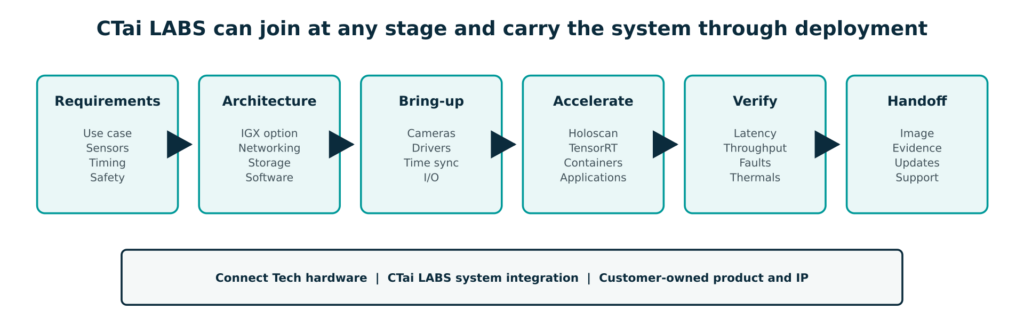
Figure 1. CTai LABS can join an NVIDIA IGX program at any point and support the complete path from requirements through deployment handoff.
What NVIDIA IGX Consulting Can Cover
IGX platform assessment and architecture
CTai LABS maps the application against IGX compute, memory, graphics, sensor I/O, networking, storage, management, safety features, software support, power, thermal limits, environment, and lifecycle. The assessment can compare the NVIDIA IGX Thor Developer Kit, Developer Kit Mini, NVIDIA IGX T5000 production path, Tempo IGX, certified OEM systems, NVIDIA Jetson Thor™, or another NVIDIA platform while major design choices are still reversible. The output is a requirements trace and platform recommendation rather than a specification-sheet comparison.
NVIDIA Holoscan application development
NVIDIA Holoscan is a domain-agnostic platform for scalable, software-defined processing of streaming sensor data. It is especially relevant to medical imaging, surgical systems, industrial inspection, scientific imaging, robotics, and other applications where capture, preprocessing, ai, visualization, recording, and networking must operate as one pipeline (NVIDIA, 2026c). CTai LABS can design Holoscan applications in C++ or Python, build and tune operators, connect sensors and inference stages, integrate visualization and storage, and profile the complete graph on the selected IGX target.
The consulting scope can also include NVIDIA Holoscan Sensor Bridge where supported sensors and network transport benefit from hardware-accelerated movement into GPU memory. CTai LABS works across capture format, packetization, Precision Time Protocol, sensor control, RDMA or Converged Ethernet paths, buffering, data placement, and failure behavior. The implementation is measured from acquisition to the output the product uses.
Sensor, network, and I/O integration
IGX applications often fail at interfaces rather than inside the model. CTai LABS can integrate GMSL cameras, medical or scientific imaging devices, Ethernet sensors, LiDAR, radar, CAN, serial devices, storage, displays, time synchronization, application-specific PCIe devices, and control interfaces. The engineering work includes drivers, Board Support Package integration, data formats, timestamps, buffering, copies, bandwidth, error handling, and the application contract around every interface. Connect Tech hardware and in-house BSP expertise provide a production route when the developer kit does not match the final mechanical or I/O requirement.
NVIDIA AI Enterprise and deployment software
NVIDIA AI Enterprise for IGX provides enterprise software with long-term support, regular security updates, validated configurations, IGX OS options, CUDA libraries, TensorRT, Triton Inference Server, and the Holoscan SDK. NVIDIA distinguishes this supported production path from JetPack releases on IGX, which are not covered by enterprise long-term support (NVIDIA, 2026d). CTai LABS can establish the software baseline, package application dependencies, configure containers, define image and version controls, and plan updates, rollback, recovery, and field support.
ai optimization and concurrent workloads
High peak compute does not remove the need to manage precision, memory, scheduling, graphics, batching, model serving, and concurrent services. CTai LABS can convert and tune models with TensorRT, configure Triton where shared model serving fits, allocate integrated and discrete GPU work, evaluate Multi-Instance GPU or other supported isolation strategies, and reserve resources for perception, reasoning, visualization, and safety-related software. Recent peer-reviewed work on real-time TensorRT multitasking reinforces the need to treat concurrent inference as a scheduling and interference problem, not a collection of independent model benchmarks (Aromolo et al., 2025).
Timing and sustained-load verification
Average inference time is only one measurement. CTai LABS evaluates sensor-to-display, sensor-to-alert, or sensor-to-control response time, jitter, queueing, throughput, GPU and CPU contention, graphics activity, network traffic, storage I/O, memory pressure, power, thermal behavior, and restart or recovery. Tests use representative sensor rates, concurrent services, models, and application settings for long enough to expose queue growth, thermal changes, intermittent faults, and resource competition.
Safety-aware design and certification support
NVIDIA IGX Thor includes safety-oriented platform features, including a Functional Safety Island and safety microcontroller support. NVIDIA and Connect Tech position the IGX ecosystem for medical, industrial, robotics, and autonomous-system programs that may pursue applicable safety or certification objectives (NVIDIA, 2026a; Connect Tech, 2026a). CTai LABS can support requirements reviews, resource isolation, fault handling, timing characterization, reproducible configurations, test procedures, traceable evidence, and coordination with the customer’s formal quality, regulatory, cybersecurity, or functional-safety process.
Neither the IGX platform nor CTai LABS engineering services makes the customer’s finished product functionally safe or certified. CTai LABS provides engineering, characterization, and supporting evidence under defined conditions. Final product requirements, hazard analysis, safety functions, verification, validation, certification, and regulatory approval remain the responsibility of the customer and its qualified assessment bodies.
Security, updates, and product lifecycle
Long-lived Edge products need a controlled software lifecycle. CTai LABS can help configure secure boot and disk-encryption options where supported, manage keys and credentials, lock dependencies, produce reproducible images, separate development packages from the shipped runtime, test updates, establish rollback and recovery, and document the field-support process. NVIDIA AI Enterprise support is part of the foundation. The customer application, third-party components, device identity, network controls, deployment tooling, and operational procedures still require product-level engineering.
What Recent Research Changes About IGX Verification
The most relevant peer-reviewed NVIDIA Holoscan research reaches a consistent conclusion: end-to-end behavior depends on the complete application graph and the resources it shares. Sinha et al. (2024) showed that concurrent compute and graphics workloads can create unpredictable latency in medical ai pipelines and that resource separation and partitioning can improve worst-case behavior. Schowitz et al. (2024) introduced response-time analysis for soft real-time Holoscan applications, then Schowitz et al. (2025) extended the analysis to produce faster and more general exact bounds for more complex graphs.
This evidence does not provide a universal benchmark for every IGX application. It provides a stronger test strategy. CTai LABS maps operators, buffers, execution dependencies, sensor rates, graphics, storage, networking, model workloads, and shared GPU demand, then validates the specific graph and platform configuration. The system is judged against customer acceptance criteria, including timing distribution, worst observed behavior, throughput, quality, fault handling, power, thermals, and operational headroom.
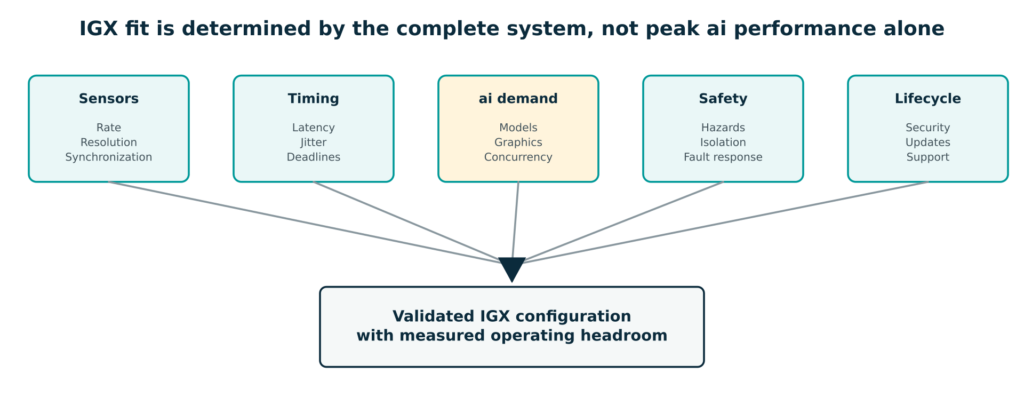
Figure 2. CTai LABS determines NVIDIA IGX fit from the complete sensor, timing, ai, safety, and lifecycle requirement.
NVIDIA IGX and Connect Tech Hardware Paths
The developer kit is useful for evaluation, but production hardware must match the final device or machine. CTai LABS works with Connect Tech hardware engineering to align the NVIDIA IGX module, carrier or system, sensors, I/O, networking, storage, power input, cooling, enclosure, environment, support horizon, and safety objectives. The selection remains application-specific.
| Connect Tech platform | Role in the solution | Relevant architecture value |
|---|---|---|
| Gauntlet Carrier Board for NVIDIA Jetson Thor | Demo and custom system foundation | Jetson T5000 support, 16-lane MIPI CSI-2 expansion, high-speed networking, NVMe, and broad I/O. |
| GMSL3 Camera Platform | Multi-camera acquisition | Up to eight supported GMSL3/GMSL2 inputs, Power over Coax, shared trigger routing, monitoring, and protected camera power. |
| Anvil-T5 Edge System | Integrated deployment path | Factory-integrated Jetson Thor Edge system with active cooling, storage and network expansion, and vision-ready camera options. |
| Rogue-T5 Carrier Board | Commercially deployable compact platform | Ruggedized connectivity, multi-lane MIPI CSI-2, NVMe, networking, and Jetson T5000 compute for product integration. |
Tempo IGX — NVIDIA IGX T5000 Platform
Tempo IGX is designed around the NVIDIA IGX T5000 module as a production-oriented platform for robotics and autonomous systems. Planned connectivity includes 16 GMSL2 camera inputs and 20 Ethernet ports. Available interfaces, BSP functionality, and supported configurations depend on the applicable hardware revision, software release, and product documentation. The architecture is intended to support applications that may pursue functional-safety objectives, but platform selection alone does not establish product-level functional safety or certification.
Why Tempo IGX Matters to the Consulting Path
Connect Tech designed Tempo IGX around the NVIDIA IGX T5000 module as a production-oriented platform for robotics and autonomous systems. Available interfaces, Board Support Package (BSP) functionality, and supported configurations depend on the applicable hardware revision, software release, and product documentation. The architecture is intended to support customer-led functional-safety development, where applicable, but platform selection alone does not establish product-level functional safety or certification (Connect Tech, 2026a).
“Robotics teams need a platform that supports today’s Edge AI workloads while keeping a clear path open for safety certification.”
Rob Callaghan, P.Eng., Chief Product Officer, Connect Tech Inc. (Connect Tech, 2026b)
How CTai LABS Evaluates an IGX Deployment
CTai LABS establishes agreed engineering acceptance criteria and tests the selected configuration under defined, representative conditions. Results document observed performance, limitations, assumptions, open risks, and areas requiring additional customer or third-party verification.
The evaluation can include:
-
Testing required sensors and interfaces at defined rates, formats and synchronization conditions
-
Measuring sensor-to-output latency, jitter, throughput and queue behaviour under representative concurrency
-
Characterizing AI model quality, memory use and runtime performance
-
Measuring compute, graphics, networking, storage and application resource utilization
-
Characterizing power and thermal behaviour under defined operating conditions
-
Exercising agreed sensor-loss, restart, update, rollback, recovery and fault scenarios
-
Producing engineering records that can support the customer’s safety, security, quality or regulatory processes
-
Documenting the tested configuration, observed limits, test methods and engineering handoff
Engineering Scope
CTai LABS services provide engineering analysis, integration, testing and characterization under defined conditions. Results are configuration- and application-specific and do not constitute a guarantee of product performance, regulatory compliance, certification or functional safety. Final product requirements, verification, validation, safety analysis, certification and regulatory approval remain the responsibility of the customer and its qualified assessment bodies.
The CTai LABS NVIDIA IGX Consulting Workflow
1.
Define the product and acceptance envelope
CTai LABS documents the intended use, users, environment, sensors, data rates, ai models, graphics, networking, storage, response-time targets, safety objectives, power, thermals, mechanical constraints, production milestone, software lifecycle, and evidence required for the next decision.
2.
Select the IGX and Connect Tech architecture
The team compares the relevant IGX and NVIDIA platform options, then selects the compute, Connect Tech hardware, sensor interfaces, network topology, storage, cooling, management, operating system, enterprise software, and application architecture. Open assumptions and certification boundaries are recorded before implementation.
3.
Bring up the complete data path
CTai LABS establishes the target image, drivers, BSP, containers, cameras and sensors, time synchronization, network transport, storage, Holoscan graph, inference runtime, customer services, and monitoring. Each interface is tested at the operating rate and with representative data.
4.
Optimize ai, data movement, and concurrency
The team measures CPU, GPU, memory, media engines, networking, storage, graphics, queues, and model behavior. CTai LABS tunes precision, TensorRT engines, Triton, Holoscan operators, buffering, scheduling, data placement, resource isolation, and application priorities against the customer requirement.
5.
Validate sustained and failure behavior
CTai LABS runs the complete workload under representative sensor rates, concurrent services, network traffic, power mode, cooling, and operating conditions. The campaign includes defined sensor loss, resource contention, restart, update, rollback, recovery, and fault cases, with evidence captured for the customer’s engineering and assurance process.
6.
Deliver the deployment baseline
The engagement concludes with the validated hardware and software configuration, build and deployment instructions, measurements, test procedures, known limits, update method, recovery path, acceptance evidence, and support handoff. The customer retains ownership of the product, data, models, application, and IP.
Example NVIDIA IGX Consulting Projects

Medical imaging pipeline with bounded response time
A medical imaging product must capture a high-bandwidth sensor stream, run preprocessing and ai, present the result to the user, and maintain predictable response time while other services operate. CTai LABS designs the Holoscan graph, integrates the imaging interface, separates or allocates compute and graphics resources, optimizes inference, profiles end-to-end timing, and documents the software and test baseline. Intended use, clinical evidence, regulatory strategy, risk management, and submission ownership remain with the customer and its qualified teams.
Multi-camera industrial inspection cell
An inspection machine combines synchronized cameras, inference, visualization, PLC or machine interfaces, recording, and plant networking. CTai LABS selects the IGX and Connect Tech hardware path, brings up the cameras and timing, builds the Holoscan or application pipeline, tunes TensorRT, verifies sustained throughput and queue behavior, and tests defined sensor-loss and recovery cases before handoff.

Safety-aware mobile robot on Tempo IGX
A mobile robot needs surround-view perception, high-speed in-vehicle networking, localization, planning, generative reasoning, diagnostics, and a path toward functional-safety certification. CTai LABS integrates GMSL3 cameras, networking, CAN, ROS 2 and NVIDIA software on Tempo IGX, allocates compute resources, characterizes timing and fault behavior, and supplies traceable engineering evidence for the customer’s formal safety program.
Migration from developer kit to production system
A prototype performs well on an NVIDIA IGX developer kit but the product needs a different interface set, enclosure, power input, thermal design, update method, and support plan. CTai LABS maps the prototype dependencies, selects the production hardware, migrates drivers and applications, establishes the controlled software image, repeats the acceptance campaign, and documents the production baseline so the product team can continue from a known configuration.
What CTai LABS Can Deliver
- An NVIDIA IGX platform-fit assessment with requirements traceability, architecture options, risks, assumptions, and a documented recommendation
- A Connect Tech hardware configuration covering compute, cameras, networking, storage, I/O, power, cooling, enclosure, environment, management, and lifecycle
- Holoscan applications, custom operators, sensor integrations, time synchronization, data transport, visualization, recording, and application interfaces
- TensorRT engines, Triton or application runtime configuration, precision choices, concurrency settings, resource allocation, and model-quality evidence
- A versioned IGX OS or supported software baseline, containers, dependency controls, software bill of materials, secure configuration inputs, update and rollback procedures, and recovery documentation
- Measurements for sensor-to-output timing, jitter, throughput, queues, CPU, GPU, memory, graphics, networking, storage, power, thermals, sustained load, and failure recovery
- Safety-aware engineering inputs, fault-case procedures, resource-isolation evidence, reproducible configurations, test records, and coordination material for the customer’s formal assurance program
- Deployment instructions, benchmark scripts, acceptance results, known limits, open risks, training, engineering handoff, and optional support
Your Physical ai Integration Partner
CTai LABS combines NVIDIA IGX software expertise with Connect Tech production hardware, in-house Board Support Package (BSP) engineering, sensor and network integration, Holoscan development, ai optimization, timing analysis, safety-aware design, and physical validation. The team can begin with an idea, solve one integration problem, or carry the complete system from architecture through deployment. Customers work directly with CTai LABS engineers and retain their data, models, application, device or machine design, and intellectual property.
Book a Demo
- The required 3D output, operating environment, target field of view, reconstruction range, motion profile, latency target, accuracy target, and downstream application.
- Current or proposed cameras, resolution, frame rate, lens, interface, trigger method, cable requirements, mounting assumptions, and additional sensors.
- Connect Tech hardware or preferred NVIDIA Jetson platform, ROS 2 distribution, model files, source code, logs, recordings, datasets, and existing performance measurements.
- Power, thermal, storage, networking, enclosure, environmental, lifecycle, service, cybersecurity, and deployment requirements.
- The evidence required for the next decision, including depth accuracy, temporal stability, throughput, end-to-end latency, dropped frames, sustained load, recovery, and application behavior.

ABOUT THE AUTHOR
Ceri Nelmes
Tech Marketing Leader & Journalist | Building Brands at the Edge of What’s Next |
Connect Tech & CTai Labs
Ceri Nelmes is Head of Marketing at Connect Tech and an experienced technology journalist and digital strategist. She covers the technologies and market shifts shaping embedded computing, Edge AI, Physical ai, robotics, autonomous systems, and the NVIDIA® ecosystem. Working with Connect Tech and CTai LABS subject-matter experts, she turns engineering developments into accurate, useful reporting for developers, technical buyers, business leaders, and the media.
 Learn More
Resources and Frequently Asked Questions
Related
Built with NVIDIA. Explore CTai LABS engineering across NVIDIA IGX, Jetson, CUDA, TensorRT, Holoscan, Isaac, Metropolis, and the wider Edge ai stack.
Explore Built with NVIDIA →NVIDIA Jetson Consulting. Compare embedded NVIDIA platform requirements and plan a production Jetson system around the application.
Explore NVIDIA Jetson Consulting →TensorRT Optimization. Optimize model conversion, precision, inference latency, throughput, memory use, and concurrent execution on NVIDIA hardware.
Explore TensorRT Optimization →Healthcare. Explore medical imaging, sensor processing, intelligent devices, and real-time healthcare Edge ai integration.
Explore Healthcare →Industrial Automation. Explore machine vision, robotics, inspection, predictive maintenance, and industrial Edge ai systems.
Explore Industrial Automation →Sources
Aromolo, F., Stevanato, A., Biondi, A., & Buttazzo, G. C. (2025). Real-time multitasking of deep neural networks with NVIDIA TensorRT. 2025 IEEE Real-Time Systems Symposium (RTSS), 364–377.
https://doi.org/10.1109/RTSS66672.2025.00037Connect Tech. (2026a, March 16). Connect Tech puts NVIDIA IGX Thor on a functional safety certification path with Tempo IGX Edge AI robotics platform.
https://connecttech.com/tempo-igx-thor-edge-ai-robotics-platform-functional-safety/Connect Tech. (2026b, June 22). Connect Tech is ready with Tempo IGX, supporting NVIDIA Halos for Robotics.
https://connecttech.com/tempo-igx-supporting-nvidia-halos-for-robotics/Gill, S. S., Golec, M., Hu, J., Xu, M., Du, J., Wu, H., Walia, G. K., Murugesan, S. S., Ali, B., Kumar, M., Ye, K., Verma, P., Kumar, S., Cuadrado, F., & Uhlig, S. (2025). Edge AI: A taxonomy, systematic review and future directions. Cluster Computing, 28, 18.
https://doi.org/10.1007/s10586-024-04686-yNVIDIA. (2026a). IGX: Industrial-grade Edge AI platform.
https://www.nvidia.com/en-us/edge-computing/products/igx/NVIDIA. (2026b, March 23). NVIDIA IGX Thor powers industrial, medical, and robotics edge AI applications.
https://developer.nvidia.com/blog/nvidia-igx-thor-powers-industrial-medical-and-robotics-edge-ai-applications/NVIDIA. (2026c). NVIDIA Holoscan SDK. NVIDIA IGX Developer Guide.
https://docs.nvidia.com/igx/user-guide/latest/SW/install-holoscan.htmlNVIDIA. (2026d). NVIDIA AI Enterprise software stack for IGX. NVIDIA IGX Developer Guide.
https://docs.nvidia.com/igx/user-guide/latest/NVAIE/nvaie.htmlSchowitz, P., Sinha, S., & Gujarati, A. (2024). Response-time analysis of a soft real-time NVIDIA Holoscan application. 2024 IEEE Real-Time Systems Symposium (RTSS), 57–69.
https://doi.org/10.1109/RTSS62706.2024.00015Schowitz, P., Sharma, S., Balodi, S., Sinha, S., Shepherd, B., & Gujarati, A. (2025). Faster, exact, more general response-time analysis for NVIDIA Holoscan applications. 2025 IEEE Real-Time Systems Symposium (RTSS), 109–121.
https://doi.org/10.1109/RTSS66672.2025.00018Sinha, S., Dwivedi, S., & Azizian, M. (2024). Towards deterministic end-to-end latency for medical AI systems in NVIDIA Holoscan. 2024 ACM/IEEE 15th International Conference on Cyber-Physical Systems (ICCPS), 235–246.
https://doi.org/10.1109/ICCPS61052.2024.00028Frequently Asked Questions
What is NVIDIA IGX Consulting?
NVIDIA IGX Consulting is system engineering for products built around NVIDIA IGX. CTai LABS can support platform selection, architecture, sensors, NVIDIA Holoscan, ai acceleration, NVIDIA AI Enterprise, timing, safety-aware design, security, validation, and deployment handoff on Connect Tech hardware.
Can CTai LABS start before an IGX platform is selected?
NVIDIA IGX Thor is an industrial-grade Edge ai platform built on NVIDIA Blackwell architecture for medical, industrial, robotics, and other sensor-rich applications. The platform combines high ai compute, 128 GB LPDDR5X memory, high-speed networking, enterprise software, and safety-oriented hardware (NVIDIA, 2026a; NVIDIA, 2026b).
What is NVIDIA IGX Thor?
NVIDIA IGX Thor is an industrial-grade Edge ai platform built on NVIDIA Blackwell architecture for medical, industrial, robotics, and other sensor-rich applications. The platform combines high ai compute, 128 GB LPDDR5X memory, high-speed networking, enterprise software, and safety-oriented hardware (NVIDIA, 2026a; NVIDIA, 2026b).
How is NVIDIA IGX Thor different from NVIDIA Jetson Thor?
Yes. CTai LABS can design Holoscan applications in C++ or Python, create and tune operators, integrate sensors, inference, visualization, recording and networking, work with Holoscan Sensor Bridge where supported, and verify end-to-end behavior on the selected IGX configuration.
Can CTai LABS develop NVIDIA Holoscan applications?
Yes. CTai LABS can design Holoscan applications in C++ or Python, create and tune operators, integrate sensors, inference, visualization, recording and networking, work with Holoscan Sensor Bridge where supported, and verify end-to-end behavior on the selected IGX configuration.
Can CTai LABS help with real-time latency and GPU contention?
Yes. CTai LABS can measure sensor-to-output response time, jitter, queueing, graphics and compute contention, operator dependencies, memory, networking, storage, power, and thermals. Peer-reviewed Holoscan research shows why the complete application graph and concurrent workload must be assessed together (Sinha et al., 2024; Schowitz et al., 2024; Schowitz et al., 2025).
Can CTai LABS help with real-time latency and GPU contention?
No. NVIDIA IGX Thor provides safety-oriented platform capabilities, but certification applies to the complete device or machine. The customer remains responsible for intended use, hazard analysis, safety functions, risk management, software lifecycle, verification, evidence, documentation, and formal assessment with qualified teams and accredited bodies.
What is Connect Tech Tempo IGX?
Tempo IGX is a Connect Tech production-oriented platform built around the NVIDIA IGX T5000 module. It integrates GMSL3 camera inputs, 10GBASE-T1 networking, A2B audio, CAN, serial, GPIO, USB, storage, and a Connect Tech BSP, with a design intended to support a functional-safety path for robotics and autonomous systems (Connect Tech, 2026a).
What is Connect Tech Tempo IGX?
Yes. Work can include the supported operating-system and software baseline, CUDA and TensorRT dependencies, Triton, Holoscan, containers, validated configuration choices, security updates, reproducible images, update and rollback planning, recovery, and application packaging around NVIDIA AI Enterprise for IGX.
Does the customer keep its IP?
Useful inputs include the application goal, intended environment, sensors and interfaces, data rates, current hardware, models, software, response-time targets, graphics, network and storage needs, safety or certification objectives, power and thermal limits, logs, source code, recordings, and existing test results. CTai LABS can help define missing inputs when the work begins from an idea.
Ready to Build Smarter?
Let’s create the intelligent Edge AI solution that moves your business forward.