Resources
What is Edge ai?
ai that runs where the data is created, keeping decisions fast and sensitive data local.
By Kara Price
Senior Marketing & Events Specialist | Content Strategy | Campaign Execution | Connect Tech Inc.
Technical review: Rob Callaghan, Chief Product Officer, Connect Tech Inc.

Key Takeaways
- Edge ai is the deployment of ai models directly on or near the devices that generate or act on data, rather than sending it to a distant cloud or data center
- In practice: cameras, sensors, robots, vehicles, and industrial machines running inference locally, often with no cloud round trip at all
- Driven by three converging pressures: latency requirements cloud architectures cannot meet, data sovereignty mandates, and the explosion of IoT data volume
- CTai LABS builds the full Edge ai stack: hardware, Board Support Package (BSP), sensor integration, and optimized models, on Connect Tech solutions with NVIDIA® Jetson™ modules
What Edge ai delivers in practice
Edge ai is not simply “ai, but local.” The architectural shift produces specific, measurable advantages over cloud-only inference.

Real-time decision-making
Data is processed at the point of capture so the decision loop avoids a cloud network round trip and stays bounded by local sensing, inference, and application logic.

Reduced bandwidth and cost
Instead of streaming raw sensor data to the cloud continuously, only meaningful outputs and decisions are transmitted, which reduces both network load and operating cost.

Data sovereignty
Sensitive data stays on-prem or on the device. For regulated industries and government deployments, this is frequently a hard requirement, not a preference.

Resilience without connectivity
Edge systems continue operating when the network connection drops, which matters in industrial, remote, and field-deployed environments where connectivity cannot be guaranteed.

Distributed scalability
Adding capacity usually means deploying more Edge nodes beside the data sources each with its own provisioning, updates, and monitoring rather than only scaling a centralized cluster.
Where Edge ai matters most
Edge ai is relevant to nearly every industry that operates physical equipment or processes sensitive data, but the urgency varies. The following domains have the clearest near-term case for Edge ai adoption:

Robotics and logistics
AMRs, warehouse automation, and fleet systems that need real-time perception and navigation without cloud dependency.
Industrial automation
Predictive maintenance, quality inspection, and defect detection running at production line speed on the factory floor.

Aerospace and defense
Unmanned systems and ISR platforms that must operate where communication links are unavailable or unreliable, without a connection to remote servers or the cloud.

Smart cities and transportation
Traffic systems, public safety monitoring, and infrastructure sensors processing data locally across distributed deployments.

Healthcare
Medical imaging and patient monitoring where data sensitivity and real-time response both matter.

Retail
In-store analytics and loss prevention that need to process customer data locally rather than route it externally.

Construction, agriculture, and mining
Remote and unattended deployments where connectivity is intermittent and the hardware must run unsupervised for extended periods.
For a deeper look at how CTai LABS approaches each of these, see Industries We Serve
Why Edge ai is accelerating and changing rapidly
Edge ai adoption is accelerating as organizations face a combination of real-time performance requirements, growing data volumes, stricter control over where sensitive data is processed, and the cost of moving increasingly complex ai workloads between devices and the cloud.
Latency remains a direct driver. Cloud inference introduces a network round trip between data capture and response, while Edge processing keeps inference close to the point of action. That distinction matters in autonomous systems, industrial automation, robotics, and real-time analytics where response time directly affects system performance.
Data sovereignty and confidentiality has become the leading adoption trigger, not a secondary concern. STL Partners research identifies 2025 as the tipping point where data localization, driven by regulatory and sovereignty requirements, overtook low-latency use cases as the primary reason organizations deploy Edge infrastructure, particularly for on-prem deployments (STL Partners, cited in Edge Infrastructure Review, 2025).
Bandwidth and IoT scale are another driver. The global number of connected IoT devices continues to grow rapidly, increasing the volume of data generated outside centralized data centers. Processing relevant data locally can reduce the amount of raw sensor data that must be continuously transmitted to centralized infrastructure. Deloitte’s 2026 enterprise AI infrastructure survey found that 36 percent of respondents have scaled ai at the Edge today, while 72 percent expect to achieve that milestone by 2028 (Deloitte, 2026).
Cost and complexity remain the biggest cited obstacles to broader enterprise Edge deployment, at almost 60 percent of respondents in the same STL Partners survey, which is precisely the gap CTai LABS is built to close: full-stack integration so the complexity is handled by one accountable team rather than assembled piecemeal (STL Partners, cited in Edge Infrastructure Review, 2025).
Memory is also becoming a cost decision. As Edge ai workloads grow from individual perception models to multimodal, generative, and agentic ai, memory capacity and bandwidth increasingly influence hardware selection. Optimization techniques such as reduced precision and quantization can reduce model size, memory footprint, and memory-bandwidth requirements, helping fit workloads within constrained Edge hardware (NVIDIA, 2026). CTai LABS profiles the actual workload and optimizes its memory footprint where possible, helping teams avoid paying for compute and memory capacity the deployment does not need.
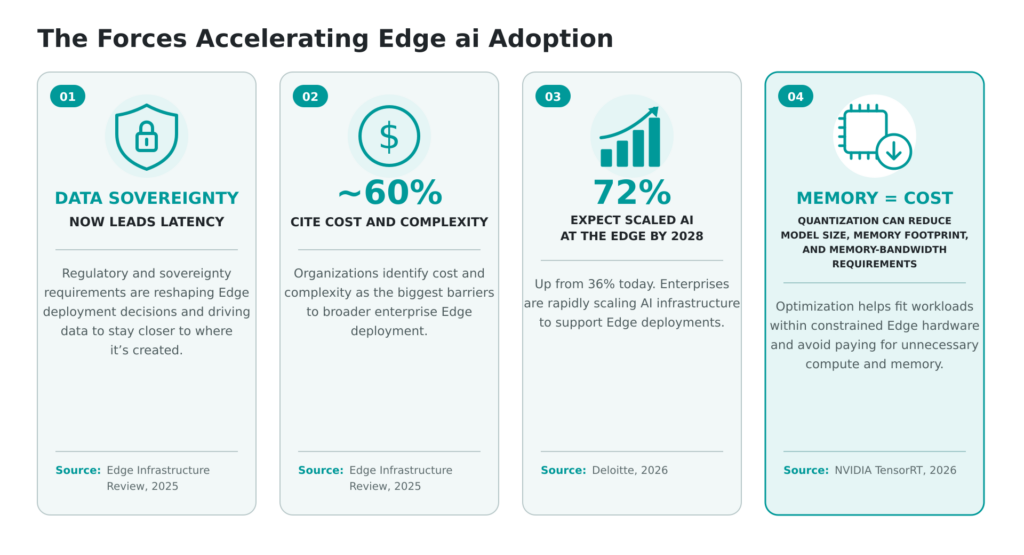
Figure 1. Data control, deployment complexity, infrastructure growth, and memory requirements are reshaping Edge ai deployment decisions.
Where Edge ai fits in the model lifecycle
Building a production Edge ai system involves more than deploying a trained model to a device. The table below covers the primary stages most Edge ai systems move through, from training to a deployed, self-improving system.
| Stage | What happens |
|---|---|
| 1. Training | Large-scale model training happens in the cloud or a data center, where the compute and dataset scale required for training are most cost-effective. This stage produces the model, not the deployment. |
| 2. Simulation and validation | Before a model meets the physical world, it is tested in simulated environments using synthetic data and edge-case scenarios that would be expensive or unsafe to reproduce physically. NVIDIA® Isaac™ Sim and Digital Twin testing are common tools at this stage for robotics and autonomous systems. |
| 3. Edge deployment | The trained and validated model is optimized, typically with TensorRT or a comparable inference engine, and deployed on Edge hardware: sensors, cameras, robots, vehicles, or embedded compute. This is where sensing, inference, and action happen locally, in real time, without round-tripping to a data center. |
| 4. Feedback and iteration | Data from real-world operation feeds back into retraining and refinement cycles. Edge devices are updated over time through OTA architecture as models improve or conditions change. |
NVIDIA describes this as a “three-computer” architecture for robotics specifically: training infrastructure, simulation infrastructure, and the on-robot inference computer (NVIDIA, 2025). The same pattern generalizes to most Edge ai systems beyond robotics.
Edge ai in robotics and Physical ai
Robotics is the domain where Edge ai requirements are most acute, and it is a useful lens for understanding why Edge processing matters structurally, not just as an optimization.
A robot has to perceive its environment, reason about what it perceives, and act, all in real time. A cloud round trip is too slow and too unreliable for the core perception-to-action loop of a moving physical system. This is the foundation of what NVIDIA and the industry now call Physical ai: ai that is embodied in the real world and must sense, plan, and act in physical environments, not just process text or images in isolation (NVIDIA, 2025).
For a robot or autonomous system, the Edge ai requirements stack on top of each other: multi-camera perception running on GMSL or MIPI CSI-2 buses, sensor fusion across LiDAR, IMU, and vision inputs at deterministic latency, and inference compact and efficient enough to run within the robot’s power and thermal budget. Once deployed, individual robots typically operate as part of a larger fleet, where Edge devices, local networks, and Digital Twins combine for fleet-wide optimization.
This is the integration work CTai LABS does as a department of Connect Tech: hardware selection, Board Support Package (BSP) development, sensor bring-up, and model optimization for exactly this class of real-world, real-time Edge ai system.
Book a Demo
Have an Edge ai workload that needs to move from model to deployment? Talk to CTai LABS about your application, performance requirements, data constraints, and deployment environment.

ABOUT THE AUTHOR
Kara Price
Senior Marketing & Events Specialist | Content Strategy | Campaign Execution |
Connect Tech Inc.
Kara Price is a technology writer covering Edge AI, robotics, and embedded computing for Connect Tech and CTai LABS. Trained in journalism at Humber College with a BA in Communication Studies from Wilfrid Laurier University, she has spent over a decade writing for technical audiences, including four years as a proposal writer in architecture and engineering and ten years publishing product and technical announcements at Connect Tech, an NVIDIA Elite Partner. She is Senior Marketing and Events Specialist at Connect Tech.
 Learn More
Resources and Frequently Asked Questions
Related
ai Integration Services. The full-stack engagement: hardware selection, BSP bring-up, sensor integration, model optimization, and a deployment-ready handoff.
See ai Integration Services →What is Physical ai? How Physical ai relates to Edge ai, and what it means for robotics and autonomous systems specifically.
Read: What is Physical ai →Edge vs. Cloud ai Inference. A decision framework for choosing where inference should run, with latency, sovereignty, connectivity, and cost compared directly.
Read: Edge vs. Cloud ai Inference →Sources
CTai LABS. (2025). Your Physical ai integration partner.
https://ctailabs.aiEdge Infrastructure Review. (2025, November 16). 2025 marks a shift: Data sovereignty and AI drive the next phase of edge deployment.
https://www.edgeir.com/2025-marks-a-shift-data-sovereignty-and-ai-drive-the-next-phase-of-edge-deployment-20251116NVIDIA. (2025). Physical ai and the three-computer architecture for robotics.
https://blogs.nvidia.com/blog/three-computers-robotics/NVIDIA. (2026). Working with quantized types: NVIDIA TensorRT. NVIDIA Documentation.
https://docs.nvidia.com/deeplearning/tensorrt/latest/inference-library/work-with-quantized-types.htmlDeloitte. (2026). Enterprises plan rapid growth for AI factories and AI at the edge. Deloitte Center for Integrated Research.
https://www.deloitte.com/us/en/insights/topics/technology-management/ai-infrastructure-survey.htmlFrequently Asked Questions
How does CTai LABS approach Edge ai integration?
CTai LABS, as a department of Connect Tech, approaches Edge ai integration through the CTI EdgeAI Stack, bringing together Edge compute, carrier hardware, BSPs, sensors, ai software, model optimization, and deployment validation. One team can work across those layers, reducing the handoff failures that stall many Edge ai projects between pilot and production.
What is the difference between Edge ai and cloud ai?
Cloud ai processes data on centralized servers, which requires sending data over a network and waiting for a round trip response. Edge ai processes data locally, on or near the device that generated it, eliminating that round trip. The trade-off is compute scale: cloud servers offer far more compute than an Edge device, but Edge ai trades some raw compute capacity for latency, bandwidth savings, and data sovereignty.
Does Edge ai replace the cloud entirely?
No. Most production Edge ai systems use a hybrid model: large-scale model training happens in the cloud, where compute and dataset scale are most cost-effective, while inference happens at the Edge, close to where decisions need to be made in real time. The cloud and the Edge perform different jobs in the same system.
What hardware runs Edge ai?
Edge ai runs on compact, power-efficient compute platforms designed for inference rather than training. NVIDIA Jetson™ modules are widely used across robotics, industrial, defense, and other Edge ai applications, but the module is only one part of a production system. As a department of Connect Tech, CTai LABS integrates Jetson modules with Connect Tech carrier boards and systems engineered for the required I/O, sensors, power, thermal environment, and deployment conditions. Connect Tech also develops its BSPs in-house, giving CTai LABS direct access to the hardware and software expertise needed to move an Edge ai workload from development hardware into a deployment-ready system.
Why does data sovereignty matter for Edge ai?
Many industries and jurisdictions now require sensitive data, healthcare records, defense telemetry, industrial process data, to stay within a specific facility, region, or organization’s control. Edge ai keeps that data local by design, since inference happens on-device rather than on an external cloud server. This has become the leading driver of Edge adoption ahead of latency in several recent industry surveys.
What is Physical ai and how does it relate to Edge ai?
Physical ai refers to ai systems that sense, reason, and act in the physical world, robots, autonomous vehicles, and industrial machines. Physical ai requires Edge ai by necessity: a robot cannot wait on a cloud round trip to decide whether to stop before an obstacle. Edge ai is the infrastructure layer that makes Physical ai possible in real time.
Ready to Build Smarter?
Let’s create the intelligent Edge AI solution that moves your business forward.

ABOUT THE AUTHOR
Ceri Nelmes
Tech Marketing Leader & Journalist | Building Brands at the Edge of What’s Next |
Connect Tech & CTai Labs
Ceri Nelmes is Head of Marketing at Connect Tech and an experienced technology journalist and digital strategist. She covers the technologies and market shifts shaping embedded computing, Edge AI, Physical ai, robotics, autonomous systems, and the NVIDIA® ecosystem. Working with Connect Tech and CTai LABS subject-matter experts, she turns engineering developments into accurate, useful reporting for developers, technical buyers, business leaders, and the media.