Industries
Smart Cities & Transportation:
Edge ai Integration
Real-time sensing, video analytics, and operational intelligence
By Ceri Nelmes
Tech Marketing Leader & Journalist | Building Brands at the Edge of What’s Next | Connect Tech & CTai Labs
Technical review: Rob Callaghan, Chief Product Officer, Connect Tech Inc.
Key Takeaways
- CTai LABS integrates city and transportation workloads from the sensor and network boundary through Edge inference, operational software, validation, and deployment
- CTai LABS can help define a new smart-city application, integrate existing cameras and sensors, expand an NVIDIA Metropolis application, resolve problems with a prototype, or upgrade an existing system
- Edge processing can reduce decision latency and unnecessary data movement while keeping retention, access, and human authority aligned with the operating policy
- Connect Tech platforms support compact, multi-camera, vehicle, and IP67 deployment patterns with NVIDIA Jetsonâ„¢ modules and in-house Board Support Package expertise
- Recent peer-reviewed research identifies interoperability, communications, privacy, security, and real-world validation as continuing smart-city integration challenges
- The customer retains its data, models, application, system design, and intellectual property
CTai LABS, a department of Connect Tech, helps municipalities, transportation authorities, infrastructure operators, and technology providers turn a smart-city or mobility objective into a deployment-ready Edge ai system. This page covers the engineering path from cameras, radar, LiDAR, environmental sensors, and vehicle or infrastructure data through time alignment, NVIDIA® Metropolis video analytics, ai inference, event logic, system integration, cybersecurity boundaries, validation, and lifecycle support on Connect Tech hardware. CTai LABS can start with only an idea and an operating goal, or join at any later point to select hardware, integrate sensors, optimize models, connect an existing platform, diagnose performance, or prepare a controlled rollout.
Build infrastructure that can sense, decide, and respond locally
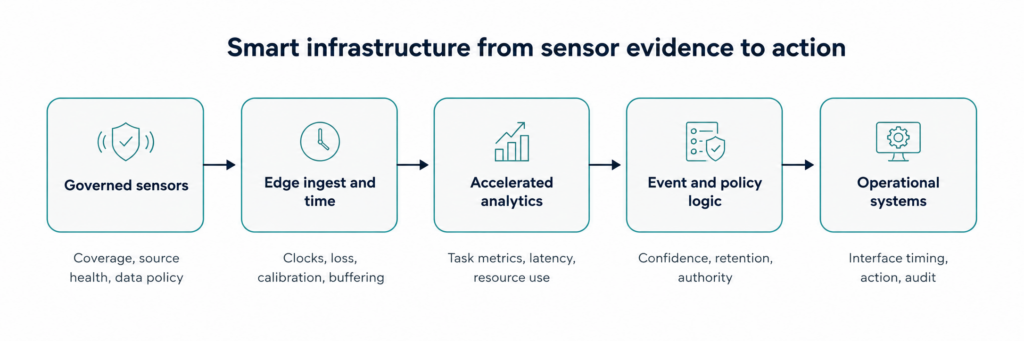
Smart-city systems become useful when sensing, communications, compute, analytics, and the operating workflow function as one governed system. A camera that detects a stopped vehicle, a radar that measures movement, or an environmental sensor that reports a threshold is only the beginning. The deployment must determine which evidence is trustworthy, how quickly an event matters, what data can leave the site, which system receives the output, and where a person remains responsible for action.
Recent research supports this systems view. Elassy et al. (2024) describe intelligent transportation systems as a combination of sensing, communications, analytics, and control that must address interoperability, security, and real-time operation. Ghasemi et al. (2025) review Edge intelligence across vehicles, roadside infrastructure, and communications, showing that model placement and data exchange are architecture decisions rather than isolated software choices. For a production program, those findings point to the same requirement: validate the complete data-to-action chain in the actual operating environment.
Where smart-city and transportation programs stall
The use case is broad but the operating decision is undefined
Traffic flow, curb management, transit operations, pedestrian safety, parking, infrastructure inspection, incident awareness, and environmental monitoring have different sensing geometry, response time, retention, and authority requirements. CTai LABS converts the program goal into an event taxonomy, measurable outputs, latency budget, confidence rules, data boundary, consumer interface, and acceptance matrix before selecting the model or compute platform.
Sensors were selected without an evidence budget
Mounting height, range, field of view, occlusion, weather, glare, night operation, vibration, lens contamination, scene density, and seasonal change determine what a sensor can support. CTai LABS can assess camera, radar, LiDAR, GNSS, environmental, and infrastructure data against the information the workflow needs. Calibration, timestamping, health, and maintenance access are included because the operating evidence must remain interpretable after installation.
Every stream is forwarded before its value is known
Continuous transport of high-resolution video and sensor data can add bandwidth, storage, privacy, and availability dependencies. Edge processing allows selected detection, tracking, counting, classification, event creation, redaction, aggregation, and local retention to run close to the source. The correct boundary is program-specific. CTai LABS measures what must be processed locally, what metadata should be shared, what source evidence must be retained, and what happens when connectivity is unavailable.
A pilot does not include the city or fleet systems that must consume it
An analytics dashboard is not the same as an operational integration. Transportation management, maintenance, dispatch, asset, traveler-information, security, and reporting systems require defined schemas, identifiers, clocks, authentication, retries, audit records, and ownership. CTai LABS can integrate RESTful API endpoints, message brokers, approved databases, geographic context, and operator applications while preserving clear boundaries around control and public-facing decisions.
The deployment plan stops at model accuracy
A field system must also sustain camera ingest, decoding, preprocessing, inference, tracking, event logic, recording, encryption, networking, observability, and updates within its power and thermal envelope. CTai LABS profiles the complete workload on the target Connect Tech platform, then validates event precision and recall, latency distribution, throughput, dropped data, uptime behavior, restart, storage limits, environmental conditions, and representative scene changes.
Figure 1. Smart-city value is created across the complete path from governed sensing to an operational response, with measurable evidence at every interface.
Architecture Through Deployment
CTai LABS organizes the engagement around the current program state and the earliest high-risk interface. Work can begin before a site survey or continue from existing infrastructure, models, dashboards, and network services without discarding components that already meet the requirement.
- Define the operating goal, users, decision or action, site conditions, event taxonomy, authority boundary, response time, data policy, and acceptance criteria.
- Assess cameras and sensors, mounting, coverage, networks, power, enclosure, Connect Tech hardware, NVIDIA Jetsonâ„¢ module, storage, thermal design, and service access.
- Bring up the Board Support Package (BSP), devices, clocks, calibration, stream ingest, recording, health, cybersecurity controls, observability, and recovery behavior.
- Integrate NVIDIA Metropolis components, CUDA® and TensorRT™ acceleration, model runtimes, tracking, fusion, event logic, redaction, aggregation, and operational interfaces where they fit the program.
- Validate recorded data, replay, bench load, site conditions, communications loss, time drift, scene change, sustained operation, update, restart, and operator workflows.
- Deliver the controlled software image, configuration and model lineage, interface documentation, validation evidence, operating limits, deployment procedure, and engineering handoff.
Match response time and consequence to the workflow
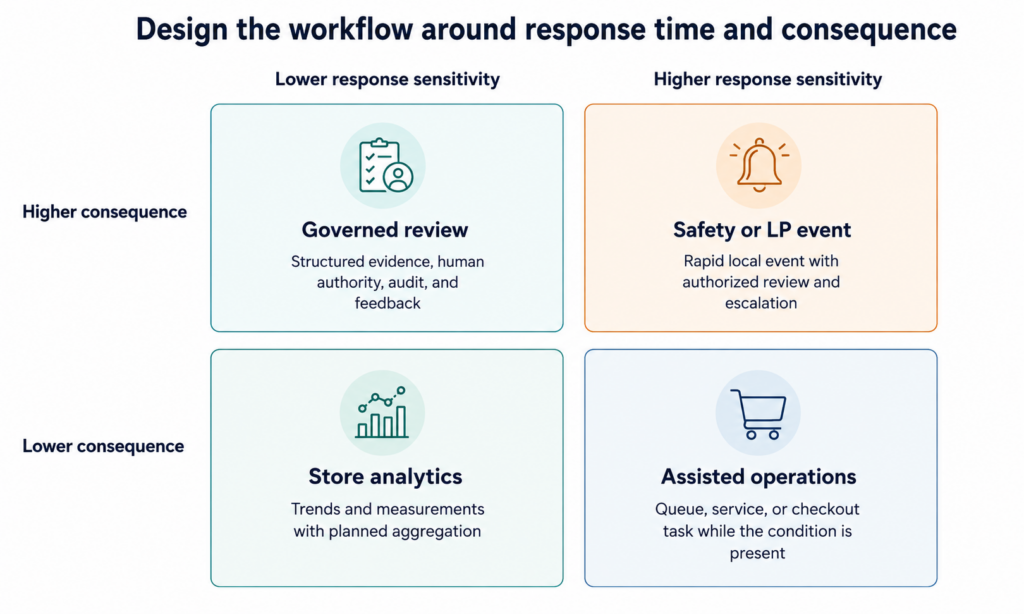
Retail use cases do not share one response window or one cost of error. Queue management and assisted checkout may require a response while the condition is present. Planogram and replenishment can tolerate a longer window but need accurate SKU and location context. Security and safety workflows may require rapid review with clear human authority. The architecture should be sized to the action, not only the number of camera streams.
Figure 2. Response time and environmental exposure help determine whether a program needs a compact site node, a multi-camera facility platform, a rugged roadside system, or a coordinated Edge cluster.
Connect Tech hardware for smart cities and transportation
Connect Tech hardware is included in the architecture because camera interfaces, networking, storage, power, enclosure, connectors, and thermal behavior determine what the analytics pipeline can sustain. CTai LABS maps the sensor count, models, event rate, retention, environment, and support plan to the smallest platform that meets the validated operating envelope with appropriate headroom.
| Connect Tech platform | Best fit | Architecture value |
|---|---|---|
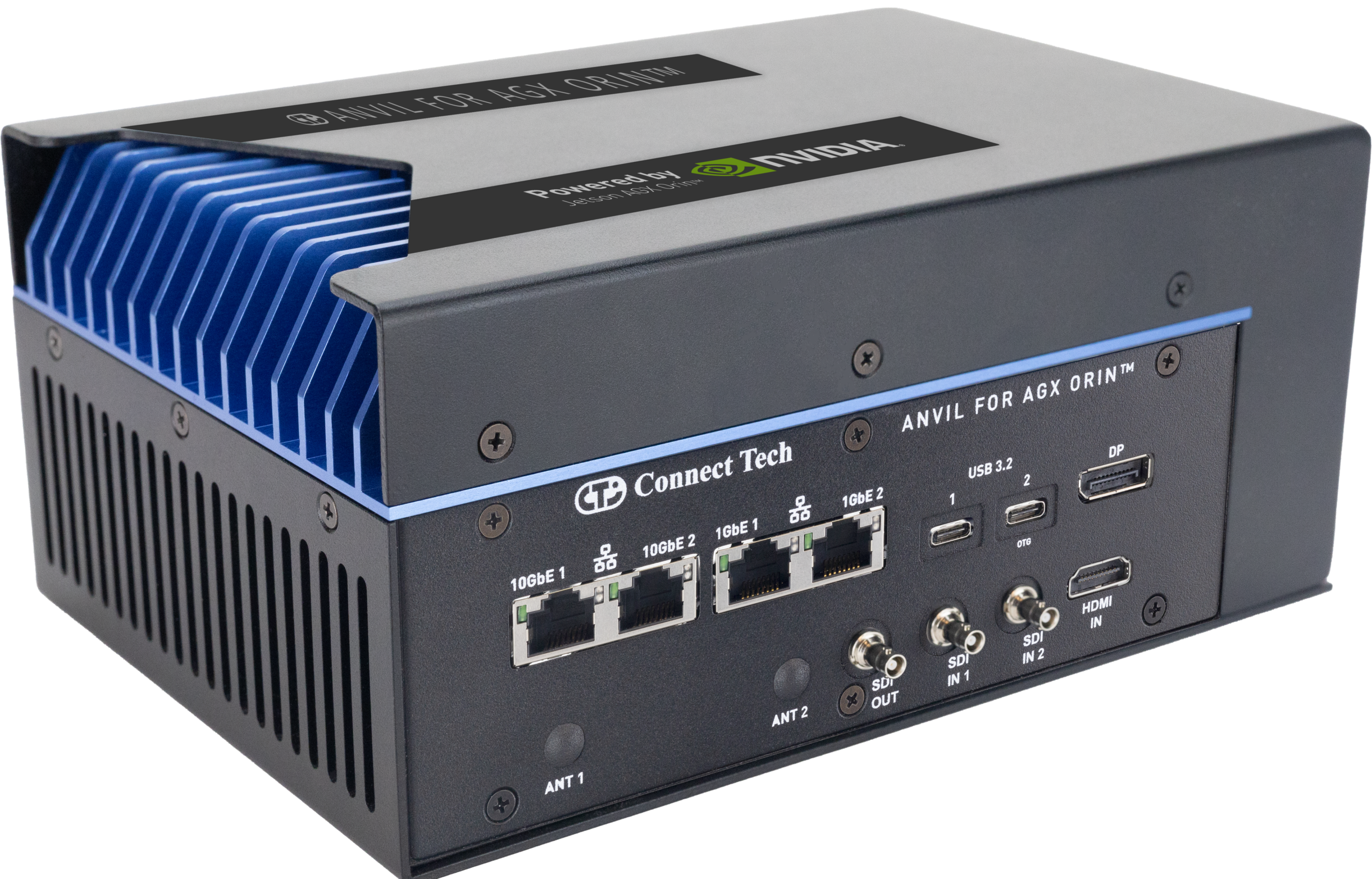
Anvil
with NVIDIA Jetson AGX Orinâ„¢
|
Multi-camera analytics in transit hubs, parking facilities, and infrastructure equipment cabinets | Jetson AGX Orin system with dual 10GbE, dual GbE, two NVMe slots, and optional camera interfaces for sensor ingest, local analytics, and recording. |
Forge
with NVIDIA Jetson AGX Orin
|
Transit hubs, depots, parking facilities, and multi-camera cabinets | Full-featured carrier with high-speed networking, NVMe expansion, and camera expansion for concurrent ingest, analytics, recording, and integration. |
|
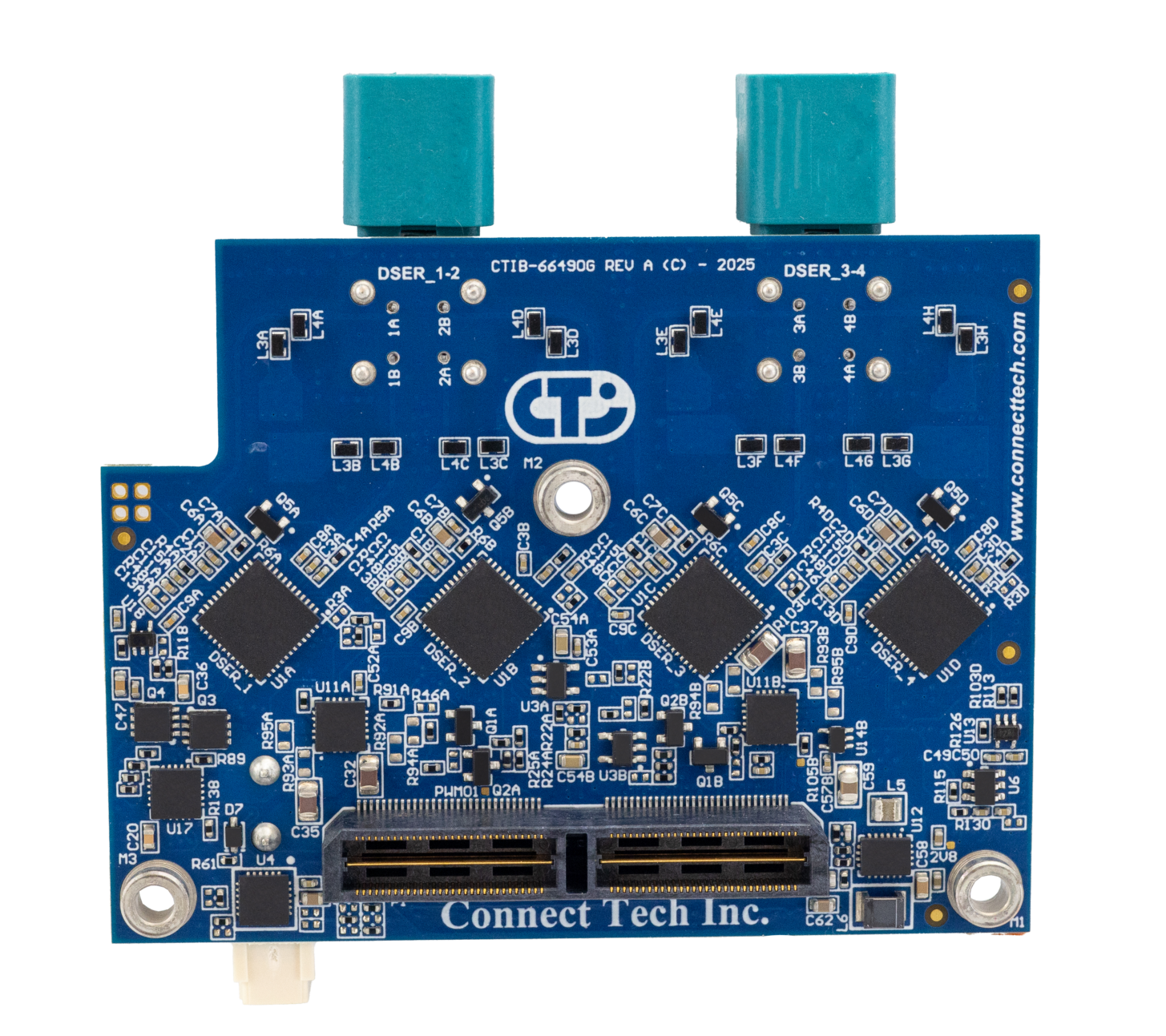
Remote-camera and multi-view installations | Supports compatible coax camera paths with power over coax and centralized processing on supported Jetson AGX Orin and Jetson Thor systems. |
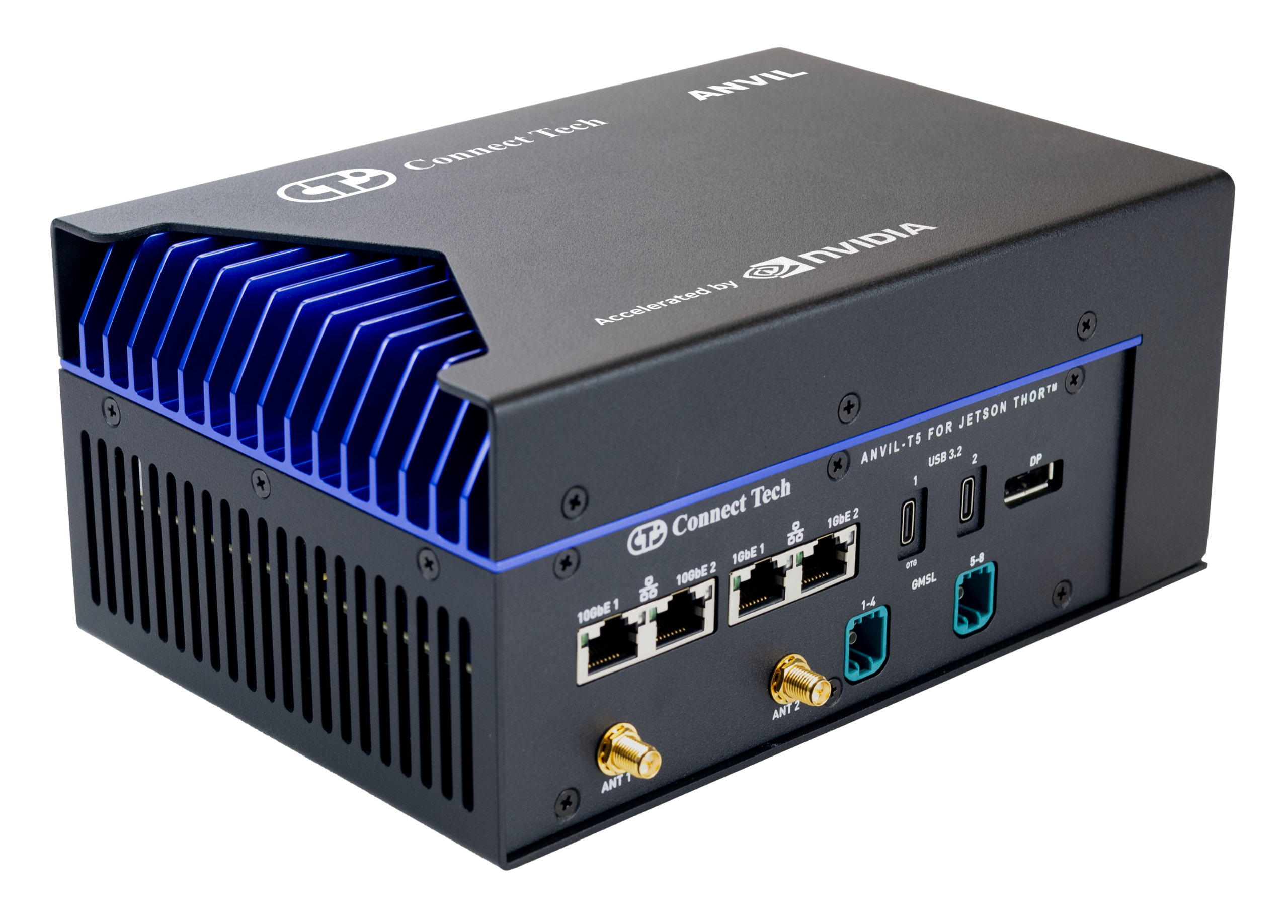
Anvil-T5
with NVIDIA Jetson Thorâ„¢
|
High-compute multimodal infrastructure applications | Jetson Thor system for demanding multi-model and sensor-rich workloads after the application, power, thermal, and lifecycle requirements are measured. |
Example smart-city and transportation projects
Intersection and corridor event intelligence
A transportation operator needs consistent detection and tracking of stopped vehicles, queue formation, turning movement, pedestrian presence, and blocked lanes across changing light and weather. CTai LABS defines the event and evidence requirements, integrates cameras and approved sensors on Anvil-RX, deploys NVIDIA Metropolis analytics, connects events to the transportation workflow, and validates timing, occlusion, scene change, connectivity loss, restart, and operator review.
Transit facility safety and operations
A transit hub wants local awareness of platform crowding, restricted-area entry, unattended objects, and service disruptions without sending every source stream off site. CTai LABS integrates multi-camera ingest on Forge, establishes privacy and retention boundaries, optimizes approved models, creates structured events and review clips, and connects those outputs to authorized operations and incident systems.
Roadside infrastructure monitoring
An agency needs to identify damaged assets, obstructed signs, standing water, debris, or environmental thresholds across dispersed locations. CTai LABS combines scheduled or continuous sensing, Edge inference, source health, local buffering, metadata, store-and-forward behavior, and maintenance-system integration on Connect Tech rugged hardware. The release includes evidence for false events, missed conditions, data gaps, environmental exposure, and recovery.
What CTai LABS can deliver
- Use-case definition, event taxonomy, site and fleet architecture, operating workflow, data and authority boundaries, risk register, and acceptance matrix.
- Camera and sensor plan, Connect Tech platform and NVIDIA Jetson module selection, networking, storage, power, thermal, enclosure, mounting, and service requirements.
- BSP and driver baseline, device bring-up, timing, calibration, recording, health monitoring, security controls, observability, update, and recovery.
- Integrated analytics, NVIDIA Metropolis components, tracking, fusion, event logic, privacy functions, RESTful API and operational-system interfaces.
- Representative dataset and scenario suite, task metrics, latency and throughput traces, sustained-load results, environmental and communications-loss evidence, and known limits.
- Versioned software and model release, deployment image, configuration and data lineage, interface documentation, rollout procedure, lifecycle plan, and knowledge transfer.
Your Physical ai Integration Partner
CTai LABS brings Connect Tech hardware, in-house Board Support Package engineering, camera and sensor integration, NVIDIA Metropolis experience, Edge ai optimization, operational software, and field-representative validation into one smart infrastructure program. The team can begin with an idea, contribute at one difficult interface, or carry the complete system from architecture through deployment while the customer retains its intellectual property.
Book a Demo
Bring your goal. Start with the outcome your smart-city or transportation program must achieve. CTai LABS, a department of Connect Tech, can begin with an early idea, an architecture decision, a working prototype, a difficult integration issue, or a system that must become deployment-ready.
What to bring:
- The operating goal, people or systems that use the result, required action, and boundaries of automated or human decision-making.
- Site maps, mounting and coverage assumptions, environmental conditions, connectivity, power, retention, privacy, security, and service constraints.
- Current or proposed cameras, radar, LiDAR, environmental sensors, Connect Tech hardware, NVIDIA Jetson platform, networks, storage, and operational systems.
- Representative video or sensor data, event definitions, models, dashboards, interfaces, logs, performance traces, and repeatable failure examples.
- Accuracy, false-event cost, latency, uptime, environmental, cybersecurity, rollout, support, and lifecycle evidence required for the next milestone.
CTai LABS uses these inputs to identify the highest-risk interfaces first and define the shortest credible path to a working, measurable system.
ABOUT THE AUTHOR
Ceri Nelmes
Tech Marketing Leader & Journalist | Building Brands at the Edge of What’s Next |
Connect Tech & CTai Labs
Ceri Nelmes is Head of Marketing at Connect Tech and an experienced technology journalist and digital strategist. She covers the technologies and market shifts shaping embedded computing, Edge AI, Physical ai, robotics, autonomous systems, and the NVIDIA® ecosystem. Working with Connect Tech and CTai LABS subject-matter experts, she turns engineering developments into accurate, useful reporting for developers, technical buyers, business leaders, and the media.
Resources and Frequently Asked Questions
Related
Continue into the services, NVIDIA integration capabilities, solutions, and technical resources that support governed sensing and real-time Edge operations.
ai Integration Services. Architecture, software, models, systems, and deployment engineering for complete Edge ai programs.
Explore ai Integration Services →System & Sensor Integration. Camera, sensor, timing, calibration, driver, and data-path integration on Connect Tech hardware.
Explore System & Sensor Integration →NVIDIA Metropolis Integration. Video analytics and intelligent infrastructure applications built around NVIDIA Metropolis.
Explore NVIDIA Metropolis Integration →Scene Analyzer Agent. On-prem scene understanding with structured outputs for approved video workflows.
Explore Scene Analyzer Agent →What Is Edge ai? A practical guide to running ai close to the data source.
Explore What Is Edge ai? →Sources
Connect Tech. (n.d.). Anvil-RX rugged system powered by NVIDIA Jetson AGX Orin. Retrieved August 21, 2026, from
https://connecttech.com/product/anvil-rx-rugged-system-powered-by-nvidia-jetson-agx-orin/Connect Tech. (n.d.). Forge carrier for NVIDIA Jetson AGX Orin. Retrieved August 21, 2026, from
https://connecttech.com/product/forge-carrier-for-nvidia-jetson-agx-orin/Connect Tech. (n.d.). GMSL3 camera platform for NVIDIA Jetson AGX Orin and Jetson Thor. Retrieved August 21, 2026, from
https://connecttech.com/product/gmsl3-camera-platform-nvidia-jetson-agx-orin-jetson-thor/Elassy, M., Al-Hattab, M., Takruri, M., & Badawi, S. (2024). Intelligent transportation systems for sustainable smart cities. Transportation Engineering, 16, 100252.
https://doi.org/10.1016/j.treng.2024.100252Ghasemi, A., Keshavarzi, A., Abdelmoniem, A. M., Nejati, O. R., & Derikvand, T. (2025). Edge intelligence for intelligent transport systems: Approaches, challenges, and future directions. Expert Systems with Applications, 280, 127273.
https://doi.org/10.1016/j.eswa.2025.127273NVIDIA. (2026). NVIDIA Metropolis.
https://www.nvidia.com/en-us/autonomous-machines/intelligent-video-analytics-platform/Sacoto-Cabrera, E. J., Perez-Torres, A., Tello-Oquendo, L., & Cerrada, M. (2025). IoT, AI, and Digital Twins in Smart Cities: A systematic review for a thematic mapping and research agenda. Smart Cities, 8(5), 175.
https://doi.org/10.3390/smartcities8050175Frequently Asked Questions
Can CTai LABS start with only a smart-city idea?
Yes. CTai LABS can begin from the operating outcome, users, site conditions, data policy, authority boundary, and desired milestone, then define the sensing, Edge compute, software, integration, validation, and rollout path.
Can CTai LABS use existing city cameras and sensors?
Yes. CTai LABS can assess current streams, protocols, clocks, image quality, metadata, network and storage limits, then preserve compatible infrastructure and define what must change for the required evidence.
Why process video and sensor data at the Edge?
Yes. CTai LABS can integrate approved NVIDIA Metropolis components with camera ingest, TensorRT-optimized inference, tracking, event logic, recording, operator workflows, and external systems on Connect Tech Edge hardware.
Does CTai LABS integrate NVIDIA Metropolis?
Yes. CTai LABS can integrate approved NVIDIA Metropolis components with camera ingest, TensorRT-optimized inference, tracking, event logic, recording, operator workflows, and external systems on Connect Tech Edge hardware.
Does CTai LABS integrate NVIDIA Metropolis?
Anvil-RX is an IP67 option for NVIDIA Jetson AGX Orin. The final choice depends on sensors, networking, storage, input power, thermal conditions, connectors, mounting, ingress exposure, workload, and service plan.
How are smart-city analytics validated?
Validation covers task-level event performance, scene and weather variation, latency distribution, data loss, sustained load, environmental exposure, restart, connectivity loss, operator workflow, data policy, and the behavior of downstream integrations.
Who owns the smart-city data and intellectual property?
The customer retains its data, models, application, system design, and intellectual property. Engagement deliverables and licensing boundaries are defined in the statement of work.
Ready to Build Smarter?
Let’s create the intelligent Edge AI solution that moves your business forward.