Industries
Autonomous Vehicles:
Physical ai Integration
Vehicle sensing, fusion, perception, and validation
By Ceri Nelmes
Tech Marketing Leader & Journalist | Building Brands at the Edge of What’s Next | Connect Tech & CTai Labs
Technical review: Rob Callaghan, Chief Product Officer, Connect Tech Inc.

Key Takeaways
- CTai LABS integrates autonomous-vehicle systems from sensors and in-vehicle compute through time, calibration, perception, fusion, planning interfaces, validation, and deployment
- An engagement can start with an idea, operating-design-domain concept, research vehicle, sensor suite, recorded dataset, trained model, ROS 2 stack, or a prototype that needs production discipline
- Connect Tech vehicle, rugged, carrier, and camera platforms support research, prototype, off-road, low-speed, and program-specific vehicle ai architectures with NVIDIA® Jetson™ modules
- Sensor fusion performance depends on calibration, time, observability, uncertainty, degraded modes, and representative scenarios, not only the individual sensor or model
- Simulation, recorded-data replay, SIL, HIL, controlled-track testing, and operating-design-domain validation answer different questions and should share traceable scenarios and acceptance criteria
- The customer retains its vehicle data, models, software, system design, and intellectual property
CTai LABS, a department of Connect Tech, helps mobility teams, vehicle manufacturers, off-road equipment developers, autonomy companies, and research programs turn a vehicle ai objective into an integrated, measurable system. This page covers the complete path from cameras, radar, LiDAR, GNSS, IMU, wheel and vehicle data through timestamping, calibration, perception, sensor fusion, localization, NVIDIA® TensorRT™ inference, ROS 2 or program-specific software, controller interfaces, scenario validation, and deployment on Connect Tech hardware. CTai LABS can start with an idea and a proposed operating design domain, or join at any later point to select compute, integrate sensors, repair timing or calibration, optimize models, instrument a vehicle, create replay and HIL assets, diagnose failure modes, or prepare a controlled release.
Build the vehicle as one observable system
An autonomous or highly assisted vehicle depends on the behavior of the complete sensing, estimation, decision, and control path. A camera model cannot compensate for unknown exposure time. A fusion stack cannot align sources whose clocks and transforms are uncertain. A planner cannot manage a condition that perception never represents. A controller interface cannot be validated when latency, confidence, fallback, and authority are undefined. CTai LABS makes those interfaces explicit and measurable.
Recent peer-reviewed research reinforces this system-level requirement. Qian et al. (2025) review camera, radar, and LiDAR fusion architectures while identifying calibration, synchronization, robustness, and computational cost as continuing challenges. Viktor and Kiss (2026) similarly emphasize multimodal fusion architecture, uncertainty, dataset limitations, environmental variation, and real-time constraints. Wang et al. (2026) review autonomous-driving safety across perception, decision, control, testing, and system assurance. Liu et al. (2025) examine large-model approaches to autonomous-driving testing and show why scenario generation and evaluation are becoming more capable while still requiring defined coverage and credible validation.
Where autonomous-vehicle programs stall

The operating design domain is a description, not a testable contract
Road type, speed, traffic, lighting, weather, visibility, road surface, geographic limits, infrastructure, communications, and fallback assumptions define the environment in which a function is intended to operate. CTai LABS translates the program’s operating design domain into scenario parameters, sensor and compute requirements, authority boundaries, degraded modes, evidence sources, and acceptance criteria. SAE J3016 terminology can support clear discussion of the driving-automation function and human role.

Sensors are integrated without a shared time and geometry model
Cameras, radar, LiDAR, GNSS, IMU, wheel odometry, vehicle buses, and actuator feedback can use different clocks, rates, trigger paths, coordinate frames, and latencies. CTai LABS maps exposure and measurement time, transport delay, jitter, intrinsic and extrinsic calibration, transforms, interpolation, buffers, source health, and replay. The deliverable includes measured uncertainty and loss behavior rather than a static calibration file alone.

Perception and fusion are evaluated only on aggregate benchmarks
A program needs evidence by scenario, range, object class, visibility, motion, occlusion, weather, source availability, confidence, and downstream consequence. CTai LABS can build task and scenario metrics for detection, tracking, segmentation, free space, depth, localization, and fusion. Model and fusion changes are evaluated on representative data and the target Connect Tech system, with failure cases retained as regression assets.

The compute platform is sized from one model
The vehicle must sustain sensor ingest, decoding, preprocessing, several models, fusion, localization, planning interfaces, recording, networking, diagnostics, encryption, and updates concurrently. CTai LABS profiles the full workload, then applies NVIDIA CUDA® and TensorRT optimization where accuracy is preserved. Memory bandwidth, copies, accelerator contention, storage, network, power, thermals, startup, and recovery are measured during representative vehicle operation.

Simulation, replay, HIL, and vehicle tests use different scenarios
Each test method exposes different risks. Simulation provides controlled variation and repeatability. Recorded-data replay supports deterministic perception and fusion analysis. Software-in-the-loop and hardware-in-the-loop expose software, timing, interfaces, and target-compute behavior. Controlled-track and field testing reveal physical sensor, environmental, vehicle-dynamics, and operational effects. CTai LABS connects these methods through common scenario identifiers, configurations, expected behavior, and release evidence.

Safety and production boundaries are assumed from the development platform
Development compute, algorithm capability, vehicle integration, and a production safety architecture are related but separate decisions. CTai LABS uses Connect Tech hardware for program-appropriate research, prototyping, off-road, low-speed, perception, validation, and product-development applications. Series-production road-vehicle programs must select compute, components, processes, suppliers, and evidence that meet their specific functional-safety, Safety Of The Intended Functionality, cybersecurity, regulatory, and lifecycle requirements. No development platform alone establishes those claims.

Figure 1. Vehicle Physical ai depends on a traceable path from physical sensing through estimation and bounded controller interfaces.
Architecture Through Deployment
CTai LABS scopes the engagement around the vehicle function, operating design domain, current platform, safety and authority boundaries, and the next evidence gate. Existing sensors, datasets, algorithms, ROS 2 components, and vehicle systems can be retained when they meet the interface and validation requirements.
- Define the driving or mobility function, operating design domain, human and system roles, controller boundary, fallback, degraded modes, cybersecurity and safety ownership, scenarios, and acceptance criteria.
- Select sensors, Connect Tech compute and camera hardware, NVIDIA Jetson™ or IGX platform, networking, storage, time source, input power, thermal solution, enclosure, connectors, and mounting.
- Bringup the Board Support Package (BSPs), sensor and vehicle interfaces, clocks, calibration, transforms, recording, replay, health monitoring, diagnostics, update, watchdog, and recovery.
- Integrate and optimize detection, segmentation, tracking, free space, depth, fusion, localization, mapping, prediction, planning interfaces, logging, and approved controller or supervision outputs.
- Validate simulation, recorded replay, SIL, HIL, bench load, controlled vehicle tests, sensor degradation, communications loss, operating-design-domain scenarios, sustained operation, power, thermals, restart, and recovery.
- Deliver the controlled release, configuration, calibration, model and data lineage, interface-control documentation, scenario suite, test evidence, known limits, deployment procedure, and engineering handoff.
Build one traceable validation path
A credible program increases physical realism without abandoning repeatability. Requirements and operating-design-domain parameters should be connected to simulation, recorded data, target compute, vehicle interfaces, and controlled trials. Each stage retires a different risk and produces evidence for the same versioned release.
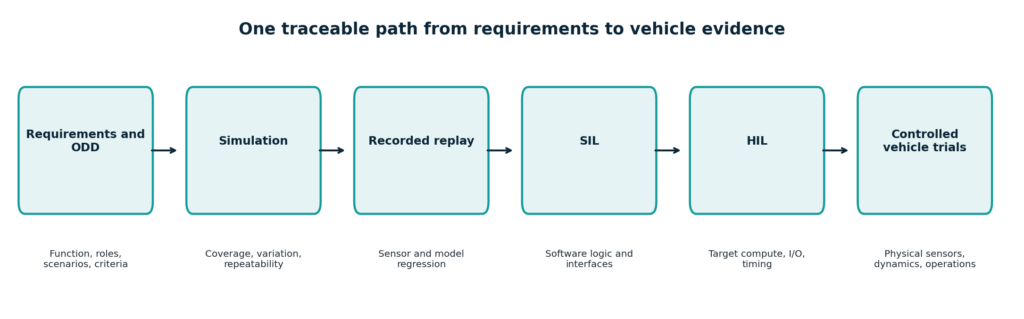
Figure 2. Requirements, scenarios, configurations, and acceptance criteria remain traceable as testing progresses from simulation to controlled operating-design-domain trials.
Connect Tech hardware for autonomous vehicles | IP67 Rated
Hardware selection follows the vehicle function, sensor count and interfaces, workload, recording, vehicle networks, input power, enclosure, connectors, thermal conditions, environmental exposure, service, evidence, and lifecycle plan. CTai LABS distinguishes development and program-specific vehicle platforms from any separate series-production safety architecture required by the customer.
| Connect Tech platform | Best fit | Vehicle integration value |
|---|---|---|
| Falcon with NVIDIA Jetson Orin NX™ | Compact vehicle perception, in-cabin local AI agent/assistance, and autonomy development | IP67 vehicle system with automotive Ethernet options, rugged connectivity for bounded sensor, perception, recording, and communications workloads. |
| Anvil-RX with NVIDIA Jetson AGX Orin™ | Rugged multi-sensor vehicle and off-road programs | IP67 AGX Orin system with sealed connectors for higher-compute perception, fusion, recording, and networking in exposed environments. |
| Rogue-RX carrier for NVIDIA Jetson AGX Orin | Custom vehicle enclosure and I/O architectures | Rugged positive-lock carrier with 10GBASE-T, USB, CAN, GPIO, and expansion paths for product teams controlling the enclosure, power, and thermal design. |
| Anvil for AGX Orin Anvil-T5 for Jetson Thor T5000 | Synchronized multi-camera vehicle perception | Supports up to eight compatible coax cameras with centralized processing and power over coax. |
| Tempo IGX with NVIDIA IGX T5000 | Advanced autonomy platforms with high sensor input, including lidar, cameras, radar, and other inputs. NVIDIA Safety Path Alignment | Production-oriented IGX platform for demanding real-time workloads. Suitability, certification, evidence, and vehicle integration remain specific to the customer's architecture and intended use. |
Example autonomous-vehicle projects
The following spoke pages are in development for a future phase. Each covers one defense ai integration topic in technical depth.
Multi-sensor perception vehicle
A mobility team has cameras, radar, LiDAR, GNSS, and IMU but inconsistent time, calibration, recording, and replay. CTai LABS integrates the sensors and vehicle network on Anvil-RX, establishes clocks and transforms, brings up perception and fusion, creates a deterministic data and replay path, profiles the target workload, and validates source loss, occlusion, lighting, weather, localization, latency, sustained load, restart, and recovery.
Low-speed autonomous platform
A low-speed shuttle, yard vehicle, agricultural machine, or industrial vehicle needs bounded localization, perception, planning, and controller interfaces inside a defined operating area. CTai LABS maps the operating design domain and authority, selects Falcon or Anvil-RX, integrates the vehicle and sensors, deploys the autonomy stack, and builds scenario evidence through simulation, replay, HIL, and controlled vehicle testing. Safety functions and approvals are owned by the program’s qualified parties.
Research stack to target-compute release
A vehicle ai stack runs across development workstations and manually configured devices. CTai LABS consolidates supported workloads on Connect Tech target hardware, creates the BSP and driver baseline, integrates CUDA and TensorRT runtimes, formalizes startup and recovery, establishes model and configuration lineage, builds target-compute regression tests, and produces a controlled release with measured performance and known limits.
What CTai LABS can deliver
- Vehicle-function and operating-design-domain definition, human and system roles, authority and controller boundaries, degraded modes, interface ownership, scenario plan, risk register, and acceptance matrix.
- Sensor, Connect Tech platform, NVIDIA Jetson or IGX, camera expansion, network, storage, time, input-power, thermal, enclosure, connector, and mounting architecture.
- Board Support Package and driver baseline, sensor and vehicle bring-up, time, calibration, transforms, recording, replay, health, diagnostics, update, watchdogs, and recovery.
- Integrated perception, tracking, segmentation, free space, sensor fusion, localization, mapping, prediction, planning interfaces, and approved controller or supervision outputs.
- Scenario and regression assets, task and system metrics, target-compute traces, sustained-load results, sensor-degradation evidence, SIL/HIL and controlled vehicle test results, and known limits.
- Controlled software and model release, configuration and calibration records, data lineage, interface-control documentation, validation report, deployment and recovery procedures, and knowledge transfer.
Your Physical ai Integration Partner
CTai LABS combines Connect Tech vehicle and rugged hardware, in-house Board Support Package engineering, multi-sensor integration, ROS 2 and autonomy software, NVIDIA TensorRT optimization, replay and HIL tooling, and vehicle-representative validation. The team can begin with an idea, solve one sensing, fusion, or target-compute problem, or carry the approved vehicle Physical ai stack from architecture through deployment while the customer retains its intellectual property and owns its safety, cybersecurity, regulatory, and operational authority.
Connect Tech hardware for autonomous vehicles

Rogue-RX (AGX203) with Jetson AGX Orin™ Industrial
Custom vehicle enclosure and I/O architectures Rugged positive-lock carrier with 10GBASE-T, USB, CAN, GPIO, and expansion paths for product teams controlling the enclosure, power, and thermal design.
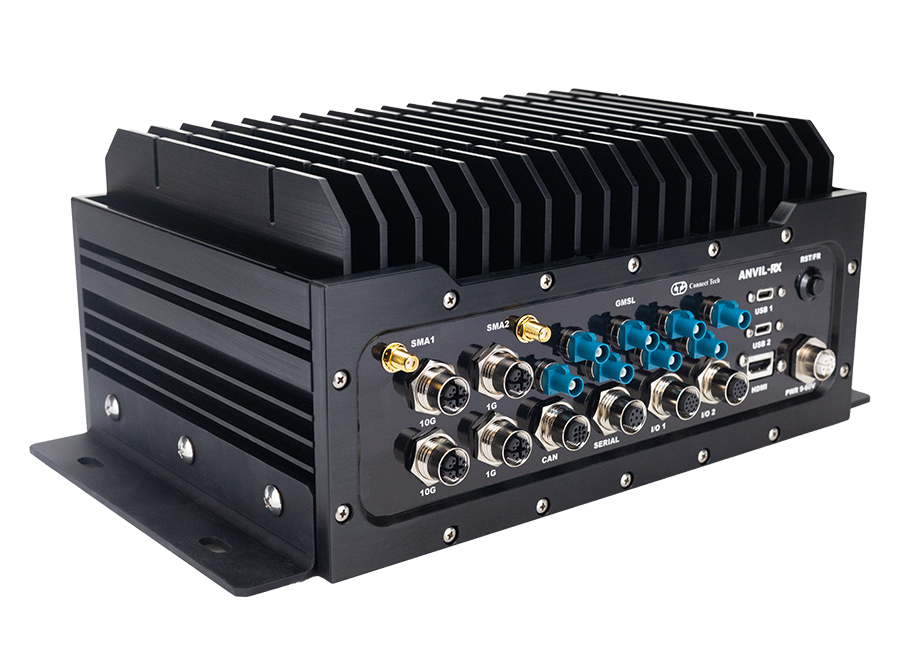
Anvil-RX with Jetson AGX Orin™
Rugged multi-sensor vehicle and off-road programs IP67 AGX Orin system with sealed connectors for higher-compute perception, fusion, recording, and networking in exposed environments.
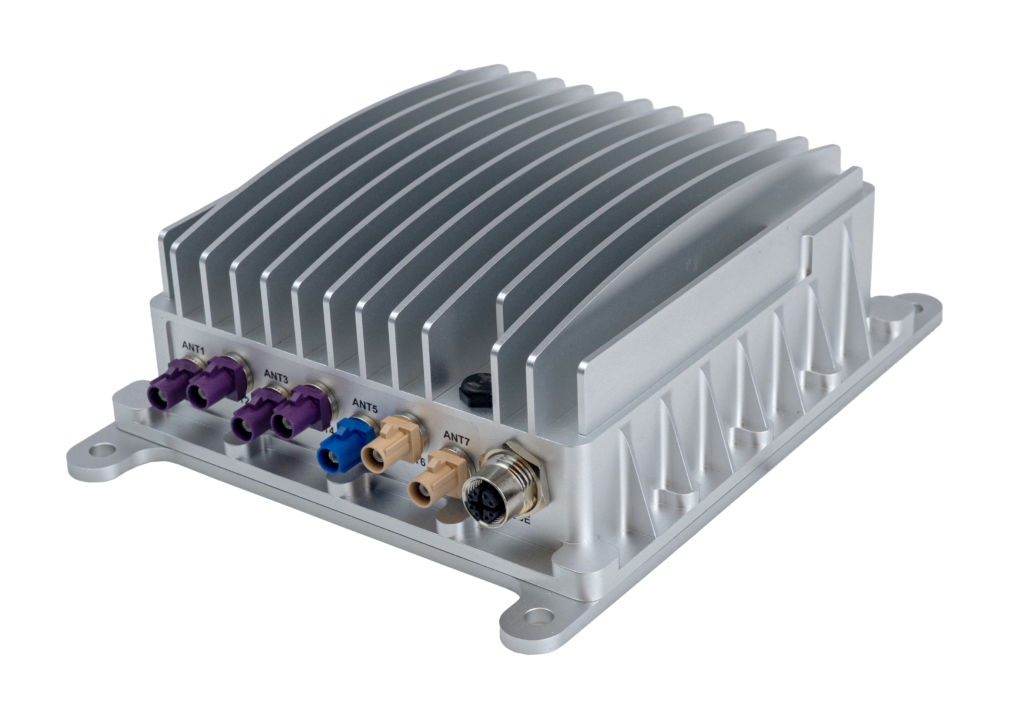
Falcon with NVIDIA Jetson Orin NX™
Compact vehicle perception, -in cabin local AI agent/assistance and autonomy development IP67 vehicle system with automotive Ethernet options, rugged connectivity for bounded sensor, perception, recording, and communications workloads.

Anvil-T5 for Jetson T5000
Built for autonomy, engineered for reliability, and powered by NVIDIA Jetson Thor, Anvil-T5 delivers the next leap in Edge AI performance. Designed to handle the most demanding robotic and autonomous workloads, it combines extreme compute capability with rugged, dependable engineering.

ABOUT THE AUTHOR
Ceri Nelmes
Tech Marketing Leader & Journalist | Building Brands at the Edge of What’s Next |
Connect Tech & CTai Labs
Ceri Nelmes is Head of Marketing at Connect Tech and an experienced technology journalist and digital strategist. She covers the technologies and market shifts shaping embedded computing, Edge AI, Physical ai, robotics, autonomous systems, and the NVIDIA® ecosystem. Working with Connect Tech and CTai LABS subject-matter experts, she turns engineering developments into accurate, useful reporting for developers, technical buyers, business leaders, and the media.
Book a Demo
Bring your goal. Start with the outcome your autonomous-vehicle program must achieve. CTai LABS, a department of Connect Tech, can begin with an early idea, an architecture decision, a working prototype, a difficult integration issue, or a system that must become deployment-ready.
What to bring:
- The vehicle function, operating design domain, speed and environment, human and system roles, controller boundary, fallback, and next evidence gate.
- Current or proposed cameras, radar, LiDAR, GNSS, IMU, vehicle networks, Connect Tech hardware, NVIDIA platform, storage, time source, power, enclosure, and cooling.
- ROS 2 or autonomy graph, algorithms, models, calibration, recorded data, maps, simulation assets, interface-control documents, logs, traces, and repeatable failure cases.
- Safety, cybersecurity, data, update, recovery, service, environmental, qualification, supplier, regulatory, and lifecycle requirements owned by the program.
- Scenario, task, latency, localization, fusion, sustained-load, degraded-mode, SIL/HIL, vehicle-test, release, and acceptance evidence required for the next milestone.
CTai LABS uses these inputs to identify the highest-risk interfaces first and define the shortest credible path to a working, measurable system.
 Learn More
Resources and Frequently Asked Questions
Continue into the perception, fusion, sensor, simulation, and model-optimization capabilities that support vehicle Physical ai programs.
Related
Robot Perception. Camera, LiDAR, depth, tracking, and environment-understanding integration.
Explore Robot Perception →Sensor Fusion. Time, calibration, multi-sensor estimation, uncertainty, and validation.
Explore Sensor Fusion →System & Sensor Integration. Device bring-up, drivers, clocks, calibration, and production data paths.
Explore System & Sensor Integration →NVIDIA Omniverse & Isaac Sim. Simulation, Digital Twin, synthetic data, and scenario-based robotics development.
Explore NVIDIA Omniverse & Isaac Sim →ai Model Optimization. TensorRT and CUDA optimization measured on the target Connect Tech platform.
Explore ai Model Optimization →Sources
Connect Tech. (n.d.). Anvil-RX rugged system powered by NVIDIA Jetson AGX Orin. Retrieved August 21, 2026, from
https://connecttech.com/product/anvil-rx-rugged-system-powered-by-nvidia-jetson-agx-orin/Connect Tech. (n.d.). Falcon vehicle system with NVIDIA Jetson Orin NX. Retrieved August 21, 2026, from
https://connecttech.com/product/falcon-vehicle-system-with-nvidia-jetson-orin-nx/Connect Tech. (n.d.). Rogue-RX carrier board for NVIDIA Jetson AGX Orin. Retrieved August 21, 2026, from
https://connecttech.com/product/rogue-rx-carrier-board-for-nvidia-jetson-agx-orin/International Organization for Standardization. (2018). ISO 26262-1:2018 road vehicles, functional safety, Part 1: Vocabulary.
https://www.iso.org/standard/68383.htmlInternational Organization for Standardization. (2022). ISO 21448:2022 road vehicles, Safety Of The Intended Functionality.
https://www.iso.org/standard/77490.htmlInternational Organization for Standardization. (2022). ISO 34502:2022 road vehicles, test scenarios for automated driving systems, scenario-based safety evaluation framework.
https://www.iso.org/standard/78951.htmlLiu, S., Cong, S., & Yang, L. (2025). Survey of research on autonomous driving testing with large models. Communications in Transportation Research, 5(2), 100179.
https://doi.org/10.1016/j.commtr.2025.100179Qian, H., Wang, M., Zhu, M., & Wang, H. (2025). A review of multi-sensor fusion in autonomous driving. Sensors, 25(19), 6033.
https://doi.org/10.3390/s25196033SAE International. (2021). J3016: Taxonomy and definitions for terms related to driving automation systems for on-road motor vehicles.
https://www.sae.org/standards/j3016-taxonomy-definitions-terms-related-driving-automation-systems-road-motor-vehiclesViktor, P., & Kiss, G. (2026). Multimodal sensor fusion in autonomous vehicles: Technologies, architectures, and open challenges. Sensors, 26(11), 3528.
https://doi.org/10.3390/s26113528Wang, S., Li, H., & Zhao, G. (2026). Recent advances in autonomous driving safety. Transactions on Artificial Intelligence, 2(1), 161–177.
https://doi.org/10.53941/tai.2026.100010Frequently Asked Questions
Can CTai LABS start with only an autonomous-vehicle idea?
Yes. CTai LABS can begin from the vehicle function, operating design domain, users, authority boundary, platform assumptions, and desired milestone, then define the sensing, compute, software, validation, and deployment path.
Can CTai LABS integrate an existing sensor suite?
Yes. CTai LABS can assess current cameras, radar, LiDAR, GNSS, IMU, wheel and vehicle data, then establish compatible interfaces, clocks, calibration, transforms, recording, replay, health, and degraded behavior.
Does CTai LABS build sensor-fusion software?
Yes. CTai LABS can integrate and develop program-specific time alignment, calibration, filtering, tracking, localization, mapping, and fusion components, then validate uncertainty, observability, source loss, and task-level behavior.
Can CTai LABS optimize existing vehicle ai models?
Yes. CTai LABS can preserve the customer’s models and IP, deploy supported runtimes with TensorRT and CUDA, compare against a reference, and measure task behavior, latency, memory, power, thermals, and sustained operation on the target platform.
How do simulation and HIL fit the program?
Simulation varies scenarios and environment. Replay evaluates recorded sensing deterministically. SIL evaluates software behavior. HIL adds target compute and physical interfaces. Controlled vehicle trials expose real sensors, dynamics, environment, and operations. CTai LABS connects them with shared scenarios and release traceability.
Is Connect Tech Jetson hardware automatically suitable for a series-production road vehicle?
No single platform establishes program suitability or safety compliance. CTai LABS selects Connect Tech hardware for the program’s research, prototype, off-road, low-speed, perception, validation, or product-development needs and works within the customer’s separate safety, cybersecurity, regulatory, supplier, and lifecycle architecture.
Who owns the autonomous-vehicle intellectual property?
The customer retains its vehicle data, maps, models, algorithms, application, system design, and intellectual property. Engagement deliverables and licensing boundaries are defined in the statement of work.
Ready to Build Smarter?
Let’s create the intelligent Edge AI solution that moves your business forward.