Industries
Aerospace and Defense: Edge ai Systems
Mission-critical Edge ai for unmanned systems, ISR payloads, and rugged vehicle-mounted compute, engineered for the environments they operate in.
By Ceri Nelmes
Tech Marketing Leader & Journalist | Building Brands at the Edge of What’s Next | Connect Tech & CTai Labs
Technical review: Rob Callaghan, Chief Product Officer, Connect Tech Inc.

Key Takeaways
- CTai LABS delivers tactical Edge AI integration on Connect Tech Solutions with NVIDIA® Jetson™
- NDAA-compliant solutions designed and manufactured in North America for secure, trusted deployment
- CTai LABS brings experience across air, land, and sea platforms, giving the team practical familiarity with defense procurement requirements and evaluation criteria.
- Rugged systems for vehicle-mounted and ground-deployed compute
- SWaP-optimized payloads for UAVs and unmanned platforms, plus ISR sensor fusion
- Deployment-ready validated systems that meet the environmental requirements of defense programs
- Connect Tech hardware for rugged applications is MIL-STD-810H-certified by design, and tested and validated as per program requirements: ruggedized connectors, wide-input voltage, extended temperature operation
- CTai LABS and Connect Tech maintain an identified aerospace and defense team supporting mission-critical edge AI deployments
- In-house BSP development removes the dependency on third-party software teams who have not seen the hardware design
The defense Edge ai market
Defense investment in Edge ai is accelerating across every domain. The shift is documented at the policy level as well as by market analysts: RAND’s research on ai’s military implications finds it poised to reshape core competitions in modern warfare, including how AI improves battlefield finding by rapidly fusing intelligence from proliferated sensors (Burdette et al., 2026), and Gartner named Physical ai, machines and devices that sense, decide, and act in real-world environments, among its top strategic technology trends for 2026 (Gartner, 2025). The global military Edge computing market was valued at USD 3.2 to 3.96 billion in 2025 depending on analyst scope, and is projected to reach USD 9.7 to 10.32 billion by 2033 to 2034 at CAGRs of 13.9 to 14.9 percent (Grand View Research, 2026; Market Intelo, 2026). The secure Edge computing for defense market specifically, covering ruggedized Edge ai hardware for tactical applications, was valued at USD 6.3 billion in 2025 and is projected to reach USD 26.8 billion by 2034 at a 16.7 percent CAGR (Market Intelo, 2026). Ruggedized Edge ai hardware, while the smallest sub-segment at 14.7 percent of secure defense Edge computing, is forecast to grow at the fastest rate, 22.1 percent CAGR through 2034, as unmanned systems proliferate and onboard compute requirements increase (Market Intelo, 2026).
The structural driver is unmanned systems growth. The global military UAV fleet is projected to grow from approximately 35,000 units in 2025 to over 88,000 units by 2032, each representing an onboard Edge compute node (Market Intelo, 2026). ISR is the dominant application: the ISR segment led the military Edge computing market in 2025, driven by real-time situational awareness, threat detection, and the processing of large volumes of sensor and full-motion video data closer to the source (Grand View Research, 2026). Autonomous perception is the fastest-growing application segment at approximately 15.4 percent CAGR, enabling ai-powered target recognition and unmanned system autonomy in communications-denied environments (Market Intelo, 2025).
North America dominates the defense Edge ai market at 37 to 43 percent of global revenue in 2025. The UK Ministry of Defence committed £180 million (approximately USD 241.9 million) to an AI and Edge Services Framework, tendered August 2025 (UK Ministry of Defence, 2025), and the European Commission committed EUR 1.07 billion across 57 new defence projects in its 2025 European Defence Fund call, spanning artificial intelligence, cyber defence, and drone systems (European Commission, 2026).

Figure 1. The defense Edge AI market and the hardware reality behind it.
What defense Edge ai integration requires
Defense programs have integration requirements that do not appear in commercial deployments, and most commercial ai integrators are not equipped to meet them. CTai LABS and Connect Tech bring an established defense procurement process built around the certification requirements defense programs expect.

Ruggedized hardware from day one
MIL-STD-810H-relevant thermal design, ruggedized locking connectors, wide-input voltage, and shock and vibration tolerance are program requirements, not optional features. They must be built into the hardware selection and system architecture at the start of the engagement, not retrofitted after a field failure. Connect Tech solutions for defense applications are designed with these requirements as baseline constraints, not as add-ons.

SWaP-constrained payload integration
UAV payloads and dismounted systems have strict size, weight, and power constraints that determine what is deployable. The Hadron and Super Hadron carrier families for Jetson Orin™ NX and Jetson Orin Nano operate at 9-to-60-volt input in a form factor around 23 grams, which is the class of hardware that makes Edge ai viable in SWaP-limited applications. Platform selection for a defense payload cannot be made from a spec sheet. It has to be made against the actual envelope of the platform it flies on.

Communications-denied operation
Defense deployments require ai systems that maintain full mission effectiveness when network connectivity is severed. ISR analytics, target recognition, and sensor fusion pipelines must run on-prem on the Edge platform, without back-haul dependency. That architectural requirement drives every layer of the software stack, which all have to function without cloud connectivity.

Multi-sensor ISR fusion
Software teams working from third-party hardware cannot resolve sensor timing issues that originate in the carrier board design. ISR payloads integrate cameras, electro-optical/infrared sensors, LiDAR, and radar inputs that must be fused at sub-50-millisecond latency for situational awareness applications. The timing coordination across heterogeneous sensor inputs, and the deterministic pipeline management required to meet latency targets, is integration work that requires hardware-level Board Support Package (BSP) access.

Long-term platform support
Defense programs have multi-decade lifecycles. The hardware, BSP, and software configuration selected for a deployment has to be supported for the full program life, not just through the initial integration. Connect Tech publishes and maintains BSPs for its carrier boards across multiple JetPack™ generations, which provides the long-term platform continuity that defense programs require.
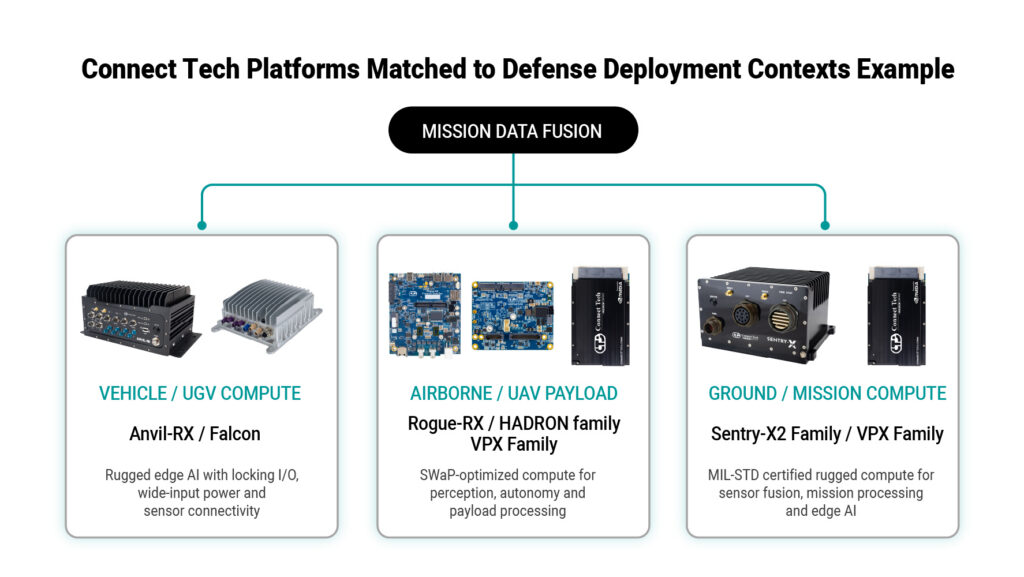
Figure 2. Example Connect Tech platforms matched to defense deployment contexts.
What defense Edge ai integration requires
Defense programs have integration requirements that do not appear in commercial deployments, and most commercial ai integrators are not equipped to meet them. CTai LABS and Connect Tech bring an established defense procurement process built around the certification requirements defense programs expect.
Capabilities for aerospace and defense
The table below maps CTai LABS’ defense integration capabilities to what each one delivers for a program.
| Capability | What CTai LABS delivers |
|---|---|
| SOSA/VPX compliance | Platform architecture aligned to SOSA (Sensor Open Systems Architecture) technical standards and VPX chassis form factors for programs requiring open, modular, vendor-agnostic compute. Reduces integration risk for platforms with existing VPX backplanes. |
| Certification and compliance | Design and validation practices aligned to MIL-STD-810H environmental testing (shock, vibration, temperature, humidity) for rugged deployment, with documentation support for program-level DO-160 and airworthiness reviews. This capability will vary per program. |
| Rugged system integration | Platform selection and full system integration for vehicle-mounted and ground-deployed applications. Falcon Vehicle System (ESG615), Rogue-RX (AGX203), and Anvil-RX for rugged compute with locking connectors, wide-input power, and extended temperature operation. |
| SWaP-limited payload integration | Platform selection and bring-up for UAV and dismounted applications. Hadron and Super Hadron for Jetson Orin NX and Jetson Orin Nano in sub-25-gram form factors with 9 to 60 V input and GMSL coax camera integration. |
| ISR sensor fusion | Multi-sensor integration across EO/IR cameras, LiDAR, IMU, and radar inputs with deterministic pipeline management and sub-50ms fusion latency targets. |
| Communications-denied ai | On-prem inference architecture that maintains full mission effectiveness without back-haul connectivity. Model optimization with TensorRT™ for the target Jetson™ module power mode. |
| BSP and driver development | In-house BSP for Connect Tech defense hardware, with long-term platform support. No third-party BSP dependency. |
| SIL/HIL/Digital Twin validation | Full validation pipeline covering Software-in-the-Loop, Hardware-in-the-Loop, and Digital Twin testing if required before fielding. Validation records for program documentation. |
Connect Tech hardware for aerospace and defense
The following spoke pages are in development for a future phase. Each covers one defense ai integration topic in technical depth.

Rogue-RX (AGX203) with Jetson AGX Orin™ Industrial
The primary platform for vehicle-mounted and mobile defense compute. Ruggedized positive-lock connectors, wide-input voltage, 2x 10GbE, 16-lane MIPI CSI-2, and a 92 by 107 mm footprint rated to -40°C to +85°C. Designed for the connector reliability and power input range that mobile defense platforms require (Connect Tech, 2025).
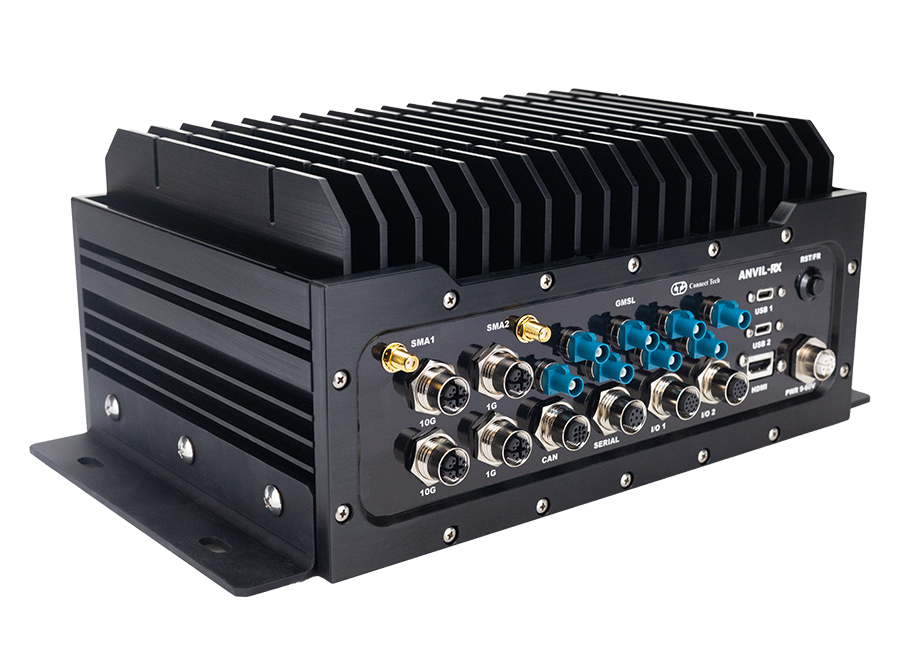
Anvil-RX with Jetson AGX Orin™
IP67-rated full system for ground-deployed and vehicle-mounted applications where sealed ingress is a requirement. M12 and sealed PC connectors. Suited to programs where the compute node is exposed to dust, water, and contamination in the operating environment (Connect Tech, 2025).
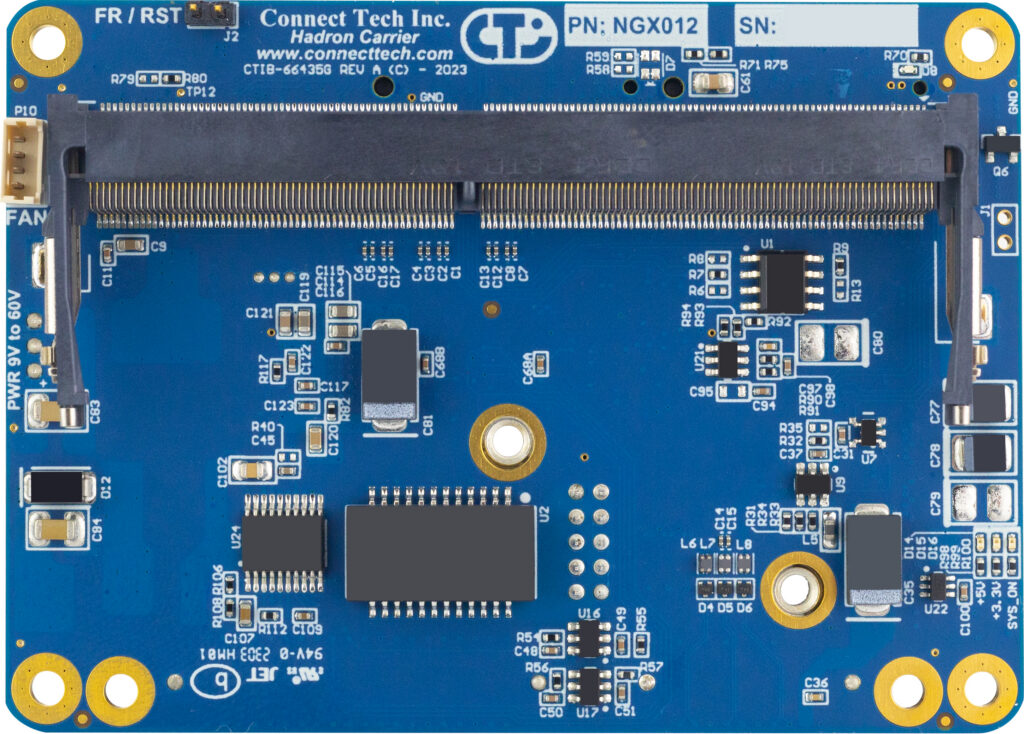
Hadron and Super Hadron with Jetson Orin™ NX and Orin™ Nano
The primary platform for UAV payloads and SWaP-limited unmanned systems. Approximately 23 grams, GMSL coax camera integration, 9 to 60 V input, headless operation. The form factor that makes Edge ai viable for small, unmanned platforms without compromising the ai pipeline (Connect Tech, 2025).
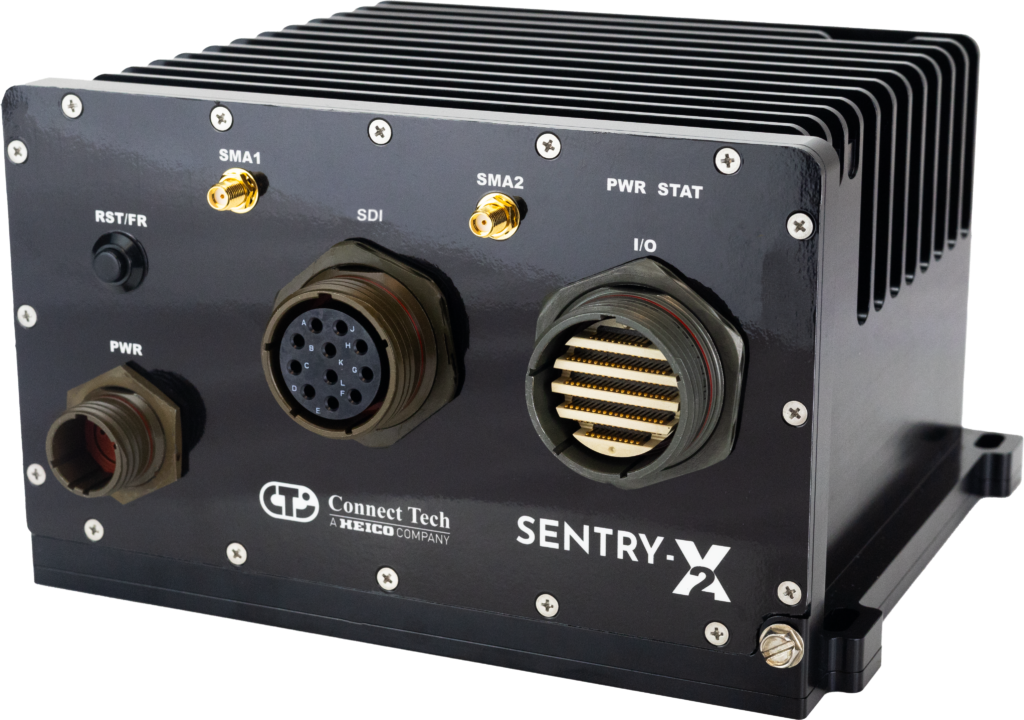
Sentry X2 Family
For aerospace and defense applications requiring rugged Edge ai computing in a compact form factor. The Sentry X2 family supports onboard processing for unmanned systems, ISR, and sensor-based applications, with configurations suited to different compute, connectivity, and installation requirements. Local processing allows systems to analyze sensor data without relying on a continuous cloud connection.
Aerospace and defense: deeper by topic
The following spoke pages are in development for a future phase. Each covers one defense ai integration topic in technical depth.
Rugged ai Computing
Hardware selection, BSP engineering, and thermal design for defense environments with MIL-STD-810H-relevant requirements.
Robot Perception
Camera pipeline bring-up, GMSL2/3 and FPD-Link III integration, and computer vision model deployment for robotics applications.

ISR ai Integration
Intelligence, Surveillance, and Reconnaissance sensor fusion, full-motion video analytics, and real-time situational awareness pipelines.
Unmanned Systems
Full-stack ai integration for UGVs, unmanned surface vehicles, and ground robotics platforms in defense environments.
Drone Perception
Payload integration, GMSL camera bring-up, sensor fusion, and ai inference for UAV and small unmanned aircraft platforms.

ABOUT THE AUTHOR
Ceri Nelmes
Tech Marketing Leader & Journalist | Building Brands at the Edge of What’s Next |
Connect Tech & CTai Labs
Ceri Nelmes is Head of Marketing at Connect Tech and an experienced technology journalist and digital strategist. She covers the technologies and market shifts shaping embedded computing, Edge AI, Physical ai, robotics, autonomous systems, and the NVIDIA® ecosystem. Working with Connect Tech and CTai LABS subject-matter experts, she turns engineering developments into accurate, useful reporting for developers, technical buyers, business leaders, and the media.
 Learn More
Resources and Frequently Asked Questions
Related
ai Integration Services. Full-stack ai engineering from architecture through deployment-ready handoff and production support.
See ai Integration Services →x86 to Jetson Migration. For programs moving from x86-based compute to Jetson Orin or Jetson Thor, including Rogue-RX for defense applications.
See x86 to Jetson Migration →Industries We Serve. CTai LABS can support custom Physical AI applications across a wide range of environments.
See Industries →Services. The full range of CTai LABS engagements, from proof of concept through consulting and dedicated engineering teams.
See Services →Sources
Burdette, Z., Phillips, D., Heim, J. L., Geist, E., Frelinger, D. R., Heitzenrater, C., & Mueller, K. P. (2026). How artificial intelligence could reshape four essential competitions in future warfare. RAND Corporation.
https://www.rand.org/pubs/research_reports/RRA4316-1.htmlConnect Tech. (2025). Rogue-RX carrier board for NVIDIA Jetson AGX Orin Industrial (AGX203); Anvil-RX rugged system for NVIDIA Jetson AGX Orin (ESG635); Hadron and Super Hadron carriers for Jetson Orin NX/Nano.
https://connecttech.comConnect Tech. (2026). Sentry X2 family of rugged embedded systems.
https://connecttech.comEuropean Commission. (2026). Commission to invest €1.07 billion in 57 defence projects supporting European Readiness Flagships.
https://defence-industry-space.ec.europa.eu/commission-invest-eur107-billion-57-defence-projects-supporting-european-readiness-flagships-2026-04-15_enFortune Business Insights. (2026). Military edge computing market size and forecast 2026–2034.
https://www.fortunebusinessinsights.com/military-edge-computing-market-115488Gartner. (2025, October 20). Gartner identifies the top strategic technology trends for 2026.
https://www.gartner.comGrand View Research. (2026). Military edge computing market size, share and trends analysis report 2026–2033.
https://www.grandviewresearch.com/industry-analysis/military-edge-computing-market-reportMarket Intelo. (2025). Military edge computing market research report 2034.
https://marketintelo.com/report/military-edge-computing-marketMarket Intelo. (2026). Secure edge computing for defense market research report 2034.
https://marketintelo.com/report/secure-edge-computing-for-defense-marketNVIDIA. (2025). Jetson AGX Orin product specifications; Jetson Thor T5000 product specifications; Jetson Orin NX and Orin Nano product specifications.
https://www.nvidia.com/en-us/autonomous-machines/embedded-systems/UK Ministry of Defence. (2025). AI and Edge Services Framework, Defence and Security Open Framework.
https://www.find-tender.service.gov.uk/Notice/029722-2025Frequently Asked Questions
What Connect Tech hardware is used for defense deployments?
The primary defense platforms are Rogue-RX (AGX203) for vehicle-mounted and mobile applications, Anvil-RX for IP67-rated sealed system deployments, Hadron and Super Hadron for UAV and SWaP-limited payloads, and Gauntlet with Jetson Thor for high-compute ISR and multi-sensor fusion applications. Falcon Vehicle System suits ground vehicle programs requiring rugged, on-board AI inference without back-haul connectivity. Platform selection is made against the specific operational environment, connector requirements, power input range, and compute workload of the program.
Is Connect Tech hardware MIL-STD-810H compliant?
Connect Tech designs its defense-oriented carrier boards with MIL-STD-810H-relevant specifications: extended temperature operation from -40°C to +85°C, ruggedized locking connectors, wide-input voltage ranges, and shock and vibration tolerance. Specific MIL-STD-810H compliance testing and certification depends on the program requirements and testing authority. CTai LABS addresses the certification pathway during the engagement scoping call.
Can the ai system operate without network connectivity?
Yes. For communications-denied environments, the ai pipeline maintains full mission effectiveness without a network connection. CTai LABS integrations for defense are architected for on-prem inference from the start. All sensor processing, model inference, and output generation runs on the Connect Tech Edge platform without back-haul dependency. Memory optimization can also be applied to help fit demanding ai workloads within the available on-device resources, supporting local inference when cloud compute or additional infrastructure is unavailable.
What sensor inputs can CTai LABS integrate for ISR applications?
EO/IR cameras across MIPI CSI-2 and GMSL2/3, LiDAR, IMU, and radar inputs are within the CTai LABS integration scope. Multi-sensor fusion with deterministic timing across heterogeneous inputs is handled at the BSP and driver level, which means the integration team has access to the carrier board design and can resolve timing issues that appear at the hardware interface.
How does CTai LABS handle long-term platform support for defense programs?
Connect Tech publishes and maintains BSPs for its carrier boards across multiple JetPack generations. CTai LABS engagements are scoped against the NVIDIA® module availability roadmap and Connect Tech BSP support timelines, so the deployed system has a supported path through the full program lifecycle. For defense programs with decade-long fielding requirements, that long-term BSP continuity is a critical selection criterion.
What is the typical SWaP envelope for a UAV payload integration?
The Hadron and Super Hadron carriers with Jetson Orin NX or Orin Nano operate at approximately 23 grams with 9 to 60 V input and GMSL coax camera integration. The specific SWaP budget for a program determines which module and power mode is appropriate. CTai LABS scopes the platform selection against the actual UAV or payload envelope during the architecture review.
Does CTai LABS work on classified programs?
CTai LABS works with defense customers under NDA. Most of what CTai LABS builds is proprietary and not published. The published case studies represent a small fraction of defense and aerospace work. For programs with classified requirements, the specifics of what CTai LABS can support are discussed directly in the scoping call.
How is ISR sensor fusion validated before fielding?
The system is validated against the production success metric defined at the start of the engagement before any field deployment. CTai LABS validates ISR sensor fusion pipelines through Software-in-the-Loop testing, Hardware-in-the-Loop testing against the actual sensor stack, and Digital Twin testing in a physics-accurate simulation environment. Validation records are produced as program documentation deliverables.
Ready to Build Smarter?
Let’s create the intelligent Edge AI solution that moves your business forward.