 Case Study | Industrial Safety and Machine Vision
Building ScrapGuard™:
Edge ai Detection for Hazardous Objects in Scrap Metal Processing
How CTai LABS developed a three-stage perception pipeline on Connect Tech hardware using real customer scrap data
By Ceri Nelmes
Tech Marketing Leader & Journalist | Building Brands at the Edge of What’s Next | Connect Tech & CTai Labs
Technical review: Rob Callaghan, Chief Product Officer, Connect Tech Inc.

Key Results
- A confidential scrap-processing customer needed a way to identify sealed pressurized cylinders in visually complex material before they reached an industrial shredder.
- CTai LABS developed ScrapGuard™ as a purpose-built three-stage perception pipeline: Cognitive Masking, Interpretive Detection, and Material Adjudication.
- CTai LABS offers a ScrapGuard kit, consultation, or a combination of both.
- The pipeline was developed and tested on real customer scrap data representing the occlusion, motion, and illumination challenges of active processing lines.
- Measured end-to-end hazardous-object identification ran in under 500 milliseconds on a Connect Tech Anvil-T5 with NVIDIA® Jetson Thor™ T5000.
- A final verified detection can be passed to the facility’s existing PLC for diverter actuation, while the inference pipeline operates locally without a cloud dependency.
- The documented result is a development validation, not a completed plant-wide deployment or a published universal accuracy benchmark.
- CTai LABS can start with an idea, a dataset, an existing model, a camera or PLC constraint, a prototype, or a deployment program that needs production engineering.
CTai LABS, a department of Connect Tech, developed ScrapGuard™ to address a specific industrial safety problem: sealed pressurized cylinders can be difficult to distinguish from the surrounding material on a fast-moving scrap conveyor, yet the detection decision must arrive before the object reaches the shredder. The project brought camera data, multi-stage ai, rugged Edge compute, control-system integration, and field commissioning requirements into one sensor-to-action architecture. This case study explains the engineering challenge, the decisions behind the system, what the development work demonstrated, and what must still be validated during the first commercial deployment.
CTai LABS can enter an engagement at any point. For a project like ScrapGuard, work can begin with an early safety concept, sample video from the line, an existing camera, a trained detector, a PLC requirement, a research prototype, or a production system that is not meeting its acceptance criteria. The team defines missing requirements, selects and integrates Connect Tech hardware, develops or optimizes the ai pipeline, measures the complete data path, and delivers a deployment baseline aligned to the customer’s operating environment and IP requirements.
Case Study at a Glance
| Field | Case Study Detail |
|---|---|
| Customer | Confidential industrial scrap-processing customer |
| Challenge | Identify sealed pressurized cylinders within heterogeneous, fast-moving scrap before the material reaches a shredder |
| CTai LABS Scope | Perception architecture, model pipeline, Edge compute integration, camera path, PLC actuation interface, validation approach, and deployment planning |
| Hardware | Connect Tech Anvil-T5 with NVIDIA® Jetson Thor™ T5000, one GMSL camera in the standard configuration, with expansion paths for additional camera inputs |
| Processing Model | Offline Edge inference with no cloud dependency in the detection path |
| Measured Development Result | Sub-500 ms end-to-end hazardous-object identification on real customer scrap data |
| Commercial Status | Development validation complete; first commercial site commissioning remains to be completed |
The Customer Challenge
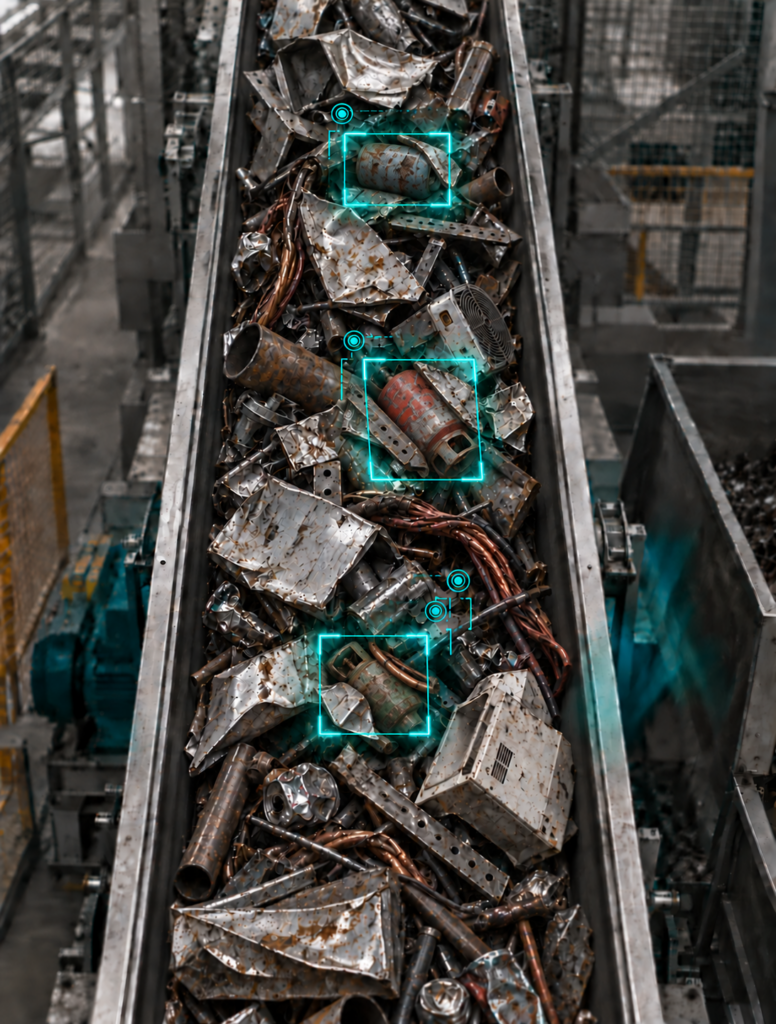
Scrap streams are visually inconsistent by definition. Objects arrive crushed, dirty, partially hidden, rotated, and mixed with materials that share similar shapes, colours, and reflective surfaces. Illumination changes with the site, camera position, ambient light, and time of day. Conveyor motion compresses the time available to capture an image, interpret it, verify the result, and initiate a response. A sealed cylinder can also resemble an open or depressurized container from a single view, making a simple appearance match unsuitable as the only decision layer.
The safety context is real. WorkSafe Victoria reported that six workers were injured when aerosol cans exploded during shredding at a recycling plant in May 2023, with flames extending up to 18 metres from the shredder. The Aluminum Association’s worldwide molten-metal incident program separately recorded 141 explosion incidents in 2024, including 19 melting incidents related to scrap charging. These datasets describe different event categories and should not be combined into a single sealed-cylinder statistic, but together they show why scrap-related explosion controls require serious engineering and site-specific validation (WorkSafe Victoria, 2025; Aluminum Association, 2025).
Recent peer-reviewed research reaches a similar conclusion about conveyor vision systems. Foreign-object detection must respond quickly to unpredictable objects under changing illumination, noise, motion, and loading conditions, while representative datasets and field validation remain recurring limitations in the literature (Rios-Colque et al., 2026). Camera-adaptive research on mine conveyors also shows that viewpoint changes can materially affect detection robustness, reinforcing the need to design around the actual site rather than a clean benchmark dataset (Peng et al., 2025).
The Engineering Objective
The objective was not to create a generic object detector and then search for a market. CTai LABS designed ScrapGuard around the actual decision: identify a candidate hazardous object, interpret it in context, verify the material class, and deliver a confirmed result within the process window. The system also had to fit the physical and operational environment, connect to existing control infrastructure, operate locally, and preserve enough information to support commissioning and event review.
“The design prioritizes deterministic edge processing, ensuring model consensus without cloud dependency or latency-induced false negatives. In a safety-critical industrial context, the system has to be reliable at every frame, on every shift, under every environmental condition the shredder floor produces.”
Doruk Sonmez, AI Solutions Architect, CTai LABS
The CTai LABS Solution
ScrapGuard uses a cascaded three-stage perception pipeline. Each stage has a distinct role, and a verified result from the final stage is required before the downstream actuation path is used. This structure allows the team to tune candidate isolation, interpretive detection, and material verification separately as site data evolves. It also avoids placing the full safety decision on a single visual cue or one model output.
1.
Cognitive Masking
The first stage applies semantic segmentation to isolate candidate hazard regions from the live camera stream. It is designed for the way objects appear on an active scrap conveyor, including deformation, partial occlusion, irregular orientation, debris, reflections, and changing illumination. The output is a focused set of candidate regions for further interpretation rather than an actuation decision.
2.
Interpretive Detection
Candidate regions pass to a reasoning-based vision-language detection stage that frames each object and makes a bounding-box decision. The purpose is to reject visual candidates that may resemble the target at the masking stage but do not hold up when interpreted in context. This is especially important when non-hazardous scrap shares cylindrical edges, metallic surfaces, or partial profiles with the target class.
3.
Material Adjudication
The final stage verifies the confirmed region and assigns the material class. The initial class set includes closed or sealed containers, copper and aluminum, dirt and contaminants, wire and cable harnesses, and customer-defined categories. Only the final verified result proceeds to the control interface. The class set can be extended when the customer supplies the data and acceptance criteria for additional hazards or material-compliance decisions.

Figure 1. ScrapGuard processes a live camera stream through three distinct perception stages before a verified result reaches the customer’s existing PLC and diverter path.
Why the Work Runs at the Edge
The detection path runs locally on the processing line. Images do not need to travel to a cloud service before the system can make the operational decision, and loss of an external network does not remove the inference path. Local processing also gives the engineering team direct control over the model runtime, buffering, camera interface, event logging, and PLC handoff that determine end-to-end response time.
Peer-reviewed industrial machine-vision research continues to identify data diversity, compute demand, operational variability, and rigorous validation as major barriers to field transfer (Manakitsa et al., 2025). Hardware-aware work on high-speed conveyor vision likewise argues that model selection and optimization must be evaluated against the target Edge platform rather than accuracy alone (Azab et al., 2026). ScrapGuard follows that system-level approach: the measured quantity is the complete hazardous-object identification path on the intended class of hardware, not an isolated model benchmark.
The Connect Tech Hardware Platform
ScrapGuard runs on the Connect Tech Anvil-T5, a rugged, actively cooled Edge system built for the NVIDIA Jetson Thor T5000. The current Anvil-T5 specification includes a -25°C to +60°C operating range, 36 V to 60 V DC input, two 10GBASE-T and two 1000BASE-T network interfaces, CAN, serial and GPIO, dual NVMe storage paths, and support for up to eight GMSL1, GMSL2, or GMSL3 camera inputs with the appropriate Connect Tech camera-board configuration (Connect Tech, 2026).
The NVIDIA Jetson T5000 module provides 128 GB of LPDDR5X memory and Blackwell-generation accelerated compute for concurrent perception and reasoning workloads (NVIDIA, 2025). For this case study, the value of that headroom is practical: CTai LABS can run the three perception stages, camera ingest, application logic, logging, and control integration locally while measuring the complete pipeline under representative data. Peak platform specifications do not replace application validation, but they provide room to test the architecture without immediately forcing cloud offload or a fragmented multi-computer design.
| System Requirement | ScrapGuard Implementation |
|---|---|
| Camera Path | One GMSL industrial camera in the standard installation; Anvil-T5 supports expansion options for additional GMSL or Ethernet camera paths |
| Compute | NVIDIA Jetson Thor T5000 in a Connect Tech Anvil-T5 Edge system |
| Inference Location | At the processing line, without a cloud dependency in the detection path |
| Control Integration | Verified result integrated to the facility’s existing PLC and diverter architecture |
| Storage and Audit | Local event records and configuration evidence for commissioning and review |
| Environment | Rugged, actively cooled system with industrial power and a published -25°C to +60°C operating range |
How CTai LABS Validated the Development System
The team developed and tested the perception pipeline on real customer scrap data. The dataset reflected the conditions that make this application difficult, including heavy occlusion, fast material movement, variable illumination, deformation, debris, and visually similar non-target material. CTai LABS measured the full path from image input through hazardous-object identification on the Anvil-T5 target rather than reporting only a model’s isolated inference time.
| Validation Area | Documented Development Result |
|---|---|
| Cognitive Masking | Hardware-accelerated candidate-region isolation on live camera streams |
| Interpretive Detection | Reasoning-based bounding-box decision intended to reject candidates that pass the masking stage |
| Material Adjudication | Verification and material classification tested on real customer scrap data |
| End-to-End Response | Sub-500 ms hazardous-object identification on Anvil-T5 with Jetson Thor T5000 |
| Actuation Path | Architecture defined for integration to the customer’s existing PLC and diverter |
| Published Accuracy | No universal public precision, recall, mAP, false-positive, or false-negative benchmark is claimed |
The First Commercial Deployment Path
CTai LABS defined a ten-week pathway to move from site requirements to a commissioned system. The schedule is a planned engagement model and will depend on site access, data readiness, control-system details, safety review, hardware configuration, and acceptance criteria. It should not be interpreted as a completed deployment result for the development customer.
| Phase | Planned Work |
|---|---|
| Weeks 1-2: Requirements | Capture conveyor geometry and speed, target classes, camera locations, existing PLC and diverter interfaces, operating environment, safety process, and acceptance evidence |
| Weeks 3-4: Pre-configuration | Configure the Anvil-T5 and camera path, prepare the software baseline, and adapt the model pipeline to representative site data |
| Weeks 5-6: Installation | Mount and align the camera, install field hardware, verify power and communications, and connect the actuation interface to the existing machinery |
| Weeks 7-8: Site Tuning | Tune thresholds and class behaviour against live conveyor conditions, then investigate false positives, false negatives, and difficult material combinations |
| Weeks 9-10: Validation | Run the agreed challenge and integration tests, complete the customer’s required safety and operational review inputs, orient operators, and document the accepted baseline |
| Handover | Deliver the agreed model, configuration, test evidence, operating limits, documentation, and support transition under the engagement’s IP terms |
What Made the ScrapGuard Approach Transferable
The reusable part of ScrapGuard is not a promise that one model can be dropped into every conveyor application. It is the engineering pattern: isolate a candidate, interpret it in context, adjudicate the final material class, run the complete path on deployment hardware, and integrate the verified decision into the customer’s control system. The same pattern can support other foreign-object, contamination, material-separation, or compliance problems when the models, classes, sensors, timing, and validation are rebuilt around the new operating context.
- Foreign-object detection for mining, aggregate processing, and bulk-material handling.
- Battery, cylinder, or prohibited-item screening in recycling and waste-processing lines.
- Material classification and contamination detection in industrial sorting.
- Foreign object debris detection in aerospace, transportation, and logistics environments.
- Closed-container, component, or packaging verification in manufacturing and receiving operations.
CTai LABS can begin with the existing ScrapGuard engineering pattern or start from a different perception architecture when the application requires it. In every case, the customer-specific data, failure modes, control interface, environment, and acceptance criteria determine the final system.
What the Customer Retains
CTai LABS structures project handoff around the agreed customer deliverables. Depending on the engagement, that can include the trained models, labelled data created for the project, thresholds, configuration, application code, deployment image, benchmark scripts, test evidence, wiring and interface documentation, and operating limits. The customer retains its source data, product or process knowledge, proprietary application, and project IP as defined in the contract. ScrapGuard™ remains a trademark used for this CTai LABS and Connect Tech solution framework.
Your Physical ai Integration Partner
ScrapGuard shows how CTai LABS combines industrial problem definition, computer vision, reasoning-based perception, rugged Connect Tech hardware, NVIDIA accelerated computing, camera integration, control-system interfaces, measurement, and deployment planning in one engagement. The team can start with an idea, improve one part of an existing system, or carry the full sensor-to-action path through validation and handoff. Customers work directly with CTai LABS engineers and keep control of their data, application, system design, and agreed intellectual property.
Book a Demo
- The required 3D output, operating environment, target field of view, reconstruction range, motion profile, latency target, accuracy target, and downstream application.
- Current or proposed cameras, resolution, frame rate, lens, interface, trigger method, cable requirements, mounting assumptions, and additional sensors.
- Connect Tech hardware or preferred NVIDIA Jetson platform, ROS 2 distribution, model files, source code, logs, recordings, datasets, and existing performance measurements.
- Power, thermal, storage, networking, enclosure, environmental, lifecycle, service, cybersecurity, and deployment requirements.
- The evidence required for the next decision, including depth accuracy, temporal stability, throughput, end-to-end latency, dropped frames, sustained load, recovery, and application behavior.

ABOUT THE AUTHOR
Ceri Nelmes
Tech Marketing Leader & Journalist | Building Brands at the Edge of What’s Next |
Connect Tech & CTai Labs
Ceri Nelmes is Head of Marketing at Connect Tech and an experienced technology journalist and digital strategist. She covers the technologies and market shifts shaping embedded computing, Edge AI, Physical ai, robotics, autonomous systems, and the NVIDIA® ecosystem. Working with Connect Tech and CTai LABS subject-matter experts, she turns engineering developments into accurate, useful reporting for developers, technical buyers, business leaders, and the media.
Learn More
Resources and Frequently Asked Questions
Related
Industrial Automation. Explore CTai LABS work across machine vision, quality inspection, predictive maintenance, rugged Edge ai, and connected industrial systems.
Explore Industrial Automation →Machine Vision ai. Build camera-to-decision systems for inspection, detection, classification, tracking, measurement, and automated response.
Explore Machine Vision ai →Quality Inspection and Defect Detection. Develop site-specific visual inspection pipelines around the product, line rate, defect classes, and production hardware.
Explore Quality Inspection and Defect Detection →Rugged Edge ai. Select and integrate Edge compute, cameras, networking, power, thermal design, and software for harsh industrial environments.
Explore Rugged Edge ai →Connect Tech Anvil-T5. Review the production Edge system used for ScrapGuard development on NVIDIA Jetson Thor T5000.
Explore Connect Tech Anvil-T5 →Sources
Aluminum Association. (2025). Annual Summary Report on Molten Metal Incidents in 2024.
https://www.aluminum.org/sites/default/files/2025-10/2025-Molten-Metal-Incident-Annual-Summary-Report_Final.pdfAzab, E., et al. (2026). Optimizing computer vision for Edge deployment in Industry 4.0: A framework and experimental evaluation. Technologies, 14(2), 126.
https://doi.org/10.3390/technologies14020126Connect Tech. (2026). Anvil-T5 Edge System with NVIDIA Jetson Thor.
https://connecttech.com/product/anvil-t5-edge-system-with-nvidia-jetson-thor/Manakitsa, N., Maraslidis, G. S., Moysis, L., & Fragulis, G. F. (2025). Generative ai in industrial machine vision: A review. Journal of Intelligent Manufacturing.
https://doi.org/10.1007/s10845-025-02604-6NVIDIA. (2025, August 25). Introducing NVIDIA Jetson Thor, the ultimate platform for Physical ai.
https://developer.nvidia.com/blog/introducing-nvidia-jetson-thor-the-ultimate-platform-for-physical-ai/Peng, F., et al. (2025). Camera-adaptive foreign object detection for coal conveyor belts. Applied Sciences, 15(9), 4769.
https://doi.org/10.3390/app15094769Rios-Colque, P., Rios-Colque, V., Rios-Colque, L., & Robles, P. A. (2026). Computer vision-based techniques for conveyor belt condition monitoring: A systematic review. Sensors, 26(8), 2527.
https://doi.org/10.3390/s26082527WorkSafe Victoria. (2025, December 22). Fine over recycling explosion increased by $225,000 on appeal.
https://www.worksafe.vic.gov.au/news/2025-12/fine-over-recycling-explosion-increased-225000-appealFrequently Asked Questions
What is ScrapGuard?
ScrapGuard is a purpose-built Edge ai perception system developed by CTai LABS to identify sealed pressurized cylinders and other defined material classes in scrap-processing streams before the material reaches a downstream hazard point such as a shredder.
What are the benefits of Scrapguard for functional safety?
Saves lives and injuries plus saves extensive downtime. Industrial health and safety professionals are some of our customers.
What does the three-stage pipeline do?
Cognitive Masking isolates candidate hazard regions. Interpretive Detection frames and evaluates those candidates in context. Material Adjudication performs final verification and material classification. A verified final result is required before the control interface proceeds.
Why not use one object-detection model?
A heterogeneous scrap stream contains deformation, occlusion, debris, reflections, lighting changes, and non-target objects that may resemble part of a cylinder. The stages separate candidate isolation, contextual interpretation, and final material verification so each part can be tuned and tested against site data.
What hardware does ScrapGuard use?
The development system uses a Connect Tech Anvil-T5 with NVIDIA Jetson Thor T5000. The standard configuration described for first deployment uses one GMSL industrial camera, while the Anvil-T5 provides expansion paths for additional GMSL or Ethernet camera integration when the site requires them.
Does ScrapGuard require the cloud?
No cloud service is required in the real-time detection path. Camera ingest, the three-stage perception pipeline, event logic, and the PLC-facing result run locally at the Edge. Remote support or fleet-management choices can be designed separately from the operational decision path.
Can ScrapGuard trigger an existing diverter or PLC action?
Yes. The architecture is designed to pass a verified result to the facility’s existing PLC and diverter path. The exact interface, electrical design, timing, interlocks, and safety responsibilities must be engineered and accepted for the customer’s machinery.
What performance has been demonstrated?
CTai LABS measured sub-500 ms end-to-end hazardous-object identification on the Anvil-T5.
Can the system detect lithium-ion batteries or other hazards?
The architecture can be extended to additional customer-defined classes when representative data, labelling rules, failure modes, and acceptance criteria are available. A new class is not considered validated merely because it is added to the label set. It requires its own development and site-specific test evidence.
Can CTai LABS start if we only have an idea or a few sample videos?
Yes. CTai LABS can begin with an idea, early site video, a sensor or PLC constraint, a dataset, a trained model, a prototype, or an existing line-side system. The team can help define missing requirements and build the shortest credible path to a measured deployment baseline.
Who owns the data and IP?
The customer retains its source data, proprietary process knowledge, application, system design, and the project IP defined in the engagement. Handover can include models, labelled project data, code, configuration, deployment images, test evidence, and documentation according to the agreed scope.
Ready to Build Smarter?
Let’s create the intelligent Edge AI solution that moves your business forward.