Services
Edge ai Proof of Concept
De-risk your deployment before you scale: prove a specific workload on the right real hardware, in real conditions, before committing budget to production.
By Ceri Nelmes
Tech Marketing Leader & Journalist | Building Brands at the Edge of What’s Next | Connect Tech & CTai Labs
Technical review: Rob Callaghan, Chief Product Officer, Connect Tech Inc.

Key Takeaways
- CTai LABS, a department of Connect Tech, builds Edge ai proofs of concept on production-grade NVIDIA® Jetson™ platforms and Connect Tech Edge ai solutions
- Short, scoped engagements that prove a specific ai workload will run reliably on real Edge hardware, in the conditions you actually deploy to, before you commit budget to full production
- You bring the use case; the team validates the model, the sensors, cameras, the thermals, and the compute on hardware you can ship
- CTai LABS hands back a working system and a clear path to scale
What is an Edge ai proof of concept?
CTai LABS answers one question: can this ai workload meet its targets on the hardware and in the environment it is meant for. For Edge ai, that question is harder than it sounds, because the Edge is unforgiving. A model that hits 94 percent accuracy on a clean validation set in the cloud could degrade badly once it faces a live camera feed, variable lighting, vibration, heat, a power budget measured in single-digit watts, and a latency ceiling measured in milliseconds. A proof of concept (PoC) is the step between an idea and a program.
An Edge ai PoC scopes that risk down to something you can prove in weeks. It usually covers a single high-value use case, a defined performance target (inference rate, accuracy, latency, power draw), the real sensors involved, and the specific NVIDIA® Jetson™ module and carrier board the workload will run on. A good PoC is scoped tight enough that the result is either clearly a yes or clearly a no.
PoC, pilot, and production are not the same thing. A PoC proves technical feasibility on representative hardware. A pilot runs that proven concept in a limited live deployment to test it operationally. Production is the full fleet. Most of the value, and most of the risk, sits in getting the first step right, because everything downstream inherits its assumptions.
Why Edge ai projects stall: the pilot purgatory problem

PoC Failure Rates
Gartner forecasts that at least 30 percent of generative ai projects would be abandoned after the proof of concept stage by the end of 2025, citing poor data quality, inadequate risk controls, escalating costs, and unclear business value (Gartner, 2024). By the time the year closed, Gartner reported the share that stalled after PoC had reached roughly half (Gartner, 2025).

Product Failure Rates
RAND Corporation found that more than 80 percent of ai projects fail, about twice the failure rate of conventional IT projects (Ryseff et al., 2024). MIT’s Project NANDA reported in 2025 that 95 percent of organizations saw zero measurable return from their generative AI efforts, with the gap traced not to the models but to data readiness, workflow integration, and the absence of a defined outcome before the build started (MIT Project NANDA, 2025). S&P Global Market Intelligence found that 42 percent of companies abandoned most of their ai initiatives in 2025, up sharply from 17 percent the year before (S&P Global Market Intelligence, 2025). Gartner’s own infrastructure research puts the share of ai projects that reach production at around 48 percent, and those that do take roughly eight months to get there (Gartner, 2025). Gartner’s research found that only 48 percent of AI projects make it into production, and those that do take an average of eight months to get there (Gartner, 2024).
How You Scope an Edge ai Project
The phrase the industry uses for the gap is pilot purgatory: a working idea that never becomes a reliable asset. The pattern behind it is consistent. A pilot runs on clean, static data and borrowed hardware. Production faces a messy, changing data stream and real-world constraints the pilot never modeled. The model was never the hard part. The system around it was never ready to absorb it.
For Edge ai specifically, three failure modes show up again and again:
1.
The hardware was an afterthought.
The model gets built first, then someone tries to fit it onto a board that cannot sustain the thermals, the I/O, or the power envelope the workload needs. Performance that looked fine on a developer kit collapses in an enclosure at 60 degrees Celsius.
2.
The integration was underestimated.
Cameras, LiDAR, IMUs, and other sensors have to be brought up, synchronized, and fed into the pipeline. Board bring-up, image flashing, and BSP work consume the schedule before the ai work even starts.
3.
There was no path from the demo.
The PoC ran on something that cannot be manufactured, certified, or shipped, so the proof has to be rebuilt from scratch for production. The result is wasted time and an erosion of trust with the people holding the budget.
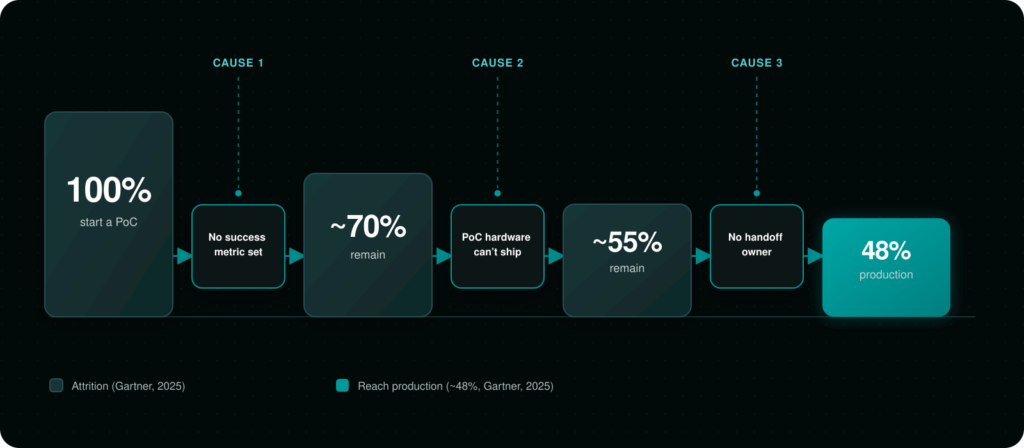
Figure 1. The PoC-to-production gap: three causes of attrition from proof of concept to production, with approximately 48 percent of projects reaching production (Gartner, 2025).
How CTai LABS closes the gap: one team, the full stack
Most ai integration partners own a slice of the problem. They write models, or they sell boards, or they do thermal design, and the seams between those slices are exactly where Edge projects fall apart. CTai LABS is the ai engineering department within Connect Tech, a company that has designed and manufactured embedded compute in-house since 1985 and has been an NVIDIA Jetson partner since the platform’s earliest days. As President Patrick Dietrich put it, “the reason to build CTai LABS was simple: hardware expertise lets the team solve real customer problems from the use case, not just deliver a product, and move customers from concept to production faster with deployment on qualified hardware,” (Connect Tech, 2025a).
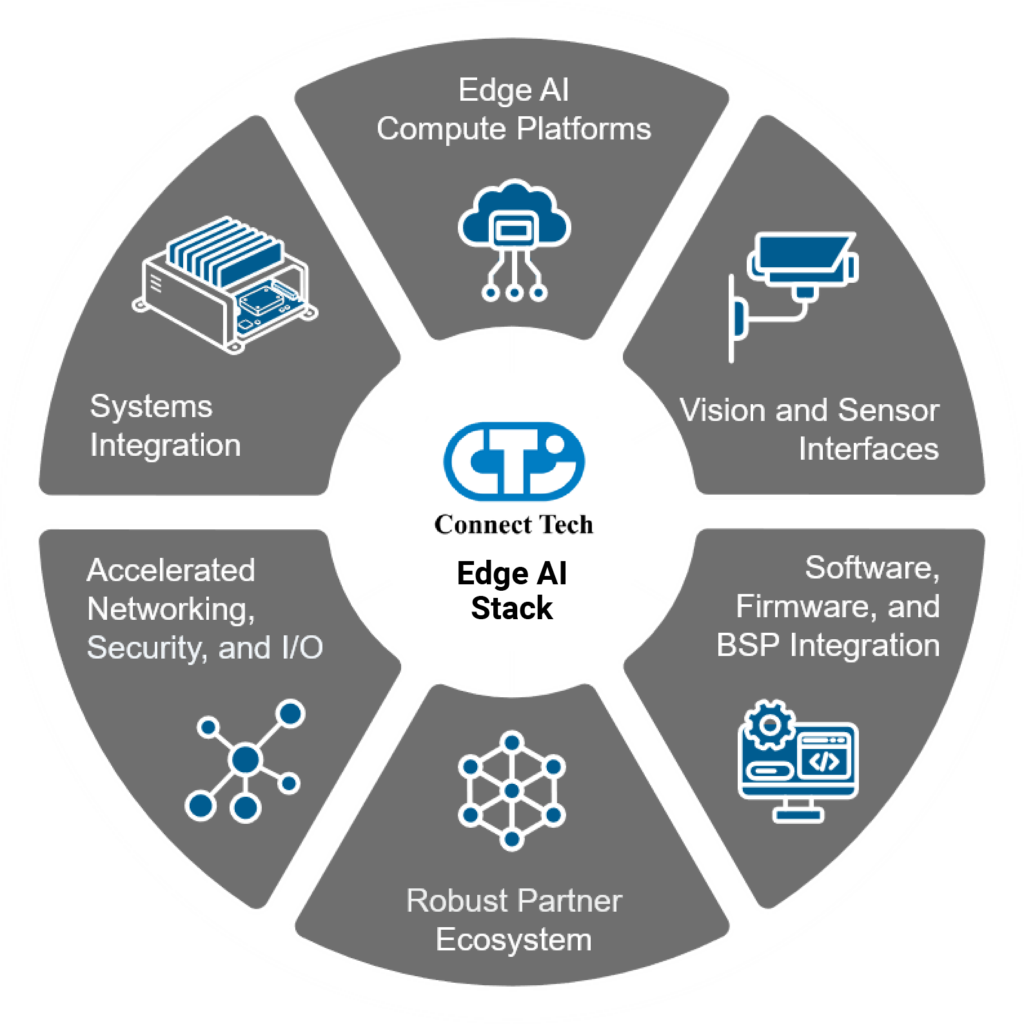
Figure 2. Connect Tech’s Edge AI stack brings together compute platforms, vision and sensor interfaces, software and BSP integration, accelerated networking and I/O, systems integration, and a robust partner ecosystem.
That structure matters for a proof of concept because it means one team owns every layer the workload touches:
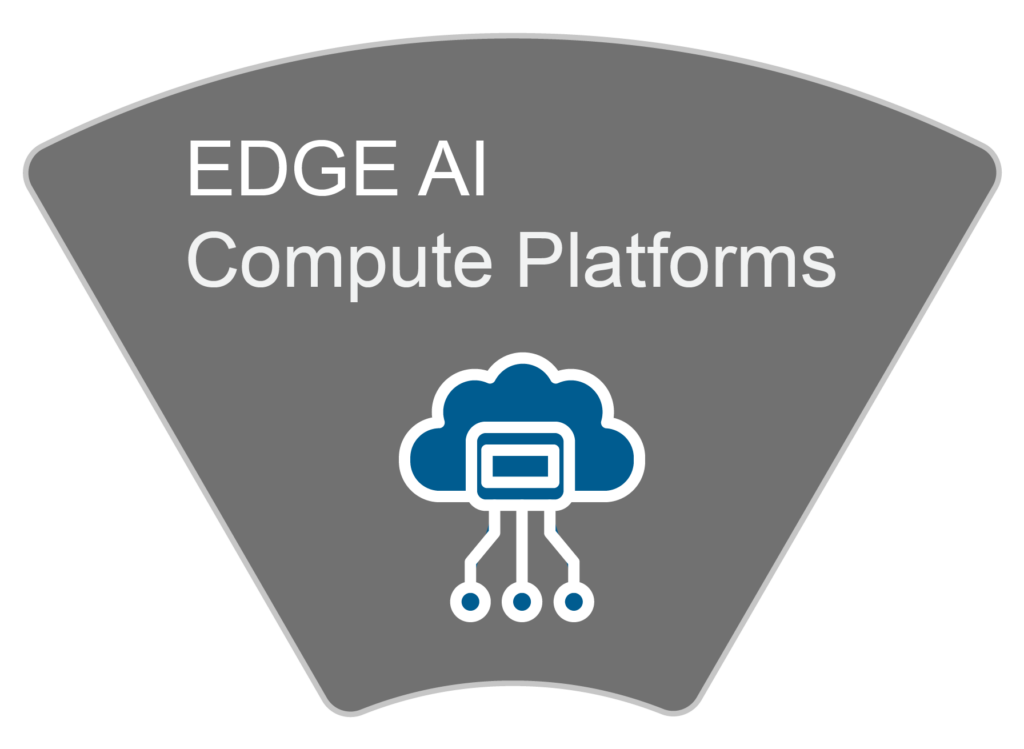
Compute
The full NVIDIA Jetson line, from Jetson Orin™ Nano and Jetson Orin™ NX through Jetson AGX Orin™ to Jetson Thor™, matched to the workload rather than to whatever was on the shelf.
Carrier and I/O
Connect Tech’s own production carrier boards, designed and built in-house, so the interfaces the PoC needs are the interfaces the shipped product will have.
Vision and Sensors
Camera, LiDAR, and IMU integration over GMSL, FPD-Link III, and MIPI CSI-2, with the bring-up handled by the same team that builds the boards.
Thermal
ThermiQ™ Edge ai Cooling Solutions, engineered for sustained Jetson workloads in constrained, harsh enclosures, so the PoC reflects real thermal behavior rather than open-bench best cases.
Software and ai
Model optimization, framework tuning across ROS, NVIDIA Isaac™ ROS, and TensorRT™, board bring-up, image flashing, and validated BSPs on the current NVIDIA software stack.
Because the same group designs the board, mounts the thermal solution, brings up the sensors, and tunes the model, all on cameras from Connect Tech’s proven and validated partner ecosystem, the proof of concept runs on a system that is already deployment-ready in form. There is no translation step between what was proven and what gets manufactured. For a PoC, that is the whole point: the thing you prove is the thing you can deploy.

Figure 3. The five layers CTai LABS owns in every proof of concept, from thermal design at the base through carrier board, compute, sensors, and ai software.
The engagement: concept to a deployment-ready proof
A CTai LABS proof of concept follows a deliberate sequence. The aim is to reach a defensible yes or no on real hardware quickly, then leave you with something you can build on.
1.
Scope and success criteria
The work starts by defining one use case and the targets that make it a success: inference rate, accuracy, latency budget, power envelope, operating temperature range, and the sensors in play. Tight scope is a feature. It is what keeps the result unambiguous.
2.
Hardware selection
The CTai LABS team maps the workload to the right Jetson module and Connect Tech carrier. A multi-camera perception task on Jetson Thor is a different decision than a low-power inference node on Jetson Orin Nano. Getting this right at the start is what prevents a rebuild later.
3.
Bring-up and integration
Image flashing, board bring-up, sensor integration, and BSP validation on the current NVIDIA software stack.
4.
Model and pipeline optimization
The ai model and its frameworks are tuned for the target, using TensorRT, Isaac ROS, and ROS as the use case requires, so the workload meets its targets within the board’s real power and thermal limits.
5.
Validation against the criteria
The system is measured against the success criteria defined at the start, under representative conditions. You get numbers, not impressions.
6.
Handover and path to production
The result is a working system on deployment-ready hardware, with a clear line to a pilot and then a fleet, on the same architecture. No translation step, no starting over.
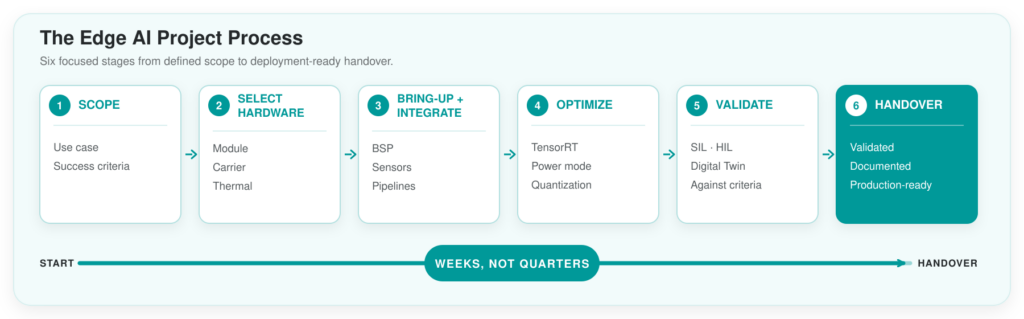
Figure 4. The CTai LABS proof of concept engagement from scope to handover, compressed into weeks rather than quarters.
Selecting the right hardware for your proof of concept
The single most consequential decision in an Edge ai PoC is which compute platform you prove it on, because that choice carries straight through to production. As memory costs climb, getting the hardware right matters more than ever. The table below maps common Edge ai workload profiles to NVIDIA Jetson modules and the Connect Tech solutions built for them.
| Workload profile | NVIDIA Jetson module | AI performance | Connect Tech carrier |
|---|---|---|---|
| Compact inference, single-sensor vision, unmanned payloads, tight power budget | Jetson Orin Nano | Up to 67 TOPS |
Hadron, Boson, Lepton (compact, rugged, locking I/O) |
| Multi-stream inference, real-time video analytics, robotics perception nodes | Jetson Orin NX |
Up to 157 TOPS (Super Mode) |
Hadron, Boson, Lepton |
| High-compute autonomy, sensor fusion, on-device model serving |
Jetson AGX Orin / AGX Orin Industrial |
Up to 275 TOPS |
Forge, Rogue, Rogue-RX (dual 10GbE, wide input power, −40 to +85°C) |
| Physical ai, humanoid and mobile robotics, generative and multi-camera workloads at the Edge | Jetson Thor (T5000) | Up to 2,070 FP4 TFLOPS |
Gauntlet (dual 10GBASE-T, GMSL3/GMSL2/FPD-Link III, 2× NVMe), Rogue-T5 |
Note: Jetson Thor’s headline figure is 2,070 FP4 TFLOPS, not TOPS; the unit reflects FP4 precision on the Blackwell™ architecture, distinct from the INT8 TOPS figures used for the Orin family. Module performance per NVIDIA published specifications (NVIDIA, 2025). Carrier specifications per Connect Tech product documentation (Connect Tech, 2025b).
Across that range, the software story stays unified. NVIDIA JetPack™ 7.2 brings the Jetson Orin family into the same software generation as Jetson Thor, on Ubuntu 24.04 and a modern Linux kernel, with official Yocto Project support for reproducible, image-based production builds and Multi-Instance GPU on Thor for deterministic multi-workload execution (NVIDIA, 2026). Connect Tech’s Board Support Packages are what make that software actually run on the carrier, including the camera and imaging pipelines a real deployment depends on (Connect Tech, 2026). A PoC built on this stack does not box you into one module. You can move across the Jetson line as the workload sharpens without abandoning your toolchain.
For teams whose PoC reveals that a platform change is the right call, the Jetson Orin vs. Jetson Thor guide covers the full decision framework, and the x86 to Jetson Migration Guide covers the technical porting steps if the starting point is x86 hardware.
Where Edge ai proofs of concept pay off
The same PoC discipline applies across the environments Connect Tech hardware is built for. The hardware mapping shifts with the demands of each, and mismatches here are what force teams into mid-project provider switches and PoC rescoping, the delays a single-source integration is built to avoid.

Robotics and autonomous systems
Autonomous mobile robots, manipulators, and humanoids need perception, compute, and control working together under motion, vibration, and a power budget. A PoC here typically proves a perception-and-navigation stack on Jetson AGX Orin or Jetson Thor, paired with the Forge or Gauntlet carrier and ThermiQ cooling. For example, Connect Tech runs its own autonomous mobile robot, D.A.V.E., as a working demonstration of ai model deployment, sensor integration, and embedded software optimization across its Edge hardware. You can see D.A.V.E. online or at some of Connect Tech’s tradeshows like XPONENTIAL, NVIDIA GTC, Embedded World, or ICRA.

Industrial automation and machine vision
High-speed inspection, defect detection, and process monitoring depend on multi-camera throughput and deterministic latency on a factory floor. These proofs of concept lean on Jetson Orin NX or Jetson AGX Orin with GMSL or FPD-Link III camera integration, validated against real line conditions rather than bench footage.

Smart infrastructure and transportation
Traffic analytics, rail and transit monitoring, and public-sector vision systems run continuously, outdoors, in wide temperature swings. The wide input power range and -40 to +85 degree Celsius operating envelope of Connect Tech’s Jetson AGX Orin carriers, combined with appropriate ThermiQ cooling, are what let a PoC reflect year-round reality.

Defense, aerospace, and mission-critical Edge
Where shock, vibration, and reliability are non-negotiable, the rugged locking connectors of the Rogue-RX (AGX203) carrier and the compact, hardened Hadron family for unmanned payloads let a proof of concept validate the workload on hardware already built to survive the deployment.

Healthcare and life sciences
Real-time imaging and diagnostic assistance demand low latency and strict reliability. Jetson AGX Orin or Jetson Thor with NVIDIA’s Edge ai frameworks gives these proofs of concept a path from validated concept to a system that can be hardened for clinical environments.
What you get
- A working system running your use case on a production-grade NVIDIA Jetson module and Connect Tech carrier, configured for your sensors.
- Measured results against the success criteria set at the start: inference rate, accuracy, latency, power, and thermal behavior under representative conditions.
- A validated hardware path so the architecture you proved is the architecture you scale, with no rebuild between PoC, pilot, and fleet.
- A clear decision backed by evidence. Either the concept hit its targets and you scale with confidence, or you learned exactly why it did not while the cost was still small.
Looking for CTai LABS Services?
Have an Edge ai use case worth proving? Talk to the CTai LABS engineering team about scoping a proof of concept on deployment-ready hardware.

ABOUT THE AUTHOR
Ceri Nelmes
Tech Marketing Leader & Journalist | Building Brands at the Edge of What’s Next |
Connect Tech & CTai Labs
Ceri Nelmes is Head of Marketing at Connect Tech and an experienced technology journalist and digital strategist. She covers the technologies and market shifts shaping embedded computing, Edge AI, Physical ai, robotics, autonomous systems, and the NVIDIA® ecosystem. Working with Connect Tech and CTai LABS subject-matter experts, she turns engineering developments into accurate, useful reporting for developers, technical buyers, business leaders, and the media.
 Learn More
Resources and Frequently Asked Questions
Related
Services. Explore the full range of CTai LABS engagements, from proof of concept through consulting and full-stack integration.
Edge AI Consulting. The broader engagement model a PoC often feeds into: architecture, integration, and a deployment-ready handoff.
About CTai LABS. D.A.V.E., the team, and Connect Tech’s NVIDIA Elite Partner standing.
Jetson Orin vs. Thor. The platform decision framework for sizing a PoC correctly from the start.
x86 to Jetson Migration. For teams whose PoC points to a platform change, the technical path from x86 hardware to the NVIDIA Jetson line.
Sources
Connect Tech. (2025a). About CTai LABS.
https://ctailabs.ai/about/Connect Tech. (2025b). ThermiQ Edge AI Cooling Solutions.
https://connecttech.com/thermiq/Connect Tech. (2026). NVIDIA Jetson carrier boards: Gauntlet, Forge, Rogue, Rogue-RX, and Hadron.
https://connecttech.com/product-category/technology/carrier-technology/Connect Tech. (2026, June 1). JetPack 7.2 and Yocto: A production deployment milestone for Jetson AGX Orin and Orin NX.
https://connecttech.com/jetpack-7-2-yocto/Gartner. (2024, July 29). Gartner predicts 30% of generative AI projects will be abandoned after proof of concept by end of 2025.
View the Gartner press releaseGartner. (2026, January 26). Why 50% of GenAI projects fail and how to beat the odds.
https://www.gartner.com/en/articles/genai-project-failureMIT Project NANDA. (2025). The GenAI divide: State of AI in business 2025. Massachusetts Institute of Technology.
MIT Project NANDANVIDIA. (2025). Jetson Orin and Jetson Thor performance specifications.
https://www.nvidia.com/en-us/autonomous-machines/embedded-systems/NVIDIA. (2026). JetPack SDK downloads and notes: JetPack 7.2.
https://developer.nvidia.com/embedded/jetpack/downloads/archive-7.2Ryseff, J., De Bruhl, B. F., & Newberry, S. J. (2024). The root causes of failure for artificial intelligence projects and how they can succeed: Avoiding the anti-patterns of AI. RAND Corporation.
https://www.rand.org/pubs/research_reports/RRA2680-1.htmlS&P Global Market Intelligence. (2025, October 27). Generative AI shows rapid growth but yields mixed results.
View the S&P Global researchFrequently Asked Questions
How long does an Edge ai proof of concept take?
Most scoped Edge ai proofs of concept run in weeks rather than months. The timeline depends on the number of sensors, the maturity of the model, and the complexity of the integration. Tight scope is what keeps it short. For context, Gartner reports that ai projects which do reach production take around eight months on average, much of it lost to integration. A focused PoC front-loads that risk into a small, fast engagement (Gartner, 2025).
What is the difference between a proof of concept and a pilot?
A proof of concept proves technical feasibility on representative hardware: can this workload meet its targets on this board, in these conditions. A pilot takes that proven concept into a limited live deployment to test it operationally before a full rollout. The PoC comes first and de-risks the pilot.
Why do so many ai proofs of concept fail to reach production?
The most common causes are poor data readiness, underestimated integration work, and a PoC built on hardware that cannot be shipped, which forces a rebuild. RAND found more than 80 percent of ai projects fail, and MIT’s Project NANDA reported 95 percent of generative ai deployments produced no measurable return, with the gap traced to the system around the model rather than the model itself (Ryseff et al., 2024; MIT Project NANDA, 2025). Building the PoC on production-grade hardware from the start removes one of the largest causes.
Which NVIDIA Jetson module should I use for my Edge ai project?
It depends on the workload. Jetson Orin Nano suits compact, low-power inference. Jetson Orin NX handles multi-stream vision and robotics perception, reaching up to 157 TOPS in Super Mode. Jetson AGX Orin delivers up to 275 TOPS for high-compute autonomy. Jetson Thor, at up to 2,070 FP4 TFLOPS, targets physical ai, humanoid robotics, and multi-camera or generative workloads at the Edge. Part of a PoC is confirming that choice on your actual workload.
Can the proof of concept hardware be used in production?
Yes, and that is the design intent. CTai LABS builds proofs of concept on Connect Tech’s production carrier boards and the NVIDIA Jetson line, so the architecture you validate is the one you scale. There is no translation step between the PoC and the shipped product.
Do you handle sensor integration and thermal design as part of the PoC?
Yes. Camera, LiDAR, and IMU integration over multiple camera sensor types, plus board bring-up, image flashing, and BSP validation are part of the engagement. Thermal behavior is validated using ThermiQ™ Edge ai Cooling Solutions, engineered for sustained Jetson workloads in constrained, real-world enclosures.
What does CTai LABS need from us to start?
A defined use case and the targets that make it a success: what the workload has to do, how fast, how accurately, within what power and temperature limits, and which sensors are involved. From there the team scopes the proof of concept and selects the hardware to prove it on.
Is Connect Tech an NVIDIA partner?
Connect Tech is an NVIDIA Elite Partner and has been an NVIDIA Jetson partner since the platform’s early days. CTai LABS, as a department of Connect Tech, combines that hardware heritage with full-stack ai integration on NVIDIA’s production-grade Edge platforms.
Ready to Build Smarter?
Let’s create the intelligent Edge AI solution that moves your business forward.