Industries
Robotics and Logistics: ai Integration
Production robotics depends on more than the model. CTai LABS integrates compute, sensors, ROS 2, perception, and ai into a deployment-ready system engineered for the real operating environment.
By Ceri Nelmes
Tech Marketing Leader & Journalist | Building Brands at the Edge of What’s Next | Connect Tech & CTai Labs
Technical review: Rob Callaghan, Chief Product Officer, Connect Tech Inc.

Key Takeaways
- CTai LABS delivers robotics ai integration as a full-stack service
- ROS 2 bring-up with NVIDIA® Isaac™ ROS acceleration
- Multi-camera perception across GMSL2/3 and FPD-Link III
- LiDAR and IMU sensor fusion, plus model optimization with NVIDIA TensorRT™
- SIL/HIL/Digital Twin validation before field deployment
- All integrations run on Connect Tech solutions with modules, with the Board Support Package (BSP) written in-house and the thermal solution engineered for the deployment environment
- Carries AMR, humanoid robot, and logistics automation projects from architecture to a deployment-ready, production-supported system
Where robotics ai is going and where projects stall
CTai LABS supports robotics and logistics platforms across autonomous mobile robots (AMRs), autonomous forklifts and pallet movers, robotic arms and manipulators, humanoid robots, automated guided vehicles (AGVs), sorting and picking robots, and other material handling and warehouse automation systems. The hardware, sensor, and ai requirements vary significantly across these platforms, but the production challenge is consistent: compute, perception, communications, control, and software have to operate as one validated system.
The scale of investment in robotics ai is not in question. The global ai in robotics market was valued at USD 25.02 billion in 2025 and is estimated to grow from USD 28.25 billion in 2026 to USD 51.8 billion by 2031. Logistics and warehousing is the fastest-growing application segment, with a projected CAGR of 23.95 percent over the forecast period (Mordor Intelligence, 2026). The broader Physical ai market was valued at USD 0.89 billion in 2025 and is projected to reach USD 15.24 billion by 2032, growing at a 47.2 percent CAGR from 2026 to 2032 (MarketsandMarkets, 2026).
The range across those estimates reflects how early the market is, not how uncertain the direction is. What is consistent is the hardware finding: hardware accounts for 51 to 61 percent of the ai in robotics market in 2025 across multiple analyst reports, because compute at the Edge is the constraint that determines whether a robotics ai system can actually deploy (Grand View Research, 2026; MarketsandMarkets, 2025). A model that works in simulation or on a cloud workstation does not become a production robotics system until someone resolves the hardware stack.
The trend itself is not in dispute among analysts with a stricter evidentiary bar: Gartner named Physical ai one of its Top Strategic Technology Trends for 2026, identifying it as a technology that brings intelligence into machines and devices that sense, decide, and act in the physical world (Gartner, 2025).
The integration challenges that stall robotics projects specifically are well-documented. ROS 2, now the de facto standard for production robotics software, has a high barrier to entry on embedded hardware, and a systematic review of ROS 2 research found it suffers from performance degradation under stress and scalability issues in complex, distributed setups (Al-Batati et al., 2026). Sensor fusion timing across cameras, LiDAR, and IMUs requires deterministic pipeline management that most generalist integrators have not built before. And vision-language-action models. The architecture now underpinning the most capable AMRs and humanoid platforms, require Jetson Thor-class compute to run at the Edge without cloud inference dependency.
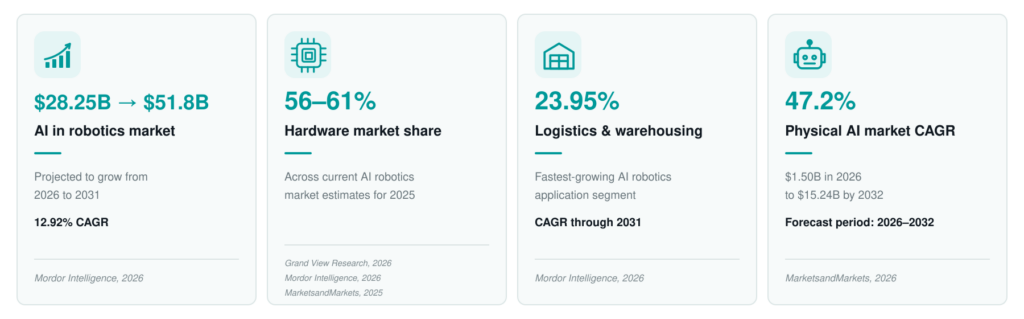
Figure 1. Robotics and logistics ai market growth is increasing across multiple measures, from the broader ai robotics market to logistics and warehousing applications and Physical ai. Across those forecasts, hardware remains a major share of the market, reflecting the compute, sensing, connectivity, and integration requirements behind production robotics deployments.
The specific integration roadblocks in robotics deployments
Robotics ai integration is not a software challenge with a hardware footnote. It is a hardware and software co-design problem, and the challenges appear in a consistent pattern across projects.

Multi-camera bring-up and synchronization
Modern AMRs and humanoid platforms typically require four to sixteen or more camera inputs for surround perception, stereo depth, and 3D reconstruction. GMSL2/3 and FPD-Link III are the bus standards that deliver the bandwidth these pipelines require, but bring-up on these buses requires carrier board-level board support package (BSP) work that most software teams have not done. Camera synchronization across multiple streams for accurate 3D reconstruction adds a second layer of timing complexity that must be resolved before any perception model is trained or tuned.
Robot Perception covers camera bring-up, synchronization, and multi-camera pipeline work in full.

Sensor fusion across heterogeneous inputs
A production AMR or logistics robot typically fuses cameras, at least one LiDAR, an IMU, and CAN-connected actuator feedback. The timing relationships between these inputs, and the latency budget between sensor capture and navigation output, are set at integration time. Getting them wrong produces localization drift and navigation failures that look like model problems but are pipeline problems. Isaac™ ROS provides the acceleration packages for this work, but configuring and validating them against a specific hardware stack requires BSP-level access (NVIDIA, 2025a).
Sensor Fusion covers timing validation across cameras, LiDAR, IMU, and CAN in full.
Camera I/O and Expansion
Expand camera connectivity for sensor fusion development with Connect Tech’s GMSL camera platforms for NVIDIA® Jetson AGX Orin™ and Jetson Thor™. These boards bring multiple camera feeds into compatible Connect Tech carriers for integration with the wider sensor pipeline.
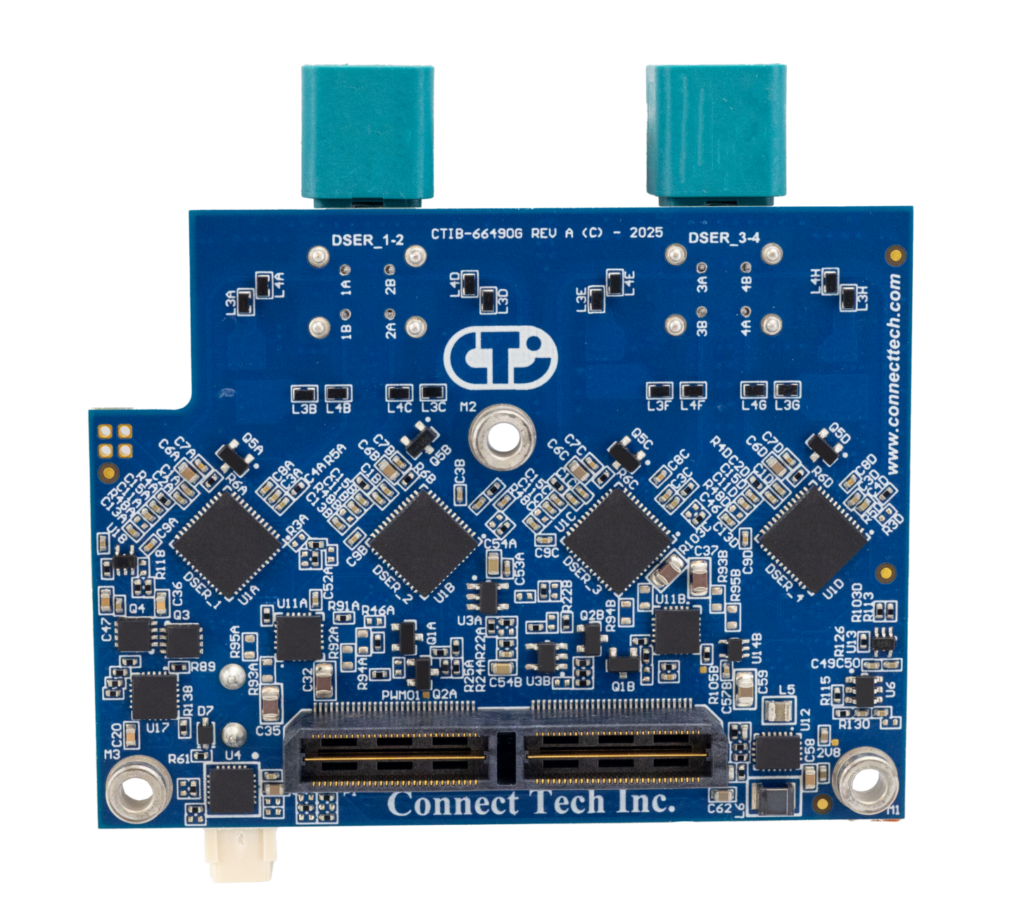
JCB009 — GMSL3 Camera Platform
Connect up to eight GMSL3 or GMSL2 cameras with Power-over-Coax connectivity and internal or external camera power. Support for longer cable runs allows flexible camera placement, while shared hardware triggering supports coordinated capture across multiple cameras.

JCB022 — GMSL2 Plus Camera Platform
Connect up to eight GMSL2 cameras through two MATE-AX quad coax connectors with a 16-lane MIPI CSI-2 output. Power-over-Coax combines camera data, control, and power in a single cable per camera, while power monitoring, protection, and internal or external camera power options support flexible integration.

ROS 2 performance on embedded hardware
ROS 2 was designed for distributed systems and has well-documented performance trade-offs when deployed on embedded platforms with multiple high-bandwidth sensor streams. The Connect Tech ROS-Ready Launchpad solution packages a validated ROS 2 environment with Isaac ROS acceleration on Connect Tech hardware, with a production BSP already in place, which compresses the bring-up phase that most robotics teams underestimate by weeks (CTai LABS, 2025c).
ROS 2 Development covers bring-up, DDS configuration, and production deployment in full.

VLA and foundation model deployment
Vision-language-action models, the architecture behind the most capable humanoid and AMR platforms in 2025 and 2026, require compute that only Jetson Thor (T5000, 2,070 FP4 TFLOPS) can deliver at the Edge within a reasonable power envelope. Deploying a VLA model in production means TensorRT™ optimization, power mode tuning, and validation against the robot’s actual sensor pipeline, not a benchmark dataset. CTai LABS has deployed 3D Spatial Understanding and Agentic Robot Memory solutions on Jetson Thor, which provides a validated starting point for teams working with foundation models at the Edge (CTai LABS, 2026a, 2026b). The commercial pressure behind this is real and recent: global humanoid robot shipments reached roughly 18,000 units in 2025 with shipments forecast to surpass 510,000 units by 2030, a compound annual growth rate of nearly 95 percent (Li, 2026).
Humanoid Robotics covers VLA and agentic ai architecture on Jetson Thor in full.

AMR systems break at the boundaries between perception, compute, and control
Autonomous mobile robots rely on perception, localization, navigation, ai inference, embedded compute, and motion control working together in real time. Problems often surface where those layers meet, including sensor timing, ROS 2 communication, compute limits, BSP support, thermal constraints, and navigation behavior in changing environments.
Autonomous Mobile Robots explores how CTai LABS works across those boundaries to bring up, optimize, and validate the complete AMR system.

Figure 2. Robotics and logistics deployments depend on integration across the full stack, from the embedded hardware and BSP through sensor pipelines, ROS 2, perception, navigation, and higher-level ai. Problems at one layer can propagate upward, which is why production deployment requires hardware and software to be engineered and validated together.
How CTai LABS integrates robotics ai
The structural position of CTai LABS inside Connect Tech is what makes the integration different. Connect Tech designs and manufactures the carrier boards that NVIDIA® Jetson™ modules run on. CTai LABS integrates and optimizes the ai stack. The same team that selects the hardware for a robotics project also brings up its sensors, configures its ROS 2 environment, and validates its models.
The engagement follows the standard CTai LABS six-stage process: workload and sensor assessment, hardware and architecture selection, BSP and sensor bring-up, model optimization, full integration validation, and a deployment-ready handoff with production support. For the robotics vertical specifically, the integration work is concentrated in the sensor bring-up and validation stages, which is where most robotics projects lose time when hardware and software are owned by different parties.
An example and testing platform is D.A.V.E. (Data. Analytics. Vision. Execution.), Connect Tech’s autonomous mobile robot, runs perception, compute, and control on Connect Tech Edge hardware with the CTai LABS full stack.
Autonomous Mobile Robots page covers full-stack AMR integration, navigation, and fleet management in full.
Capabilities and what they deliver for robotics and logistics
The table maps the core robotics integration capabilities CTai LABS delivers to what each one produces for the project.
| Capability | What CTai LABS delivers |
|---|---|
| ROS 2 and Isaac ROS | Pre-configured ROS 2 environment with Isaac ROS acceleration on Connect Tech hardware. BSP-validated, production-ready, skipping weeks of bring-up. Available as the ROS-Ready Launchpad solution. |
| Multi-camera perception | Camera bring-up across Connect Tech solutions. Synchronized multi-camera pipelines for stereo depth, surround perception, and 3D reconstruction. |
| Sensor fusion | Camera, LiDAR, IMU, and CAN integration with Isaac ROS sensor fusion packages. Timing validation across all sensor streams before any model sees the fused data. |
| Model optimization | TensorRT conversion and INT8/FP16 quantization for perception and navigation models against the real Jetson module power mode and thermal envelope. |
| Agentic and VLA deployment | Vision-language-action model integration for humanoid and advanced AMR applications on Jetson Thor. Robot memory and reasoning architecture for multi-step task planning without cloud dependency. |
| SIL/HIL/Digital Twin validation | Full validation pipeline using Software-in-the-Loop, Hardware-in-the-Loop, and NVIDIA Isaac Sim Digital Twin testing before field deployment. |
Connect Tech hardware for robotics
Platform selection for robotics deployment is driven by compute workload, camera count and bus type, power envelope, and environmental constraints. The primary Connect Tech platforms for robotics and logistics applications are:
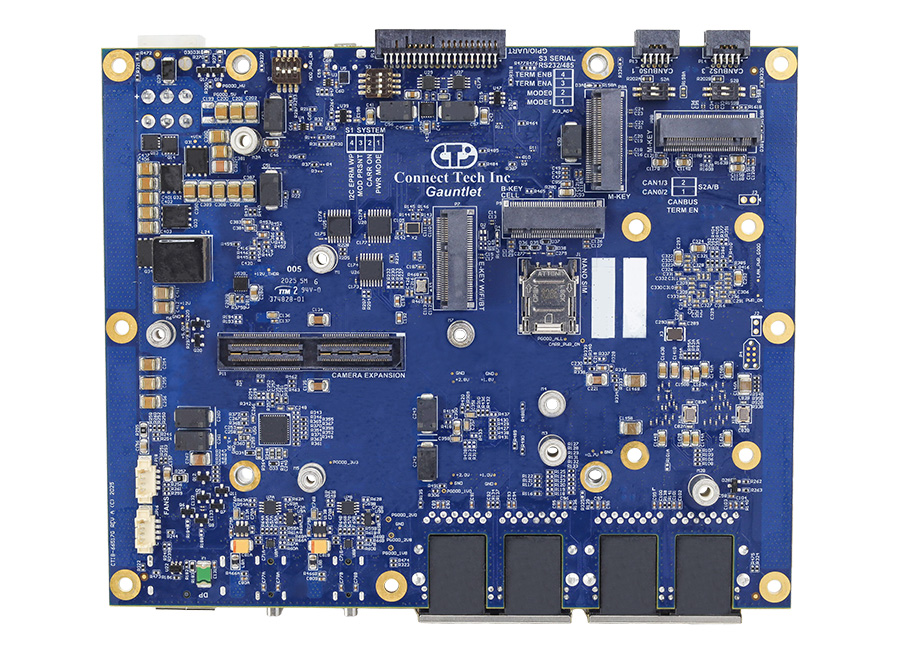
Gauntlet with Jetson Thor (T5000)
The primary platform for humanoid robots, advanced AMRs, and multi-model autonomy applications. Jetson Thor delivers 2,070 FP4 TFLOPS at 40 to 130 watts, with 7.5 times the ai compute and 3.5 times the energy efficiency of AGX Orin. The Gauntlet carrier supports 16-lane MIPI CSI-2, GMSL3/2/1, FPD-Link III, SDI, dual 10GbE, and CAN 2.0b, providing the camera bandwidth and I/O that full-platform autonomy stacks require. First choice for VLA model deployment and vision-language-action applications (Connect Tech, 2025; NVIDIA, 2025c).

Forge (AGX201) with Jetson AGX Orin
The primary platform for logistics automation, warehouse AMRs, and industrial perception applications. Jetson AGX Orin delivers up to 275 TOPS at 15 to 60 watts. Forge provides dual 10GbE plus dual GbE, dual NVMe M.2, and a 155 by 125 mm footprint rated to -40C to +85C. Suited to applications where Jetson AGX Orin compute is sufficient and a compact, rugged carrier is required (Connect Tech, 2022; NVIDIA, 2025b).
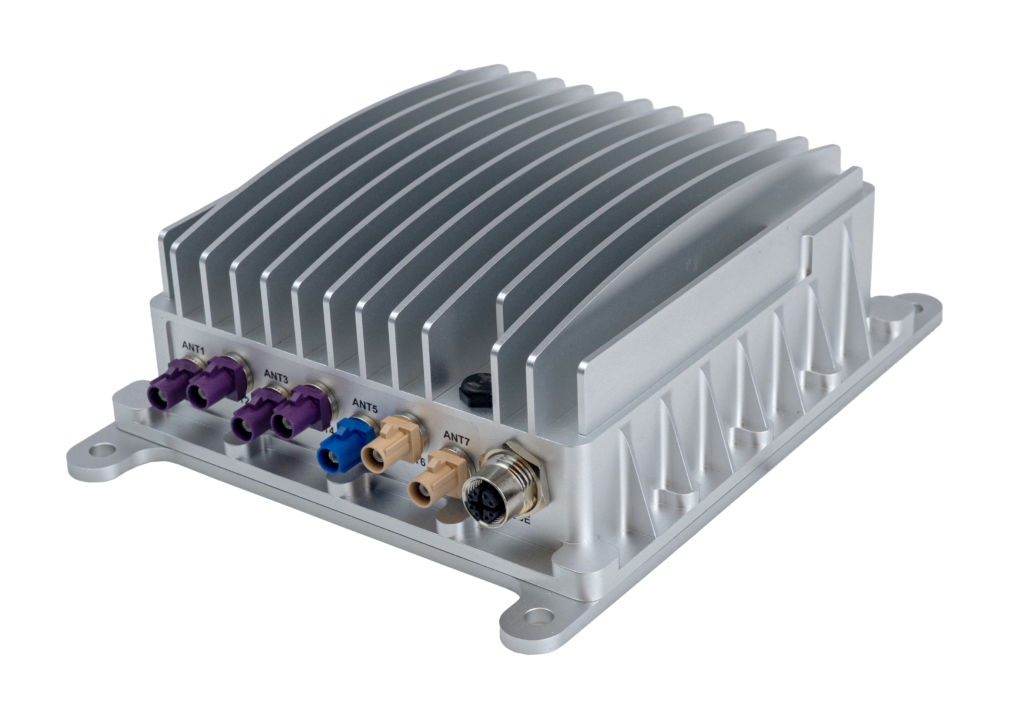
Falcon Vehicle System with Jetson Orin NX
Built for harsh vehicle environments, Falcon is a compact, IP67-rated Edge AI system powered by NVIDIA® Jetson Orin™ NX. Four GMSL2 camera inputs, vehicle-native T1 Ethernet, and two CAN interfaces support camera, sensor, and vehicle integration. Fanless operation and a +9V to +36V input range make it well suited to autonomous heavy equipment and outdoor mobile robotics.
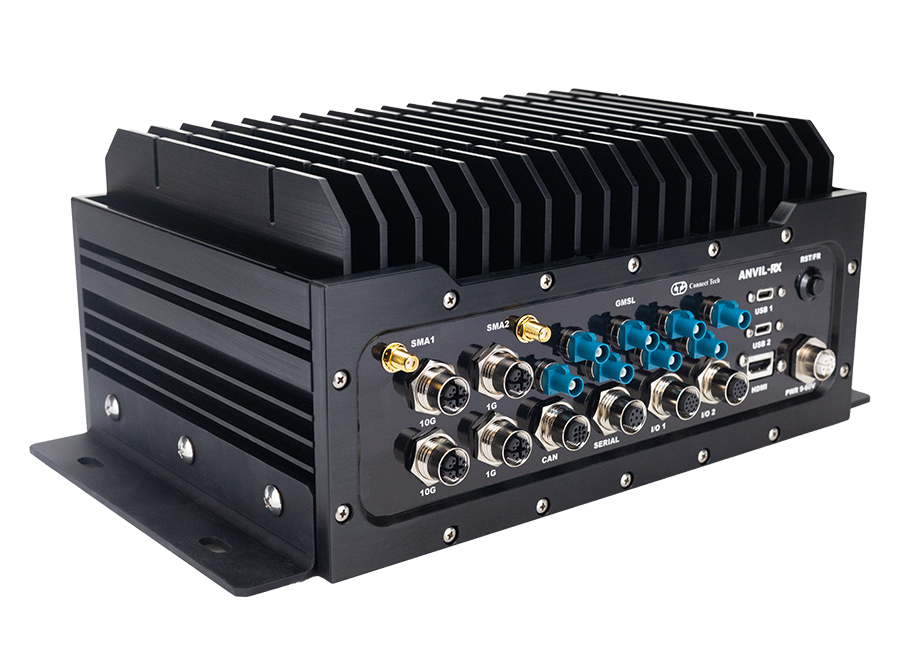
Anvil-RX Rugged System with Jetson AGX Orin
Powered by NVIDIA® Jetson AGX Orin™, Anvil-RX combines IP67 protection with rugged M12 connectors for demanding robotics and industrial environments. Eight GMSL2 camera inputs, dual 10GbE, dual 2.5GbE, and two CAN interfaces provide extensive connectivity for multi-sensor systems. Tested to MIL-STD-810H, it supports deployment in AMRs, agricultural equipment, and outdoor automation.
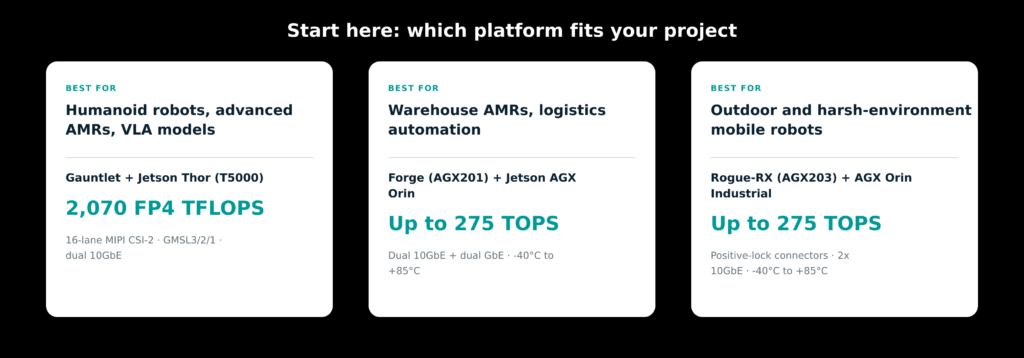
Figure 3. Which Connect Tech platform fits a given robotics project, decision-first.
Robotics ai: deeper by topic
The following topics have dedicated pages in development. Each covers one dimension of the robotics ai integration stack in technical depth. Links will be active when pages are published.

ROS 2 Development
ROS 2 Development

Robot Perception
Camera pipeline bring-up, GMSL2/3 and FPD-Link III integration, and computer vision model deployment for robotics applications.
Sensor Fusion
Multi-sensor integration across cameras, LiDAR, IMU, and CAN, with Isaac ROS sensor fusion packages and timing validation.

Autonomous Mobile Robots
Full-stack AMR integration: navigation, perception, obstacle avoidance, and fleet management on Connect Tech Edge hardware.

Humanoid Robotics
VLA model deployment, Agentic ai architecture, and Jetson Thor integration for humanoid platforms.

ABOUT THE AUTHOR
Ceri Nelmes
Tech Marketing Leader & Journalist | Building Brands at the Edge of What’s Next |
Connect Tech & CTai Labs
Ceri Nelmes is Head of Marketing at Connect Tech and an experienced technology journalist and digital strategist. She covers the technologies and market shifts shaping embedded computing, Edge AI, Physical ai, robotics, autonomous systems, and the NVIDIA® ecosystem. Working with Connect Tech and CTai LABS subject-matter experts, she turns engineering developments into accurate, useful reporting for developers, technical buyers, business leaders, and the media.
 Learn More
Resources and Frequently Asked Questions
Related
ROS-Ready Launchpad. Pre-configured ROS 2 and Isaac ROS environment on Connect Tech hardware, ready to build on without BSP bring-up work.
See ROS-Ready Launchpad →ai Integration Services. The full-stack engagement model: architecture through deployment-ready handoff and production support.
See ai Integration Services →ScrapGuard Case Study. A deployed Edge ai vision system on Connect Tech hardware in a real-world industrial environment.
See Case Studies →Industries We Serve. Edge ai integration across CTai LABS focus verticals.
See Industries →Services. The full range of CTai LABS engagements, from proof of concept through consulting and dedicated engineering teams.
See Services →Sources
Al-Batati, A. S., Koubaa, A., Abdelkader, M., Gabr, K., & Aloqaily, H. (2026). ROS 2 in a nutshell: A survey. ACM Computing Surveys.
https://doi.org/10.1145/3815113Connect Tech. (2022, May 25). Product launch: Introducing Forge, first carrier board for NVIDIA Jetson AGX Orin.
https://connecttech.com/product-launch-introducing-forge-first-carrier-board-for-nvidia-jetson-agx-orin/Connect Tech. (2024, March 1). Rogue-RX: Empowering AI in rugged conditions.
https://connecttech.com/rogue-rx-empowering-ai-rugged-conditions/Connect Tech. (2025, May 13). Connect Tech leads market with Jetson Thor carrier powered by NVIDIA Blackwell.
https://connecttech.com/connect-tech-leads-market-jetson-thor-carrier-nvidia-blackwell/Frequently Asked Questions
What does robotics ai integration involve?
Robotics ai integration involves bringing up the full hardware and software stack that a robotics ai system runs on: the BSP for the carrier board, the ROS 2 environment with Isaac ROS acceleration, the sensor pipeline across cameras, LiDAR, IMUs, and CAN, the perception and navigation models optimized with TensorRT for the target Jetson module, and SIL/HIL/Digital Twin validation before field deployment. It is not a software-only task. The hardware determines what is possible at every layer above it.
Which NVIDIA Jetson module is right for robotics deployment?
It depends on compute workload, camera count, power envelope, and application type. For example, Jetson Thor (T5000, 2,070 FP4 TFLOPS) on the Gauntlet carrier is the right choice for humanoid robots, advanced AMRs, and VLA model deployment. Jetson AGX Orin (up to 275 TOPS) on Forge or Rogue-RX suits logistics AMRs and perception-heavy applications where Thor-class compute is not required (NVIDIA, 2025b, 2025c). CTai LABS makes that decision against the real project constraints, not the spec sheet.
Does CTai LABS support ROS 2?
Yes. CTai LABS brings up ROS 2 with Isaac ROS acceleration on Connect Tech hardware as a standard part of robotics integration engagements. The ROS-Ready Launchpad solution packages a validated ROS 2 environment, production BSP, and Isaac ROS configuration on which teams can build their application immediately, without the bring-up phase (CTai LABS, 2026c).
Can CTai LABS integrate GMSL cameras for a robotics application?
Yes. GMSL2 and GMSL3 camera bring-up is a core CTai LABS capability, because Connect Tech designs the carrier boards that support these buses. The Gauntlet carrier, for example, supports GMSL3/2/1, FPD-Link III, and MIPI CSI-2 simultaneously. Camera synchronization, timing validation, and multi-camera pipeline integration are handled by the same team that wrote the BSP for the carrier.
What is a Vision-Language-Action model and does CTai LABS deploy them?
A Vision-Language-Action (VLA) model is a robotics foundation model that combines visual perception, language understanding, and action planning in a single architecture. It enables robots to understand natural language instructions and execute complex multi-step tasks. CTai LABS deploys VLA models at the Edge on Jetson Thor, where the 2,070 FP4 TFLOPS compute is sufficient to run these models without cloud inference dependency. CTai LABS has validated 3D Spatial Understanding and Agentic Robot Memory solutions on this platform (CTai LABS, 2026a, 2026b).
How does CTai LABS handle Digital Twin validation for robotics?
CTai LABS uses NVIDIA Isaac Sim for Digital Twin testing, running the full software stack in a physics-accurate simulation environment before hardware deployment. This allows validation of perception models, navigation algorithms, and sensor fusion pipelines against scenarios that would be expensive or unsafe to reproduce in hardware testing. SIL and HIL validation follow, before the system is handed off for field deployment.
Does CTai LABS work on humanoid robotics projects?
Yes. Humanoid robotics is one of the applications CTai LABS is directly positioned for through its Jetson Thor integration work. The platform requirements for humanoid robots, high compute density, multi-camera perception across GMSL and FPD-Link III, VLA model inference, and real-time sensor fusion, are exactly what the Gauntlet with Jetson Thor is designed to handle. CTai LABS has deployed agentic ai and 3D spatial understanding on this platform.
What is the difference between the ROS-Ready Launchpad and a full integration engagement?
The ROS-Ready Launchpad is a pre-configured starting point: a validated ROS 2 and Isaac ROS environment on Connect Tech hardware with the BSP already in place. It compresses the bring-up phase. A full integration engagement goes further: it covers the application-specific sensor integration, model training and optimization, navigation stack configuration, SIL/HIL validation, and a deployment-ready handoff. Many projects start with the Launchpad and expand into full engagement as the application scope is defined.
Ready to Build Smarter?
Let’s create the intelligent Edge AI solution that moves your business forward.