Built with NVIDIA
NVIDIA Jetson Consulting
Architecture, migration, optimization, and production integration for NVIDIA Jetson Edge ai systems.
By Ceri Nelmes
Tech Marketing Leader & Journalist | Building Brands at the Edge of What’s Next | Connect Tech & CTai Labs
Technical review: Rob Callaghan, Chief Product Officer, Connect Tech Inc.
Key Takeaways
- NVIDIA® Jetson™ consulting should start with the production workload, not a module name. Model architecture, memory capacity and bandwidth, sensor I/O, power, thermals, software compatibility, physical constraints, and lifecycle requirements all affect the right platform
- The NVIDIA Jetson family now spans NVIDIA Jetson Orin™ Nano, NVIDIA Jetson Orin™ NX, NVIDIA Jetson AGX Orin™, and NVIDIA Jetson Thor™, with materially different compute architectures, memory configurations, power ranges, and I/O capabilities (NVIDIA, 2026a)
- Migration is not only a software exercise. NVIDIA notes that Jetson modules are broadly software compatible, but hardware pinouts and electromechanical footprints vary, and a JetPack change can require porting work (NVIDIA, 2026b)
- CTai LABS works as an extension of the customer’s engineering team across Jetson architecture, Connect Tech carrier and system integration, BSP and driver work, sensors, ai Model Optimization, Memory Optimization, and production validation. The customer retains its product ownership and IP
- Right-sizing can include a One-SKU-Down strategy when the measured workload permits it. CTai LABS can optimize and benchmark the complete application on the target platform rather than assuming the largest module is the safest production choice
NVIDIA® Jetson™ makes it possible to bring accelerated ai into robots, autonomous machines, vision systems, industrial equipment, and other Edge products. The harder production question is not whether Jetson can run ai. It is which Jetson configuration, software stack, carrier, sensor architecture, and optimization path can sustain the customer’s application inside the real product envelope.
CTai LABS provides NVIDIA Jetson consulting across that complete decision. Backed by Connect Tech’s Jetson hardware, BSP, and embedded software engineering experience, the team can enter at initial architecture, an existing prototype, a migration between Jetson generations, or a deployment that needs to be optimized and validated for production.
The engagement is scoped around the customer’s product and workload. CTai LABS supplies the Jetson and Edge integration depth for the project while the customer’s engineering organization retains its application, domain expertise, product ownership, and intellectual property.
CTai LABS’ system-level approach is part of the CTI EdgeAI Stack: aligning the Jetson compute module with the carrier, I/O, BSP, sensors, software, model/runtime configuration, and production requirements instead of selecting the module in isolation.
Jetson consulting starts with the workload
The right Jetson platform is determined by the workload and deployment constraints, not by peak ai performance in isolation. The application may be limited by memory capacity, memory bandwidth, CPU load, video encode/decode, sensor ingest, I/O topology, storage, networking, power, thermals, software support, or the interaction between several of those constraints (Cordova-Cardenas et al., 2025).
NVIDIA’s current Jetson lineup illustrates why the decision is multidimensional. NVIDIA Jetson Orin™ Nano, NVIDIA Jetson Orin™ NX, NVIDIA Jetson AGX Orin™, and NVIDIA Jetson Thor™ span different module sizes, memory configurations, power envelopes, GPU architectures, and accelerator capabilities. Thor introduces NVIDIA Blackwell architecture and substantially more memory and ai compute, while Orin remains a broad production family across smaller and larger form factors (NVIDIA, 2026a; NVIDIA, 2026c).
CTai LABS translates the production requirements into a measurable platform envelope, then validates the proposed configuration on the hardware and software stack intended to ship.

Figure 1. CTai LABS can support the Jetson deployment from requirements and architecture through bring-up, optimization, validation, and production handoff, with the engagement boundary defined around the customer’s internal capabilities.
What NVIDIA Jetson consulting can cover
Jetson architecture and module right-sizing
CTai LABS can map the workload against Jetson Orin and Thor options, including compute architecture, memory capacity, memory bandwidth, power mode, I/O, storage, networking, video pipelines, physical form factor, and software requirements. The objective is to select enough platform for the complete system without carrying unnecessary cost, power, thermal load, or memory into production.
This is also where a One-SKU-Down strategy can be evaluated. If a workload has been scoped on a higher-memory or higher-performance module, CTai LABS can profile the limiting resources, optimize the model and system, and test whether the application can meet its production targets on a lower-resource configuration.
Orin, Thor, and Jetson migration
A move between Jetson platforms can involve much more than recompiling the application. NVIDIA states that Jetson modules are software compatible, but notes that JetPack changes can require porting and that connector pinouts and electromechanical footprints vary across module families (NVIDIA, 2026b).
CTai LABS can assess the migration across the full stack: carrier compatibility, I/O, power, cooling, BSP, drivers, JetPack and CUDA dependencies, TensorRT engines, model formats, containers, application services, and production test requirements. For Orin-to-Thor migration, that includes validating what should move unchanged, what needs to be rebuilt or retuned, and whether the application can make useful use of Thor’s Blackwell-era capabilities rather than treating migration as a specification upgrade.
BSP, JetPack, drivers, and system software
Production Jetson systems depend on the software below the application. CTai LABS can work with Connect Tech BSP resources across Jetson Linux, board support packages, device-tree configuration, drivers, system images, boot behavior, and platform-specific integration.
Software lifecycle matters during platform selection as well. Connect Tech’s 2026 JetPack 7.2 work, for example, brought JetPack 7 support to Jetson AGX Orin and Orin NX and created new migration and production-deployment options for systems that had been based on earlier JetPack releases (Connect Tech Inc., 2026a).
System and sensor integration
The Jetson module is only one component in a Physical ai or vision system. CTai LABS can integrate cameras and perception devices across GMSL2/3, MIPI CSI-2, FPD-Link III, SDI, HD-SDI, and HDMI, along with LiDAR, IMUs, radar, CAN, networking, and other required interfaces.
That work connects sensor timing, synchronization, drivers, data formats, preprocessing, inference, and application behavior so the perception pipeline is validated as a system rather than as separate hardware and software tasks.
ai Model Optimization and runtime tuning
A model that runs on Jetson is not necessarily configured for the production target. CTai LABS can establish a baseline on the selected module and optimize precision, quantization, NVIDIA® TensorRT™, runtime configuration, preprocessing and postprocessing, batching or concurrency, and pipeline behavior against the application’s quality, latency, and throughput requirements.
Memory Optimization and One-SKU-Down validation
Memory capacity is a product decision as well as a software constraint. CTai LABS profiles the complete application footprint, including model weights, runtime allocation, buffers, sensor pipelines, operating-system headroom, and concurrent services. The team can then test whether memory and model optimizations create enough operating headroom to validate the workload on a lower-memory Jetson configuration.
CTai LABS has demonstrated this approach on a dual-model video ai workload that had previously been scoped for a 64 GB Jetson AGX Orin configuration. After migration and optimization, the full workload was benchmarked on Jetson AGX Orin 32GB with approximately 10 GB of idle free RAM and three live 720p30 RTSP streams sustained with continuous alerting (Sonmez, 2026).
Power, thermal, and sustained-load validation
Peak benchmark performance is not enough for an embedded product. CTai LABS can test the complete workload at the intended power mode, sensor load, enclosure and cooling approach, and ambient conditions to identify throttling, thermal saturation, memory pressure, or resource contention that does not appear in a short development-kit benchmark (Fridous et al., 2026).
Production integration and handoff
The work can continue through reproducible system images, application packaging, flashing, update and rollback planning, validation procedures, documentation, and production support. The goal is a Jetson configuration the customer’s engineering team can carry forward with known performance, operating headroom, and software dependencies.
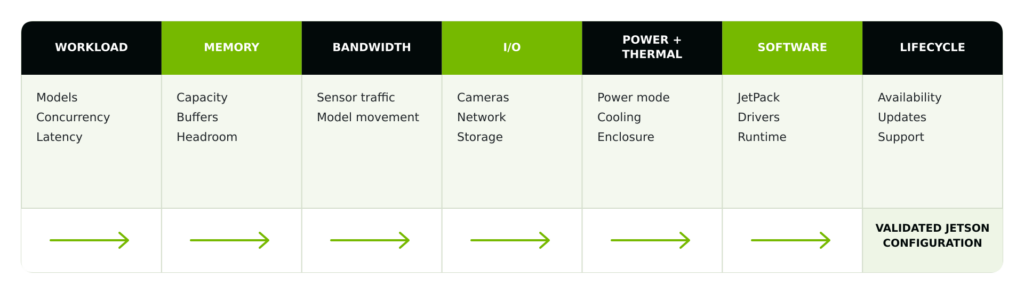
Figure 2. Jetson right-sizing is a system decision. CTai LABS combines workload, memory, data movement, I/O, power and thermal, software, and lifecycle requirements before validating the selected module and Connect Tech platform (Cordova-Cardenas et al., 2025).
Orin or Thor? Start with the engineering requirement
The Orin-versus-Thor decision should not be reduced to which platform has the larger ai performance number. NVIDIA’s current specifications use different precision metrics across the families, and Thor adds architectural capabilities that do not map one-to-one to Orin TOPS figures (NVIDIA, 2026a). The useful question is whether the workload and product architecture require the additional memory, compute, networking, and Blackwell-era features, and whether the rest of the system can use them.
| Decision factor | Orin-family question | Thor-family question |
|---|---|---|
| Workload fit | Can the required models, sensor pipeline, and application meet targets within the selected Orin module’s compute and memory envelope? | Does the workload materially benefit from the additional Blackwell compute, memory, and platform capabilities? |
| Memory | Is 4 GB, 8 GB, 16 GB, 32 GB, or 64 GB sufficient after the complete application is profiled and optimized? | Does the application need the larger Thor memory envelope or additional concurrency/headroom? |
| Power and thermal | Can the product sustain the chosen Orin power mode inside its enclosure and environment? | Can the product support Thor’s higher configurable power range and corresponding thermal design? |
| Migration | Can the existing Orin software and carrier architecture remain in place? | What changes across JetPack, carrier, I/O, cooling, model/runtime, and application dependencies? |
| Lifecycle | Does the selected Orin module and software path meet the product’s production timeline and support requirements? | Does Thor align better with the product roadmap, future model requirements, or next-generation architecture? |
A Jetson migration is a validation project
NVIDIA’s compatibility guidance is useful because it separates software compatibility from physical compatibility. Software reuse across Jetson can be high, but a move that changes JetPack, module family, carrier requirements, power, or mechanical design still creates engineering work that has to be scoped and tested (NVIDIA, 2026b).
- Inventory the current module, carrier, BSP, JetPack release, CUDA and TensorRT dependencies, drivers, containers, models, sensors, and external I/O.
- Identify what changes on the target Jetson family, including physical compatibility, power, cooling, I/O routing, software versions, and unsupported dependencies.
- Rebuild or migrate the system image and application stack, then bring up sensors and peripherals on the target hardware.
- Re-profile model performance, memory use, data movement, and concurrency. A new GPU architecture or runtime can change the optimum model configuration.
- Validate end-to-end latency, sustained thermals, power, reliability, and production update behavior before declaring the migration complete.
Why CTai LABS for NVIDIA Jetson consulting
CTai LABS sits inside Connect Tech, an NVIDIA Jetson ecosystem partner that develops carrier boards, embedded systems, cooling, camera platforms, and BSP support for Jetson. That matters because Jetson consulting often crosses the boundary between the ai workload and the embedded platform.
Instead of handing a model issue to one vendor, a camera issue to another, and a BSP issue to a third, CTai LABS can work across those layers with Connect Tech hardware and software engineering and ai architect teams. The engagement can remain focused on the deployment for as long as the project requires, without the customer having to build a permanent internal team covering every Jetson specialty.
Connect Tech’s 2026 support for the Jetson Thor family also includes development, migration, and deployment services alongside carrier-board and system support, giving CTai LABS a practical path for customers moving from Orin-era systems into Thor or planning new Blackwell-based Edge ai products (Connect Tech Inc., 2026b).
Typical NVIDIA Jetson consulting engagements
- Selecting the right Jetson module and Connect Tech carrier or system for a new Edge ai product.
- Moving an application from a Jetson developer kit into production hardware.
- Migrating from an earlier Jetson generation or JetPack release to Orin or Thor.
- Diagnosing an application that meets model benchmarks but misses end-to-end latency, memory, power, or thermal targets.
- Integrating cameras, LiDAR, IMUs, CAN, networking, storage, or other production I/O with the ai pipeline.
- Optimizing a workload to fit a lower-memory or lower-power Jetson configuration.
- Preparing a reproducible software image, validation plan, and production handoff for a Jetson-based deployment.
How a CTai LABS Jetson engagement works
1.
Discovery and requirements
Define the model or application, sensors, target environment, latency and throughput targets, memory needs, interfaces, power and thermal limits, production volumes, and software/lifecycle constraints.
2.
Architecture and platform recommendation
Map the requirements to Jetson Orin or Thor options, Connect Tech hardware, sensor interfaces, BSP/software approach, and the required optimization work.
3.
Bring-up and integration
Build or adapt the software image, integrate drivers and sensors, validate I/O, and bring the application up on the target platform.
4.
Benchmark and optimize
Measure the complete workload, identify the limiting resource, and optimize model, runtime, memory, data path, and system configuration.
5.
Production validation
Test sustained performance, power, thermals, stability, startup/recovery behavior, and application requirements under representative conditions.
6.
Handoff and support
Document the validated configuration, deployment image, known limits, update requirements, and ongoing Connect Tech/CTai LABS support path.
NVIDIA Jetson consulting is most valuable when platform selection, software, sensors, model performance, memory, power, thermals, and production requirements are treated as one engineering problem. CTai LABS brings those layers together, helping customers choose and validate the right Jetson architecture, migrate existing applications, optimize the complete workload, and move from development hardware to a documented production configuration. The customer retains ownership of the product and IP, while CTai LABS provides the Jetson and Edge engineering depth needed to get the system into production.
Book a Demo
Bring the model or application, current Jetson platform if one exists, target sensors, software stack, production constraints, and the problem the team is trying to solve. CTai LABS can assess the architecture, identify the Jetson and Connect Tech platform that fits the workload, and scope the integration, optimization, migration, or validation work required to get it into production.

ABOUT THE AUTHOR
Ceri Nelmes
Tech Marketing Leader & Journalist | Building Brands at the Edge of What’s Next |
Connect Tech & CTai Labs
Ceri Nelmes is Head of Marketing at Connect Tech and an experienced technology journalist and digital strategist. She covers the technologies and market shifts shaping embedded computing, Edge AI, Physical ai, robotics, autonomous systems, and the NVIDIA® ecosystem. Working with Connect Tech and CTai LABS subject-matter experts, she turns engineering developments into accurate, useful reporting for developers, technical buyers, business leaders, and the media.
 Learn More
Resources and Frequently Asked Questions
Related
Built with NVIDIA. Explore how CTai LABS works across NVIDIA Jetson, CUDA, TensorRT, Isaac, and the wider Edge ai stack.
Jetson Orin vs. Thor. Compare the architectural and deployment factors that determine which Jetson generation fits a workload.
Jetson Migration. Plan the hardware, BSP, JetPack, runtime, and application work required to move an existing Jetson deployment.
ai Model Optimization. Optimize model precision, runtime, latency, throughput, and memory behavior on the target Jetson platform.
Memory Optimization. Profile the complete workload and evaluate One-SKU-Down opportunities across Jetson memory configurations.
System and Sensor Integration. Integrate cameras, perception devices, drivers, synchronization, and the complete sensor-to-inference data path.
Sources
Connect Tech Inc. (2026a, June 1). JetPack 7.2 and Yocto: A production deployment milestone for Jetson AGX Orin and Orin NX.
https://connecttech.com/jetpack-7-2-yocto/Connect Tech Inc. (2026b, July 15). Connect Tech announces support for new NVIDIA Jetson T3000 and T2000 modules.
https://connecttech.com/2026-07-jetson-t3000-announcement/Cordova-Cardenas, R., Amor, D., & Gutiérrez, Á. (2025). Edge AI in practice: A survey and deployment framework for neural networks on embedded systems. Electronics, 14(24), 4877.
https://doi.org/10.3390/electronics14244877Fridous, V. M., Agarwal, A., Bhaskar, K. B., Nandagopal, V., & Sivakamasundari, N. (2026). Optimization and benchmarking of lightweight neural networks for efficient embedded AI deployment. Engineering Reports, 8(5), e70814.
https://doi.org/10.1002/eng2.70814NVIDIA. (2026a). Embedded systems developer kits & modules from NVIDIA Jetson.
https://www.nvidia.com/en-us/autonomous-machines/embedded-systems/NVIDIA. (2026b). Jetson FAQ. NVIDIA Developer.
https://developer.nvidia.com/embedded/faqNVIDIA. (2026c). NVIDIA Jetson modules. NVIDIA Developer.
https://developer.nvidia.com/embedded/jetson-modulesSonmez, D. (2026, July). We budgeted 64GB. Super Mode said otherwise. CTai LABS.
https://ctailabs.ai/edge-ai-solutions/Frequently Asked Questions
What does NVIDIA Jetson consulting include?
The scope can include Jetson architecture and module selection, Connect Tech carrier or system selection, BSP and JetPack work, drivers, sensor integration, ai Model Optimization, Memory Optimization, migration, power and thermal validation, production imaging, and deployment support.
How do I choose between Jetson Orin and Jetson Thor?
Start with the production workload and system constraints. Model size and precision, concurrency, memory, sensor I/O, networking, power, thermals, software requirements, and product roadmap all matter. CTai LABS can benchmark the workload and validate whether Orin or Thor provides the required production headroom.
Can CTai LABS help migrate an existing Jetson application?
Yes. CTai LABS can assess the current hardware, BSP, JetPack release, CUDA and TensorRT dependencies, models, sensors, drivers, containers, and application services, then migrate and validate the system on the target Jetson platform.
Are all NVIDIA Jetson modules interchangeable?
No. NVIDIA states that Jetson modules are software compatible, but a JetPack change can require porting. Hardware pinouts and electromechanical footprints also vary between module families, so carrier, mechanical, power, and software compatibility must be checked for the specific migration (NVIDIA, 2026b).
Can CTai LABS help us evaluate a One-SKU-Down configuration?
Yes, when the workload supports it. CTai LABS can profile model and system memory, optimize the model and runtime, reduce memory pressure, and benchmark the complete application on a lower-resource configuration. The recommendation is based on measured production headroom, not on module specifications alone. Read the white paper.
Does CTai LABS work with cameras and sensors as part of Jetson consulting?
Yes. CTai LABS can integrate supported camera and sensor interfaces, including GMSL2/3, MIPI CSI-2, FPD-Link III, SDI, HD-SDI, and HDMI, as well as LiDAR, IMUs, radar, CAN, networking, and other application-specific I/O.
Can CTai LABS optimize our model for Jetson?
Yes. ai Model Optimization can include precision and quantization work, NVIDIA TensorRT, runtime tuning, preprocessing and postprocessing, pipeline profiling, memory analysis, and benchmarking against the target latency, throughput, power, and quality requirements.
Does the customer keep its IP?
Yes. CTai LABS works as an extension of the customer’s engineering team for the agreed engagement. The customer retains its application, proprietary logic, product ownership, and intellectual property.
Can you start from a developer kit or existing prototype?
Yes. The engagement can begin with a developer kit, existing Connect Tech hardware, a model, a software image, a sensor stack, or a partially integrated prototype. Discovery identifies what can be retained and what still needs to be engineered or validated.
What should we provide to start a Jetson consulting engagement?
Provide your goals if you have them. Useful inputs include the model or application, current and target Jetson modules, JetPack version, sensors and interfaces, expected data rates, latency and throughput targets, memory requirements, power and thermal constraints, physical envelope, and any existing benchmark or integration results.