
Services
System & Sensor Integration
Bring sensors, Edge compute, drivers, and ai software together in a deployment-ready system.
By Kara Price
Senior Marketing & Events Specialist | Content Strategy | Campaign Execution | Connect Tech Inc.
Technical review: Rob Callaghan, Chief Product Officer, Connect Tech Inc.
Key Takeaways
- CTai LABS brings cameras, LiDAR, IMUs, and other perception devices onto Edge ai and robotics platforms
- Engineering can cover hardware bring-up, sensor drivers, board support package configuration, interface validation, data movement, synchronization, and application-level testing
- Connect Tech maintains a broad vision ecosystem with camera and sensor partners, supported-camera information, and verified software pathways for selected hardware
- The service follows the complete sensor-to-application chain, from the physical connection and software support through the ai or robotics workload
- CTai LABS supports both single-device deployments and sensor-rich systems for robotics, industrial automation, autonomous machines, and rugged applications
Electrical compatibility alone does not make a sensor deployment-ready. Interfaces, drivers, Board Support Packages (BSPs), power, bandwidth, triggering, synchronization, preprocessing, and application software all influence whether data reaches the ai workload at the required rate, format, and timing.
CTai LABS provides System and Sensor Integration for teams connecting perception hardware to production Edge compute. Work can span cameras, LiDAR, IMUs, and other sensing devices, with bring-up and validation performed as part of the complete hardware/software environment. CTai LABS identifies end-to-end camera, LiDAR, IMU, and perception-device support as a core capability (CTai LABS, 2026).
Sensor integration is a system-level engineering problem
Selecting the device is only the beginning. The embedded compute platform must expose the correct interface, supply adequate power and bandwidth, provide software support, and deliver usable data to the application. Multi-device deployments add timing and coordination requirements because several streams may need to describe the same physical event or scene.
Connect Tech’s vision portfolio illustrates this system-level approach. Camera platforms support GMSL2/3, MIPI CSI-2, FPD-Link III, SDI, HD-SDI, and HDMI across NVIDIA® Jetson AGX Orin™ and NVIDIA Jetson Thor™ deployments (Connect Tech, 2026a). MIPI CSI-2 itself is designed as a high-speed imaging interface for embedded and machine-vision applications, including multi-camera systems, so interface choice directly affects bandwidth, physical-layer design, and downstream software architecture (MIPI Alliance, 2025). Connect Tech also maintains a supported-camera database covering hardware compatibility, partner verification, integration type, and BSP driver availability (Connect Tech, 2026b).
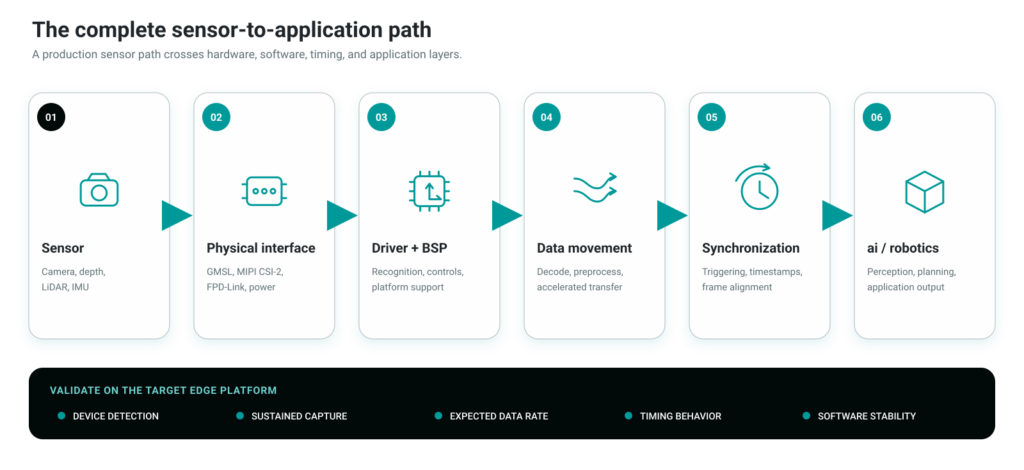
Figure 1. The complete sensor-to-application path. A production sensor integration path connects sensing hardware, physical interfaces, drivers and BSP support, data movement, synchronization, and the ai or robotics application, with validation performed on the target Edge platform.
What CTai LABS can bring together
- Cameras and machine-vision sensors for detection, inspection, tracking, navigation, teleoperation, and spatial understanding.
- Stereo and depth cameras for applications that require depth perception or 3D scene information.
- LiDAR for ranging, mapping, localization, obstacle detection, and multi-sensor perception pipelines.
- IMUs for motion, orientation, and inertial measurements used in robotics and autonomous systems.
- Multiple perception devices where camera, depth, ranging, and motion data must operate together.
- Application-specific devices requiring interface, driver, and data-flow validation on the selected Edge platform.
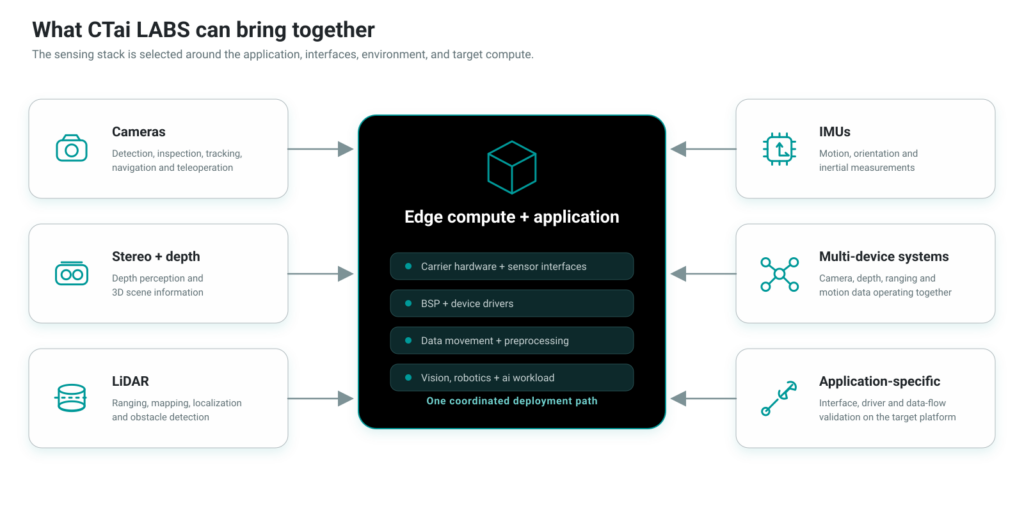
Figure 2. Sensor types CTai LABS can bring together. Cameras, depth sensors, LiDAR, IMUs, multi-device systems, and application-specific devices are integrated through one coordinated Edge compute and application stack
Hardware and interface bring-up
CTai LABS can start at the physical layer by confirming the sensor, carrier, expansion hardware, cabling, power budget, and interface needed for the deployment. For vision systems, Connect Tech already offers camera platforms across several standards. GMSL2 Plus, for example, supports up to eight GMSL2 cameras on supported Connect Tech carrier boards and includes Power over Coax, triggering, monitoring, and software-configurable interface functions (Connect Tech, 2026c).
Drivers, BSPs, and sensor software
Production bring-up depends on software support as much as the connector. CTai LABS can configure sensor drivers and platform software so the device is recognized by the operating system and exposed correctly to the application. Connect Tech’s supported-camera table documents BSP driver packages for selected combinations, while its technical documentation shows camera options being selected during Jetson BSP flashing and verified at the operating-system level (Connect Tech, 2026b; Connect Tech, 2024). MIPI’s Camera Command Set provides another example of why standardized software control matters: it defines common image-sensor functions intended to reduce device-specific driver effort for compliant CSI-2 cameras (MIPI Alliance, 2023).
Data-path and application integration
Once a device is available to the operating system, its data still has to reach the software consuming it efficiently. CTai LABS can connect sensor outputs to vision, perception, robotics, and ai workloads, including preprocessing and the application interfaces between acquisition and inference. For ROS 2 deployments on NVIDIA Jetson, NVIDIA® Isaac™ ROS NITROS can also reduce CPU memory copies between accelerated nodes through type adaptation and negotiation, which can be valuable in high-bandwidth image-processing graphs (NVIDIA, 2026).
Synchronization and multi-sensor requirements
Robotics and autonomous systems often depend on measurements from several devices operating on different clocks and update rates. CTai LABS can account for triggering, timestamps, frame alignment, transport delay, and other timing requirements during bring-up. Research on multi-sensor calibration identifies temporal alignment as a fundamental requirement for combining measurements reliably, while visual-inertial work has shown how exposure timing, operating-system scheduling, and data-transfer delays can complicate synchronization in practical systems (Furgale et al., 2013; Tschopp et al., 2020). The final method depends on the sensors, interfaces, and application.
Validation on the target system
Validation is performed on the intended Edge platform under representative operating conditions. Testing can cover device detection, sustained capture, expected resolution or data rate, software stability, simultaneous operation, timing behavior, and the application’s ability to consume the incoming data. The test plan is tied to deployment requirements rather than a generic sensor demonstration.
A proven vision ecosystem through Connect Tech
Vision is a strong example of how Connect Tech hardware and CTai LABS engineering work together. Connect Tech develops pre-integrated and verified solutions with camera and sensor providers, including software support for selected configurations intended to reduce application-development effort (Connect Tech, 2026a).
The current Connect Tech vision ecosystem includes Allied Vision, Analog Devices, Basler, D3 Embedded, e-con Systems, FRAMOS, RealSense, Leopard Imaging, Orbbec, Stereolabs, Tier IV, Vision Components, and XIMEA among its technology relationships and supported solutions (Connect Tech, 2026a; Connect Tech, 2026d).
These established pathways give customers a practical starting point for camera selection, hardware bring-up, and software enablement alongside Connect Tech Edge compute. CTai LABS can carry the resulting sensor path into the broader ai or robotics workload.
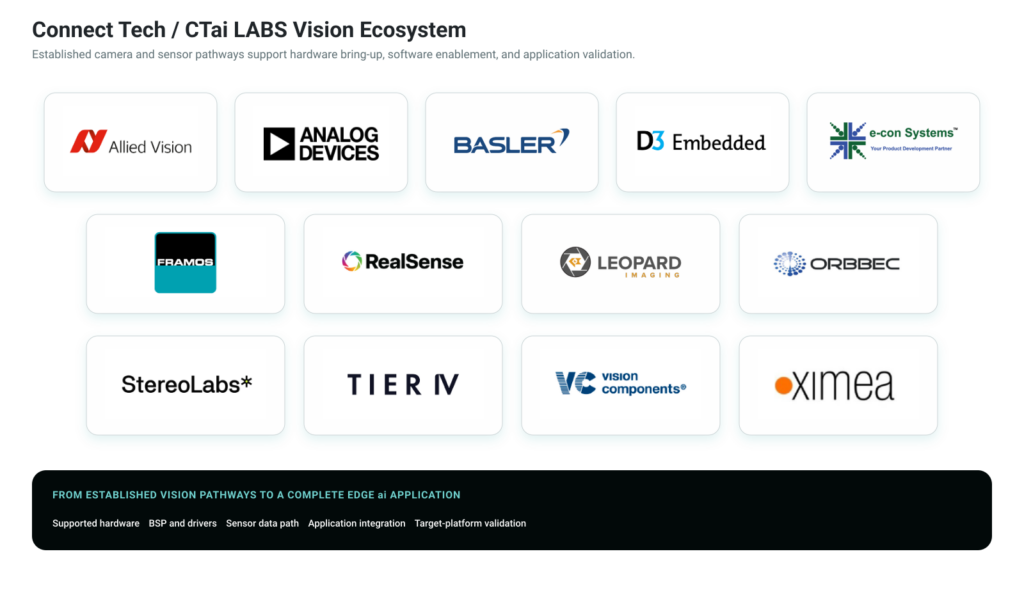
Figure 3. Connect Tech / CTai LABS Vision Ecosystem
The CTai LABS System and Sensor Integration workflow
1.
Define the sensing requirement
Define what the application must perceive or measure, the sensor types under consideration, target environment, data rates, placement constraints, and Edge compute platform.
2.
Map the hardware path
Confirm interfaces, carrier or expansion hardware, cabling, power, bandwidth, and physical constraints for the selected devices.
3.
Bring up the sensor software
Configure the BSP, drivers, device settings, and supporting software needed for the platform to detect and operate the hardware.
4.
Integrate the data path
Connect sensor output to the vision, perception, robotics, or ai workload, including required preprocessing and software interfaces.
5.
Configure multi-sensor behavior
Implement the triggering, timestamps, alignment, and coordination needed when more than one device contributes to the application.
6.
Validate the complete system
Test the complete sensing stack on the target platform against functional, performance, timing, and stability requirements.
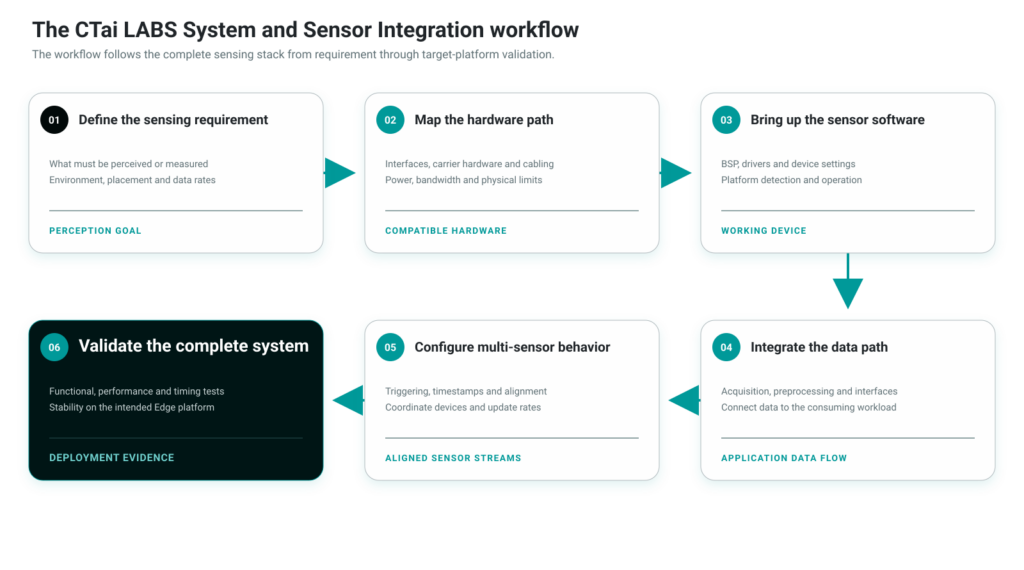
Figure 4. The CTai LABS System and Sensor Integration workflow. The six-stage workflow moves from defining the sensing requirement and mapping the hardware path through software bring-up, data integration, multi-sensor coordination, and complete-system validation.
What you get from an Edge ai System and Sensor Integration engagement
- A defined sensor-to-compute architecture for the target application.
- Hardware and interface bring-up for the selected device set.
- Driver, BSP, and supporting software configuration where needed.
- A working data flow from the sensing hardware into the application or ai pipeline.
- Timing and coordination work for multi-device systems where applicable.
- Validation results from the intended Edge platform.
- Documented settings and implementation guidance for the production build.
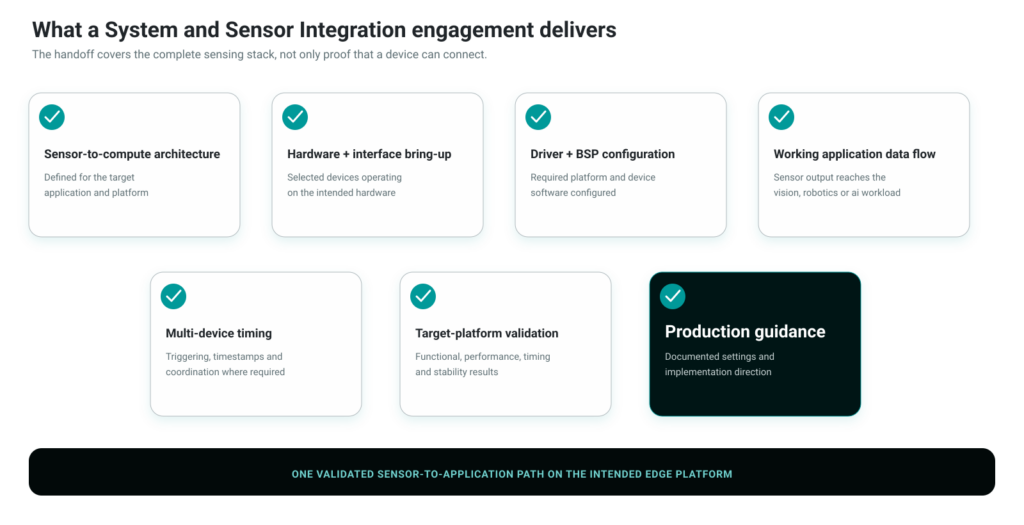
Figure 5. System and Sensor Integration engagement deliverables. A CTai LABS engagement provides a validated sensor-to-application path covering architecture, hardware bring-up, driver and BSP configuration, application data flow, multi-device timing, target-platform validation, and production guidance.
When System and Sensor Integration is the right service
- You have selected cameras or other sensors and need to bring them onto an embedded Edge ai platform.
- You need help choosing a supported camera or sensing path for a Connect Tech system.
- The device is physically connected, but the driver, BSP, or application software is not behaving as required.
- Your robotics or autonomous system uses cameras, LiDAR, IMUs, or several perception devices that must operate together.
- You are moving from a development setup to production hardware and need the sensing stack validated on the final platform.
Why integrate with CTai LABS
CTai LABS combines ai and software engineering with Connect Tech’s embedded hardware expertise. For sensor-rich products, carrier-board interfaces, camera expansion hardware, BSP support, device software, and application behavior can be addressed within the same organization rather than handed across separate vendors.
That cross-layer capability extends into the CTI EdgeAI Stack, where Edge compute, carrier hardware, sensor interfaces, BSPs, ai software, and deployment requirements are engineered as parts of the same system rather than separate integration tasks.
The same cross-layer approach supports the CTI EdgeAI Stack: compute, carrier hardware, sensor interfaces, BSPs, accelerated ai software, and deployment constraints are treated as parts of one system. For Physical ai applications, this reduces the gap between proving a sensor works and proving the complete workload works on the intended hardware.
Connect Tech’s published vision portfolio includes pre-integrated and verified camera solutions, supported-camera information, and expansion hardware across multiple interface standards (Connect Tech, 2026a; Connect Tech, 2026b). CTai LABS extends this foundation into the complete Edge ai application, including LiDAR, IMUs, and other perception devices where required (CTai LABS, 2026).
Book a Demo
Bring the sensor list, target hardware, and application requirements. CTai LABS will assess the hardware and software path, identify the first validation steps, and scope the engagement around the intended deployment.

ABOUT THE AUTHOR
Kara Price
Senior Marketing & Events Specialist | Content Strategy | Campaign Execution |
Connect Tech Inc.
Kara Price is a technology writer covering Edge AI, robotics, and embedded computing for Connect Tech and CTai LABS. Trained in journalism at Humber College with a BA in Communication Studies from Wilfrid Laurier University, she has spent over a decade writing for technical audiences, including four years as a proposal writer in architecture and engineering and ten years publishing product and technical announcements at Connect Tech, an NVIDIA Elite Partner. She is Senior Marketing and Events Specialist at Connect Tech.
 Learn More
Resources and Frequently Asked Questions
Related
Services. Explore CTai LABS engineering services across consulting, integration, optimization, and deployment support.
See CTai LABS Services →Robotics & Logistics. Explore CTai LABS work for sensor-rich robotics and autonomous systems.
See Robotics & Logistics →Sensor Fusion. Explore the robotics-focused work of combining data from cameras, LiDAR, IMUs, and other perception sources.
See Sensor Fusion →Sources
Connect Tech. (2024, March 18). Connect Tech expands robust lineup of vision solutions with HDMI camera platform, supporting the NVIDIA Jetson.
https://connecttech.com/vision-solutions-hdmi-camera-platform-supporting-nvidia-jetson/Connect Tech. (2026a). Vision solutions.
https://connecttech.com/vision-solutions/Connect Tech. (2026b). Supported cameras.
https://connecttech.com/supported-cameras/Connect Tech. (2026c). GMSL2 Plus camera platform for NVIDIA Jetson AGX Orin & Jetson Thor T5000.
https://connecttech.com/product/gmsl2-plus-camera-platform-for-nvidia-jetson-agx-orin-jetson-thor-t5000/Connect Tech. (2026d). Channel partners & technology partners.
https://connecttech.com/our-partners-2026/CTai LABS. (2026). CTai LABS | EDGE ai Stack.
https://ctailabs.ai/Furgale, P., Rehder, J., & Siegwart, R. (2013). Unified temporal and spatial calibration for multi-sensor systems. 2013 IEEE/RSJ International Conference on Intelligent Robots and Systems, 1280–1286.
https://doi.org/10.1109/IROS.2013.6696514MIPI Alliance. (2023). MIPI Camera Command Set (MIPI CCS).
https://www.mipi.org/specifications/camera-command-setMIPI Alliance. (2025). MIPI CSI-2.
https://www.mipi.org/specifications/csi-2NVIDIA. (2026). Isaac ROS NITROS.
https://nvidia-isaac-ros.github.io/v/release-4.6/repositories_and_packages/isaac_ros_nitros/index.htmlTschopp, F., Riner, M., Fehr, M., Bernreiter, L., Furrer, F., Novkovic, T., Pfrunder, A., Cadena, C., Siegwart, R., & Nieto, J. (2020). VersaVIS: An open versatile multi-camera visual-inertial sensor suite. Sensors, 20(5), 1439.
https://doi.org/10.3390/s20051439Frequently Asked Questions
What sensors can CTai LABS integrate?
CTai LABS supports cameras, LiDAR, IMUs, and other perception devices. The recommended approach depends on the interface, Edge compute platform, available software support, and application requirements (CTai LABS, 2026).
Can CTai LABS help select cameras for a Connect Tech system?
Yes. The build-spec scope includes software bring-up and sensor drivers, and Connect Tech’s existing camera solutions demonstrate BSP and driver support for selected hardware combinations. The exact software work is defined by the chosen device and platform.
Does sensor integration include software and drivers?
Yes. The build-spec scope includes software bring-up and sensor drivers, and Connect Tech’s existing camera solutions demonstrate BSP and driver support for selected hardware combinations. The exact software work is defined by the chosen device and platform.
Can CTai LABS integrate multiple sensors in the same system?
Yes. Multi-sensor systems can include cameras, LiDAR, IMUs, depth sensors, and other perception devices. CTai LABS can address the data flow, timestamps, triggering, and coordination needed for those sources to operate within the same application.
What camera interfaces are available on Connect Tech vision platforms?
Connect Tech supports GMSL2/3, MIPI CSI-2, FPD-Link III, SDI, HD-SDI, and HDMI camera pathways. Availability depends on the selected Connect Tech platform, NVIDIA Jetson module, and camera configuration (Connect Tech, 2026a).
Can CTai LABS integrate sensors for robotics applications?
Yes. The service is designed for sensor-rich Edge ai systems, including robotics and autonomous machines. Camera, depth, LiDAR, and IMU data can be brought into the perception or robotics software stack according to the application’s sensing and timing requirements.
Can CTai LABS integrate sensors for robotics applications?
Useful starting information includes the target Edge compute platform, proposed sensors or sensing requirements, interface needs, representative data rates, application software, and deployment environment. CTai LABS can use those inputs to identify the bring-up, software, synchronization, and validation work required.
What does CTai LABS need to start?
Useful starting information includes the target Edge compute platform, proposed sensors or sensing requirements, interface needs, representative data rates, application software, and deployment environment. CTai LABS can use those inputs to identify the bring-up, software, synchronization, and validation work required.