Services
ai Model Optimization
The model should fit the hardware and the performance target before you ship it.
By Ceri Nelmes
Tech Marketing Leader & Journalist | Building Brands at the Edge of What’s Next | Connect Tech & CTai Labs
Technical review: Rob Callaghan, Chief Product Officer, Connect Tech Inc.

Key Takeaways
- ai model optimization for embedded hardware adapts a trained model and its inference path to the compute, latency, throughput, power, thermal, and quality requirements of the device it will run on.
- CTai LABS optimizes on the target Edge platform, not a desktop proxy, so the result reflects the hardware, runtime, power mode, and production pipeline that will ship.
- The service can include NVIDIA® TensorRT™ conversion, precision selection, quantization, model graph and engine tuning, runtime profiling, and workload-level optimization.
- Lower precision can reduce model footprint and improve inference efficiency, but accuracy has to be measured after optimization. The right precision is workload-specific, not a universal setting.
Why optimize with CTai LABS
CTai LABS is a department of Connect Tech, an NVIDIA Elite Partner, giving the optimization team direct access to the hardware, software, and ai engineering expertise behind Connect Tech Edge compute platforms. CTai LABS provides full-stack ai and hardware/software integration, including Jetson application enablement, model and framework optimization, processor and platform integration, and sensor integration (CTai LABS, 2026).
Model optimization benefits from this combined expertise because the model does not run in isolation. Performance can be constrained by module selection, thermal design, I/O activity, preprocessing, memory availability, or the software stack surrounding inference. At the Edge, inference also shares a fixed system with the operating system, sensor pipeline, application logic, video decode, networking, and other product functions. A model can therefore be accurate enough and fast enough on a workstation while still being the wrong fit for an embedded deployment.
CTai LABS evaluates these interactions as part of the wider system rather than treating the model and embedded platform as separate projects. Successful deployment requires the model to meet latency and throughput requirements within the available memory, power, and thermal envelope while preserving the accuracy required by the application. Model optimization becomes one part of making the wider CTI EdgeAI Stack deployable for the actual production workload.
Connect Tech has positioned CTai LABS as the engineering layer working directly with customers on application development, optimization, and deployment for Physical ai systems. For model-optimization engagements, the resulting configuration can feed directly into the production system.
CTai LABS provides ai model optimization as a focused engineering service for teams with an existing model or defined model family requiring reliable performance on the hardware selected for deployment. The work is measured on the target platform under conditions reflecting the intended deployment, including representative model inputs, workloads, and sensor data. This keeps optimization tied to the system requirement rather than an abstract benchmark.
What you get from an ai model optimization engagement
- A baseline profile of the existing model or pipeline on the target platform.
- An optimized inference setup, including the selected runtime and precision strategy where applicable.
- Measured latency, throughput, model footprint, and quality results against the agreed test conditions.
- Model-footprint observations indicating whether a separate Memory Optimization engagement is warranted.
- Power-mode and system-level observations affecting sustained performance.
- A hardware-fit conclusion based on whether the target module meets the agreed model performance and quality requirements.
- Documented settings and a path for integrating the optimized workload into the wider Edge ai system.
When Edge ai model optimization is the right service
- You already have a trained model, but it misses the latency or throughput target on the intended Edge hardware.
- You are deciding between two NVIDIA Jetson™ module configurations and want benchmark evidence before locking the bill of materials.
- You want to evaluate different quantization and pruning techniques without accepting an unmeasured accuracy trade-off.
- Your desktop or data-center benchmark looks good, but you need to know what the workload does on the real embedded platform.
- You are migrating an existing workload and need to determine whether model and runtime optimization can improve hardware utilization before the platform is finalized.
Why model optimization can become a hardware problem at the Edge
Cloud and workstation development environments make it easy to treat compute and memory as resources available for expansion later. Embedded hardware removes the flexibility. The module, memory capacity, memory bandwidth, power mode, cooling solution, I/O load, and physical enclosure establish a fixed operating envelope. Once the product architecture is chosen, the model has to live inside it.
Independent benchmarking practice reflects the same need for deployment-specific measurement. MLPerf Inference evaluates trained models across defined deployment scenarios and performance conditions rather than treating a single benchmark result as universally representative (Reddi et al., 2019).
ai model optimization for embedded hardware involves more than converting a network to a faster runtime. NVIDIA® TensorRT™ can compile trained models into optimized inference engines, with support for multiple precision formats and deployment-level optimizations. Even so, NVIDIA recommends benchmarking latency and throughput using the target model on the intended hardware rather than assuming optimization gains will transfer uniformly across deployments (NVIDIA, 2026b). Reduced-precision inference introduces a similar trade-off: lower precision can improve performance and reduce memory demands, but numerical error may affect model accuracy (NVIDIA, 2026d; NVIDIA, 2026a).
In a real Edge deployment, model performance can be constrained by several factors at once:
- Latency. A robotics or vision pipeline may have a hard response-time ceiling even when average throughput looks acceptable.
- Throughput. Multi-camera or multi-stream systems need enough sustained inference capacity to keep every input current.
- Model footprint. Model weights, activations, and runtime allocations affect whether the optimized model leaves sufficient resources for the wider application.
- Context length, concurrency, and serving configuration can affect inference performance and model footprint. When memory becomes the primary engineering constraint, CTai LABS’ dedicated Memory Optimization service addresses it separately.
- Power and thermals. A benchmark running at a power mode or temperature the final enclosure cannot sustain is not a production result.
- Accuracy. Quantization and other precision changes are only useful if the optimized model still meets the application’s quality threshold.
The optimization target is therefore multi-dimensional. A production-ready result must satisfy the application’s accuracy, latency, throughput, power, thermal, and overall system-fit requirements together.
Research on constrained inference systems reinforces this multi-metric approach. MLPerf Tiny evaluates accuracy, latency, and energy together rather than using inference speed alone as the measure of an effective deployment (Banbury et al., 2021).
What CTai LABS optimizes
CTai LABS starts with the production performance requirement and works backward into the model and runtime. The service can be scoped around a computer-vision network, perception pipeline, transformer, vision-language model, large language model, or a system running several models simultaneously. The exact optimization path depends on what is limiting inference performance or model efficiency.
Baseline profiling on the target hardware for Physical ai
Before changing precision or runtime settings, CTai LABS establishes a baseline on the hardware the product is intended to use. Baseline measurements can include end-to-end latency, throughput, model load time, model footprint, power mode, thermal behavior, and accuracy or task-quality metrics. For a camera pipeline, the measurement has to include the path the model will actually see. For a generative workload, it should reflect the real prompt shape, output length, concurrency, and serving configuration.
A model-only benchmark can hide the actual system bottleneck. NVIDIA’s TensorRT performance guidance notes that batching, tensor dimensions, data movement, and hardware utilization can all change the result, and recommends profiling rather than assuming that a single configuration is optimal (NVIDIA, 2026c).
TensorRT engine conversion and runtime tuning
For supported NVIDIA GPU deployments, CTai LABS can convert and tune the model with TensorRT so the inference engine is built for the target GPU and model graph. TensorRT supports trained models originating from common frameworks and ONNX, and its optimizer selects implementations for the network while supporting mixed-precision execution and deployment-specific features (NVIDIA, 2026b).
Effective engine optimization requires attention to dynamic shapes, unsupported operations, plugins, engine build settings, kernel selection, and the surrounding application. Together, these factors determine whether the optimized engine delivers a meaningful end-to-end improvement.
Edge ai precision and quantization
Reduced precision is one of the most important tools for fitting ai into an embedded envelope. TensorRT supports quantized types including INT8 and other low-precision formats, with NVIDIA documenting benefits including reduced memory footprint, improved energy efficiency, and suitability for resource-constrained Edge devices (NVIDIA, 2026d). FP16 can also provide speed and memory-efficiency advantages over FP32, although the appropriate precision depends on the model and its numerical sensitivity (NVIDIA, 2026a).
Empirical Edge deployments also show why precision should be validated rather than assumed. In one IEEE study using TensorRT on Jetson Xavier NX, FP16 preserved the model’s reported accuracy while improving inference speed, whereas INT8 produced higher speed but a substantial accuracy loss for the tested workload (Yue et al., 2023).
CTai LABS tests different precision levels to see where they improve speed and reduce memory use without compromising the accuracy your application needs. The optimized model is compared against the baseline quality metric so the team can see whether a lower-precision configuration preserves the accuracy or output quality required by the use case. If the quality loss is unacceptable, the answer may be mixed precision, a different quantization approach, or a different hardware target.
Edge ai workload and pipeline tuning
Optimization can also happen around the model. Batch size, input resolution, preprocessing, decode paths, request concurrency, context length, and the number of simultaneously active models can change the system result. For vision systems, the best optimization may remove unnecessary data movement or align the inference schedule with the camera pipeline. For generative systems, serving configuration can matter as much as model precision.
Model optimization can reduce model footprint as a consequence of precision, quantization, and runtime choices. When memory capacity becomes the primary problem, including KV-cache sizing, multi-model residency, allocation strategy, or preserving application headroom, CTai LABS scopes the work separately under Memory Optimization to avoid duplicating the two services.
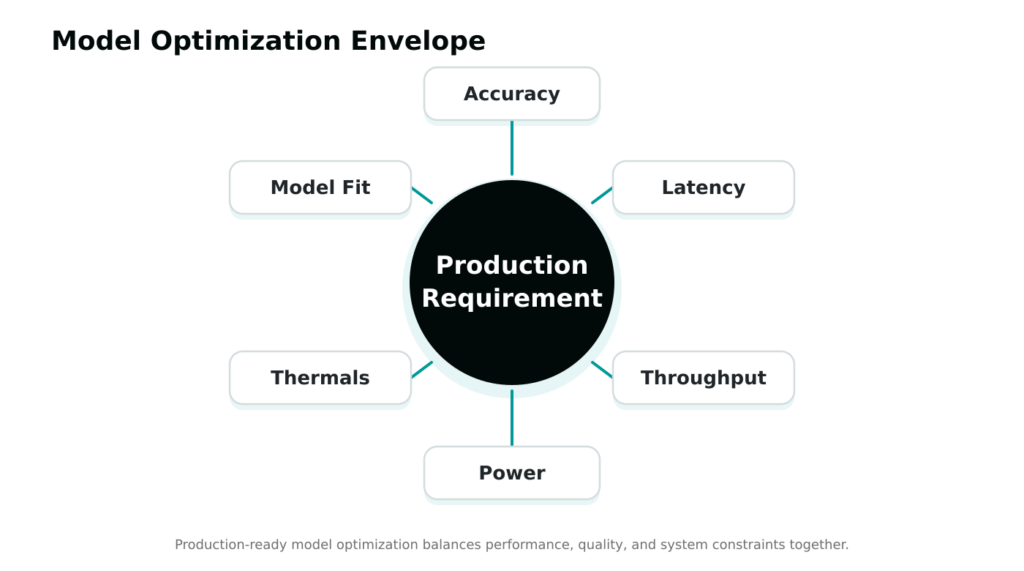
Figure 1. Model optimization envelope. Production-ready model optimization balances accuracy, latency, throughput, power, thermals, and model fit for the intended deployment.
The CTai LABS optimization workflow
A focused model-optimization engagement is designed to answer a practical deployment question: which model/runtime combination meets the required performance and quality targets on this hardware, and which measurements support the decision?
1.
Define the production target
Agree on the workload, hardware, latency and throughput targets, accuracy or quality threshold, power mode, sensor or request shape, and any other non-negotiable deployment constraints.
2.
Establish the baseline
Run the existing model and software path on the target platform where possible. Record performance and quality metrics before optimization so every later change has a comparison point.
3.
Identify the limiting resource
Determine whether the first constraint is compute utilization, runtime overhead, data movement, model architecture, precision, thermal behavior, or a combination of factors. Optimization effort follows the bottleneck. If memory capacity is the dominant problem, CTai LABS can scope the work separately under Memory Optimization.
4.
Apply the optimization path
Build and tune TensorRT or another target runtime, evaluate precision and quantization options, adjust serving configuration, and tune the surrounding inference pipeline where it materially affects the result.
5.
Re-test quality and system performance
Measure the optimized configuration against the original success criteria. Lower latency is not a win if accuracy falls below the required threshold, and lower memory use is not enough if the thermal envelope cannot be sustained.
6.
Document the deployment configuration
Hand back the validated model/runtime setup, benchmark results, relevant build and deployment settings, and the hardware recommendation supported by the measurements.
Book a Demo
Bring the model, the target hardware, and the performance problem. CTai LABS will assess the constraint, identify what should be measured first, and scope the optimization work around the deployment target.

ABOUT THE AUTHOR
Ceri Nelmes
Tech Marketing Leader & Journalist | Building Brands at the Edge of What’s Next |
Connect Tech & CTai Labs
Ceri Nelmes is Head of Marketing at Connect Tech and an experienced technology journalist and digital strategist. She covers the technologies and market shifts shaping embedded computing, Edge AI, Physical ai, robotics, autonomous systems, and the NVIDIA® ecosystem. Working with Connect Tech and CTai LABS subject-matter experts, she turns engineering developments into accurate, useful reporting for developers, technical buyers, business leaders, and the media.
 Learn More
Resources and Frequently Asked Questions
Related
Services. Explore the full CTai LABS engineering service path, from consulting and proof of concept through integration, optimization, and deployment support.
See CTai LABS Services →Edge ai Memory Bandwidth. A technical resource on why model fit and sustained performance depend on memory behavior as well as compute.
Read Edge ai Memory Bandwidth →TensorRT Optimization. Tool-specific engineering for teams that need deeper NVIDIA TensorRT implementation and tuning.
See TensorRT Optimization →Sources
Banbury, C., Reddi, V. J., Torelli, P., Jeffries, N., Kiraly, C., Holleman, J., Montino, P., Kanter, D., Warden, P., Pau, D., Thakker, U., Torrini, A., Cordaro, J., Di Guglielmo, G., Duarte, J., Tran, H., Tran, N., Wenxu, N., & Xuesong, X. (2021). MLPerf Tiny benchmark. Proceedings of the Neural Information Processing Systems Track on Datasets and Benchmarks, 1.
CTai LABS. (2026). CTai LABS | EDGE ai Stack.
https://ctailabs.ai/NVIDIA. (2026a). Accuracy considerations. NVIDIA TensorRT documentation.
https://docs.nvidia.com/deeplearning/tensorrt/latest/inference-library/accuracy-considerations.htmlNVIDIA. (2026b). NVIDIA TensorRT documentation.
https://docs.nvidia.com/deeplearning/tensorrt/latest/index.htmlNVIDIA. (2026c). Optimizing TensorRT performance. NVIDIA TensorRT documentation.
https://docs.nvidia.com/deeplearning/tensorrt/latest/performance/optimization.htmlNVIDIA. (2026d). Working with quantized types. NVIDIA TensorRT documentation.
https://docs.nvidia.com/deeplearning/tensorrt/latest/inference-library/work-with-quantized-types.htmlReddi, V. J., Cheng, C., Kanter, D., Mattson, P., Schmuelling, G., Wu, C.-J., Anderson, B., Breughe, M., Charlebois, M., Chou, W., Chukka, R., Coleman, C., Davis, S., Deng, P., Diamos, G., Duke, J., Fick, D., Gardner, J. S., Hubara, I., … Zhou, Y. (2019). MLPerf inference benchmark. arXiv.
https://doi.org/10.48550/arXiv.1911.02549Yue, X., Li, H., & Meng, L. (2023). An ultralightweight object detection network for empty-dish recycling robots. IEEE Transactions on Instrumentation and Measurement, 72, 1–12.
https://doi.org/10.1109/TIM.2023.3241078Frequently Asked Questions
What is ai model optimization for embedded hardware?
It is the process of adapting a trained model and its inference path to the real limits of the target embedded system. It can include runtime conversion, precision and quantization choices, model graph and engine tuning, workload tuning, and validation of latency, throughput, accuracy, power, and thermal behavior on the target hardware.
Can CTai LABS optimize the ai model we have already trained?
Yes. A trained model is a common starting point. CTai LABS establishes a baseline, identifies the limiting resource, applies the appropriate runtime and model optimizations, and validates the result on the intended Edge platform.
Does quantization always make an ai model faster?
No. Quantization can reduce memory footprint and can improve inference efficiency, but the result depends on the model, hardware, supported kernels, tensor shapes, and runtime configuration. NVIDIA recommends benchmarking the actual model and hardware, while reduced precision introduces accuracy trade-offs requiring measurement (NVIDIA, 2026d; NVIDIA, 2026c).
What does CTai LABS need to start?
Ideally, your goal or the trained model or model family, the intended target hardware or representative input data (if known), and the success criteria. If the hardware has not been selected yet, CTai LABS can include platform-fit testing in the scope.
Ready to Build Smarter?
Let’s create the intelligent Edge AI solution that moves your business forward.