
Resources
Edge vs. Cloud ai Inference
Where inference runs should be decided by the workload's latency, data path, failure model, compute profile, and lifecycle economics.
By Doruk Sönmez, M.Sc.
AI Solutions Architect, CTai LABS/Connect Tech Inc.
Technical review: Rob Callaghan, P.Eng., Chief Product Officer, Connect Tech Inc.
Key Takeaways
- Why Choose CTai LABS for Edge vs. Cloud ai Inference: CTai LABS applies a full-stack deployment approach across compute, networking, data movement, models, memory, power, and lifecycle requirements to determine what should run locally, what belongs in the cloud, and how the two should work together
- Edge inference is the stronger architecture when the control loop cannot depend on a network round trip, raw sensor data is expensive or inappropriate to move, or the system must continue operating through a connectivity loss.
- Cloud inference is often a better fit when AI processing is needed only occasionally, demand changes significantly, or the model is too large to run on the local device. It can also simplify management across many devices and let them share powerful cloud hardware. This approach works best when reliable connectivity is available and the application can tolerate the time needed to send data to the cloud and receive a response.
- The economic comparison is workload-specific. Edge shifts cost toward deployed hardware, integration, fleet operations, and power. Cloud shifts cost toward recurring compute, endpoint availability, data processing, networking, and data movement.
- For industrial Edge ai deployment, the most useful design is often hybrid: keep the deterministic perception-to-action path local, while using cloud or data-center infrastructure for training, fleet analytics, model distribution, long-horizon storage, and other non-real-time work.
- The placement decision should be made from measured production inputs: latency budget, input data rate, duty cycle, model footprint, memory bandwidth, network availability, fleet size, update strategy, and required failure behavior.
The question is not whether Edge ai is better than Cloud ai. It is which parts of the inference system can tolerate network dependence, which data should cross that boundary, and where the workload can run within its performance and economic envelope.
That distinction matters in industrial systems because the inference request is often not a small API payload. It may begin as several camera streams, LiDAR returns, machine telemetry, audio, or other continuously generated sensor data. Moving the model to the data changes the architecture of the entire pipeline: transport, buffering, failure recovery, security boundaries, compute sizing, and fleet operations all move with it.
CTai LABS helps customers make that placement decision at the system level. The team evaluates the model, sensor inputs, data rates, latency targets, memory requirements, connectivity, power, hardware, and deployment environment together, then identifies which parts of the pipeline should remain local, which can move to cloud or data-center infrastructure, and where a hybrid architecture provides the best operational fit. That analysis can also extend into platform right-sizing, model optimization, sensor integration, and production validation so the Edge-versus-cloud decision is tied to the system that actually has to ship.
AWS’s current machine-learning guidance makes the same placement decision explicit: evaluate cloud and Edge options against latency, connectivity, privacy, and device compute constraints rather than defaulting to a centralized endpoint (Amazon Web Services, 2026a). The What is Edge ai resource frames the lifecycle similarly, with large-scale training in centralized infrastructure and deployment-time inference close to the physical system when the application requires local sensing and action.
Edge vs. cloud is a placement problem, not a platform preference
Inference placement changes four paths at once: the data path, the compute path, the control path, and the operational path. An architecture can look inexpensive at the model endpoint while becoming expensive at the network, or look simple in a lab while creating an unacceptable failure mode in production. CTai LABS’ experts can help book a demo.
Platform selection: Edge vs. Cloud and the Connect Tech carrier board lineup
| Decision factor | Edge inference | Cloud inference |
|---|---|---|
| Control-loop latency | Compute is physically close to the sensor and actuator path. Network transit is removed from the critical inference loop. | Request and response traverse a network path. Endpoint latency can be low, but network latency, jitter, congestion, and outage behavior remain part of the system. |
| Connectivity failure | Local inference can continue when upstream connectivity is degraded or unavailable, provided the device itself remains operational. | Inference availability depends on the path to the hosted endpoint unless a local fallback exists. |
| Raw data movement | High-rate sensor data can be filtered, summarized, or acted on locally. Only selected events, metadata, or results need to leave the system. | Input data must reach centralized compute. The network and ingestion architecture therefore scale with the data that is sent. |
| Compute envelope | Fixed by the deployed module, memory capacity, memory bandwidth, power mode, thermals, and enclosure. | Can access larger accelerator pools and multiple endpoint types. Capacity can be changed without physically replacing field hardware. |
| Utilization model | Hardware is purchased for the deployed system and may sit below peak utilization between events. | Managed services can match deployment type to traffic pattern, including persistent, serverless, asynchronous, and batch inference (Amazon Web Services, 2026c). |
| Data boundary | Sensitive inputs can remain on-device or on-prem, reducing the amount of source data exposed to external infrastructure. | Cloud security controls can be strong, but the data path and processing boundary extend into centralized infrastructure. |
| Fleet operations | Requires device provisioning, health monitoring, version control, over-the-air (OTA) strategy, rollback, and hardware lifecycle management across the fleet. | Centralized endpoint updates simplify model rollout at the serving layer, although clients and upstream data pipelines still require lifecycle management. |
| Model size and concurrency | Constrained by local compute, memory, memory bandwidth, and competing application workloads. | Large accelerators and scale-out serving are better suited to models or concurrency levels that exceed the practical Edge envelope. |
| Cost shape | Higher up-front hardware and integration cost, then local power, support, and fleet-management cost over the deployment life. | Recurring endpoint, accelerator, data-processing, storage, networking, and transfer costs. Cost varies significantly with utilization and inference mode. |
NOTE: The table is intentionally asymmetric. Cloud inference does not inherently mean high latency, and Edge inference does not inherently mean low cost. The engineering question is whether each architecture can meet the complete production requirement once the network, hardware, data, and operating model are included.
1.
Start with the control loop
The first boundary is the maximum time between data capture and the action that depends on the inference result. For a quality-inspection system, that may be the time available to reject a part before it leaves a station. For a robot, it may be the perception-to-control interval available before the next motion decision. For an asynchronous document workflow, the acceptable response time may be seconds or minutes.
If the application can tolerate variable network transit and endpoint response time, cloud inference remains viable. If the control loop must continue with bounded local behavior when the network degrades, the critical inference path belongs at the Edge. AWS identifies near-instantaneous inference and operation without network connectivity as primary reasons to deploy inference directly on Edge devices (Amazon Web Services, 2026a).
For industrial systems, average latency is not enough. The architecture should be evaluated against tail latency, jitter, queueing, reconnect behavior, and the consequence of a missed deadline. A 30 ms median response is not sufficient if occasional 400 ms latency spikes can stall a safety-adjacent or motion-dependent process.
2.
Calculate the data path before the inference bill
Sensor-rich systems often generate much more data than the application ultimately needs to retain or transmit. A multi-camera system may process continuous image streams even though only a small fraction of frames contain an event worth storing. LiDAR, audio, vibration, and machine telemetry create similar data-volume challenges, each with different rates and processing requirements.
Edge inference allows preprocessing, filtering, feature extraction, event detection, and model execution to happen before the network boundary. AWS notes that local Edge processing can reduce frequent data transfers and the associated messaging, compute, and transmission requirements (Amazon Web Services, 2026d).
That does not mean the cloud disappears. A well-designed industrial system may send detections, embeddings, selected clips, health telemetry, audit records, or anomalous samples upstream while discarding or retaining raw data locally according to policy. The useful metric is therefore not simply inferences per second. It is bytes generated, bytes that must be processed, bytes that must cross the network, and bytes that must be retained.
3.
Design for Network Loss
Cloud inference makes the network a runtime dependency. That may be acceptable in a controlled facility with redundant connectivity and a non-critical workload. It is a different proposition for a mobile robot, remote industrial asset, field system, or production process that is expected to continue operating during an upstream outage.
The architecture should define what happens when connectivity is lost, degraded, or intermittent: does inference stop, does the system enter a safe state, does a smaller local model take over, or does the complete application continue locally? This failure behavior should be specified before choosing the serving location.
4.
Compare the actual compute envelope
Edge hardware has a fixed operating envelope. Compute capability, memory capacity, memory bandwidth, power, thermals, storage, and I/O are selected before the system ships. A model that fits nominally can still fail as a deployment if video decode, preprocessing, sensor drivers, application logic, caches, and additional models consume the same resources.
Cloud infrastructure offers a wider range of serving configurations and can scale to accelerators that are impractical inside an embedded system. AWS currently distinguishes persistent real-time endpoints, serverless inference for intermittent traffic, asynchronous inference for latency-insensitive large payloads, and batch inference for offline workloads (Amazon Web Services, 2026b; Amazon Web Services, 2026c).
For Edge deployment, model optimization is therefore part of architecture selection. Quantization, runtime selection, model compression, and hardware-aware optimization can reduce the model footprint and make local execution practical, but the result must be benchmarked on the intended hardware (Amazon Web Services, 2026d). CTai LABS applies the same principle in its ai Model Optimization and Memory Optimization work: the workload is evaluated against the complete device envelope, not an isolated model benchmark.
5.
Economics: compare cost per deployed workload, not cost per inference in isolation
The Edge-versus-cloud cost question is often reduced to hardware purchase versus cloud usage. That misses several recurring costs on both sides.
| Cost category | Edge | Cloud |
|---|---|---|
| Compute | Module or system acquisition amortized across deployed life; local power and cooling. | Endpoint or accelerator time; persistent capacity, serverless duration, asynchronous, or batch charges depending on serving model. |
| Network | Local network plus upstream traffic for selected outputs, updates, and telemetry. | Ingress architecture plus ongoing data movement between devices, cloud services, regions, or external consumers where applicable. |
| Integration | Hardware/software co-design, BSP, drivers, model optimization, thermal and I/O validation. | Endpoint integration, cloud architecture, IAM/security, autoscaling, observability, and data-pipeline engineering. |
| Operations | Provisioning, OTA, fleet monitoring, rollback, field replacement, and hardware lifecycle. | Endpoint monitoring, scaling, model registry/deployment, service availability, cloud operations, and ongoing usage governance. |
| Capacity risk | Over-sizing strands capital and power at every node; under-sizing may require hardware replacement or re-optimization. | Over-provisioned persistent endpoints waste recurring spend; aggressive scale-to-zero or serverless choices can change latency characteristics. |
Cloud cost can be highly efficient when demand is intermittent and the serving architecture can scale with actual use. AWS explicitly recommends matching inference mode to traffic pattern because persistent real-time endpoints, serverless, asynchronous, and batch workloads have different utilization and cost behavior (Amazon Web Services, 2026b). The same guidance warns against running inference in the cloud when local processing would be more efficient for data generated at the Edge (Amazon Web Services, 2026a).
Edge economics improve when the device is already required for sensing or control, the inference duty cycle is sustained, raw data rates are high, or the deployed lifetime is long enough to amortize the local accelerator. Cloud economics improve when demand is sparse or bursty, the model requires accelerator capacity that would be wasteful to replicate at every site, or centralized serving materially reduces the operational burden.
For a real industrial edge ai deployment, build the cost model from the workload: number of deployed nodes, hours of operation, inference duty cycle, model concurrency, input data rate, upstream retention policy, hardware life, expected replacement rate, cloud endpoint utilization, and fleet-management overhead. A per-token or per-inference price without those variables is not a system-level comparison.
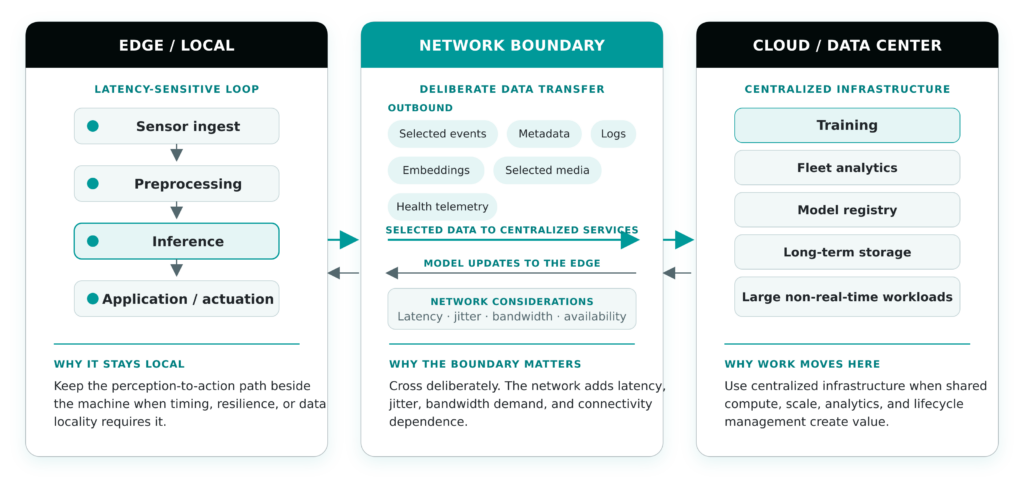
Figure 1. A hybrid inference architecture keeps the latency-sensitive perception-to-action loop beside the machine, crosses the network boundary only for data and services that need centralized infrastructure, and retains cloud or data-center compute for training, analytics, model lifecycle management, and other non-real-time workloads.
The hybrid architecture is usually the production architecture
For many industrial and Physical ai systems, the useful answer is not Edge or cloud. It is a deliberate boundary between them.
- Run the deterministic or safety-adjacent perception-to-action path locally.
- Keep high-volume raw sensor processing near the data source when continuous upload has no operational value.
- Use centralized infrastructure for training, large-scale evaluation, fleet-wide analytics, long-term storage, model registry, and deployment orchestration.
- Upload representative failures, anomalies, selected clips, or telemetry that improve the next model or support operational analysis.
- Design OTA, rollback, observability, and versioning as part of the system from the beginning.
This mirrors the lifecycle in the What is Edge ai resource: centralized infrastructure remains valuable for training and iteration, while Edge deployment owns the local sensing and inference loop. AWS IoT guidance similarly describes cloud-trained models deployed for local inference so organizations can combine centralized training capacity with low-latency local execution.
A decision framework for industrial Edge ai deployment
The following questions should be answered with measured or specified values before the serving architecture is locked.
1.
What is the hard latency budget?
Measure from sensor capture to application action. Include preprocessing, queueing, inference, postprocessing, transport, and actuator or application response.
2.
What happens when the network disappears?
Define the required behavior for seconds, minutes, or hours without upstream connectivity. If the machine must keep operating, identify which models and data dependencies must remain local.
3.
How much data is generated before inference?
Calculate sustained and peak sensor data rates. Then calculate how much of that data actually needs to leave the site after local processing.
4.
Does the model fit the Edge envelope?
Profile model memory, runtime workspace, KV cache where applicable, sensor pipelines, decode, preprocessing, application memory, power, and thermal behavior on the candidate hardware.
5.
What is the duty cycle?
A continuously active production line and a sporadic inspection request have very different economics. Measure active inference time, concurrency, burst behavior, and idle periods.
6.
How many nodes will exist?
Fleet size changes both architectures. Edge multiplies hardware and device operations. Cloud multiplies traffic and centralized serving demand.
7.
How will models be updated and observed?
Define versioning, OTA delivery, rollback, telemetry, drift detection, and validation. Edge autonomy still requires a lifecycle strategy.
8.
Which data must remain local?
Map regulatory, contractual, customer, and security requirements to the actual data path. Local inference can reduce data movement, but Edge devices still require their own security controls.
Where cloud inference may be the stronger choice
- The model or multi-model workload exceeds the practical memory, compute, or thermal envelope of the deployed device.
- Requests are intermittent enough that serverless or asynchronous serving can avoid paying for idle dedicated capacity.
- The application can tolerate network dependence and variable end-to-end latency.
- Centralized scaling across many users or sites provides better accelerator utilization than replicating hardware at each location.
- The workload depends on large shared models, centralized retrieval systems, or data stores that are already resident in the cloud.
- Rapid centralized model changes are more important than autonomous local operation.
Where Edge inference is the stronger choice
- The inference result sits inside a real-time machine or robot control loop.
- The system must continue operating through intermittent, constrained, or unavailable connectivity.
- Raw video, LiDAR, audio, or industrial sensor data is high-volume and only a small subset needs to leave the site.
- Data residency or customer requirements make local processing preferable.
- The workload is sustained enough that dedicated local acceleration can be utilized effectively.
- The application already requires embedded compute for sensor I/O, control, or local software, making inference an additional workload on a necessary system.
Where CTai LABS fits
Inference placement is ultimately a hardware-software co-design decision. CTai LABS works across the layers that determine whether the Edge side of that architecture is viable: platform selection, sensor integration, BSP and software bring-up, model optimization, memory optimization, and deployment validation on Connect Tech Edge systems.
The CTI EdgeAI Stack supports that Edge-versus-cloud decision by evaluating the local deployment as a complete system, including compute, sensor integration, software, ai models, memory, networking, power, and deployment requirements. That system-level view helps determine which workloads should remain at the Edge, which can move to centralized infrastructure, and where a hybrid architecture provides the best operational fit.
Book a Demo
Bring the workload, sensor path, latency target, deployment environment, and current cloud or Edge architecture to CTai LABS, Your Physical ai Integration Partner. We can help determine what should run locally, what should remain centralized, and what the target Edge platform has to sustain.

ABOUT THE AUTHOR
Doruk Sönmez, M.Sc.
AI Solutions Architect, CTai LABS
Doruk is an AI Solutions Architect at CTai LABS, the Physical AI and Edge AI services division of Connect Tech Inc., an NVIDIA Elite Partner. An NVIDIA DLI Certified Instructor, he specializes in deploying vision-language models, agentic AI workflows, and accelerated video pipelines on NVIDIA Jetson platforms.
 Learn More
Resources and Frequently Asked Questions
Related
Edge ai Memory Bandwidth. Understand why memory bandwidth can become the limiting resource even when nominal ai compute appears sufficient.
Read: Edge ai Memory Bandwidth →What is Edge ai? Understand the architecture behind Edge ai, including why inference moves closer to sensors, machines, and physical systems when latency, connectivity, data movement, or autonomy make centralized processing impractical.
Read: What is Edge ai →Memory Optimization. Profile the complete Edge ai workload, reduce memory pressure, create operating headroom, and determine whether the application can be validated on a lower-memory NVIDIA Jetson configuration.
See Memory Optimization →ai Model Optimization. Optimize models for the target Edge platform across precision, quantization, runtime behavior, memory use, latency, and throughput while maintaining application requirements.
See ai Model Optimization →Services. Explore CTai LABS engineering services for Edge ai consulting, integration, optimization, and deployment.
See Services →Edge AI Solutions. See how CTai LABS combines Connect Tech hardware with full-stack ai engineering for deployment.
See Edge AI Solutions →Sources
Amazon Web Services. (2026a). Evaluate cloud versus edge options for machine learning deployment. AWS Well-Architected Framework, Machine Learning Lens.
https://docs.aws.amazon.com/wellarchitected/latest/machine-learning-lens/mlperf05-bp01.htmlAmazon Web Services. (2026b). Inference cost optimization best practices. Amazon SageMaker AI Developer Guide.
https://docs.aws.amazon.com/sagemaker/latest/dg/inference-cost-optimization.htmlAmazon Web Services. (2026c). Inference options in Amazon SageMaker AI. Amazon SageMaker AI Developer Guide.
https://docs.aws.amazon.com/sagemaker/latest/dg/deploy-model-options.htmlAmazon Web Services. (2026d). Optimize ML models for the edge. AWS Well-Architected Framework, Internet of Things Lens.
https://docs.aws.amazon.com/wellarchitected/latest/iot-lens/optimize-ml-models-for-the-edge.htmlKotevska, O., Johnson, J., & Kusne, A. G. (2022). Analyzing data privacy for Edge systems. 2022 IEEE International Conference on Smart Computing (SMARTCOMP), 223–228.
https://doi.org/10.1109/SMARTCOMP55677.2022.00058Zhang, Z., & Matta, I. (2025). Rethinking inference placement for deep learning across Edge and cloud platforms: A multi-objective optimization perspective and future directions. arXiv.
https://arxiv.org/abs/2510.22909Frequently Asked Questions
Is Edge inference always faster than cloud inference?
Edge inference removes the network round trip from the critical path, which can reduce latency and eliminate network jitter from the inference loop. The model can still be slower on an undersized Edge device than on a large cloud accelerator. Compare end-to-end application latency, not model execution time alone.
Is cloud inference always cheaper than deploying Edge hardware?
No. Cloud can be highly cost-efficient for intermittent or elastic workloads, especially when the serving mode scales with demand. Edge can be more attractive for sustained local workloads, high sensor-data volumes, or long-lived deployments where local hardware is well utilized. The comparison should include compute, data movement, networking, hardware, power, integration, and operations.
Can an industrial ai system use both Edge and cloud inference?
Yes. Hybrid architectures are common. The local system can own the latency-sensitive perception and control loop while centralized infrastructure handles training, fleet analytics, model distribution, long-term storage, or larger non-real-time models. Research on Edge-cloud inference placement similarly treats computation delay and transmission delay as separate contributors to end-to-end latency, reinforcing the need to account for the network path when deciding where inference should run (Zhang & Matta, 2025).
What data should be sent to the cloud if inference runs at the Edge?
Send the data required by the centralized workload. Depending on the application, that may be detections, metadata, embeddings, selected images or clips, anomalies, health telemetry, audit records, or samples for retraining. Continuous raw-data upload should have a defined operational purpose.
How does model size affect the Edge-versus-cloud decision?
The Edge device has finite memory capacity, memory bandwidth, compute, power, and thermal headroom. The complete application must fit inside that envelope. If the model cannot be optimized to fit while meeting quality and performance requirements, a larger Edge platform, a split architecture, or centralized inference may be required.
Does Edge inference eliminate cloud infrastructure?
Usually not. Even highly autonomous Edge systems commonly use centralized infrastructure for training, model registry, OTA distribution, fleet monitoring, analytics, and long-term data management. Edge inference changes which runtime decisions depend on that infrastructure.
What should manufacturers measure before choosing Edge or cloud inference?
At minimum: end-to-end latency and jitter, sensor input rate, network availability, inference duty cycle, model and application memory, throughput, power and thermal behavior, fleet size, data-retention requirements, and the operational consequence of losing connectivity.
How does CTai LABS evaluate an industrial edge ai deployment?
CTai LABS can evaluate the local workload against the target hardware and system requirements, including sensor integration, software bring-up, model performance, memory, power, thermals, and deployment behavior. The goal is to establish whether the Edge side of the architecture can meet the production requirement and what should remain in centralized infrastructure.
Ready to Build Smarter?
Let’s create the intelligent Edge AI solution that moves your business forward.