Resources
What is Physical ai?
How ai moves beyond the screen to perceive, reason, and act in the physical world
By Ceri Nelmes
Tech Marketing Leader & Journalist | Building Brands at the Edge of What’s Next | Connect Tech & CTai Labs
Technical review: Rob Callaghan, Chief Product Officer, Connect Tech Inc.
Physical ai brings artificial intelligence out of purely digital environments and into systems that interact with the real world. These systems combine ai with sensors, real-time compute, control systems, and physical hardware to understand their surroundings and respond through real-world actions. From autonomous mobile robots and industrial machines to vehicles and intelligent vision systems, Physical ai closes the loop between perception, reasoning, and action.
For Edge ai developers, that shift changes the engineering problem. Models must operate alongside sensors, compute, power, thermal constraints, and control systems, often under strict latency requirements. Understanding where Physical ai came from helps explain why those requirements are becoming increasingly important.
How Physical ai fits into ai's evolution
NVIDIA® CEO Jensen Huang has described ai’s progression through perception ai, generative ai, and agentic ai, with Physical ai emerging as the next wave: ai that understands and interacts with the physical world (RCR Wireless News, 2025).
| Stage | What it means |
|---|---|
| 1. Perception ai | Recognizing and interpreting information about the world through computer vision: images, sound, vibration, temperature, and other sensor data. AlexNet (2012) is the commonly cited starting point. Foundation for technologies like defect detection on a production line and lane recognition in early driver assistance systems (RCR Wireless, 2025). |
| 2. Generative ai | Understanding meaning and generating new content: text, images, code, and translation. This is the wave most people associate with ai today, and it remains entirely software-bound. A generative model can describe a task. It cannot perform one. |
| 3. Agentic ai | ai that reasons, plans, and acts autonomously within software environments: orchestrating tools, executing multi-step workflows, and making decisions without constant human prompting. Still confined to digital systems. |
| 4. Physical ai | ai that perceives, reasons, and acts in the physical world by combining intelligent models with sensors, control systems, and physical hardware. The system does not just recommend an action. It performs one: a robotic arm grips an object, a mobile robot re-plans its path around an obstacle, an autonomous vehicle brakes (NVIDIA, 2025; SNS Insider, 2026). |
The distinction that matters most is between stage 3 and stage 4. Agentic ai can plan a multi-step task and execute it across software tools. Physical ai performs that plan with a body: a robotic arm, a mobile platform, a vehicle, a surgical instrument. The constraint is no longer just intelligence. It is sensing, actuation, and real-time control under real-world physical constraints such as gravity, friction, and inertia, where decisions have immediate physical consequences.
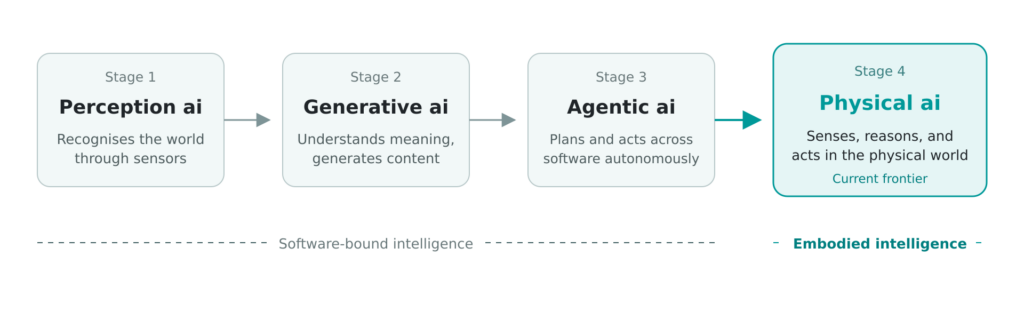
Figure 1. The four-stage evolution of ai, from perception to embodiment.
What a Physical ai system is made of:
Physical ai is not one model or one piece of hardware. It is a stack of components that have to work together in real time:

Sensors
Cameras, LiDAR, IMUs, and other inputs that let the system perceive its environment. This is the system’s first sense of reality, and the quality of perception sets a ceiling on everything downstream.

Edge compute
GPUs and ai accelerators running inference locally, on the device, because a cloud round trip is too slow for a moving physical system to wait on. This is where Edge ai and Physical ai intersect directly: Physical ai cannot function without Edge ai underneath it.

Mechanical hardware
Actuators, motors, and the physical structure that allows the system to move, grip, or navigate.

World and action models
World foundation models (such as NVIDIA Cosmos) that learn how the physical world behaves, used to generate synthetic training data and test behavior in simulation before a system touches reality. Vision-language-action (VLA) models (such as NVIDIA Isaac™ GR00T) that connect perception and language understanding directly to physical action (Encord, 2026).
The 2026 inflection point in Physical ai is specifically at the model layer. Earlier robotic systems relied on hand-coded programming for every task. World models and VLA models now let robots learn and generalize, which is what NVIDIA and much of the industry describe as the “ChatGPT moment for robotics” (Encord, 2026; Axios, 2026).

Figure 2. The components of a Physical ai system, from sensing to physical action.
Why Physical ai requires the Edge
A Physical ai system cannot wait on a network round trip to decide whether to stop before an obstacle. The perception-to-action loop must run in real time, on the device, which is why Physical ai and Edge ai are inseparable in practice.
This is also why the hardware layer is not a footnote to a Physical ai project. It is the constraint that determines whether a system is deployable at all: power envelope, thermal performance, camera bus bandwidth, and sensor timing all must be engineered together with the model, not bolted on after the model is trained. Having a partner like CTai LABS build your full stack has its advantages.
For a full breakdown of why Edge processing matters and how it differs from cloud ai, see What is Edge ai?
The Physical ai market
Market sizing for Physical ai varies significantly by analyst, largely because of the category boundary. Whether it includes only robotics hardware or the full ai-plus-robotics stack, is still being defined. Estimates for the 2025 market range from roughly USD 5 billion to USD 82 billion, with published forecasts project compound growth rates above 30 percent with some estimates exceeding 47 percent depending on market scope (Kaiso Research, 2026; Grand View Research, 2026; MarketsandMarkets, 2026; SNS Insider, 2026). What is consistent across the estimates is the direction and the driver: hardware holds the largest revenue share, accounting for approximately 54 to 56 percent in reports that publish a component breakdown, because compute, sensors, and actuators are the foundational layer every Physical ai system depends on (Grand View Research, 2026; SNS Insider, 2026).

Figure 3. Physical ai market sizing varies by scope, measurement, variables, but hardware leads every estimate.
Physical ai in practice: where it is already deployed
Physical ai is not a future-tense concept. It is in active commercial deployment across several industries today:

Manufacturing and industrial automation.
Adaptive robots, ai-enabled vision inspection, and predictive maintenance on production lines. Manufacturing and automotive lead Physical ai application revenue (Kaiso Research, 2026).

Logistics and warehousing
Autonomous mobile robots and fleet systems navigating dynamic warehouse environments in real time, deployed at scale by companies including Amazon.

Healthcare
Surgical robotics systems that compensate for patient movement during procedures in real time, and physical rehabilitation and monitoring systems.

Defense and aerospace
Autonomous ground, aerial, and maritime systems operating in environments where human control is delayed, denied, or impractical.

Agriculture and construction
Field robots and autonomous equipment operating in unstructured, outdoor, often connectivity-limited environments.
For a closer look at how CTai LABS approaches Physical ai across these industries, see Industries We Serve.

ABOUT THE AUTHOR
Ceri Nelmes
Tech Marketing Leader & Journalist | Building Brands at the Edge of What’s Next |
Connect Tech & CTai Labs
Ceri Nelmes is Head of Marketing at Connect Tech and an experienced technology journalist and digital strategist. She covers the technologies and market shifts shaping embedded computing, Edge AI, Physical ai, robotics, autonomous systems, and the NVIDIA® ecosystem. Working with Connect Tech and CTai LABS subject-matter experts, she turns engineering developments into accurate, useful reporting for developers, technical buyers, business leaders, and the media.
 Learn More
Resources and Frequently Asked Questions
Related
What is Edge ai? The infrastructure layer that makes real-time Physical ai possible.
Read: What is Edge ai? →ai Integration Services. The full-stack engagement: hardware, Board Support Package (BSP), sensor integration, model optimization, and deployment-ready handoff.
See ai Integration Services →Industries We Serve. How Physical ai applies across robotics, industrial automation, defense, and more.
See Industries We Serve →CTai LABS Services. Full-stack ai engineering, x86 to Jetson™ migration, model optimization, and dedicated team engagements.
See all CTai LABS Services →Start Reading
Explore our technical resources, reference articles, videos, and case studies.
Sources
Axios. (2026, January 5). Nvidia CES 2026: Jensen Huang says "ChatGPT moment for physical AI" is coming.
https://www.axios.com/2026/01/05/nvidia-ces-2026-jensen-huang-speech-aiEncord. (2026, February 5). What is Physical AI? Definition, examples, and uses.
https://encord.com/blog/physical-ai/Grand View Research. (2026). Physical AI market size and share, industry report 2026–2033.
https://www.grandviewresearch.com/industry-analysis/physical-ai-market-reportKaiso Research. (2026, May). Physical AI market size, share and forecast 2026–2035.
https://www.kaisoresearch.com/report-store/global-physical-ai-marketMarketsandMarkets. (2026, April 3). Physical AI market worth $15.24 billion by 2032.
https://www.marketsandmarkets.com/PressReleases/physical-ai.aspNVIDIA. (2025). Physical ai and the three-computer architecture for robotics.
https://blogs.nvidia.com/blog/three-computers-robotics/NVIDIA. (2026, January 5). NVIDIA releases new physical AI models as global partners unveil next-generation robots [Press release].
https://nvidianews.nvidia.com/news/nvidia-releases-new-physical-ai-models-as-global-partners-unveil-next-generation-robotsRCR Wireless News. (2025, January 10). NVIDIA charts a course from agentic AI to physical AI.
https://www.rcrwireless.com/20250110/ai-ml/nvidia-charts-a-course-from-agentic-ai-to-physical-aiSNS Insider. (2026, May 20). Physical AI market size, share and growth report 2035.
https://www.snsinsider.com/reports/physical-ai-market-9007Frequently Asked Questions
What is the difference between Physical ai and Embodied ai?
The terms are closely related and often used interchangeably, but Physical ai is generally used to describe ai systems integrated with physical hardware, sensors, actuators, and robots, to interact with the real world. Embodied ai is a broader academic and research term covering the study of intelligence that arises through physical interaction with an environment. In industry usage, Physical ai is the more common term for production systems and commercial deployment.
What is the difference between Physical ai and robotics?
Robotics is the engineering discipline that builds the mechanical hardware: actuators, motors, structures. Physical ai is the intelligence layer that lets that hardware perceive, reason, and act autonomously. A robot without ai follows a fixed program. A robot with Physical ai perceives its environment and adapts its behavior in real time. Most modern robotics development now assumes a Physical ai layer is part of the system.
What is a vision-language-action (VLA) model?
A VLA model extends the vision-language models behind today’s chatbots with a third capability: producing physical actions. NVIDIA Isaac GR00T is a widely cited example, an open foundation model purpose-built for humanoid robots that connects visual perception and language understanding directly to physical control. VLA models are a core technology enabling the current wave of Physical ai.
Why is Edge ai required for Physical ai to work?
A Physical ai system, a robot, vehicle, or industrial machine, has to perceive, decide, and act in real time. Sending sensor data to a cloud server and waiting for a response introduces latency that is unacceptable for systems making physical decisions, sometimes safety-critical ones, in milliseconds. Edge ai means inference happens locally, on the device, which is what makes real-time physical action possible.
What is a world foundation model and why does it matter for Physical ai?
A world foundation model, such as NVIDIA Cosmos, learns how the physical world behaves: gravity, friction, material properties, cause and effect. Developers use these models to generate synthetic training data and test robot behavior in simulation before deployment, which is significantly faster and safer than training and validating exclusively on physical hardware. CTai LABS will validate on the physical hardware as well.
Is Physical ai the same as autonomous vehicles?
Autonomous vehicles are one category of Physical ai, but not the only one. Physical ai also covers humanoid and industrial robots, surgical systems, agricultural equipment, drones, and any system that perceives and acts in the physical world. Autonomous vehicles are simply one of the most visible and heavily invested applications.
How does CTai LABS fit into the Physical ai ecosystem?
CTai LABS, a department of Connect Tech, builds the Edge ai hardware and software stack that Physical ai systems run on: hardware design, BSP development, sensor integration, and model optimization on NVIDIA Jetson hardware. For example, CTai LABS also sometimes tests its stack on D.A.V.E., a third-party robot that Connect Tech hardware powers, which means the team has direct, hands-on experience with the integration challenges every Physical ai project encounters.
Ready to Build Smarter?
Let’s create the intelligent Edge AI solution that moves your business forward.