Industrial Automation
Predictive Maintenance AI
Development and Integration
Condition monitoring, anomaly detection, and maintenance decision pipelines
By Kara Price
Senior Marketing & Events Specialist | Content Strategy | Campaign Execution | Connect Tech Inc.
Technical review: Rob Callaghan, Chief Product Officer, Connect Tech Inc.
Key Takeaways
- CTai LABS builds predictive maintenance around the failure mode, detectable condition, maintenance action, and evidence available
- Consulting can begin with an idea, an asset list, existing sensor history, a known recurring fault, a trained model, or an alert system that operators do not trust
- Connect Tech hardware with NVIDIA® Jetson™ modules supports local ingestion and inference for vibration, temperature, current, acoustic, pressure, flow, and process data
- NVIDIA CUDA® and TensorRT™ can accelerate supported signal and model workloads after accuracy, timing, and resource use are measured
- A useful output is a traceable maintenance action with confidence, context, and a lead-time window, not an unexplained anomaly score
- The customer retains its operational data, maintenance knowledge, models, and intellectual property
CTai LABS helps industrial teams turn equipment data and maintenance knowledge into a predictive maintenance system that runs on Connect Tech Edge hardware and connects to real work orders. This page covers failure-mode selection, sensor architecture, signal conditioning, data quality, anomaly detection, fault diagnosis, remaining-useful-life estimation, Edge deployment, alert policy, CMMS or historian integration, validation, and production handoff. CTai LABS can start with only an asset and maintenance goal, or join at any point to assess existing telemetry, instrument a machine, integrate a model, reduce nuisance alerts, move inference on-prem, or prepare a deployment-ready release.
Predictive maintenance must connect detection to intervention
Predictive maintenance uses condition and process data to identify degradation early enough for a planned action. That statement contains four separate engineering questions: what failure is developing, which measurements can reveal it, how much warning time is useful, and what maintenance decision follows. A model that detects statistical change without answering those questions may create alerts but not operational value.
Hector and Panjanathan (2024) reviewed the planning models and machine-learning techniques used in Industry 4.0 predictive maintenance and described data preparation, feature selection, model development, decision-making, and planning as connected stages. Li and Li (2025) compared deep-learning models across industrial sensor datasets and also identified data quality, deployment efficiency, interpretability, and workflow integration as practical concerns. Montes-Sánchez et al. (2024) demonstrated an Edge ai approach for detecting early aging in peristaltic pumps, showing how a bounded failure mode and target data path can be evaluated as a complete application.
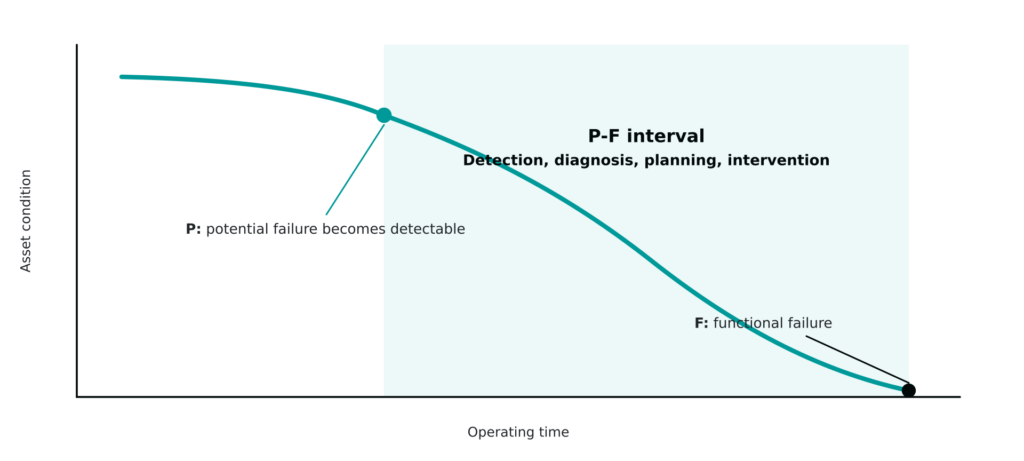
Figure 1. The P–F interval is the usable window between a detectable potential failure and loss of required function. Sensor, model, alert, and maintenance lead times must fit inside that window.
Define the maintenance question before selecting the model

Condition monitoring
Condition monitoring reports measurements and trends that maintenance specialists interpret. It can be the correct first milestone when failure labels are scarce or when domain expertise already provides useful limits. CTai LABS can integrate sensors, signal processing, dashboards, storage, alarm logic, and evidence capture without claiming that every trend is a prediction.
Anomaly detection and fault diagnosis
Anomaly detection identifies departure from learned or engineered normal behavior. Fault diagnosis assigns the departure to a defined failure mode or component. CTai LABS can combine time-domain and frequency-domain features, autoencoders, one-class methods, classifiers, sequence models, and physics-informed rules according to the asset and data. Alerts include the supporting signals and operating context required for review.
Prognostics and remaining useful life
It needs degradation histories, defined end-of-life criteria, operating context, censoring treatment, and uncertainty. CTai LABS can determine whether the available data supports a useful-life estimate or whether a health index, fault probability, or condition trend is the more defensible output.
Where predictive maintenance programs stall
Failure data is rare, incomplete, or biased
Assets are repaired before failure, maintenance notes may use inconsistent language, and sensor history may start after degradation is already underway. CTai LABS creates an asset and failure taxonomy, reconciles work-order and process history, records intervention and censoring, and separates training, validation, and test periods in a way that reflects future operation.
Operating state looks like degradation
Speed, load, recipe, material, ambient condition, cleaning, startup, and planned shutdown can change signals without indicating a fault. CTai LABS conditions models on operating state, builds state-specific baselines, or routes data through separate regimes. This reduces nuisance alerts and makes a detected change easier for maintenance teams to interpret.
The sensor path is not production-ready
Timestamp gaps, dropped samples, aliasing, sensor mounting, calibration, gain changes, communication outages, and unrecorded firmware updates can create false patterns. CTai LABS validates sensor placement, sampling, conditioning, clocks, buffering, storage, health monitoring, and Edge processing before model behavior is accepted.
Alerts do not enter the maintenance workflow
A deployment needs asset identity, severity, confidence, lead time, supporting evidence, acknowledgement, escalation, suppression, feedback, and closure. CTai LABS can connect the Edge system to a CMMS, historian, MES, SCADA, or program-specific RESTful API, while retaining the human and procedural controls required by the plant.
Architecture Through Deployment
The first engagement milestone is selected from the asset risk and the evidence already available. CTai LABS can begin before instrumentation, with archived history, during a model pilot, or after a deployed system has accumulated alert feedback.
- Prioritize assets and failure modes by consequence, detectability, intervention lead time, maintenance action, data availability, and acceptance criteria.
- Select sensors, sampling, signal conditioning, time sources, Connect Tech hardware, NVIDIA® Jetson™ module, storage, network, power, and enclosure.
- Bring up acquisition, health monitoring, data quality, feature or representation pipelines, asset context, history, and maintenance-system interfaces.
- Develop or integrate condition, anomaly, diagnosis, or prognostic models with confidence, state awareness, explainability, and alert policy.
- Validate by time period, asset, operating state, failure mode, lead time, nuisance-alert rate, missed events, Edge timing, sustained load, and recovery.
- Deliver the versioned system, model and data lineage, alert workflow, validation evidence, operating limits, deployment procedure, and handoff.
Connect Tech hardware for predictive maintenance
Predictive maintenance hardware is selected from sensor rate, feature and model workload, asset location, networking, storage, environmental exposure, and the number of machines served. Connect Tech platforms support both distributed local nodes and centralized multi-asset Edge systems.
| Connect Tech platform | Maintenance fit | System value |
|---|---|---|
| Hadron-DM or Boson with Jetson Orin™ NX | Distributed machine health node | Compact Edge inference close to the asset with local storage and I/O for bounded sensor and model workloads. |
| Forge with Jetson AGX Orin™ | Multi-asset or multimodal monitoring | High-speed networking, NVMe, and compute for concurrent vibration, acoustic, thermal, vision, and process-data pipelines. |
| Rogue-RX with Jetson AGX Orin™ | Mobile or electrically variable equipment | Positive-locking connectivity and industrial I/O for vehicle, machine, and harsh-environment installations. |
| Anvil-RX with Jetson AGX Orin™ | Exposed industrial assets | IP67 system packaging, sealed connectors, network, camera, CAN, storage, and optional wireless or positioning expansion for field deployments. |
Example Predictive Maintenance Projects

Early aging detection for pumps
A process team needs earlier warning of pump degradation without flooding operators with alarms. CTai LABS defines the target aging states, integrates vibration, current, pressure, or flow signals, establishes operating-state context, evaluates sequence and feature-based models, and deploys the approved alert pipeline on Connect Tech hardware with evidence attached to each event.
Motor and gearbox condition monitoring
Several critical drives have vibration and temperature history but inconsistent maintenance labels. CTai LABS reconciles asset and work-order records, creates a signal-quality baseline, extracts time and frequency evidence, builds an anomaly and diagnosis workflow, and connects alerts to maintenance review. The first release can operate as decision support while the feedback dataset matures.

Remote asset health at the Edge
Equipment operates at sites with intermittent connectivity and wide environmental variation. CTai LABS integrates local sensing, buffering, inference, event summaries, store-and-forward synchronization, health monitoring, and update and recovery procedures on Anvil-RX. The system continues its bounded monitoring function when the backhaul is unavailable.
What CTai LABS can deliver
- Asset and failure-mode prioritization, detectable-condition analysis, maintenance action map, data assessment, risk register, and acceptance matrix.
- Sensor, sampling, conditioning, Connect Tech platform, NVIDIA Jetson module, storage, network, power, enclosure, and timing architecture.
- Data ingestion and quality pipeline, asset and operating-state context, feature or representation workflow, history, and maintenance-system integration.
- Condition, anomaly, diagnosis, or prognostic models with confidence, explanation evidence, alert policy, acknowledgement, escalation, and feedback handling.
- Time-based and asset-based validation, lead-time and nuisance-alert analysis, missed-event review, Edge performance traces, and known operating limits.
- Versioned release, model and data lineage, deployment image, monitoring, update and recovery procedures, documentation, and knowledge transfer.
Your Physical ai Integration Partner
CTai LABS connects asset knowledge, sensors, Connect Tech Edge hardware, data engineering, ai models, and maintenance workflows so the result can produce an actionable and measurable condition signal. The team can start with an idea, contribute one failure-mode work package, or carry the full predictive maintenance pipeline through deployment while the customer retains its intellectual property.
Book a Demo
Bring your goal. Start with the outcome your predictive maintenance program must achieve. CTai LABS, a department of Connect Tech, can begin with an early idea, an architecture decision, a working prototype, a difficult integration issue, or a system that needs to become deployment-ready.
What to bring:
- The assets, failure modes, consequences, maintenance actions, and warning time that would create operational value.
- Current sensors, sample rates, controls, historian, work orders, failure reports, operating states, and asset hierarchy.
- Connect Tech or development hardware, NVIDIA Jetson platform, network, storage, enclosure, power, and environmental constraints.
- Representative time-series data, maintenance events, known anomalies, model code, alerts, operator feedback, and current metrics.
- Acceptable warning, nuisance-alert, missed-event, latency, availability, data-retention, release, and support criteria.
CTai LABS uses these inputs to identify the highest-risk interfaces first and define the shortest credible path to a working, measurable system.

ABOUT THE AUTHOR
Kara Price
Senior Marketing & Events Specialist | Content Strategy | Campaign Execution |
Connect Tech Inc.
Kara Price is a technology writer covering Edge AI, robotics, and embedded computing for Connect Tech and CTai LABS. Trained in journalism at Humber College with a BA in Communication Studies from Wilfrid Laurier University, she has spent over a decade writing for technical audiences, including four years as a proposal writer in architecture and engineering and ten years publishing product and technical announcements at Connect Tech, an NVIDIA Elite Partner. She is Senior Marketing and Events Specialist at Connect Tech.
 Learn More
Resources and Frequently Asked Questions
Related
Industrial Automation. Explore CTai LABS capabilities for factory-floor machine vision, inspection, predictive maintenance, and rugged Edge ai.
Explore Industrial Automation →Machine Vision AI.
See Machine Vision AI →Quality Inspection & Defect Detection.
See Quality Inspection & Defect Detection →Rugged Edge ai.
See Rugged Edge ai →Sources
Connect Tech. (n.d.). Anvil-RX rugged system powered by NVIDIA Jetson AGX Orin. Retrieved August 21, 2026, from
https://connecttech.com/product/anvil-rx-rugged-system-powered-by-nvidia-jetson-agx-orin/Connect Tech. (n.d.). Forge carrier board for NVIDIA Jetson AGX Orin. Retrieved August 21, 2026, from
https://connecttech.com/product/forge-carrier-for-nvidia-jetson-agx-orin/Connect Tech. (n.d.). Rogue-RX carrier board for NVIDIA Jetson AGX Orin. Retrieved August 21, 2026, from
https://connecttech.com/product/rogue-rx-carrier-board-for-nvidia-jetson-agx-orin/Hector, I., & Panjanathan, R. (2024). Predictive maintenance in Industry 4.0: A survey of planning models and machine learning techniques. International Journal of Advanced Manufacturing Technology, 132, 4471–4492.
https://pmc.ncbi.nlm.nih.gov/articles/PMC11157603/Li, W., & Li, T. (2025). Comparison of deep learning models for predictive maintenance in industrial manufacturing systems using sensor data. Scientific Reports, 15, 23545.
https://doi.org/10.1038/s41598-025-08515-zMontes-Sánchez, J. M., Uwate, Y., Nishio, Y., Jiménez-Fernández, A., & Vicente-Díaz, S. (2024). Predictive maintenance Edge Artificial Intelligence application study using recurrent neural networks for early aging detection in peristaltic pumps. IEEE Transactions on Reliability.
https://doi.org/10.1109/TR.2024.3488963Frequently Asked Questions
What makes an Edge ai system rugged?
Yes. The first release may use engineered condition indicators, normal-behavior baselines, anomaly detection, or a structured data-collection plan. The output and claims will match the available evidence.
Does a wide component temperature rating prove the full system?
Common inputs include vibration, acoustic, temperature, current, voltage, pressure, flow, oil, speed, torque, process variables, and images. Sensor selection depends on the failure mode and usable warning interval.
What is ThermiQ?
Yes. CTai LABS can run signal processing, inference, alert policy, local storage, and system health on Connect Tech Edge hardware, with optional store-and-forward synchronization when connectivity returns.
Can CTai LABS help with MIL-STD-810H testing for an industrial system?
Anomaly detection identifies departure from expected behavior. Remaining useful life estimates time or usage to a defined end state and requires stronger degradation evidence, context, and uncertainty treatment.
Can the system run without a cloud connection?
CTai LABS accounts for operating state, verifies sensor quality, calibrates thresholds, adds persistence and suppression rules, and uses maintenance feedback to distinguish process changes from equipment degradation.
Can CTai LABS diagnose thermal throttling?
Yes. The system can integrate with the approved CMMS, historian, MES, SCADA, message bus, database, or RESTful API, subject to the site’s network and cybersecurity requirements.
Who owns the rugged Edge ai application?
The customer retains its operational data, maintenance knowledge, models, application, and intellectual property. Deliverables and third-party licensing are defined in the statement of work.
Ready to Build Smarter?
Let’s create the intelligent Edge AI solution that moves your business forward.