Aerospace and Defense
AI Integration for Unmanned Systems
Perception, navigation, mission software, degraded modes, and rugged Edge compute across air, land, and sea platforms
By Ceri Nelmes
Tech Marketing Leader & Journalist | Building Brands at the Edge of What’s Next | Connect Tech & CTai Labs
Technical review: Rob Callaghan, Chief Product Officer, Connect Tech Inc.

Key Takeaways
- CTai LABS integrates the onboard compute, sensors, platform interfaces, ROS 2, perception, estimation, planning, mission logic, communications, and validation stack for unmanned systems
- Work can begin with an idea, a platform requirement, an existing vehicle, a simulation, a sensor payload, an autonomy stack, or a fielded system with a defined integration problem
- Connect Tech Sentry-X2 Mini, Anvil-RX, Falcon, Rogue-RX, and Graphite VPX provide deployment paths for NVIDIA® Jetson™ compute
- NVIDIA Isaac™ ROS, CUDA®, and TensorRT™ can support accelerated perception and robotics workloads where they fit the approved architecture
- Degraded modes, command and control boundaries, navigation uncertainty, health monitoring, cybersecurity, recovery, and human supervision are designed before field testing
- CTai LABS supports bounded autonomy and decision assistance within customer-defined authority; the customer retains its application and intellectual property
CTai LABS helps aerospace and defense teams turn an unmanned-system idea, existing vehicle, payload, simulation, or autonomy prototype into an integrated Physical ai platform on Connect Tech hardware. This page covers onboard compute, sensors, platform buses, ROS 2, time and calibration, perception, localization, navigation, mission software, communications, health, degraded modes, security, simulation, Hardware-in-the-Loop testing, field validation, release, and handoff. CTai LABS can start with only a mission and platform concept, or join at any point to select compute, integrate a payload, bring up sensors, migrate software, optimize an existing model, diagnose field behavior, or prepare a deployment-ready system.
An unmanned system is a coupled vehicle, autonomy, and mission stack
Air, ground, surface, and subsea platforms differ in dynamics and environment, but their integration problem has a common structure. Sensors and vehicle state feed perception and estimation. Planning and mission logic produce bounded commands. Platform controllers execute those commands. Communications, operators, health services, logs, and recovery behavior supervise the complete system. Timing, coordinate frames, authority, and failure behavior connect every layer.
Katkuri et al. (2024) systematically reviewed deep-learning computer-vision frameworks for autonomous UAV navigation across sensing and inspection, landing, surveillance and tracking, and search and rescue. The review documents rapid algorithm development, but also highlights practical challenges involving real-time processing, environmental variation, data, safety, and resource constraints. Those challenges are not specific to aircraft. They support target-platform testing and explicit degraded modes for any unmanned system that uses learned perception.
Open modular standards can reduce integration ambiguity when the platform already uses defined profiles. The Open Group describes the SOSA® Technical Standard as a reference architecture spanning hardware and software for sensor systems. ANSI/VITA 65.0-2025 defines OpenVPX system profiles for modules, slots, backplanes, and development chassis. Connect Tech Graphite VPX places NVIDIA® Jetson AGX Orin™ Industrial in a rugged 3U VPX single-board computer aligned with the SOSA standard, creating a path for Edge ai acceleration within a modular sensor architecture.
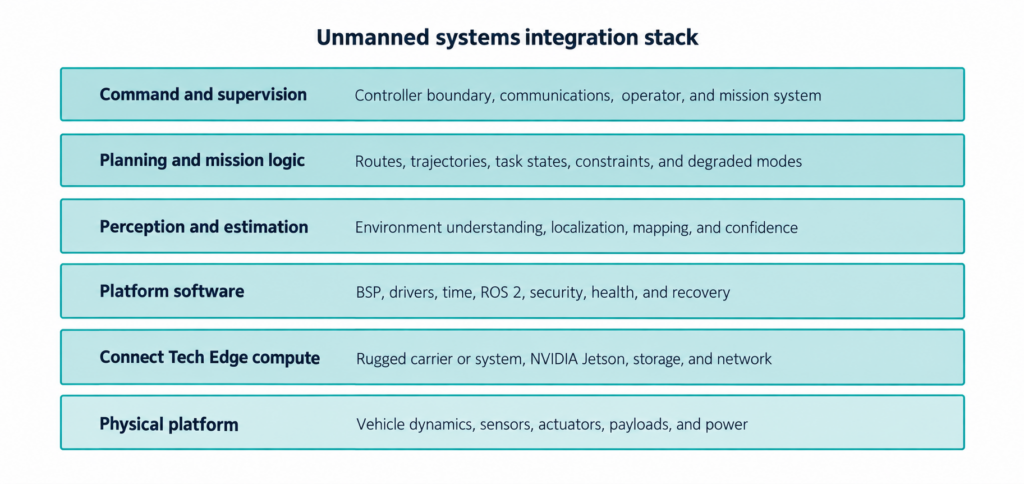
Figure 1. Unmanned-system integration connects mission behavior to autonomy, perception, platform interfaces, Connect Tech compute, and physical sensors while supervision and recovery span the stack.
Integrate the platform boundaries first

Vehicle and payload interfaces
CTai LABS maps cameras, LiDAR, radar, IMUs, GNSS, encoders, altimeters, CAN, serial, Ethernet, USB, discrete I/O, storage, payload controls, and platform telemetry to the selected Connect Tech hardware. The work includes Board Support Package (BSP) and driver bring-up, message and interface contracts, time, units, coordinate frames, health, and recording. Existing autopilots or low-level controllers remain inside defined command and safety boundaries.

Perception and state estimation
Perception may include terrain or obstacle understanding, landing-zone assessment, free-space estimation, object or feature detection, tracking, mapping, or inspection. State estimation can combine inertial, GNSS, visual, LiDAR, radar, odometry, altimetry, and platform measurements. CTai LABS integrates the selected algorithms with calibration, uncertainty, source health, delayed data, and sensor-loss behavior visible to the rest of the system.

Planning and mission software
Planning converts state and mission constraints into routes, trajectories, behaviors, or task sequences. CTai LABS can integrate ROS 2 and NVIDIA Isaac ROS components where they fit, or connect program-specific software through documented interfaces. Geofences, operating zones, command limits, confidence gates, watchdogs, abort or return behavior, and operator authority are implemented according to the customer’s system design.

Communications-denied and degraded operation
Connectivity loss changes which information and commands are available. The system needs explicit states for stale data, navigation degradation, sensor loss, storage limits, clock loss, compute restart, and communication recovery. CTai LABS can implement local bounded behavior, store-and-forward data, link-health monitoring, supervision transitions, and recovery tests without assuming that one fallback is suitable for every platform.

Cybersecurity and release control
Unmanned systems require controlled software, dependency and configuration records, device identity, secure boot or storage features where supported, authenticated interfaces, least-privilege services, logging, update, rollback, and recovery. CTai LABS implements these within the customer-defined cybersecurity and accreditation boundary and validates that security services do not break the platform’s timing or recovery requirements.
Architecture Through Deployment
CTai LABS can begin at concept selection, with a customer vehicle, in simulation, on a benchtop payload, or after field trials expose a specific limitation. Work is staged so each autonomy increase is supported by additional evidence.
- Define mission scenarios, platform dynamics, operating area, authority, supervision, connectivity, environmental, cybersecurity, degraded-mode, and acceptance requirements.
- Select the Connect Tech platform, NVIDIA Jetson™ module, sensors, platform and payload interfaces, storage, network, time source, power, thermal design, and enclosure.
- Bring up the BSPs, sensors, vehicle and payload interfaces, clocks, calibration, transforms, ROS 2 or middleware, health, logging, update, and recovery.
- Integrate perception, state estimation, localization, mapping, planning, mission logic, communications, operator interfaces, and approved ai components.
- Validate recorded-data replay, simulation, SIL, HIL, bench, restrained or controlled trials, degraded modes, sustained load, environmental conditions, and recovery.
- Deliver the controlled release, calibration and configuration records, scenario evidence, known limits, deployment procedure, and engineering handoff.
Connect Tech hardware for unmanned systems
Platform selection balances sensor interfaces, compute, storage, SWaP, input power, environment, connectors, networking, and program evidence. Connect Tech provides compact, vehicle, sealed, carrier-level, and VPX paths for different unmanned architectures.
| Connect Tech platform | Unmanned-system fit | Deployment value |
|---|---|---|
| Sentry-X2 Mini with Jetson Orin™ NX | Compact airborne and unmanned payloads | IP67 MIL-rugged system with D38999 connectors, Ethernet, USB, and NVMe for bounded perception, navigation, and mission workloads. |
| Anvil-RX with Jetson AGX Orin™ | Exposed ground and surface platforms | IP67 system with sealed connectivity, GMSL2 camera options, high-speed Ethernet, CAN, storage, and optional wireless or RTK GNSS. |
| Falcon with Jetson Orin™ NX | Vehicle-native ground platforms | Compact IP67 Edge ai system with vehicle-oriented networking for perception and data processing on mobile equipment. |
| Graphite VPX or Sentry-X2 with Jetson AGX Orin™ Industrial | Larger modular or tactical platforms | VPX or integrated rugged compute paths for multi-sensor, higher-bandwidth, and chassis-based mission architectures. |
Example Unmanned Systems Projects
Ground vehicle autonomy integration
A UGV has an existing drive controller but needs production-intent perception, localization, mission software, and compute. CTai LABS integrates cameras, LiDAR, IMU, GNSS, CAN, ROS 2, estimation, planning, health, and supervision on Anvil-RX or Falcon, then validates time, command boundaries, sensor loss, link loss, sustained load, environmental behavior, and recovery.
Unmanned surface platform sensor and mission stack
A surface platform combines cameras, radar, GNSS, IMU, payload sensors, and intermittent communications. CTai LABS defines the time and data architecture, integrates approved perception and mission services, implements local logging and degraded states, and validates corrosion-protected system interfaces, platform motion, bandwidth loss, compute restart, and operator handoff.
Airborne payload and navigation upgrade
An aircraft payload needs improved local perception without replacing the certified or approved flight-control boundary. CTai LABS integrates Sentry-X2 Mini or a compact carrier path, brings up cameras and navigation data, deploys the perception runtime, and exposes bounded confidence-aware outputs through an interface controlled by the customer program.
What CTai LABS can deliver
- Mission, platform, authority, supervision, connectivity, environmental, cybersecurity, degraded-mode, scenario, and acceptance requirements.
- Connect Tech platform and NVIDIA Jetson module selection with sensors, payload and vehicle interfaces, storage, network, time, power, thermal, enclosure, and SWaP requirements.
- Board Support Package and driver baseline, sensor and platform bring-up, clocks, calibration, transforms, ROS 2 or middleware, health, security, update, and recovery.
- Integrated perception, estimation, localization, mapping, planning, mission logic, communications, operator interfaces, and approved ai components.
- Replay, simulation, SIL, HIL, bench, controlled-trial, degraded-mode, sustained-load, environmental, cybersecurity-function, and recovery evidence.
- Controlled release, model and data lineage, calibration and configuration records, scenario results, known limits, deployment procedure, and knowledge transfer.
Your Physical ai Integration Partner
CTai LABS combines Connect Tech rugged compute, BSP engineering, robotics software, sensor fusion, Edge ai, mission-system integration, and staged validation. The team can begin with an idea, take ownership of one platform boundary, or carry the approved unmanned-system stack from architecture through deployment while the customer retains its intellectual property.
Book a Demo
Bring your goal. Start with the outcome your rugged ai computing program must achieve. CTai LABS, a department of Connect Tech, can begin with an early idea, an architecture decision, a working prototype, a difficult integration issue, or a system that needs to become deployment-ready.
What to bring:
- The mission function, data sources and consumers, response-time needs, degraded modes, and next program milestone.
- Platform environment, SWaP, mounting, chassis or enclosure, slot and backplane profiles, cooling, input power, connectors, and interfaces.
- Current or proposed Connect Tech hardware, NVIDIA Jetson platform, sensors, networks, storage, security boundary, and software baseline.
- Interface-control documents, models, sample data, code, logs, performance traces, test methods, and existing evidence.
- Configuration-control, qualification, cybersecurity, release, service, support, and lifecycle requirements.
CTai LABS uses these inputs to identify the highest-risk interfaces first and define the shortest credible path to a working, measurable system.

ABOUT THE AUTHOR
Ceri Nelmes
Tech Marketing Leader & Journalist | Building Brands at the Edge of What’s Next |
Connect Tech & CTai Labs
Ceri Nelmes is Head of Marketing at Connect Tech and an experienced technology journalist and digital strategist. She covers the technologies and market shifts shaping embedded computing, Edge AI, Physical ai, robotics, autonomous systems, and the NVIDIA® ecosystem. Working with Connect Tech and CTai LABS subject-matter experts, she turns engineering developments into accurate, useful reporting for developers, technical buyers, business leaders, and the media.
 Learn More
Resources and Frequently Asked Questions
Related
Aerospace & Defense. Explore CTai LABS capabilities for rugged compute, ISR, unmanned systems, and airborne perception.
Explore Aerospace & Defense →Rugged ai Computing. Design and integrate rugged Edge ai systems built to perform reliably in demanding aerospace and defense environments.
See Rugged ai Computing →ISR ai Integration. Integrate sensor data, ai models, and rugged Edge compute to support real-time intelligence, surveillance, and reconnaissance.
See ISR ai Integration →Drone Perception. Build onboard perception systems that help drones detect, interpret, and respond to their surroundings in real time.
See Drone Perception →Sources
Connect Tech. (n.d.). Anvil-RX rugged system powered by NVIDIA Jetson AGX Orin. Retrieved August 21, 2026, from
https://connecttech.com/product/anvil-rx-rugged-system-powered-by-nvidia-jetson-agx-orin/Connect Tech. (n.d.). Falcon vehicle system with NVIDIA Jetson Orin NX. Retrieved August 21, 2026, from
https://connecttech.com/product/falcon-vehicle-system-with-nvidia-jetson-orin-nx/Connect Tech. (n.d.). Sentry-X2 Mini rugged system powered by NVIDIA Jetson Orin NX. Retrieved August 21, 2026, from
https://connecttech.com/product/sentry-x2-mini-rugged-system-nvidia-jetson-orin-nx/Katkuri, M., Madan, A., Khatri, N., Abdul-Qawy, A. S. H., & Patnaik, S. (2024). Autonomous UAV navigation using deep learning-based computer vision frameworks: A systematic literature review. Array, 23, 100361.
https://doi.org/10.1016/j.array.2024.100361NVIDIA. (2026). Isaac ROS documentation.
https://nvidia-isaac-ros.github.io/Zhu, J., Li, H., & Zhang, T. (2024). Camera, LiDAR, and IMU based multi-sensor fusion SLAM: A survey. Tsinghua Science and Technology, 29(2), 415–429.
https://doi.org/10.26599/TST.2023.9010010Frequently Asked Questions
Can CTai LABS start with only an unmanned system concept?
Yes. CTai LABS can begin from the mission, platform assumptions, operating environment, authority, and milestone, then define the compute, sensors, software boundaries, risks, and validation path.
Does CTai LABS replace the flight or vehicle controller?
Not by default. CTai LABS integrates onboard compute, sensing, autonomy, and mission software around customer-defined controller and safety boundaries. Scope can be adjusted for the specific program.
Can the system operate when communications are lost?
It can perform the bounded local behavior approved by the program. CTai LABS implements link-health states, stale-data handling, local storage, supervision transitions, and tested recovery rather than assuming uninterrupted connectivity.
Can CTai LABS use an existing ROS 2 or autonomy stack?
Yes. CTai LABS can preserve working software, integrate the production hardware and sensors, measure the complete timing path, add degraded modes and release controls, and change only the boundaries required by the acceptance criteria.
How are unmanned-system functions validated?
Validation can progress through recorded-data replay, simulation, Software-in-the-Loop, Hardware-in-the-Loop, bench tests, controlled physical trials, environmental exposure, and mission scenarios, with each result traced to an acceptance criterion.
Does CTai LABS automate operational authority?
No. CTai LABS integrates bounded autonomy and decision assistance inside customer-defined authority, supervision, legal, safety, and program controls.
Who owns the unmanned-system software and data?
The customer retains its software, data, models, platform design, and intellectual property. Engagement deliverables and third-party licensing are defined in the statement of work.
Ready to Build Smarter?
Let’s create the intelligent Edge AI solution that moves your business forward.