 Case Study | CONSTRUCTION & MINING
Engineering ai Deployment Across Construction and Mining Equipment Fleets
How CTai LABS built an Edge-to-cloud provisioning and management architecture for a construction and mining equipment OEM, enabling ai deployment and over-the-air updates across machines with limited connectivity
By Kara Price
Senior Marketing & Events Specialist, Connect Tech Inc.
Technical review: Rob Callaghan, Chief Product Officer, Connect Tech Inc.


Key Results
- A confidential construction and mining equipment OEM needed a repeatable way to provision and manage ai-capable machines across a distributed fleet without assuming continuous network connectivity
- CTai LABS built an Edge-to-cloud design that keeps operational ai on the machine while cloud services coordinate deployment and management
- The system covers machine identity, provisioning, approved configuration, application and model packaging, deployment status, and over-the-air (OTA) updates
- Transfers can pause, retry, or resume as connectivity changes, which is important for machines that regularly work outside reliable network coverage
- Software and ai releases can be coordinated centrally while each machine maintains a known local software version and reports its status when connectivity returns
- Progressive rollout, update verification, recovery planning, and deployment history give the OEM more control than a one-way OTA file transfer
- The customer retains its machine data, product knowledge, application code, deployment logic, and project IP as defined in the engagement
Construction and mining equipment creates a difficult software management problem. Machines are geographically distributed, and network access changes as equipment moves through jobsites, pits, haul roads, or other remote terrain. Yet ai applications still need to run when the cloud cannot be reached. The OEM needed more than remote access to individual machines. It needed a consistent way to establish machine identity, provision approved software, deploy ai applications and models, coordinate over-the-air (OTA) updates, recover from interrupted transfers, and understand what was installed across the fleet.
CTai LABS, a department of Connect Tech, designed the project around a simple operating principle: ai remains available on the machine, while cloud services coordinate deployment and management across the fleet. The resulting Edge-to-cloud design supports centralized control without making connectivity a requirement for every machine decision.
Your Physical ai Integration Partner
Managing ai across equipment fleets crosses several disciplines: embedded software, cloud infrastructure, networking, cybersecurity, ai deployment, hardware, validation, and field service. CTai LABS brings those areas into one engineering program so an OEM can move from a single ai-enabled prototype to a manageable fleet without making cloud access a hidden dependency. Customers work directly with CTai LABS engineers and retain control of their data, application, system design, and agreed intellectual property.
Case Study at a Glance
| Field | Case Study Detail |
|---|---|
| Customer | Confidential construction and mining equipment OEM |
| Challenge | Provision, deploy, and manage ai software across distributed machines operating with intermittent or limited connectivity |
| CTai LABS Scope | Edge-to-cloud design, machine provisioning, identity and software status, application and model deployment, OTA management, synchronization, recovery planning, and fleet lifecycle engineering |
| Operating Model | ai runs locally on the machine while cloud services coordinate deployment and management |
| Connectivity Assumption | Machines may be offline or bandwidth constrained for periods of time; information synchronizes when a suitable connection is available |
| Documented Project Result | A management framework that supports centralized ai deployment and OTA updates without making machine operation dependent on a persistent cloud link |
| Commercial Status | Built for the OEM; fleet scale, rollout timing, and field KPI data are confidential or not publicly disclosed |
The Customer Challenge
Equipment may work behind terrain, below grade, or across remote areas where cellular and Wi-Fi coverage changes throughout the day. Peer-reviewed construction research identifies the same constraint: remote jobsites can have limited telecommunications support or no reliable network coverage, making cloud-dependent real-time applications difficult to sustain. Edge computing keeps latency-sensitive ai processing close to the jobsite and can support operation without high-speed internet access (Chen et al., 2024).
Other research reaches a similar conclusion. Cloud-dependent monitoring can add latency and become less resilient when connectivity is intermittent. Recent Edge-to-cloud research instead emphasizes continuity, orchestration, monitoring, and recovery as core requirements for industrial systems (Boluda-Prieto et al., 2026). Broader IoT research also shows why remote deployment needs safe recovery and rollback behavior rather than a simple “push and hope” update process (Radovici et al., 2020).
For the OEM, the challenge was not simply how to send a new ai model to a machine. The system also had to know which software and model versions belonged on each unit, whether a machine was ready to receive an update, what to do when a transfer stopped partway through, and when to retry.
The Engineering Objective
Operational ai needed to continue locally. At the same time, the OEM needed a centralized view of installed and intended software, controlled releases, tolerance for interrupted communications, and enough evidence to diagnose or recover from an update failure.
The design separates two responsibilities. Cloud services coordinate fleet information and deployment policy. Each machine handles local execution, update verification, and the transition between software versions. Connectivity carries synchronization data and update packages when available, but it is not part of the real-time operational decision.
The CTai LABS Solution
CTai LABS organized the solution into four layers. Giving each layer a clear role lets the OEM change cloud services, machine software, ai packages, or networking without rebuilding the entire management system.
1.
Machine Identity and Provisioning
Every managed machine needs a durable identity and a known starting point before automated deployment becomes dependable. The provisioning layer creates the device record, associates the machine with the correct product or group, and applies its approved configuration. It also links the physical machine to the corresponding cloud inventory. Provisioning becomes a repeatable manufacturing and service process rather than a one-time engineering task.
2.
ai Runtime on the Machine
The operational ai application stays on the machine. Local services track installed application and model versions, retain required configuration, and record status while the unit is disconnected. If the network disappears, the machine continues its Edge ai function without waiting for the cloud. When communications return, stored status and deployment information can be synchronized with the management system.
3.
Fleet Control Plane
The cloud side maintains the device inventory, intended configuration, package information, deployment policy, release targets, and update status. Rather than addressing machines individually, the OEM can create groups based on product, software version, geography, customer program, or another approved attribute, then assign a release to the appropriate group. Industry device management platforms use a similar pattern, with rollout, abort, retry, timeout, and scheduling controls intended to reduce the risk of large deployments (Amazon Web Services, n.d.).
4.
OTA Management for Intermittent Connectivity
The OTA process is designed to tolerate interruption. A machine can detect an available release, retrieve the required package when bandwidth permits, verify it before installation, report progress, and retry or resume after a connection loss. The precise recovery method depends on the OEM’s operating system and packaging approach, but the design assumes that a single update may span several connection windows.
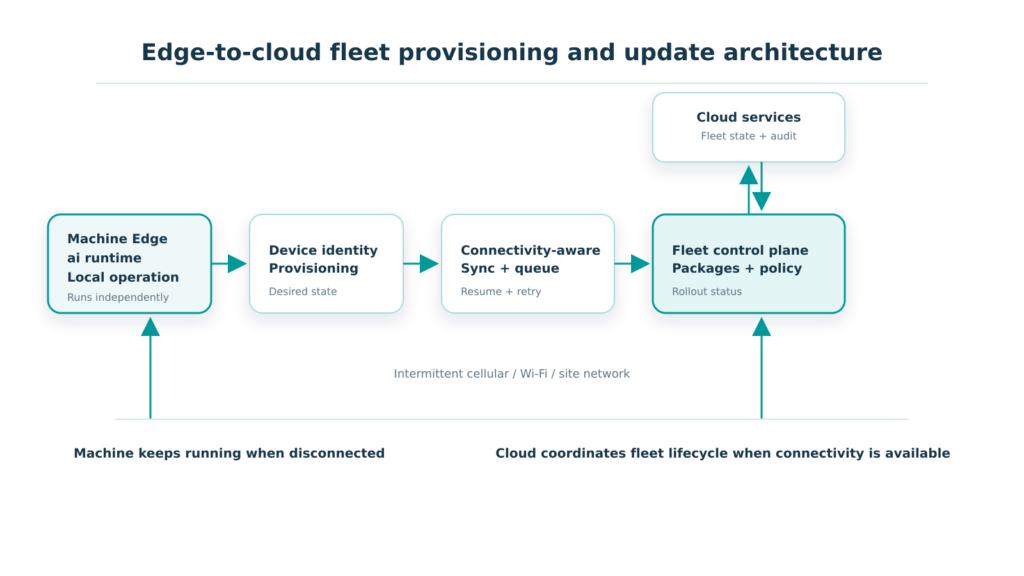
Figure 1. CTai LABS keeps operational ai on the machine while cloud services coordinate provisioning, software releases, and fleet status. Update traffic can pause and resume as connectivity changes.
Why the Design Accounts for Limited Connectivity
A cloud-dependent design can leave a machine with an incomplete package, outdated instructions, or an unclear update history. A more resilient Edge-to-cloud approach keeps the operational service available locally and reconciles information when communications return. Research on continuity between Edge and cloud systems has demonstrated the value of local execution and later reconciliation when temporary network failures prevent cloud interaction (Colarusso et al., 2025).
How Deployment Across the Fleet Works
| Lifecycle Step | What Happens |
|---|---|
| Provision | Register the machine, establish identity, assign group information, and apply an approved starting configuration |
| Target | Select a machine or group based on approved attributes and current software |
| Stage | Publish the application, model, or configuration package with version and integrity information |
| Deliver | Transfer when a suitable connection is available, with support for retry or resume after interruption |
| Verify | Confirm package integrity and required conditions before changing the installed software |
| Apply | Move to the approved version under the OEM's update policy and operating constraints |
| Report | Record progress, success, failure, and installed version locally, then synchronize the result to the cloud |
| Recover | Retry, revert, or retain the previous version according to the approved recovery process |
| Audit | Preserve intended software, reported software, deployment history, and version evidence for support |
Separating ai Deployment from Machine Operation
Model deployment is often treated as a machine-learning task, but managing equipment in the field is a broader systems problem. A new model may depend on a matching application version, runtime library, container, driver, configuration, calibration file, or data schema. CTai LABS treated the model as one component of an approved software release rather than an isolated file.
That distinction is especially important in construction and mining. A machine may remain operational for long periods with limited backhaul. The release process therefore has to define what happens when a package is available but not downloaded, downloaded but not verified, verified but waiting for an approved installation window, or partially applied and in need of recovery.
Staged Rollout and Fleet Risk Control
A package that works on a bench or small pilot can still fail with a different hardware revision, site configuration, storage level, or network condition. CTai LABS designed for progressive deployment instead of releasing to the entire fleet at once. A small group can receive the new version first, results can be reviewed, and the wider release can be stopped or held if agreed failure criteria are reached.
Research on remote updates for commercial IoT systems highlights the importance of safe recovery after temporary failures. Large device management platforms also expose controls for rollout rate, retries, timeouts, and abort conditions (Radovici et al., 2020; Amazon Web Services, n.d.). CTai LABS applied those general engineering principles to the OEM’s machines and operating constraints rather than adopting a consumer-device update model.
What the Architecture Gives the OEM
- A repeatable process for machine onboarding and provisioning.
- An inventory tied to known machine identities and approved software versions.
- Centralized targeting for ai models, applications, configuration, and other approved software.
- Local ai operation without a persistent cloud connection.
- Delivery designed to handle retries, synchronization, and recovery when connectivity changes.
- Progressive rollout controls that limit how many machines are exposed to a failed release.
- Comparison of intended and reported software versions to identify drift.
- Deployment history and version evidence for support and troubleshooting.
- A foundation that can later support health monitoring, remote diagnostics, telemetry, and broader equipment management.
Where CTI EdgeAI Stack Fits
Fleet management depends on a stable, supportable compute and software foundation on the machine. Where Connect Tech (CTI) platforms are part of the equipment design, CTI’s EdgeAI Stack can provide that foundation through hardware, board support software, system configuration, and Edge deployment support. CTai LABS, a department of Connect Tech, connects it to the OEM’s models, application packages, cloud services, update policy, and validation process.
What Made the Approach Transferable
- Autonomous and semi-autonomous construction machinery receiving software and model updates between jobs.
- Mining equipment operating across pits, haul roads, tunnels, or processing areas with uneven network coverage.
- Agricultural equipment working beyond continuous cellular coverage.
- Robotics and logistics fleets that need centralized software control while retaining local autonomy.
- Rugged Edge systems at remote industrial sites where service visits are costly and maintenance windows are limited.
What the Customer Retains
Depending on scope, those may include provisioning logic, services running on the machine, cloud integration code, package definitions, deployment policy, configuration schemas, update logic, test procedures, recovery workflows, architecture documentation, and operational runbooks. The customer retains its machine data, product knowledge, proprietary application, deployment logic, and project IP as defined in the engagement.
Book a Demo
What to bring:
- Machine types, expected fleet size, deployment regions, service model, and the operational consequence of a failed or delayed update.
- Current Edge hardware, operating system, containers or runtimes, ai models, application dependencies, and software versioning approach.
- Available connectivity by site, including cellular, Wi-Fi, private networks, satellite, depot connectivity, expected offline periods, and bandwidth constraints.
- Existing cloud services, device registry, identity model, certificates or keys, software repositories, CI/CD process, and cybersecurity requirements.
- Update package sizes, maintenance windows, rollback expectations, validation criteria, field service responsibilities, and evidence required before a broad release.
- IP requirements, customer support expectations, ownership boundaries, and the handoff model for the OEM’s internal engineering and service teams.

ABOUT THE AUTHOR
Kara Price
Senior Marketing & Events Specialist | Content Strategy | Campaign Execution |
Connect Tech Inc.
Kara Price is a technology writer covering Edge AI, robotics, and embedded computing for Connect Tech and CTai LABS. Trained in journalism at Humber College with a BA in Communication Studies from Wilfrid Laurier University, she has spent over a decade writing for technical audiences, including four years as a proposal writer in architecture and engineering and ten years publishing product and technical announcements at Connect Tech, an NVIDIA Elite Partner. She is Senior Marketing and Events Specialist at Connect Tech.
Learn More
Resources and Frequently Asked Questions
Related
Construction, Agriculture & Mining. Explore CTai LABS work for rugged machinery, remote operations, autonomy, machine vision, and Edge ai in demanding environments.
Explore Construction, Agriculture & Mining →Edge ai Consulting. Design the compute, software, networking, and deployment framework behind production Edge ai systems.
Explore Edge ai Consulting →Rugged Edge ai. Engineer Edge compute for vibration, temperature, power, networking, and field service constraints.
Explore Rugged Edge ai →ai Optimization. Reduce runtime, memory, and compute requirements before deploying a model across equipment fleets.
Explore ai Optimization →System & Sensor Integration. Connect cameras, sensors, industrial interfaces, compute, and application software into a complete Edge system.
Explore System & Sensor Integration →Sources
Amazon Web Services. (n.d.). What is AWS IoT Jobs? AWS IoT Core Developer Guide.
https://docs.aws.amazon.com/iot/latest/developerguide/jobs-what-is.htmlBoluda-Prieto, M. D., Mateo-Casalí, M. Á., Fraile Gil, F., & Alarcón Valero, F. (2026). Resilient edge-to-cloud architecture with self-healing and self-correcting mechanisms for industrial data continuity. Computers & Industrial Engineering, 213, 111795.
https://doi.org/10.1016/j.cie.2025.111795Chen, G., Alsharef, A., & Jaselskis, E. (2024). Construction jobsite image classification using an Edge computing framework. Sensors, 24(20), 6603.
https://doi.org/10.3390/s24206603Colarusso, C., Falco, I., & Zimeo, E. (2025). Business continuity of Cloud-based IoT applications through a seamless continuum. Internet of Things, 33, 101723.
https://doi.org/10.1016/j.iot.2025.101723Radovici, A., Culic, I., Rosner, D., & Oprea, F. (2020). A model for the remote deployment, update, and safe recovery for commercial sensor-based IoT systems. Sensors, 20(16), 4393.
https://doi.org/10.3390/s20164393Frequently Asked Questions
What problem did CTai LABS solve for the construction OEM?
The OEM needed to deploy and manage ai software across distributed equipment without assuming that every machine would have a continuous network connection. CTai LABS built an Edge-to-cloud provisioning and management architecture that coordinates deployment in the cloud while keeping operational ai on the machine.
Does the machine require a cloud connection to run its ai application?
No. The machine continues to run its approved local software when disconnected. Status and deployment information synchronize with the management system when connectivity becomes available.
What can be updated over the air?
The system can manage approved releases containing applications, ai models, containers, configuration, and supporting software. The exact package types depend on the OEM’s operating system, runtime, safety boundaries, and release process.
What happens if connectivity drops during an update?
The design treats interrupted connectivity as an expected condition. Update progress is preserved so the machine can retry, resume, hold, or recover according to the approved policy rather than assuming a continuous transfer window.
How do staged rollouts reduce fleet risk?
A new version can be sent to a limited group first. The OEM can review results and stop or hold a wider release if agreed failure criteria are reached, limiting the impact of a defective package or incompatible software version.
Is this architecture tied to one cloud provider?
The case study describes a technical pattern rather than a public commitment to a specific cloud service. Identity, inventory, package management, targeting, rollout control, and device reporting can be implemented against the OEM’s approved cloud and cybersecurity stack.
Where does CTI EdgeAI Stack fit?
As a department of Connect Tech, CTai LABS can pair CTI EdgeAI Stack’s supported compute and system software foundation with its provisioning, ai deployment, management, and validation work when Connect Tech hardware is part of the machine.
Who owns the fleet data and IP?
The customer retains its machine data, proprietary product knowledge, applications, deployment logic, and project IP as defined in the engagement. Handover can include architecture documentation, code, configuration, update logic, test evidence, and operational runbooks according to scope.
Ready to Build Smarter?
Let’s create the intelligent Edge AI solution that moves your business forward.