Robotics and Logistics
Autonomous Mobile Robots
Full-stack AMR engineering from perception and navigation to Edge deployment
By Kara Price
Senior Marketing & Events Specialist | Content Strategy | Campaign Execution | Connect Tech Inc.
Technical review: Rob Callaghan, Chief Product Officer, Connect Tech Inc.

Key Takeaways
- CTai LABS provides full-stack AMR engineering across Edge compute, sensors, ROS 2, perception, localization, navigation, ai optimization, Board Support Packages (BSPs), and validation
- AMR performance depends on the complete robot: compute, sensor timing, communications, power, thermals, software behavior, and the operating environment
- CTai LABS can integrate cameras, LiDAR, IMUs, wheel odometry, and other perception sources, then connect those inputs to localization, mapping, navigation, and ai software
- For NVIDIA® Jetson™-based robots, CTai LABS can use NVIDIA Isaac™ ROS, NVIDIA TensorRT™, and NVIDIA Isaac Sim where they fit the application
- As a department of Connect Tech, CTai LABS can work beyond the application layer into carrier hardware, BSPs, drivers, camera interfaces, and embedded system troubleshooting
- Data. Analytics. Vision. Execution. (D.A.V.E.), one of Connect Tech’s autonomous mobile robot, provides a practical internal platform for exercising the same perception, compute, control, and robot-memory problems customers bring to CTai LABS
An autonomous mobile robot (AMR) must do several things at once: understand its surroundings, estimate its position, plan a safe route, respond to changing obstacles, control movement, and keep the required software running within a fixed embedded compute budget. Modern navigation frameworks reflect that complexity. Nav2, for example, brings perception, planning, control, localization, environmental representation, and robot behaviors into the navigation system rather than treating motion as a single algorithm (Open Navigation, 2026a).
CTai LABS helps robotics teams engineer the layers as one system. The work can begin with architecture and platform selection, an existing AMR prototype, a sensor stack that is not yet behaving correctly, a ROS 2 environment that needs to be brought up or optimized, or an ai workload that does not yet meet the robot’s latency, memory, power, or thermal targets.
CTai LABS engineers the hardware, perception, navigation, ai, and supporting software around the conditions the robot is expected to encounter in operation.
What CTai LABS Can Do for Autonomous Mobile Robots

AMR Architecture and Edge Compute Selection
CTai LABS can translate the robot’s functional requirements into system architecture before hardware and software decisions. Architecture work can account for where the AMR operates, what it must perceive, its required response time, camera and sensor count, expected autonomy level, runtime, environmental conditions, communications, and the processing that must remain local at the Edge.
The resulting architecture can cover:
- ai compute module and Connect Tech (CTI) hardware selection.
- Camera, LiDAR, IMU, encoder, GNSS, radar, or other sensing requirements.
- Sensor interfaces, bandwidth, triggering, timestamps, and synchronization.
- ROS 2 and navigation software structure.
- Perception, localization, mapping, obstacle avoidance, and ai requirements.
- Power, thermal, enclosure, storage, networking, and physical constraints.
- Performance targets and a validation plan tied to the intended deployment.
AMR sizing is a system decision. A compute platform that is sufficient for one model may still be undersized once camera decoding, sensor processing, mapping, navigation, communications, logging, and application logic are running beside inference.

Perception and Multi-Sensor Systems
Autonomous navigation depends on a useful representation of the environment. CTai LABS can integrate the sensing stack required to build that representation, including RGB and stereo cameras, depth sensors, LiDAR, IMUs, wheel odometry, and other application-specific perception devices.
Research on AMR sensing and navigation highlights the complementary role of cameras, LiDAR, inertial sensing, odometry, and other sensing modalities, particularly where a single sensor cannot reliably provide all of the information required for localization, mapping, obstacle detection, and navigation (Liu et al., 2024; Ušinskis et al., 2025). CTai LABS can carry those sensing requirements into the embedded implementation: hardware interfaces, drivers, BSP support, calibration, timing, synchronization, data handling, perception software, and system-level testing.
Depending on the application, work can include multi-camera bring-up across interfaces such as GMSL3 or FPD-Link III, LiDAR and IMU bring-up, depth processing, object detection, segmentation, visual odometry, sensor fusion, and the data flow between perception and navigation.

ROS 2, Nav2, and NVIDIA® Isaac™ ROS
ROS 2 is widely used as the software foundation for modern robotics, while Nav2 provides a modular autonomous navigation framework for mobile and surface robots. Nav2 combines planners, controllers, localization, environmental models, behavior trees, and recovery behaviors to support navigation in complex environments (Open Navigation, 2026a).
CTai LABS can bring up and configure ROS 2 environments, integrate drivers and hardware interfaces, connect perception to navigation, configure Nav2 components, optimize node communication, and troubleshoot performance across the robotics software stack.
For NVIDIA Jetson™ deployments, NVIDIA Isaac ROS provides NVIDIA CUDA®-accelerated packages and ai models for robotics tasks including perception and navigation (NVIDIA, 2026a). CTai LABS can use those packages where they provide an engineering advantage, rather than applying acceleration as a checkbox.

Localization, Mapping, and Navigation
An AMR has to know where it is, understand where it can move, select a route, and react when the environment no longer matches the expected plan. Nav2 supports both mapping and localization workflows, including SLAM-based map creation and AMCL-based localization, with sensor data feeding the robot’s representation of its environment (Open Navigation, 2026b).
CTai LABS can support:
- Simultaneous localization and mapping (SLAM).
- Visual and visual-inertial odometry.
- LiDAR-based localization.
- Sensor-fused state estimation.
- Map creation and management.
- Global and local path planning.
- Dynamic obstacle detection and avoidance.
- Navigation stack configuration and tuning.
- Recovery behavior and localization edge-case testing.
The right approach depends on the environment. A warehouse AMR, an outdoor inspection platform, and a robot operating in a changing construction environment may require different sensor combinations, map assumptions, localization strategies, and recovery behavior. Vision-only navigation is possible on some platforms, but even NVIDIA and Nav2 guidance highlights conditions such as glass, featureless corridors, thin obstacles, vibration, and changing lighting as factors that must be evaluated for the application (Open Navigation, 2026c).
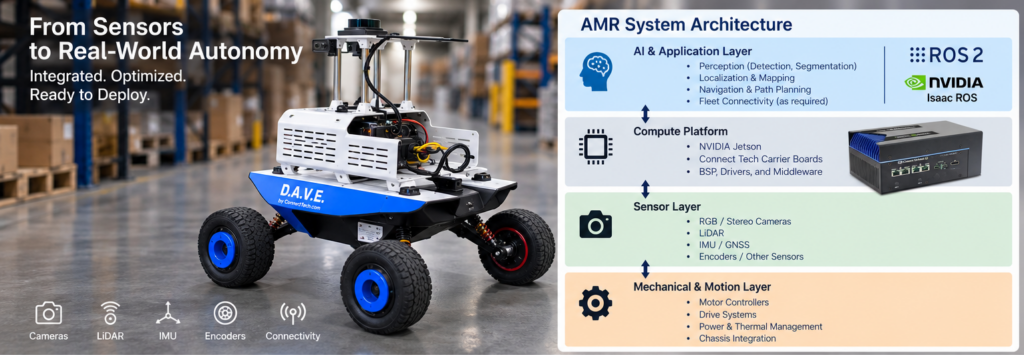
Figure 1. AMR full-stack architecture. CTai LABS can work across sensors, Edge compute, BSPs and drivers, ROS 2, perception, localization and navigation, ai inference, control interfaces, and validation as one coordinated system.

ai Model Deployment and Optimization
Perception models that perform well on a workstation may need substantial optimization before they fit an AMR. The model shares embedded resources with every other robot process, and sustained performance can be affected by memory, preprocessing, power mode, thermal behavior, camera load, and other software running alongside inference.
CTai LABS can profile and optimize ai workloads on the target Edge platform, including NVIDIA TensorRT™ where applicable. NVIDIA’s current TensorRT guidance emphasizes benchmarking the actual model and hardware environment because latency, throughput, power, clocks, thermal behavior, and software configuration affect measured performance (NVIDIA, 2026b).
Optimization work can include model conversion, precision selection, quantization, runtime configuration, model-footprint reduction, profiling, pre- and post-processing improvements, and changes elsewhere in the application when the bottleneck is not the model itself. Accuracy remains part of the decision: reduced precision can improve efficiency, but NVIDIA documents accuracy-performance trade-offs that must be measured rather than assumed (NVIDIA, 2026c).

BSP, Driver, Camera, and Hardware Bring-Up
Some AMR failures appear at the application layer but originate lower in the embedded stack. A sensor may be electrically connected but not exposed correctly to the operating system. A camera may be producing data but missing the timing behavior required by the perception software. A system may meet a performance target briefly but throttle after sustained operation.
As a department of Connect Tech, CTai LABS can work directly with the Edge-compute platform, carrier hardware, BSP, drivers, interfaces, and peripheral devices. Connect Tech positions CTai LABS as its full-stack engineering team for robotics and embedded ai, combining ai engineering with its hardware, firmware, software, and production experience (Connect Tech, 2025).
That means an AMR engagement can include:
- Connect Tech carrier board and embedded system configuration.
- BSP configuration or customization.
- Device tree and low-level platform work.
- Camera and sensor driver bring-up.
- Peripheral, networking, and communications bring-up.
- Power and thermal evaluation.
- Hardware/software troubleshooting across the complete embedded stack.
From Prototype AMR to Deployment
A robot that can navigate a controlled demonstration is not automatically ready for field operation. Deployment introduces crowded spaces, changing layouts, occlusion, inconsistent lighting, sensor disagreement, delayed frames, degraded connectivity, longer runtimes, and operating conditions that were absent from the original test setup.
Research on AMR benchmarking similarly shows the importance of testing autonomous navigation under progressively more complex conditions, including static obstacles, moving obstacles, and realistic operating environments, rather than relying on unrestricted navigation trials alone (Rondoni et al., 2024).
CTai LABS can define validation around the robot’s actual success criteria and use simulation, software-in-the-loop (SIL), hardware-in-the-loop (HIL), system profiling, and physical testing where appropriate. NVIDIA Isaac Sim supports robot simulation, ROS 2 integration, synthetic data workflows, SIL, and HIL methodologies that can be used to exercise robotics software before and alongside physical deployment (NVIDIA, 2026d).
Findings from validation can feed back into sensor selection, ROS 2 configuration, navigation parameters, model optimization, thermal design, compute sizing, or other system decisions. The purpose of the loop is to expose failure modes while they are still engineering problems, not customer-site problems.
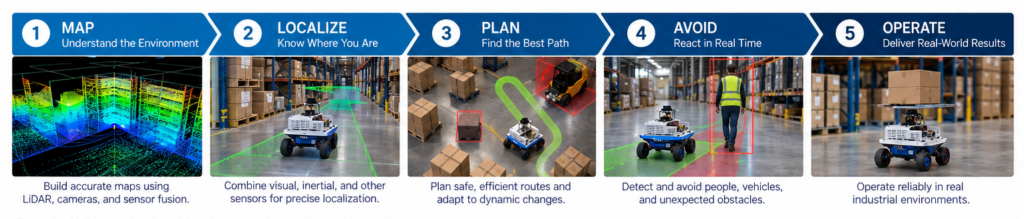
Figure 2. AMR autonomy workflow. Mapping, localization, path planning, obstacle avoidance, and continuous operation depend on coordinated sensing, compute, and robotics software. CTai LABS can engineer and optimize the components across each stage.
D.A.V.E.: AMR Engineering in Practice
Data. Analytics. Vision. Execution. (D.A.V.E.) is Connect Tech’s autonomous mobile robot and a practical demonstration of CTai LABS’ work across perception, compute, control, ai model deployment, sensor engineering, and embedded software optimization on Connect Tech Edge hardware (Connect Tech, 2025; CTai LABS, 2026).
D.A.V.E. is useful because it gives CTai LABS engineers a real mobile platform to evaluate how software behaves once it meets sensors, motors, physical movement, embedded compute, and the operating environment. Connect Tech has also demonstrated D.A.V.E. using local Edge inference and robot-memory concepts, including camera and LiDAR inputs for mapping and autonomous navigation.
The point is not that every customer AMR should look like D.A.V.E. The value is having an internal robotics platform where the same kinds of cross-layer engineering issues can be reproduced and investigated.
What an AMR Engagement Can Deliver
The exact deliverables depend on the starting point and project scope. A focused navigation problem and a full AMR development program should not produce the same statement of work.
Depending on the engagement, CTai LABS can provide:
- AMR architecture recommendations and documented technical decisions.
- A defined Edge compute, carrier, BSP, and software baseline.
- Integrated cameras, LiDAR, IMUs, or other sensing devices.
- ROS 2 and Nav2 bring-up, configuration, and application development.
- Perception, localization, mapping, navigation, and obstacle-avoidance work.
- Optimized ai models and measured target-hardware performance.
- Simulation, SIL, HIL, or physical system validation results.
- Deployment configuration, implementation documentation, and handoff material.
- Ongoing BSP, software, optimization, or engineering support where included in scope.
The customer keeps their IP throughout the engagement. CTai LABS can operate as an extension of the customer’s engineering team, taking responsibility for the specialized Edge ai and robotics layers defined in the scope.
Where Autonomous Mobile Robots Fit
AMRs are used wherever a mobile platform must move materials, collect information, inspect an environment, or perform tasks with reduced direct human control. CTai LABS can support AMR and related autonomous-machine work across Robotics & Logistics, Industrial Automation, and rugged Construction, Agriculture & Mining applications, with the system architecture adapted to the operating environment.
- Warehouse and intralogistics AMRs.
- Autonomous carts, pallet movers, and material-handling platforms.
- Industrial inspection and monitoring robots.
- Manufacturing and facility automation.
- Outdoor autonomous platforms.
- Construction, agriculture, and mining robotics.
- Research, prototype, and next-generation mobile robotics platforms.
Why CTai LABS for AMR Development
AMR development crosses disciplines quickly. Navigation depends on sensors. Sensors depend on interfaces, timing, BSP support, and physical placement. Perception depends on the available compute and memory. Sustained ai performance depends on power and thermals. Field reliability depends on how all of those decisions behave together.
CTai LABS combines ai architects, robotics and software engineering, embedded hardware knowledge, BSP expertise, sensor engineering, optimization, and target-system validation within the Connect Tech organization. The CTI EdgeAI Stack provides the compute platform foundation, while CTai LABS provides the engineering layer that turns the hardware and software components into a working autonomous system.
For customers, the advantage is not simply access to more technologies. It is the ability to work through a robotics problem without artificial boundaries between the model, ROS 2 environment, sensors, embedded platform, and deployment hardware.
CTai LABS: Your Physical ai Integration Partner
Book a Demo
Bring CTai LABS your AMR idea, architecture, existing robot, sensor stack, navigation problem, model-performance constraint, or deployment requirement. The team can assess the current system, identify where the engineering work sits across the stack, and define a practical route toward a validated autonomous platform.
ABOUT THE AUTHOR
Kara Price
Senior Marketing & Events Specialist | Content Strategy | Campaign Execution |
Connect Tech Inc.
Kara Price is a technology writer covering Edge AI, robotics, and embedded computing for Connect Tech and CTai LABS. Trained in journalism at Humber College with a BA in Communication Studies from Wilfrid Laurier University, she has spent over a decade writing for technical audiences, including four years as a proposal writer in architecture and engineering and ten years publishing product and technical announcements at Connect Tech, an NVIDIA Elite Partner. She is Senior Marketing and Events Specialist at Connect Tech.
 Learn More
Resources and Frequently Asked Questions
Related
Robotics & Logistics. Robotics ai integration across autonomous systems, ROS 2, perception, sensors, and Edge deployment.
Explore Robotics & Logistics →ROS-Ready Launchpad. A pre-configured ROS 2 and NVIDIA Isaac ROS environment on Connect Tech hardware.
Explore ROS-Ready Launchpad →Robot Memory & Reasoning. Agentic memory and reasoning capabilities for robots that need persistent environmental context.
Explore Robot Memory & Reasoning →System & Sensor Integration. Bring cameras, LiDAR, IMUs, drivers, BSPs, and application software together on Edge hardware.
Explore System & Sensor Integration →Sources
Connect Tech Inc. (2025, November 4). CTai LABS launched by Connect Tech: A new initiative for end-to-end Edge AI integration.
https://connecttech.com/ctai-labs-launched-new-initiative-end-to-end-edge-ai-integration/CTai LABS. (2026). About CTai LABS.
https://ctailabs.ai/about/Liu, Y., Wang, S., Xiong, T., Wu, M., & Xie, Y. (2024). A review of sensing technologies for indoor autonomous mobile robots. Sensors, 24(4), 1222.
https://doi.org/10.3390/s24041222NVIDIA. (2026a). NVIDIA Isaac ROS. NVIDIA Developer.
https://developer.nvidia.com/isaac/rosNVIDIA. (2026b). Best practices. NVIDIA TensorRT documentation.
https://docs.nvidia.com/deeplearning/tensorrt/latest/performance/best-practices.htmlNVIDIA. (2026c). Accuracy considerations. NVIDIA TensorRT documentation.
https://docs.nvidia.com/deeplearning/tensorrt/latest/inference-library/accuracy-considerations.htmlNVIDIA. (2026d). Getting started with Isaac Sim. NVIDIA Physical AI learning documentation.
https://docs.nvidia.com/learning/physical-ai/getting-started-with-isaac-sim/latest/index.htmlOpen Navigation. (2026a). Nav2: Your autonomous navigation framework.
https://docs.nav2.org/jazzy/Open Navigation. (2026b). Mapping and localization. Nav2 documentation.
https://docs.nav2.org/rolling/configuration_and_development/first_time_robot_setup_guide/sensors/mapping_localization/Open Navigation. (2026c). Lidar-free, vision-based navigation. Nav2 documentation.
https://docs.nav2.org/rolling/tutorials/general_tutorials/isaac_perceptor/Rondoni, C., Scotto di Luzio, F., Tamantini, C., Tagliamonte, N. L., Chiurazzi, M., Ciuti, G., & Zollo, L. (2024). Navigation benchmarking for autonomous mobile robots in hospital environment. Scientific Reports, 14, 18334.
https://doi.org/10.1038/s41598-024-69040-zUšinskis, V., Nowicki, M., Dzedzickis, A., & Bučinskas, V. (2025). Sensor-fusion based navigation for autonomous mobile robot. Sensors, 25(4), 1248.
https://doi.org/10.3390/s25041248Frequently Asked Questions
What does CTai LABS do for autonomous mobile robots?
CTai LABS provides full-stack AMR engineering across compute selection, sensors, BSPs and drivers, ROS 2, Nav2, perception, localization, mapping, navigation, ai model optimization, and system validation. The scope can begin with an architecture, an existing robot, or a specific performance problem.
Can CTai LABS work with an existing AMR prototype?
Yes. CTai LABS can profile and assess an existing robot, identify constraints across hardware and software, and scope targeted work such as sensor bring-up, ROS 2 or Nav2 configuration, ai optimization, embedded-platform troubleshooting, or deployment validation.
Can CTai LABS develop ROS 2 and Nav2 software?
Yes. CTai LABS can bring up ROS 2 environments, integrate drivers and hardware interfaces, configure navigation components, connect perception to Nav2, and troubleshoot system-level behavior on the target Edge platform.
Can CTai LABS integrate cameras, LiDAR, and IMUs on an AMR?
Yes. Multi-sensor engineering is a core part of CTai LABS robotics work. The exact scope can include interfaces, drivers, BSP support, calibration, timestamps, synchronization, sensor fusion, data paths, and application-level validation.
Can CTai LABS optimize ai models for NVIDIA Jetson?
Yes. CTai LABS can profile and optimize ai workloads on the target NVIDIA Jetson platform, including TensorRT conversion and optimization where appropriate. Performance is evaluated in the context of the complete robot, including memory, power, thermals, sensors, and other processes sharing the system.
Does CTai LABS use NVIDIA Isaac ROS or Isaac Sim?
Where they fit the application, yes. Isaac ROS can provide NVIDIA CUDA-accelerated robotics packages for perception and navigation, while Isaac Sim can support simulation, synthetic data, SIL, and HIL workflows. CTai LABS selects tools based on the project requirement rather than forcing a specific framework.
Who owns the IP created during an AMR engagement?
The customer does. The customer keeps their IP throughout the CTai LABS engagement.
Ready to Build Smarter?
Let’s create the intelligent Edge AI solution that moves your business forward.