Industrial Automation
Rugged Edge AI Development
and Integration
Environmental, electrical, thermal, and software engineering for industrial Edge ai systems
By Kara Price
Senior Marketing & Events Specialist | Content Strategy | Campaign Execution | Connect Tech Inc.
Technical review: Rob Callaghan, Chief Product Officer, Connect Tech Inc.

Key Takeaways
- CTai LABS engineers rugged Edge ai as a complete operating envelope that includes environment, workload, power, I/O, software, service, and validation
- An engagement can start with an idea, environmental requirements, a selected enclosure, a prototype, a field failure, or a system that must move from lab hardware to production
- Connect Tech Rogue-RX, Anvil-RX, Falcon, and compact Jetson platforms provide production paths for NVIDIA® Jetson™ compute
- ThermiQ™ passive, cold-plate, and liquid-cooling options are selected from measured heat flow and deployment constraints
- NVIDIA TensorRT™ and CUDA® optimization must be verified under sustained ambient, power, and concurrent-workload conditions
- Environmental standards define test methods and tailoring inputs; compliance claims depend on the specific configuration and program evidence
CTai LABS helps industrial teams move Edge ai from a development bench into heat, cold, dust, moisture, vibration, variable power, and service conditions using Connect Tech hardware. This page explains how compute workload, enclosure, connectors, camera and sensor I/O, input power, thermal design, Board Support Packages (BSPs), security, monitoring, update, recovery, and environmental validation become one deployment architecture. CTai LABS can start with only an idea and operating environment, or join at any point to select a platform, migrate a prototype, diagnose thermal throttling, repair an interface, plan testing, or produce a deployment-ready release.
Rugged Edge ai is an operating envelope, not a label
A rugged system must perform its required function across defined environmental and electrical conditions for the required duty cycle. The relevant evidence depends on the product configuration, mounting, cooling, enclosure, connectors, cables, input power, software, models, sensors, and concurrent workloads. A component temperature rating or an enclosure ingress rating does not prove the complete application.
Recent peer-reviewed work reinforces the need for application-level thermal testing. Krišlauks et al. (2026) characterized an NVIDIA® Jetson AGX Orin™ system in an outdoor enclosure across ambient temperatures from −20°C to +40°C using both a synthetic stress workload and TensorRT™ vision inference. The study showed that workload, fan control, enclosure conditions, power consumption, and thermal behavior must be considered together. CTai LABS applies that systems approach to the actual Connect Tech platform and customer workload rather than transferring a result from a different enclosure.
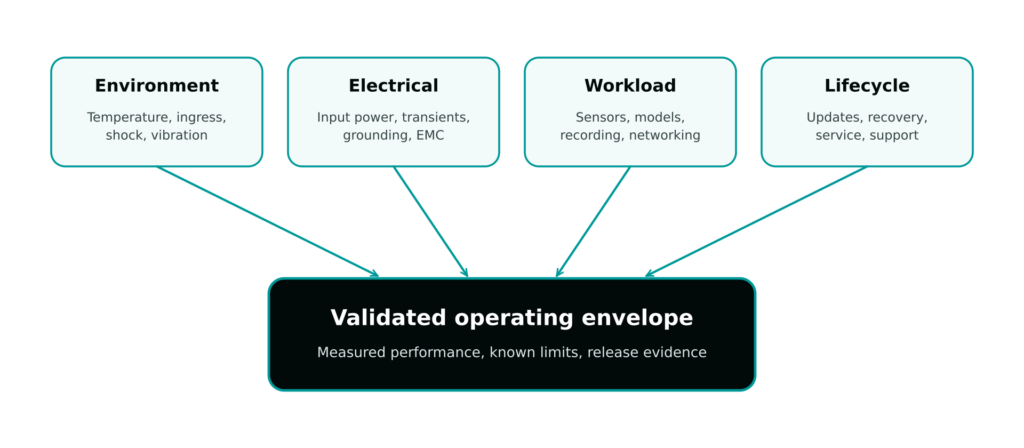
Figure 1. Rugged deployment evidence is created by testing the actual workload within the environmental, electrical, interface, and lifecycle conditions of the final configuration.
Engineer the constraints together

Temperature and heat rejection
The thermal path runs from the NVIDIA Jetson™ module through the thermal interface, heat spreader or cold plate, enclosure, and surrounding air or coolant. CTai LABS sizes the path from sustained application power and ambient conditions, then measures clocks, temperatures, power, latency, throughput, and errors during representative workloads. Connect Tech ThermiQ™ solutions provide passive, cold-plate, and liquid-cooling paths that can be integrated according to the mechanical and environmental design.

Shock, vibration, ingress, and connectors
Mechanical exposure affects boards, storage, connectors, cables, optics, calibration, and mounting. Ingress protection applies to an enclosure and its mated interfaces, not an exposed carrier board. CTai LABS can select sealed systems or positive-locking carrier connections, define cable strain and service access, protect calibration-sensitive sensors, and plan functional checks before, during, and after the required environmental methods.

Input power and electrical behavior
Vehicles and machines can produce brownouts, cranking events, transients, noise, ground differences, and load steps. CTai LABS maps the source, protection, regulation, startup sequencing, hold-up, shutdown, and recovery path. The Edge workload, storage writes, cameras, wireless devices, and heaters or fans are included in the power budget because they change both steady-state and transient demand.

Sustained ai workload and data movement
A system may pass a short inference demonstration and still lose deadlines after temperature rises, recording begins, the network saturates, or a second model starts. CTai LABS profiles CPU, GPU, memory, storage, network, sensor ingest, power, and thermals together. TensorRT and CUDA® changes are accepted only after task accuracy and sustained system behavior are verified.
Software lifecycle and recovery
Field equipment needs a known Board Support Package (BSP) and JetPack™ baseline, secure configuration, device identity, health monitoring, logging, time, update, rollback, and recovery. CTai LABS can create a signed or controlled release process using supported NVIDIA Jetson security features where required. Security and support claims are mapped to the exact JetPack generation and product configuration.
Architecture Through Deployment
CTai LABS can begin with an environment and mission profile, a selected Connect Tech platform, a prototype in a development enclosure, or evidence from a field problem.
- Define the operating environment, mounting, duty cycle, sensor and model workload, input power, service strategy, failure behavior, standards, and acceptance evidence.
- Select the Connect Tech carrier or system, NVIDIA Jetson module, enclosure, connectors, storage, network, wireless, camera expansion, and ThermiQ™ thermal path.
- Bring up the Board Support Package, drivers, devices, power modes, security controls, monitoring, logging, startup, shutdown, update, rollback, and recovery.
- Integrate and optimize sensors, ai inference, data movement, recording, networking, and application services on the production-intent configuration.
- Tailor environmental and electrical tests to the program, then measure functional performance and physical condition before, during, and after exposure.
- Deliver the configuration baseline, test evidence, operating limits, deployment image, service procedure, recovery path, documentation, and handoff.
Connect Tech hardware for rugged Edge ai
Connect Tech provides carrier-level and enclosed-system options so the environmental architecture can match the final machine. Product ratings and certifications must be confirmed for the ordered configuration and test program.
| Connect Tech platform | Industrial fit | Rugged deployment value |
|---|---|---|
| Rogue-RX with Jetson AGX Orin™ | Embedded systems inside a protected enclosure | Positive-locking high-speed and discrete I/O, 10GBASE-T, USB, CAN, serial, GPIO, and a compact carrier path for harsh environments. |
| Anvil-RX with Jetson AGX Orin™ | Exposed outdoor and washdown-adjacent systems | IP67 system packaging with sealed connectors, GMSL2 camera options, high-speed Ethernet, CAN, storage, and optional wireless or RTK GNSS. |
| Falcon with Jetson Orin™ NX | Vehicle and heavy-equipment Edge ai | Compact IP67 vehicle system with vehicle-oriented networking for local inference on mobile equipment. |
| Hadron or Super Hadron with Jetson Orin™ NX | SWaP-constrained embedded integration | Compact carrier options with wide-input power and camera paths for systems where the customer provides the final enclosure and qualification. |
Example Rugged Edge AI Projects
Outdoor multi-camera inspection node
A system must process several cameras outdoors through seasonal temperature, rain, dust, and intermittent connectivity. CTai LABS maps the camera and network load, selects Anvil-RX, integrates the inference and storage pipeline, defines condensation and service assumptions, and validates performance, restart, data recovery, and thermal headroom across the required environment.
Heavy-equipment perception computer
A mobile machine needs local perception with vehicle power, vibration, dust, and limited enclosure space. CTai LABS selects Falcon or a Rogue-RX integration, brings up cameras, CAN, network, and storage, profiles the production models at target power modes, and creates a program-specific shock, vibration, temperature, power, and functional test matrix.
Development kit to production enclosure migration
An ai application works on a desk but the deployment enclosure throttles during sustained load. CTai LABS recreates the complete thermal and power path, measures workload phases, maps I/O and cable changes, selects Connect Tech hardware and ThermiQ™ cooling, and verifies the production release under the actual enclosure and ambient limits.
What CTai LABS can deliver
- Environmental, electrical, workload, lifecycle, standards, and acceptance requirements with a risk and test matrix.
- Connect Tech platform, NVIDIA Jetson module, enclosure, connector, storage, network, wireless, camera, input-power, and ThermiQ™ thermal architecture.
- Board Support Package and driver baseline, security configuration, monitoring, logging, startup and shutdown, update, rollback, and recovery implementation.
- Integrated and optimized sensor, inference, recording, networking, and application workloads on production-intent hardware.
- Thermal, power, interface, environmental, sustained-load, restart, recovery, and functional evidence with documented operating limits.
- Versioned release, configuration record, deployment image, test report, service procedure, documentation, and engineering handoff.
Your Physical ai Integration Partner
CTai LABS combines Connect Tech rugged hardware, ThermiQ™ thermal engineering, BSP expertise, Edge ai optimization, sensor integration, and application-level validation. The team can begin with an idea, investigate a field limit, or carry the complete rugged Edge ai system from architecture through deployment while the customer retains its intellectual property.
Book a Demo
Bring your goal. Start with the outcome your rugged Edge ai program must achieve. CTai LABS, a department of Connect Tech, can begin with an early idea, an architecture decision, a working prototype, a difficult integration issue, or a system that needs to become deployment-ready.
What to bring:
- The required function, deployment environment, duty cycle, mounting, service interval, failure behavior, and applicable standards or customer methods.
- Sensor and model workloads, concurrency, latency, throughput, data retention, networking, and availability requirements.
- Current or proposed Connect Tech hardware, NVIDIA Jetson module, enclosure, connectors, cables, storage, wireless, input power, and cooling.
- Thermal logs, power measurements, failure reports, system images, models, application traces, photographs, and test evidence already available.
- The operating limits, qualification milestone, release, update, recovery, support, and lifecycle evidence the program requires.
CTai LABS uses these inputs to identify the highest-risk interfaces first and define the shortest credible path to a working, measurable system.

ABOUT THE AUTHOR
Kara Price
Senior Marketing & Events Specialist | Content Strategy | Campaign Execution |
Connect Tech Inc.
Kara Price is a technology writer covering Edge AI, robotics, and embedded computing for Connect Tech and CTai LABS. Trained in journalism at Humber College with a BA in Communication Studies from Wilfrid Laurier University, she has spent over a decade writing for technical audiences, including four years as a proposal writer in architecture and engineering and ten years publishing product and technical announcements at Connect Tech, an NVIDIA Elite Partner. She is Senior Marketing and Events Specialist at Connect Tech.
 Learn More
Resources and Frequently Asked Questions
Related
Industrial Automation. Explore CTai LABS capabilities for factory-floor machine vision, inspection, predictive maintenance, and rugged Edge ai.
Explore Industrial Automation →Machine Vision AI.
See Machine Vision AI →Quality Inspection & Defect Detection.
See Quality Inspection & Defect Detection →Predictive Maintenance.
See Predictive Maintenance →Sources
Connect Tech. (n.d.). Anvil-RX rugged system powered by NVIDIA Jetson AGX Orin. Retrieved August 21, 2026, from
https://connecttech.com/product/anvil-rx-rugged-system-powered-by-nvidia-jetson-agx-orin/Connect Tech. (n.d.). Falcon vehicle system with NVIDIA Jetson Orin NX. Retrieved August 21, 2026, from
https://connecttech.com/product/falcon-vehicle-system-with-nvidia-jetson-orin-nx/Connect Tech. (n.d.). Rogue-RX carrier board for NVIDIA Jetson AGX Orin. Retrieved August 21, 2026, from
https://connecttech.com/product/rogue-rx-carrier-board-for-nvidia-jetson-agx-orin/Connect Tech. (n.d.). ThermiQ. Retrieved August 21, 2026, from
https://connecttech.com/thermiq/Krišlauks, R., Tiscenko, D., Medvedevs, V., Ormanis, J., & Judvaitis, J. (2026). Ambient temperature impact on the thermal behavior and power consumption of the NVIDIA Jetson AGX Orin in an outdoor enclosure. Electronics, 15(11), 2467.
https://doi.org/10.3390/electronics15112467NVIDIA. (2026). Secure Boot. Jetson Linux Developer Guide.
https://docs.nvidia.com/jetson/archives/r38.4/DeveloperGuide/SD/Security/SecureBoot.htmlU.S. Department of Defense. (2019). MIL-STD-810H: Environmental engineering considerations and laboratory tests.
https://quicksearch.dla.mil/Frequently Asked Questions
What makes an Edge ai system rugged?
Ruggedness is demonstrated for a defined configuration and function across specified environmental, electrical, mechanical, and lifecycle conditions. It depends on enclosure, connectors, cooling, mounting, software, workload, and test evidence.
Does a wide component temperature rating prove the full system?
ThermiQ™ is Connect Tech’s thermal-management family for NVIDIA Jetson deployments, including passive, cold-plate, and liquid-cooling options. Selection depends on the module, workload, enclosure, ambient, and mechanical design.
What is ThermiQ™?
ThermiQ™ is Connect Tech’s thermal-management family for NVIDIA Jetson deployments, including passive, cold-plate, and liquid-cooling options. Selection depends on the module, workload, enclosure, ambient, and mechanical design.
Can CTai LABS help with MIL-STD-810H testing for an industrial system?
CTai LABS can help tailor relevant environmental methods, prepare the production-intent system, instrument functional checks, and document results. A compliance statement depends on the exact configuration, methods, severities, laboratory, and program authority.
Can the system run without a cloud connection?
Yes. CTai LABS can deploy sensing, inference, application logic, local storage, monitoring, and recovery on Connect Tech Edge hardware, with optional store-and-forward connectivity.
Can CTai LABS diagnose thermal throttling?
Yes. CTai LABS can correlate clocks, temperatures, power, workload, data rates, enclosure conditions, and application latency to identify the limiting thermal path and verify changes.
Who owns the rugged Edge ai application?
The customer retains its application, data, models, product design, and intellectual property. Engagement deliverables and third-party licensing are defined in the statement of work.
Ready to Build Smarter?
Let’s create the intelligent Edge AI solution that moves your business forward.