Case Study
ROS-Ready Launchpad:
A Host-Native ROS 2 Starting
Image for Edge AI Robotics
Bundling AI Robotics foundations: start on the application, not platform bring-up
By Doruk Sönmez, M.Sc.
AI Solutions Architect, CTai LABS, a department of Connect Tech Inc. NVIDIA DLI Certified Instructor
Review: Kara Price, Senior Marketing & Events Specialist, Connect Tech Inc, ConnectTech.com
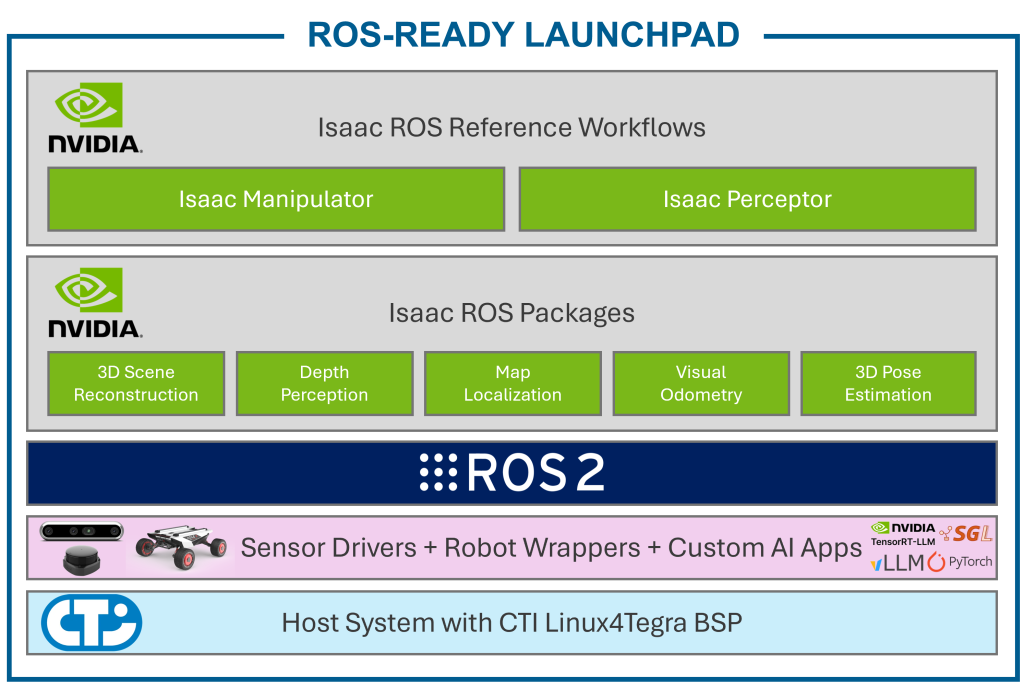
Figure 1 : ROS-Ready Launchpad running on a Connect Tech Edge system, with ROS 2, Isaac ROS, sensors, and application layers shown as a simple stack.

Key Results
- ROS-Ready Launchpad gives robotics teams a pre-configured ROS 2 environment on Connect Tech hardware so engineering can start with the robot application instead of basic platform bring-up
- NVIDIA® Isaac™ ROS, NVIDIA Jetson™ support, SDKs, libraries, sensor drivers, ROS wrappers, verified dependencies, and the Connect Tech board support package are assembled into one tested system image
- The host-native architecture removes containerization as a required operating layer, reducing setup complexity and giving ROS 2 nodes direct access to the system
- Launchpad is a starting point, not a closed application: teams can add their own nodes, models, navigation logic, sensors, and proprietary robotics software
- CTai LABS can extend the Launchpad into a complete robotics engagement across sensors, perception, navigation, model optimization, validation, and deployment, while the customer keeps their IP
- Built on the CTI EdgeAI Stack, Launchpad connects Connect Tech hardware, platform software, accelerated robotics tools, and support into a repeatable foundation for faster robot development
What Is ROS-Ready Launchpad?
ROS-Ready Launchpad is Connect Tech’s productized ROS 2 system image for robotics teams that want to begin development on a known software and hardware foundation instead of assembling the environment from scratch. It combines ROS 2, NVIDIA® Isaac™ ROS, NVIDIA Jetson™ software support, Connect Tech’s optimized board support package, robotics libraries, sensor drivers, ROS wrappers, and verified dependencies directly on the host system (Connect Tech Inc., 2025).
For teams searching for ROS2 development services, the practical value is straightforward: Launchpad moves a large share of platform setup and compatibility work upstream. Engineers can spend more time on perception, navigation, manipulation, autonomy, fleet behavior, and the application logic that differentiates the robot.
ROS 2 has matured into a broad robotics middleware ecosystem spanning real-time systems, distributed architectures, hardware acceleration, security, simulation, and multi-robot applications. That breadth is valuable, but it also creates more decisions around middleware, packages, interfaces, versions, and hardware behavior than a simple development-kit installation suggests (Al-Batati et al., 2026). ROS-Ready Launchpad turns those recurring decisions into a tested starting configuration.
Why Robotics Teams Lose Time Before Application Development Starts
A ROS 2 application is rarely one package running in isolation. Cameras, LiDAR, IMUs, motor interfaces, navigation, perception, transforms, logging, networking, and ai inference all need to exchange data with predictable behavior. A team may have strong robotics software expertise and still spend substantial time resolving platform-level issues before the application can be evaluated under representative conditions.
Common sources of delay include:
- ROS 2 installation and package-version alignment
- Board support package, JetPack™, CUDA®, library compatibility, and lifecycle management
- Camera and sensor drivers, wrappers, calibration, and device permissions
- DDS and Quality of Service configuration for the data rates and reliability requirements of the robot
- Isaac™ ROS package dependencies and accelerated graph configuration
- CPU, GPU, and memory behavior under concurrent robotics tasks
- System updates that introduce dependency or driver conflicts
- Differences between a development-kit setup and the Connect Tech hardware intended for field use
Research on ROS 2 also shows that communication latency is shaped by more than one component. Node architecture, middleware, message handling, executor behavior, and system configuration can all affect end-to-end timing, which is why a working graph still needs platform-level validation before it becomes a dependable robotics foundation (Kronauer et al., 2021).
What ROS-Ready Launchpad Includes
ROS-Ready Launchpad is a tested, production-oriented environment designed to reduce the setup burden around ROS 2 and accelerated robotics development (Connect Tech Inc., 2025). The system image includes:
- ROS 2 installed directly on the host system
- NVIDIA Isaac ROS packages and supporting NVIDIA libraries
- Connect Tech’s optimized board support package for the target hardware
- Pre-configured SDKs and robotics dependencies
- Sensor drivers and ROS wrappers for supported devices
- Verified package compatibility and dependency management
- Security and performance updates through the associated support model
NVIDIA Isaac ROS Acceleration on the Same Foundation
NVIDIA Isaac ROS provides CUDA-accelerated ROS 2 packages and ai models for robotics capabilities such as localization and mapping, 3D scene reconstruction, perception, and motion-related tasks. NVIDIA describes Isaac ROS as a collection of high-performance, low-latency ROS 2 packages designed to use acceleration on Jetson and other NVIDIA platforms (NVIDIA, 2026a).
NVIDIA Isaac Transport for ROS, or NITROS, adds type adaptation and type negotiation for accelerated processing graphs. In supported configurations, adapted data types can reduce unnecessary CPU-to-accelerator memory copies and allow compatible nodes to negotiate data formats suited to the hardware (NVIDIA, 2026b).
Launchpad gives teams a prepared environment in which those accelerated components can be evaluated alongside the rest of the robot software instead of treated as a separate proof-of-concept stack.
From System Image to the Robot You Actually Need to Build
ROS-Ready Launchpad is intentionally not a finished robot application. It supplies the software foundation below the customer’s differentiating work.
A typical project can build upward from Launchpad through:
- Camera, LiDAR, radar, IMU, GNSS, CAN, and application-specific sensor bring-up
- Navigation with Nav2, SLAM, localization, mapping, and obstacle avoidance
- Accelerated perception using Isaac ROS packages and customer ai models
- Sensor fusion, timestamping, calibration, and frame transforms
- Robot-specific motor, actuator, and control interfaces
- NVIDIA TensorRT™ optimization where ai inference performance is a limiting factor
- Natural-language, agentic, or vision-language capabilities where the use case supports them
- SIL, HIL, Digital Twin, and representative-system validation before field deployment
The customer’s application, proprietary robotics logic, models, data, and product IP remain the customer’s. CTai LABS works as an extension of the engineering team when additional development is required.
A Practical CTI EdgeAI Stack Starting Point
ROS-Ready Launchpad fits naturally within the CTI EdgeAI Stack because robot software does not operate independently from the compute platform underneath it. The carrier board or Edge system, NVIDIA Jetson module, thermal design, board support package, sensor interfaces, ROS 2 middleware, accelerated libraries, and application nodes all influence whether the robot behaves consistently under real operating conditions.
By aligning those layers before application development begins, Launchpad gives robotics teams a repeatable base configuration rather than a collection of individually compatible parts. CTai LABS can then extend the same foundation through full-stack engineering when the project needs custom sensors, models, performance work, or system validation.
The result supports CTai LABS’ role as Your Physical ai Integration Partner without turning the Launchpad page into a generic consulting page: the productized system image handles the repeatable foundation, while CTai LABS handles the application-specific engineering that follows.
Where ROS-Ready Launchpad Fits Best
Launchpad is most useful when the robot needs a substantial ROS 2 software stack on embedded Edge compute and the team wants to avoid rebuilding platform bring-up for every prototype or hardware revision.
Relevant applications include:
- Robotics & Logistics: AMRs, warehouse robots, autonomous carts, inspection robots, service robots, and fleet platforms
- Industrial Automation: robotic inspection, machine tending, mobile manipulation, autonomous material movement, and ai-enabled work cells
- Construction, Agriculture & Mining: rugged autonomous equipment, field robots, inspection platforms, and robots operating with intermittent connectivity
- Aerospace applications where ROS 2 is used for research, autonomy, sensing, or robotic subsystems, subject to the program’s platform and certification requirements
For NVIDIA-focused content, CTai LABS does not position NVIDIA products around defense or military applications. Application framing for Launchpad should remain centered on robotics, industrial, logistics, rugged, research, and other approved use cases.
Robotics Solutions Built on ROS-Ready Launchpad
CTai LABS built the following robotics capabilities on ROS-Ready Launchpad’s shared ROS 2 software environment:
- 3D Spatial Understanding: monocular depth, 3D reconstruction, scene understanding, and ROS 2 outputs for navigation or planning
- Robot Memory & Reasoning: long-term environmental memory, retrieval-augmented reasoning, natural-language tasking, Nav2, and SLAM
- Custom Isaac ROS Development: application-specific accelerated perception, NITROS graph design, sensors, and performance validation
How CTai LABS Can Extend ROS-Ready Launchpad
Some teams only need the system image and support. Others need Launchpad adapted into a complete robotics platform. CTai LABS can extend the foundation through scoped engineering work that may include:
- ROS 2 graph and application architecture
- Isaac ROS package selection and configuration
- Camera and sensor support across GMSL2/3, MIPI CSI-2, FPD-Link III, SDI, HD-SDI, HDMI, LiDAR, IMUs, radar, CAN, and Ethernet
- Model conversion, precision selection, quantization, and TensorRT optimization
- Navigation, mapping, transforms, and sensor fusion
- DDS and Quality of Service tuning
- Performance profiling across CPU, GPU, memory, storage, networking, and sensor I/O
- Platform migration across supported NVIDIA Jetson modules and Connect Tech hardware
- SIL, HIL, Digital Twin validation, and simulation
- Deployment-ready image preparation, documentation, and engineering handoff
The engagement can stay narrowly focused on one blocker or expand across the complete robot stack. CTai LABS remains an extension of the customer’s team for the agreed scope, and the customer keeps their IP.
Support Beyond Initial Bring-Up
Book a Demo
Bring your robot architecture, target Connect Tech hardware, current ROS 2 environment, sensor list, NVIDIA Jetson platform, software constraints, and the part of bring-up or development that is consuming engineering time. CTai LABS can determine whether ROS-Ready Launchpad is the right starting point and scope any additional robotics engineering needed around it.

ABOUT THE AUTHOR
Doruk Sönmez, M.Sc.
AI Solutions Architect, CTai LABS
Doruk is an AI Solutions Architect at CTai LABS, the Physical AI and Edge AI services division of Connect Tech Inc., an NVIDIA Elite Partner. An NVIDIA DLI Certified Instructor, he specializes in deploying vision-language models, agentic AI workflows, and accelerated video pipelines on NVIDIA Jetson platforms.
 Learn More
Resources and Frequently Asked Questions
Sources
Al-Batati, A., Koubaa, A., Gabr, K., Abdelkader, M., & Aloqaily, H. (2026). ROS 2 in a nutshell: A survey. ACM Computing Surveys.
https://doi.org/10.1145/3815113Connect Tech Inc. (2025, March 10). ROS-Ready Launchpad: Accelerate robotics development.
https://connecttech.com/ros-ready-launchpad/Kronauer, T., Pohlmann, J., Matthé, M., Smejkal, T., & Fettweis, G. P. (2021). Latency analysis of ROS2 multi-node systems. In 2021 IEEE International Conference on Multisensor Fusion and Integration for Intelligent Systems (MFI) (pp. 1–7). IEEE.
https://doi.org/10.1109/MFI52462.2021.9591166NVIDIA. (2026a). NVIDIA Isaac ROS. NVIDIA Developer.
https://developer.nvidia.com/isaac/rosNVIDIA. (2026b). NITROS. Isaac ROS documentation.
https://nvidia-isaac-ros.github.io/v/release-3.2/concepts/nitros/index.htmlFrequently Asked Questions
Is ROS-Ready Launchpad a ROS 2 distribution?
No. ROS-Ready Launchpad is a Connect Tech system image and support offering built around ROS 2, NVIDIA Isaac ROS, NVIDIA software libraries, Connect Tech platform software, sensor support, and verified dependencies. It packages a tested environment so teams do not have to assemble every layer independently.
Does ROS-Ready Launchpad require Docker or another container runtime?
No. The core ROS 2 and Isaac ROS environment is installed directly on the host system. Customers can still use containers for their own applications where isolation or packaging requirements make them useful.
What is the difference between ROS-Ready Launchpad and NVIDIA Isaac ROS Development?
ROS-Ready Launchpad is the productized starting point: a prepared ROS 2 and Isaac ROS system image on Connect Tech hardware. NVIDIA Isaac ROS Development is a custom CTai LABS engineering service for graph architecture, NITROS, accelerated perception, sensors, profiling, optimization, and application-specific robotics work.
Can we add our own ROS 2 packages and proprietary nodes?
Yes. Launchpad is designed to be built on. Customers can add their own ROS 2 nodes, navigation logic, control software, ai models, interfaces, and application code. The customer keeps their IP.
Can CTai LABS integrate our cameras and sensors?
Yes. CTai LABS can integrate supported cameras, LiDAR, IMUs, radar, CAN devices, networking, and other application-specific I/O, including timing, synchronization, calibration, drivers, wrappers, and ROS 2 interfaces.
Can Launchpad be used with NVIDIA Isaac ROS NITROS?
Yes. Isaac ROS is part of the Launchpad software foundation, and CTai LABS can configure accelerated graph sections that use NITROS where supported. Performance depends on the complete graph, data types, node placement, and process architecture, so the robot should be profiled as a system rather than assuming every node benefits equally.
Does ROS-Ready Launchpad eliminate all ROS 2 development work?
No. It removes a substantial portion of repeatable platform bring-up and dependency work. Robot-specific perception, navigation, control, sensing, application logic, validation, and performance engineering still depend on the use case.
Can CTai LABS help us move from a development kit to Connect Tech hardware?
Yes. CTai LABS can assess the current ROS 2 stack, JetPack and library versions, drivers, sensors, models, storage, power, thermals, and performance requirements, then migrate and validate the application on the selected Connect Tech platform.
Who owns the software developed during a CTai LABS engagement?
The customer keeps their IP, including their application logic, proprietary robotics software, models, data, and product-specific work.
Ready to Build Smarter?
Let’s create the intelligent Edge AI solution that moves your business forward.