Industries
Retail: Edge ai Integration
Store-level vision, inventory intelligence, and operational automation
By Ceri Nelmes
Tech Marketing Leader & Journalist | Building Brands at the Edge of What’s Next | Connect Tech & CTai Labs
Technical review: Rob Callaghan, Chief Product Officer, Connect Tech Inc.

Key Takeaways
- CTai LABS integrates retail Edge ai from cameras and sensors through local inference, event logic, store workflows, enterprise interfaces, validation, and rollout
- A project can begin with an idea, one store problem, existing video infrastructure, a dataset, a model, an NVIDIA® Metropolis application, or a pilot that must scale
- Edge processing supports timely store actions and program-specific data boundaries while reducing the need to move every source stream upstream
- Connect Tech platforms support compact checkout and shelf nodes, multi-camera store systems, remote-camera architectures, and rugged loading-dock deployments
- Recent peer-reviewed retail research shows the value of computer vision while also highlighting camera geometry, product variation, occlusion, lighting, limited data, and Edge resource constraints
- The customer retains its store data, models, application, workflow design, and intellectual property
CTai LABS, a department of Connect Tech, helps retailers, store-technology providers, equipment manufacturers, and solution teams turn a retail ai objective into a working Edge system. This page covers the complete path from cameras, shelf sensors, point-of-sale context, and store systems through acquisition, NVIDIA® Metropolis video analytics, model inference, event logic, task creation, enterprise integration, validation, and deployment on Connect Tech hardware. CTai LABS can start with a store problem and an idea, or join at any later point to assess cameras, select compute, integrate an existing model, improve performance, reduce false events, connect operational systems, standardize a pilot, or prepare a repeatable rollout.
Turn visual evidence into a store action
Retail ai creates value when the system moves from a scene to a specific, timely workflow. Detecting an empty facing matters only if the correct SKU, location, confidence, inventory context, employee task, and confirmation path are available. Identifying a queue matters only if the staffing action can occur before the condition changes. A loss-prevention event needs governed evidence, review, and human authority. CTai LABS designs those outputs and interfaces as part of the system rather than treating the model result as the finished product.
Recent research shows both the opportunity and the integration work. Ou et al. (2025) demonstrated real-time planogram compliance using computer vision and virtual shelves, a workflow that depends on camera geometry and product-to-planogram mapping. Rahi et al. (2025) investigated stock detection with minimal data, reflecting the practical challenge of product and packaging diversity. Zhao et al. (2025) developed a lightweight retail-product detector, emphasizing the importance of Edge efficiency. Jose et al. (2024) combined shelf sensing and customer-behavior tracking, illustrating how physical sensors, software, and store context must be integrated around the analytic model.
Where retail ai programs stall

Where retail ai programs stall
A shelf, queue, checkout, safety, or asset event must identify the location, time, product or zone, confidence, evidence, urgency, owner, and required response. CTai LABS maps the analytic output into a structured event and connects it to approved tasking, inventory, point-of-sale, workforce, security, facilities, or reporting systems. The design includes acknowledgement, escalation, deduplication, expiry, audit, and recovery so alerts do not become an unmanaged queue.

The camera view does not support the claimed task
Shelf depth, facings, glare, promotional material, customer occlusion, packaging similarity, camera height, lens choice, resolution, motion, and lighting change affect the evidence available. CTai LABS evaluates the actual scene and task, then defines camera coverage, calibration, regions of interest, source health, and maintenance requirements. Existing video can be reused when it provides the required detail and timing.

Product and store variation appears after the pilot
A model trained in one aisle or store may encounter new planograms, packaging, seasonal displays, lighting, fixtures, demographics, and operating practices. CTai LABS can establish a representative sampling plan, SKU and location mapping, annotation guide, store-based test split, model and configuration lineage, drift checks, and a controlled update process. Results are reported by store, zone, product family, event, and operating condition rather than only as one average.

Video, models, and storage compete for the same Edge resources
A store platform may decode many streams, run several models, track objects, create clips, redact images, update dashboards, store evidence, and communicate with enterprise services concurrently. CTai LABS profiles the complete workload on Connect Tech hardware and applies NVIDIA TensorRT™ and CUDA® optimization after task behavior is protected. The release is validated for latency distribution, dropped frames, queue depth, memory, storage, network, power, thermals, and sustained operation.

Privacy and authority boundaries are added late
Retail applications can involve employees, customers, transactions, and sensitive video. CTai LABS implements the customer-defined collection, minimization, redaction, retention, access, logging, encryption, and deletion requirements within the technical architecture. Human review and decision authority are explicit for security, loss-prevention, and employee-facing workflows. Legal and policy ownership remains with the retailer and its qualified teams.

Figure 1. Retail Edge ai becomes operational when governed sensor evidence is converted into a structured event, store task, and measurable resolution.
Architecture Through Deployment
CTai LABS begins with the current state of the program. That can be one desired store outcome, an installed camera system, a small dataset, an approved model, a point solution, or a multi-store pilot that needs a repeatable hardware and software baseline.
- Define the store outcome, event or measurement, user and response, location context, timing, cost of error, data and authority boundaries, rollout model, and acceptance criteria.
- Assess cameras and sensors, fixtures and coverage, Connect Tech hardware, NVIDIA Jetson™ module, networking, storage, input power, thermal and enclosure needs, and service access.
- Bring up the Board Support Package, streams, clocks, calibration, identifiers, recording, health monitoring, privacy controls, observability, update, and recovery.
- Integrate NVIDIA Metropolis components, models, TensorRT optimization, tracking, SKU or zone context, event logic, clips or metadata, tasking, and enterprise interfaces.
- Validate store and product variation, task metrics, false events, missed events, latency, sustained load, connectivity loss, storage limits, restart, operator workflow, and controlled updates.
- Deliver the versioned software and model release, configuration and location lineage, interface documentation, store acceptance evidence, deployment image, rollout procedure, and engineering handoff.
Match response time and consequence to the workflow
Retail use cases do not share one response window or one cost of error. Queue management and assisted checkout may require a response while the condition is present. Planogram and replenishment can tolerate a longer window but need accurate SKU and location context. Security and safety workflows may require rapid review with clear human authority. The architecture should be sized to the action, not only the number of camera streams.
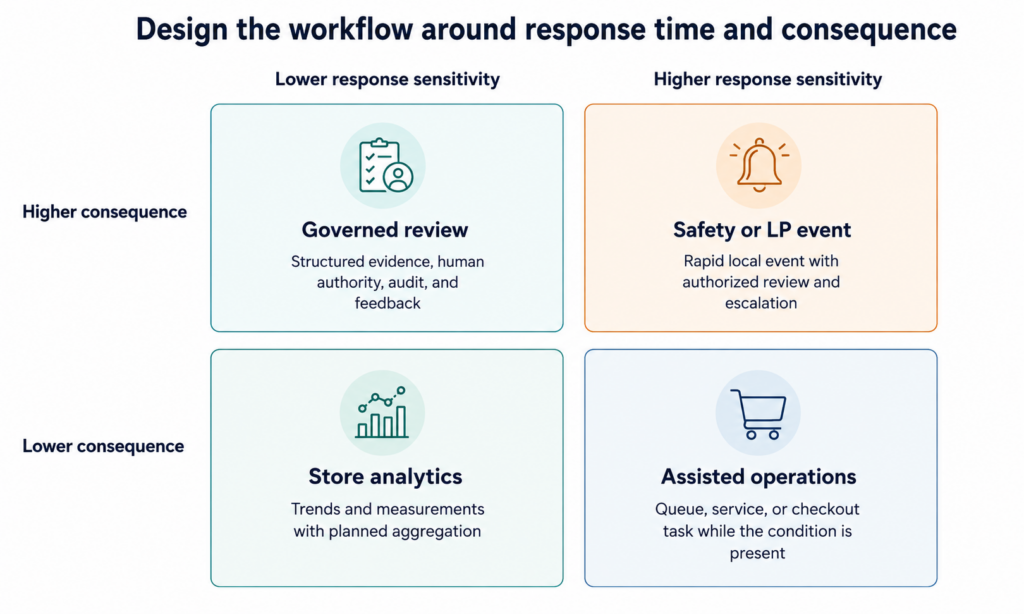
Figure 2. Response time and consequence of a wrong decision help determine event logic, review, retention, and system integration.
Connect Tech hardware for retail Edge ai
CTai LABS selects Connect Tech hardware from the number and type of cameras, decoding load, models, response time, storage, network, mechanical envelope, environment, power, lifecycle, and rollout needs. The goal is a common production baseline with enough headroom for the complete store workload and a clear support path.
| Capability | What CTai LABS delivers |
|---|---|
| ROS 2 and Isaac ROS | Pre-configured ROS 2 environment with Isaac ROS acceleration on Connect Tech hardware. BSP-validated, production-ready, skipping weeks of bring-up. Available as the ROS-Ready Launchpad solution. |
| Multi-camera perception | Camera bring-up across Connect Tech solutions. Synchronized multi-camera pipelines for stereo depth, surround perception, and 3D reconstruction. |
| Sensor fusion | Camera, LiDAR, IMU, and CAN integration with Isaac ROS sensor fusion packages. Timing validation across all sensor streams before any model sees the fused data. |
| Model optimization | TensorRT conversion and INT8/FP16 quantization for perception and navigation models against the real Jetson module power mode and thermal envelope. |
| Agentic and VLA deployment | Vision-language-action model integration for humanoid and advanced AMR applications on Jetson Thor. Robot memory and reasoning architecture for multi-step task planning without cloud dependency. |
| SIL/HIL/Digital Twin validation | Full validation pipeline using Software-in-the-Loop, Hardware-in-the-Loop, and NVIDIA Isaac Sim Digital Twin testing before field deployment. |
Example retail Edge ai projects
Shelf availability and planogram workflow
A retailer wants to identify out-of-stock facings, misplaced products, and planogram exceptions while limiting manual aisle checks. CTai LABS defines the shelf and SKU evidence, camera geometry, store and product dataset, model strategy, location mapping, confidence rules, task integration, and confirmation workflow. The system is deployed on compact or centralized Connect Tech hardware and validated across stores, lighting, packaging, occlusion, promotions, and controlled updates.

Queue and service responsiveness
A store needs to identify sustained queue conditions and send an actionable request before service deteriorates. CTai LABS integrates approved cameras, regions, counting and tracking, dwell logic, threshold calibration, local event generation, and workforce or operations interfaces. Validation covers entrances and exits, groups, carts, occlusion, staff movement, false events, event expiry, network loss, and the time from scene change to acknowledged task.
Governed video analytics for loss prevention
A loss-prevention team wants structured review events from checkout, self-service, receiving, or restricted areas while keeping decisions with authorized staff. CTai LABS integrates video and approved transaction or zone context, deploys models on Forge or Anvil-RX, creates evidence clips and metadata, applies the retailer’s access and retention policy, and connects events to a controlled review workflow. The release documents false-event behavior, coverage limits, operator authority, audit, and recovery.
What CTai LABS can deliver
- Retail use-case definition, event taxonomy, store workflow, data and authority boundaries, response-time and error-cost model, rollout assumptions, risk register, and acceptance matrix.
- Camera and sensor plan, Connect Tech platform and NVIDIA Jetson module selection, networking, storage, power, thermal, enclosure, fixture, and service requirements.
- Board Support Package (BSP) and driver baseline, stream bring-up, time, calibration, location and SKU context, recording, health, privacy controls, update, and recovery.
- Integrated NVIDIA Metropolis components, detection, tracking, stock or planogram analytics, event logic, tasking, clips or metadata, and store or enterprise interfaces.
- Representative store and product dataset, task metrics, false and missed event evidence, latency and throughput traces, sustained-load results, connectivity and recovery tests, and known limits.
- Versioned software and model release, deployment image, configuration and location lineage, interface documentation, rollout playbook, lifecycle process, and knowledge transfer.
Your Physical ai Integration Partner
CTai LABS combines Connect Tech Edge hardware, in-house Board Support Package engineering, NVIDIA Metropolis integration, camera and sensor expertise, ai model optimization, store workflow software, and representative validation. The team can start with an idea, solve one camera, model, or integration problem, or carry the complete retail Edge ai system from architecture through deployment while the customer retains its intellectual property.
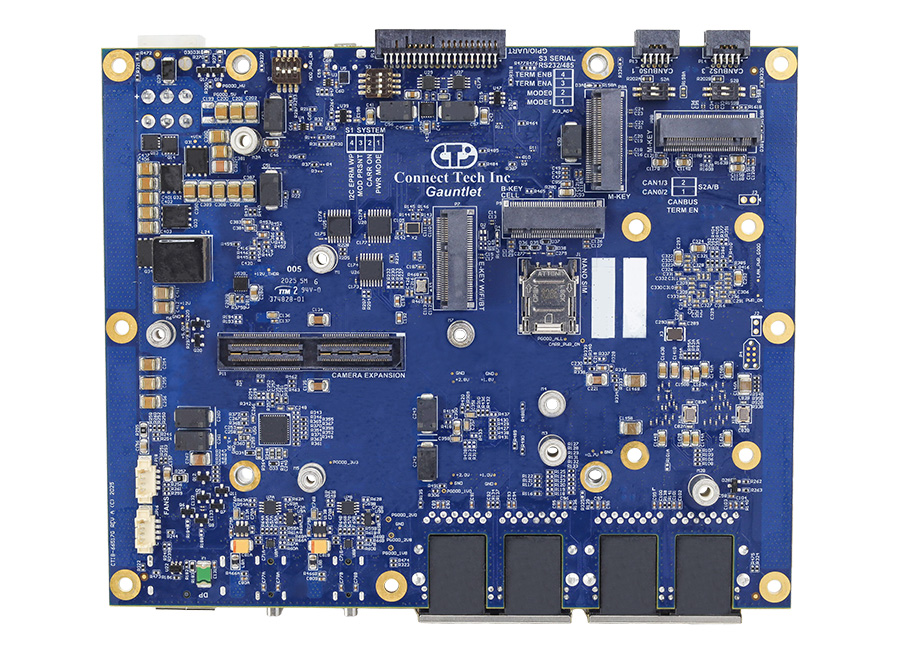
Gauntlet with Jetson Thor (T5000)
For inspection and monitoring applications requiring vision-language-action or multi-model inference, including Scene Analyzer Agent deployments and agentic process monitoring. Jetson Thor delivers 2,070 FP4 TFLOPS at 40 to 130 watts. Supports 16-lane MIPI CSI-2, GMSL3/2/1, FPD-Link III, and dual 10GbE (Connect Tech, 2025).
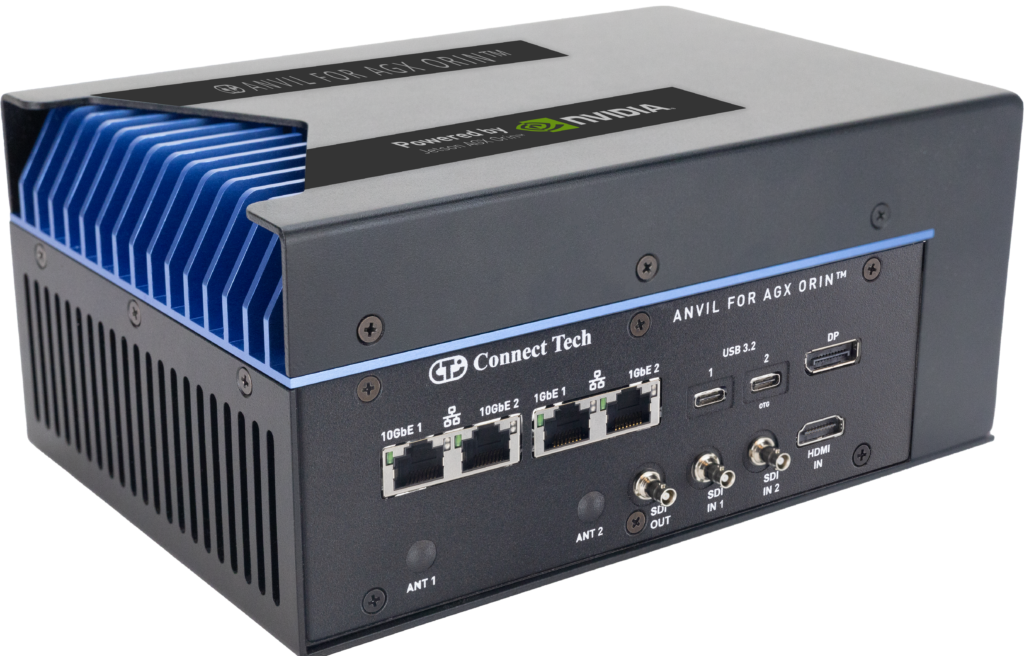
Anvil for Jetson AGX
Built for compute-intensive AI applications, Anvil delivers a rugged, power-efficient platform for autonomous vehicles, smart cities, and vision systems. With high-speed networking, optional camera inputs, expandable storage, and a wide input power range, it provides flexible connectivity for demanding Edge AI deployments.

Anvil-T5 for Jetson T5000
Built for autonomy, engineered for reliability, and powered by NVIDIA Jetson Thor, Anvil-T5 delivers the next leap in Edge AI performance. Designed to handle the most demanding robotic and autonomous workloads, it combines extreme compute capability with rugged, dependable engineering.

Essential EdgeAI
Powered by NVIDIA® Jetson™, Essential EdgeAI delivers a compact, low-cost network node for scalable generative AI and AI-enabled video analytics. With USB 3.1, Gigabit Ethernet, and UART connectivity, plus active or passive cooling options, it provides a flexible foundation for Edge AI deployments.
Book a Demo
Bring your goal. Start with the outcome your retail Edge ai program must achieve. CTai LABS, a department of Connect Tech, can begin with an early idea, an architecture decision, a working prototype, a difficult integration issue, or a system that must become deployment-ready.
What to bring:
- The store outcome, event or measurement, user, required response, timing, cost of error, and authority boundary.
- Store layouts, camera views, fixtures, lighting, product or zone context, connectivity, storage, power, privacy, security, and rollout constraints.
- Current cameras and sensors, Connect Tech or development hardware, NVIDIA Jetson platform, models, tasking, point-of-sale, inventory, workforce, and security systems.
- Representative video, product and planogram data, annotations, transaction or location context, source code, interfaces, logs, and failure examples.
- Task metrics, false and missed event limits, latency, sustained-load, retention, access, recovery, store acceptance, rollout, support, and lifecycle evidence.
CTai LABS uses these inputs to identify the highest-risk interfaces first and define the shortest credible path to a working, measurable system.

ABOUT THE AUTHOR
Ceri Nelmes
Tech Marketing Leader & Journalist | Building Brands at the Edge of What’s Next |
Connect Tech & CTai Labs
Ceri Nelmes is Head of Marketing at Connect Tech and an experienced technology journalist and digital strategist. She covers the technologies and market shifts shaping embedded computing, Edge AI, Physical ai, robotics, autonomous systems, and the NVIDIA® ecosystem. Working with Connect Tech and CTai LABS subject-matter experts, she turns engineering developments into accurate, useful reporting for developers, technical buyers, business leaders, and the media.
 Learn More
Resources and Frequently Asked Questions
Related
Continue into the NVIDIA integration, scene-analysis, sensor, optimization, and architecture capabilities that support store-level Edge ai.
NVIDIA Metropolis Integration. Video analytics and intelligent-space applications built around NVIDIA Metropolis.
Explore NVIDIA Metropolis Integration →Scene Analyzer Agent. On-prem scene understanding with structured outputs for approved video workflows.
Explore Scene Analyzer Agent →ai Model Optimization. TensorRT and CUDA optimization measured on the target Connect Tech platform.
Explore ai Model Optimization →System & Sensor Integration. Camera, timing, calibration, driver, and Edge data-path engineering.
Explore System & Sensor Integration →Edge vs. Cloud ai Inference. Architecture tradeoffs for latency, data movement, availability, and operations.
Explore Edge vs. Cloud ai Inference →Sources
Connect Tech. (n.d.). Anvil-RX rugged system powered by NVIDIA Jetson AGX Orin. Retrieved August 21, 2026, from
https://connecttech.com/product/anvil-rx-rugged-system-powered-by-nvidia-jetson-agx-orin/Connect Tech. (n.d.). Forge carrier for NVIDIA Jetson AGX Orin. Retrieved August 21, 2026, from
https://connecttech.com/product/forge-carrier-for-nvidia-jetson-agx-orin/Jose, J. A. C., Bertumen, C. J. B., Roque, M. T. C., et al. (2024). Smart shelf system for customer behavior tracking in supermarkets. Sensors, 24(2), 367.
https://doi.org/10.3390/s24020367NVIDIA. (2026). NVIDIA retail.
https://www.nvidia.com/en-us/industries/retail/Ou, T.-Y., Ponce, A., Lee, C., & Wu, A. (2025). Real-time retail planogram compliance application using computer vision and virtual shelves. Scientific Reports, 15, 43898.
https://doi.org/10.1038/s41598-025-27773-5Rahi, B., Sagmanli, D., Oppong, F., Pekaslan, D., & Triguero, I. (2025). Generalising stock detection in retail cabinets with minimal data using a DenseNet and Vision Transformer ensemble. Machine Learning and Knowledge Extraction, 7(3), 66.
https://doi.org/10.3390/make7030066Zhao, Y., Solihin, M. I., Yang, D., Cai, B., Chow, L. S., Handayani, D., & Prabuwono, A. S. (2025). LSR-YOLO: A lightweight and fast model for retail products detection. PLOS ONE, 20(10), e0334216.
https://doi.org/10.1371/journal.pone.0334216Frequently Asked Questions
Can CTai LABS start with one retail use case?
Yes. CTai LABS can typically begin with one store outcome and location, establish the evidence and workflow, then define a platform and validation approach that can support a controlled expansion.
Can CTai LABS start with one retail use case?
Yes. CTai LABS can assess stream access, resolution, field of view, lighting, compression, latency, clock behavior, scene coverage, network, and retention before deciding whether the existing cameras support the task.
Does CTai LABS integrate NVIDIA Metropolis for retail?
Yes. Video ingest, inference, tracking, event generation, local evidence, and approved system interfaces can run on Connect Tech Edge hardware. The retailer defines which metadata or evidence leaves the store.
Can retail analytics run without sending all video to the cloud?
Yes. Video ingest, inference, tracking, event generation, local evidence, and approved system interfaces can run on Connect Tech Edge hardware. The retailer defines which metadata or evidence leaves the store.
How does CTai LABS handle new products and store layouts?
The release can include store, camera, zone, SKU, dataset, model, and threshold lineage, representative regression sets, monitoring, and a controlled update process so variation is evaluated before rollout.
How are false events managed?
CTai LABS measures false and missed events by use case and condition, calibrates thresholds and dwell rules, adds deduplication and expiry, and integrates acknowledgement, review, escalation, and feedback where the workflow requires them.
Who owns the retail data and intellectual property?
The customer retains its video and sensor data, models, workflows, application, store configuration, and intellectual property. Engagement deliverables and licensing boundaries are defined in the statement of work.
Ready to Build Smarter?
Let’s create the intelligent Edge AI solution that moves your business forward.