Services
3D Spatial Intelligence for
Robotics | 3D Scene Reconstruction
Real-Time Scene Understanding from a Single Camera
By Doruk Sönmez, M.Sc.
AI Solutions Architect, CTai LABS, a department of Connect Tech Inc. NVIDIA DLI Certified Instructor
Review: Kara Price, Senior Marketing & Events Specialist, Connect Tech Inc, ConnectTech.com

Key Takeaways
- Why Choose CTai LABS for 3D Spatial Intelligence: CTai LABS integrates camera ingestion, accelerated 3D reconstruction, spatial reasoning, and ROS2 into an Edge ai perception pipeline optimized around the customer’s robot, sensors, and deployment environment
- Single monocular camera, per-frame metric depth and 3D point-cloud generation
: TensorRT-accelerated depth estimation on NVIDIA® Jetson™ T5000 generates metric depth and point clouds from a single 2D sensor (see more below) - ai-powered spatial reasoning: an on-device spatial-reasoning model converts reconstructed geometry into structured scene information, including object categories, layouts, and oriented 3D bounding boxes
- Runs entirely at the Edge: there is no cloud round-trip or cloud-based per-frame inference charge, with full functionality in bandwidth-constrained or disconnected sites
- Smarter decision-making: robots reason about reachability, clearance, and free space instead of just raw pixels
- ROS2 integration: built to extend Connect Tech’s ROS-Ready Launchpad, with GMSL camera support for production-grade deployment
What Is 3D Spatial Intelligence for Robotics?
Environmental perception is one of the harder problems in robotics and automation. Robotics and autonomous systems depend on reliable environmental perception to navigate, manipulate objects, and make decisions in physical space. CTai LABS, a department of Connect Tech, addresses this challenge with a 3D spatial intelligence integration built for NVIDIA® Jetson™ Edge ai platforms.
At its core, this capability combines TensorRT-accelerated real-time 3D scene reconstruction with multimodal spatial-reasoning ai, all running on-device. A single monocular 2D camera feed, with no stereo rig, no LiDAR, and no calibrated multi-camera array, becomes a real-time, machine-readable map of physical space. Every frame is processed locally on the Edge ai system, without a single frame ever leaving the device for the cloud.
This is a meaningful shift for teams building robotics and autonomous systems. For the monocular application, this creates an opportunity to reduce sensor and mechanical complexity while generating 3D spatial information locally for downstream robotics tasks such as navigation and obstacle avoidance (Kalra et al., 2025).
How Monocular 3D Reconstruction Works at the Edge
The pipeline is built around four coordinated stages, all running on NVIDIA Jetson T5000 hardware at the Edge.
- Real-time 3D scene reconstruction. A live 2D camera stream is captured and run through a TensorRT-optimized monocular depth-estimation model. The result is a metric depth map and a colorized XYZ+RGB point cloud, generated with low latency and no stereo hardware (Piccinelli et al., 2024). Because the reconstruction uses a single monocular sensor, the perception stack can reduce camera count, cabling, and mechanical complexity while generating depth and point-cloud data for downstream robotics applications.
- ai-powered spatial reasoning. The resulting point cloud is passed to an on-device model that converts raw geometry into structured scene understanding, including layout elements, object categories, and oriented 3D bounding boxes. The output is a semantic map, not just unlabeled points, showing what each object is, how large it is, and how it is oriented in space, so planning and navigation logic can use it directly.
- Intelligent object and layout recognition. The workflow identifies and locates objects within the reconstructed 3D space, building a layout of the environment that captures what is present, where it is, at what scale, and how it relates to walls, floors, and other objects in full 3D. Path planners, manipulation stacks, and SLAM systems can consume that layout directly, turning raw perception into a usable map of the workspace.
- Low-latency pipeline acceleration. GMSL camera streaming, NVIDIA zero-copy multimedia memory paths, TensorRT inference, and the ROS 2 layer work together to reduce unnecessary buffering and memory movement across the perception pipeline (NVIDIA, 2026). Keeping data on accelerated processing paths from ingestion through inference and publishing helps reduce latency for closed-loop robotics workloads.
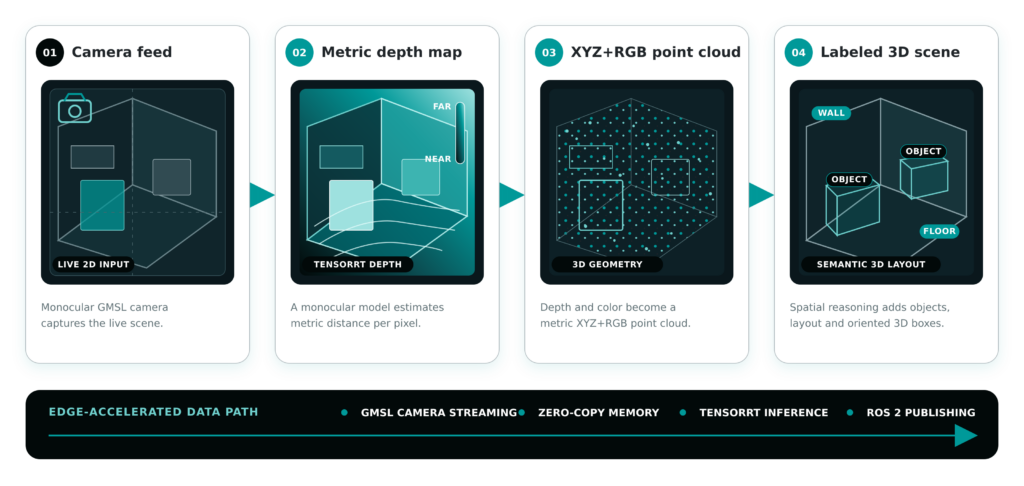
Figure 1. Edge-accelerated 3D spatial intelligence pipeline. A monocular GMSL camera feed is converted into a metric depth map, an XYZ+RGB point cloud, and a labeled 3D scene using zero-copy memory paths, TensorRT inference, and ROS 2 publishing.
What the 3D Spatial Intelligence Integration Accomplishes for Robotics
This 3D spatial intelligence capability extends Connect Tech’s ROS-Ready Launchpad and Jetson T5000-based Edge ai systems, targeting the core problems in Physical ai and Embodied ai where robots must perceive, reason, and react in dynamic environments. ROS-Ready Launchpad provides a production-ready environment with ROS 2, NVIDIA Isaac™ ROS, preconfigured NVIDIA libraries, optimized sensor drivers, and ROS wrappers (Connect Tech, 2026). This integration adds three capabilities on top of that stack.
True environmental context
Systems move beyond 2D perception to understand spatial relationships, volumes, and object placements in full 3D. That volumetric grounding lets a robot reason about reachability, clearance, and free space instead of just pixels.
Edge-native, low-latency processing
Camera ingestion, TensorRT depth inference, point cloud generation, and spatial scene-understanding inference all run locally on Connect Tech Edge ai systems. There is no cloud round-trip or cloud-based per-frame inference charge, so autonomy stays responsive even in bandwidth-constrained or disconnected environments like warehouses, mines, and remote job sites.
Optimized integration
Connect Tech’s hardware-software co-design experience smooths the path from development to rugged deployment, backed by CTai LABS integration services.
Together, these capabilities demonstrate the CTI EdgeAI Stack in a robotics workload, connecting sensor ingestion, NVIDIA Jetson compute, accelerated inference, ROS 2 software, and deployment requirements through one Edge architecture.
Benefits for Customers

Real-time 3D reconstruction from a single 2D camera
Generate metric depth and colorized point clouds from monocular camera frames using a TensorRT-accelerated depth estimation model on Jetson T5000 and a single GMSL sensor.

ai-based scene understanding
Convert reconstructed point clouds into structured spatial outputs, including scene layouts, object categories, and oriented 3D bounding boxes, for downstream robotics applications. Navigation, manipulation, and planning stacks receive semantic, ready-to-use spatial data instead of raw geometry they would otherwise have to interpret themselves.

Optimized for CTI Edge ai systems
The hardware-accelerated implementation is tuned for NVIDIA Jetson T5000 and Jetson Orin-class platforms.

GMSL vision integration
Connect Tech’s GMSL-capable Edge systems support camera architectures designed for longer cable runs and robust sensor integration, providing an alternative to USB-based camera connectivity for production robotics deployments (RealSense, 2026).

ROS2 integration
Works directly with Connect Tech’s ROS-Ready Launchpad for accelerated robotics development.

Comprehensive scene understanding
Automatically create detailed environmental layouts from live monocular video, with recognized objects, spatial relationships, and 3D structure available to navigation, SLAM, manipulation, and planning stacks.
Applications of Edge ai 3D Spatial Intelligence
- Warehouse automation. Provide robots with 3D scene information for navigation, obstacle avoidance, item retrieval, aisle-clearance estimation, and identification of blocked pathways or misplaced inventory.
- Manufacturing. Provide depth and 3D scene context for object manipulation, inspection, inventory tracking, and robotic picking and packing.
- Retail. Build spatial representations of store environments that can support product recognition, inventory workflows, compliance checks, and shelf monitoring.
- Research. Accelerate development of Embodied ai applications with ready-to-use monocular depth estimation, 3D reconstruction, and ai-driven scene-understanding capabilities on Jetson T5000, letting research teams prototype spatial-reasoning applications without building a perception stack from scratch.
Ready to Add Spatial Intelligence to Your Platform?
Bring your robotics perception challenge to CTai LABS, Your Physical ai Integration Partner. Our team can integrate and optimize camera ingestion, accelerated 3D reconstruction, spatial reasoning, and ROS 2 around your sensors, robot architecture, and target NVIDIA Jetson platform. Built on Connect Tech Edge ai systems and ROS-Ready Launchpad, the solution provides a starting point for turning camera data into locally processed, machine-readable 3D scene information.

ABOUT THE AUTHOR
Doruk Sönmez, M.Sc.
AI Solutions Architect, CTai LABS
Doruk is an AI Solutions Architect at CTai LABS, the Physical AI and Edge AI services division of Connect Tech Inc., an NVIDIA Elite Partner. An NVIDIA DLI Certified Instructor, he specializes in deploying vision-language models, agentic AI workflows, and accelerated video pipelines on NVIDIA Jetson platforms.
 Learn More
Sources and Frequently Asked Questions
Sources
Connect Tech. (2026). ROS-Ready Launchpad: Accelerate robotics development.
https://connecttech.com/ros-ready-launchpad/Kalra, A., Singh, A., & Prakash, N. (2025). Monocular depth estimation for autonomous robot navigation in dynamic environments. Computers & Electrical Engineering, 126, 110554.
https://doi.org/10.1016/j.compeleceng.2025.110554NVIDIA. (2026). NVIDIA Isaac Transport for ROS (NITROS). NVIDIA Isaac ROS.
https://nvidia-isaac-ros.github.io/concepts/nitros/index.htmlPiccinelli, L., Yang, Y.-H., Sakaridis, C., Segu, M., Li, S., Van Gool, L., & Yu, F. (2024). UniDepth: Universal monocular metric depth estimation. Proceedings of the IEEE/CVF Conference on Computer Vision and Pattern Recognition (CVPR), 10106–10116.
https://openaccess.thecvf.com/content/CVPR2024/html/Piccinelli_UniDepth_Universal_Monocular_Metric_Depth_Estimation_CVPR_2024_paper.htmlRealSense. (2026, April 16). RealSense demonstrates industry's most comprehensive GMSL depth camera portfolio. Association for Advancing Automation.
https://www.automate.org/news/realsense-demonstrates-industry-s-most-comprehensive-gmsl-depth-camera-portfolio-realsense-incReady to Build Smarter?
Let’s create the intelligent Edge AI solution that moves your business forward.