Edge ai Solutions

Examples of Edge ai and robotics capabilities CTai LABS built, validated, and deployed on Connect Tech hardware.

CTai LABS, a department of Connect Tech Inc.

Icons Key

Key Takeaways

  • Building ROS 2 bring-up, 3D perception, agentic robot memory, real-time scene intelligence, or Real2Sim validation from scratch costs a project months it usually doesn’t have
  • CTai LABS has already engineered and validated six of these capabilities on production Connect Tech hardware with NVIDIA® Jetsonâ„¢ modules: ROS 2 acceleration, monocular 3D spatial understanding, multi-camera reconstruction, agentic robot memory, real-time scene intelligence, and Real2Sim/Sim2Real evaluation
  • Each solution is a validated starting point: deploy it directly, extend it, or use it as the foundation for a custom CTai LABS engagement
  • Available as a starting point for a custom integration engagement, or as reference architectures for teams building their own system
CTai LABS Icon transparent.   From AI Models to Deployable Systems

Edge AI Requires Every Layer
to Work Together

Most Edge ai and robotics teams build the same handful of capabilities from scratch: a working ROS 2 environment, 3D perception from a camera feed, a way for a robot to remember what it’s seen, real-time scene understanding, or a validated path from simulation to the field. CTai LABS has already built, validated, and deployed six of these on production Connect Tech hardware with NVIDIA® Jetsonâ„¢ modules. CTai LABS solutions turn elements of the CTI EdgeAI Stack into deployment-ready starting points for specific Edge and Physical ai workloads, bringing together Connect Tech compute, software, sensors, ai frameworks, and integration work before the customer begins application-specific development.

Icons Camera
Sensors

Cameras, LiDAR and application data

Icons Server
Edge Compute

NVIDIA Jetson or IGX platform

Icons Brain
AI Software

Models, agents and processing pipelines

Icons Chart
Operational Outcome

Insight, automation or autonomous action

CTai LABS Icon   Robotic Development

ROS-Ready Launchpad

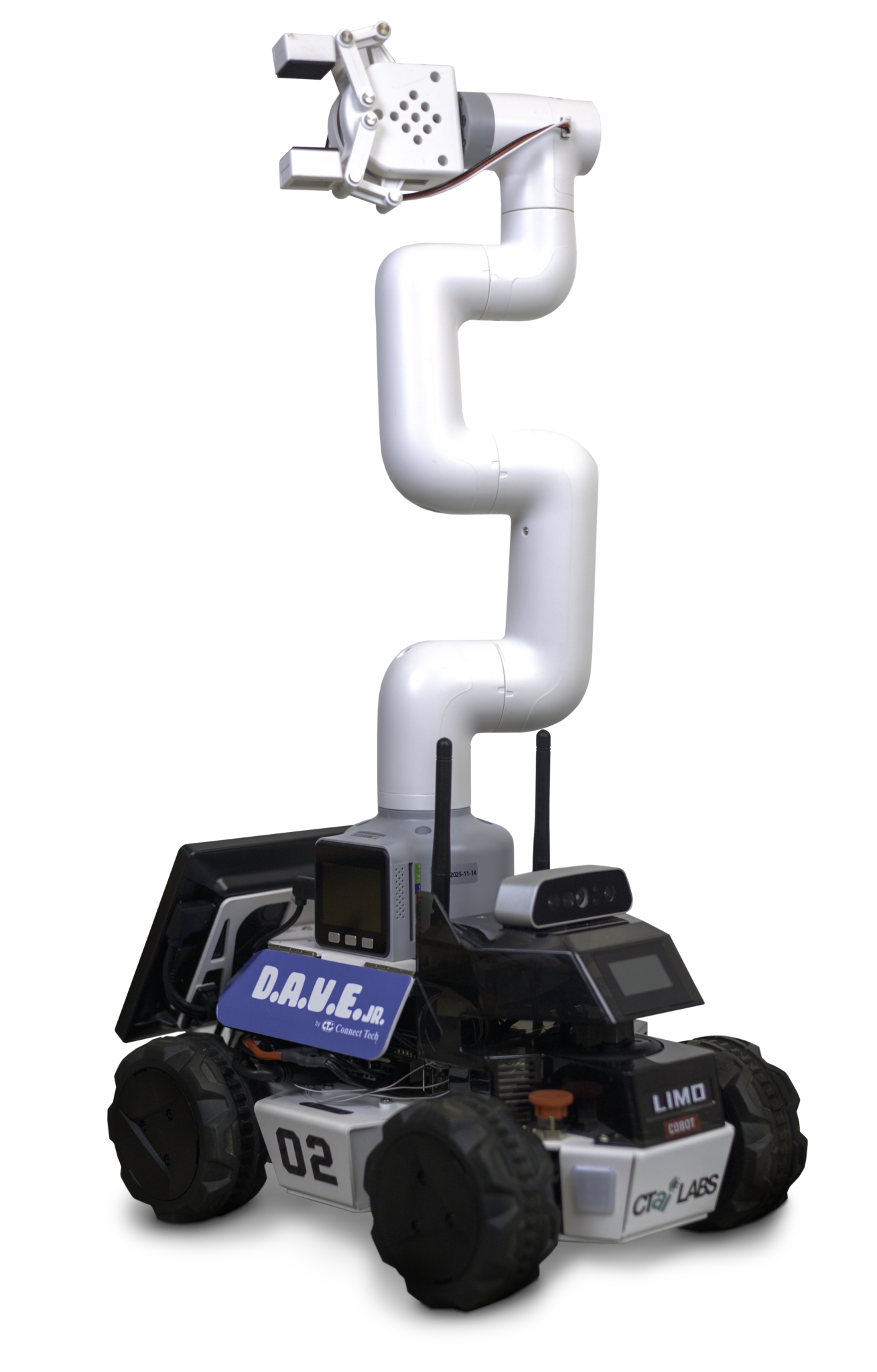
Standing up ROS 2 on new hardware usually means fighting container overhead, driver gaps, and a Board Support Package (BSP) that wasn’t built with robotics in mind. ROS-Ready Launchpad is CTai LABS’ answer: a containerization-free system image with the complete ROS 2 and Isaacâ„¢ ROS stack installed directly on the host, running on Connect Tech’s own optimized BSP, with sensor drivers already built for Intel RealSense, Leopard Imaging Hawk, and Stereolabs ZED cameras, etc (Connect Tech, 2025). A robotics team gets direct host access and production-tested components, and can start building the application layer immediately across the Jetson Orin and Jetson Thor platform families, without spending the first weeks assembling the stack.

Icons ROS
ROS 2 and NVIDIA Isaac ROS Environment

Preconfigured and validated to help your team begin development faster.

Icons Camera Large
Camera and Sensor Bring-Up

Streamline the integration of cameras, LiDAR and other robotics sensors.

Icons Integration
Hardware and Software Integration

Bring compute, software, peripherals and application requirements together in one working system.

Image of D.A.V.E. JR
CTai LABS Icon transparent.   Spatial Intelligence

3D Spatial Understanding (3D-LLM)

A robot that can’t accurately judge the size, shape, and position of what’s around it can’t safely navigate or manipulate anything, and getting there usually means a stereo rig, a LiDAR unit, or a calibrated multi-camera array. CTai LABS’ 3D Spatial Understanding collapses that down to a single monocular camera: TensorRTâ„¢-accelerated depth estimation on Jetson Thorâ„¢ generates a metric point cloud, and an on-device vision-language-action model turns that geometry into labeled objects, layouts, and oriented 3D bounding boxes, so a robot can reason about reachability and clearance, not just interpret a grid of pixels. Built as an extension of ROS-Ready Launchpad, with GMSL camera support for production deployment.

CTai LABS Icon   3D Perception

Multi-Camera 3D Reconstruction

Some deployments can’t get away with a single camera. Autonomous vehicles, AMRs, and inspection systems need multiple synchronized viewpoints to reason about space accurately. CTai LABS built and validated a multi-camera 3D reconstruction pipeline across GMSL2/3 and FPD-Link III camera inputs on Connect Tech solutions, covering camera synchronization, calibration, and reconstruction bring-up, the integration work most teams underestimate until it’s already eating the schedule.

Icons Multi Camera Capture
Multi-Camera
Capture

Combine synchronized views from multiple cameras to capture a scene from different angles and reduce visual blind spots.

Icons 3D Scene Reconstruction
3D Scene
Reconstruction

Transform overlapping camera data into a unified spatial representation of the physical environment.

Icons Application Ready Spatial Data
Application-Ready
Spatial Data

Use reconstructed scene data to support measurement, inspection, navigation, simulation or downstream AI processing.

CTai LABS Icon transparent.   Visual Intelligence

Scene Analyzer Agent

Icons Camera

Multi-Camera Video Processing

Icons Migration

Scene Understanding and Event Detection

Icons SpeachBubbles

Natural-Language Insights

Reviewing hours of camera footage manually doesn’t scale, and sending it to the cloud isn’t an option in air-gapped or bandwidth-limited sites. CTai LABS’ Scene Analyzer Agent converts live or recorded video into structured, queryable scene knowledge entirely on-device: a vision-language model generates dense scene descriptions, Nemotron-family LLMs evaluate those descriptions against configured alerts, and a CA-RAG layer answers natural-language questions grounded only in locally stored evidence, clips, timestamps, and metadata, with nothing sent to the cloud. Hardware-accelerated decode (NVENC, NVDEC, VIC) keeps long-duration video processing efficient, and the same architecture scales from efficiency-optimized Jetson AGX Orinâ„¢ configurations to maximum-concurrency Jetson Thor deployments.

CTai LABS Icon   Agentic Physical AI

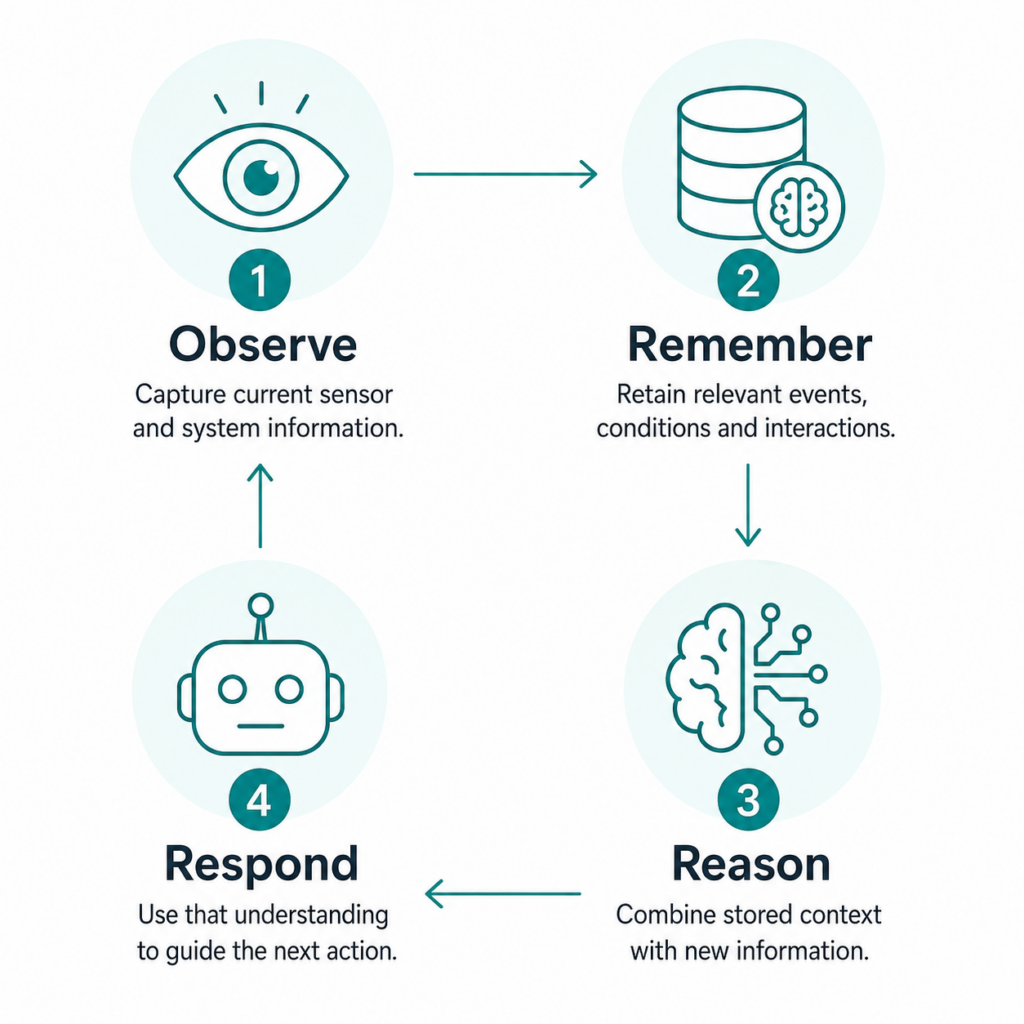
Robot Memory and Reasoning (Agentic)

A robot that only reacts to what’s directly in front of it can’t be asked to find the elevator, it can only be driven there. CTai LABS built an agentic memory architecture, based on NVIDIA’s ReMEmbR research on spatio-temporal robot memory, that gives a robot a persistent, queryable record of what it’s seen: a vision-language model captions each scene, the captions are embedded into a vector database as the robot moves, and a Retrieval-Augmented Generation pipeline turns a plain-language request into a navigation goal for Nav2 and SLAM to execute (Anwar et al., 2024). The LLM runs locally with Ollama on Connect Tech Edge hardware, so the entire reasoning loop stays on the robot with no cloud dependency. Built on ROS-Ready Launchpad, with each stage as an independently updatable ROS2 node.

Remember and Reason
CTai LABS Icon transparent.   Physical AI in Practice

Physical ai Evaluation Kit

Models trained or validated in simulation often behave differently once they hit real hardware, because most digital twins are built once from static assets and never updated. The Physical ai Evaluation Kit closes that gap: built on NVIDIA’s three-computer Physical ai architecture, it runs Edge capture on Connect Tech’s Anvil-T5 with Jetson Thor, streams that data into a live digital twin on NVIDIA DGX Spark through a custom CTai LABS Omniverse extension, and validates manipulation policies with Isaac GR00T N1.6 before redeploying them back to the Edge. The digital twin stays continuously grounded in live sensor data, updating as the physical environment changes, which is what lets a policy validated in simulation carry over to the real world with far less behavioral drift. Demonstrated live at GTC 2026.

01

Edge Capture

Anvil-T5 + Jetson Thor

02

Live Digital Twin

DGX Spark + Omniverse

03

Policy Validation

Isaac GR00T N1.6

Ready to Build Smarter?

Let’s create the intelligent Edge AI solution that moves your business forward.

CTai LABS Icon transparent.   Learn More

Resources and Frequently Asked Questions

Explore More

Sources

Anwar, A., Welsh, J., Biswas, J., Pouya, S., & Chang, Y. (2024). ReMEmbR: Building and reasoning over long-horizon spatio-temporal memory for robot navigation.

https://arxiv.org/pdf/2409.13682

Connect Tech. (2025). ROS-Ready Launchpad: Accelerate robotics development.

https://connecttech.com/ros-ready-launchpad/

Frequently Asked Questions

What is the difference between CTai LABS solutions and CTai LABS services?

Solutions are pre-engineered reference systems and validated pipelines that CTai LABS has already built and tested on Connect Tech hardware. They compress the starting-point work. Services are the engagement model through which CTai LABS builds, integrates, and deploys systems for a specific customer project.

Each solution is a validated starting point, not a shrink-wrapped product. The ROS-Ready Launchpad, for example, gives a team a working ROS 2 environment on production hardware without the bring-up work, but the application layer is still built by the team or through a CTai LABS engagement. The Physical ai Evaluation Kit is the right entry point for teams that need to validate the hardware and software fit before committing to the build.

Solutions are validated across the NVIDIA Jetson Orin family (Orin NX, Orin Nano, AGX Orin) and Jetson Thor (T5000). The specific module depends on the compute, power, and I/O requirements of the solution. The 3D Spatial Understanding and Multi-Camera 3D Reconstruction solutions are validated on Jetson Thor given their compute and camera bandwidth requirements. Module specifics are detailed on each solution page.

Availability varies by solution. The Book a Demo call is the right place to discuss access, licensing, and how a specific solution maps to your project. CTai LABS is built around collaboration, not vendor lock-in.

Solutions and services are two entry points to the same engineering team. A team that arrives via a solution page is typically looking for a validated starting point for a specific technical capability. A team that arrives via the services pages is typically looking for a broader engagement scope. Both routes lead to the same outcome: a deployment-ready system on proven Connect Tech Edge hardware.

Because the integration work is usually the same work every team ends up doing anyway: ROS 2 bring-up, sensor driver support, model optimization for the target Jetson module, before the actual application logic ever starts. CTai LABS has already done that work and validated it on production Connect Tech hardware, so a team starts from a working system instead of an empty board.