Edge ai Resources
Technical guides, decision frameworks, videos, case studies, manuals, and reference articles for engineers taking ai from prototype to production at the Edge.
CTai LABS, a department of Connect Tech Inc.
Explore Our Resources
Browse technical articles, practical guides and expert insights covering the technologies, platforms and deployment challenges behind Edge AI and Physical AI.
Use the filters below to explore foundational concepts, hardware comparisons, inference strategies, performance considerations and production deployment guidance.
Foundational Concepts
What Is Physical AI?
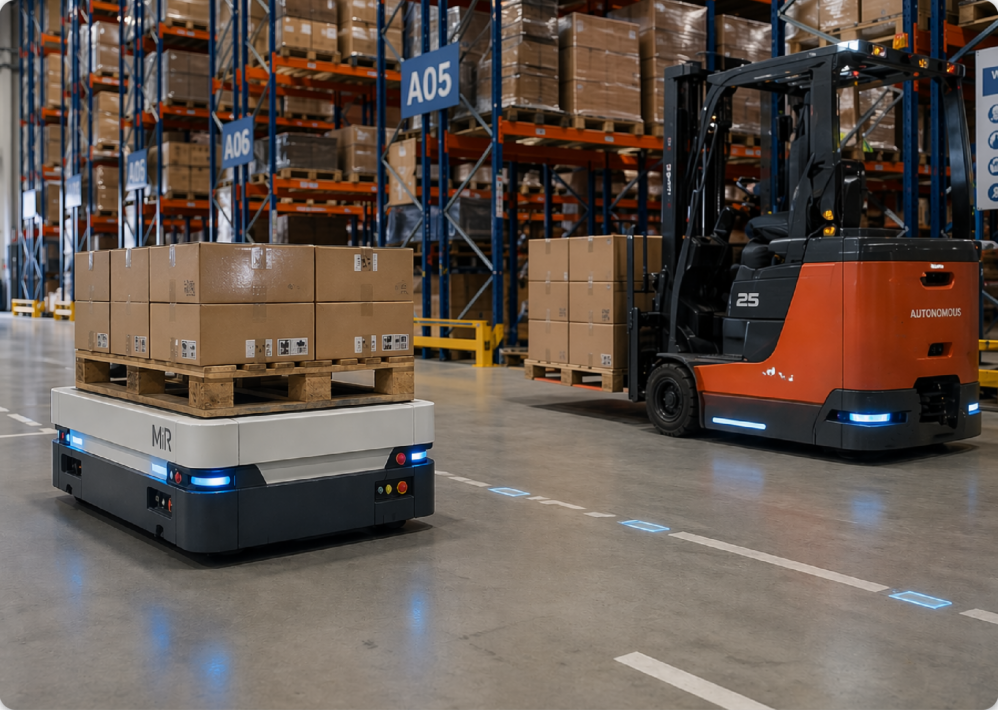
CTai LABS builds the Edge ai layer that Physical ai systems run on, so this piece is written from inside the stack, not from outside looking in. NVIDIA CEO Jensen Huang frames Physical ai as the fourth stage in ai’s evolution, the point where a system stops recommending an action and starts performing one: a robotic arm grips an object, a mobile robot re-plans around an obstacle, a vehicle brakes (NVIDIA, 2026). CTai LABS covers what that stack is made of: sensors, Edge compute, mechanical hardware, world and action models, and why the hardware layer is inseparable from the model. Market sizing for Physical ai varies widely by analyst, from roughly $5 billion to $81 billion for 2025. Hardware holds the largest share of every estimate, 53 to 58 percent (Grand View Research, 2026; SNS Insider, 2026), which is where CTai LABS integrates: hardware selection, BSP development, sensor integration, and model optimization, for systems already in commercial deployment across manufacturing, logistics, healthcare, defense, and agriculture.

Foundational Concepts
What Is Edge AI?
CTai LABS integrates Edge ai as a full stack, hardware, BSP, sensor pipeline, and optimized model. Edge adoption is being pulled by three forces: latency (cloud round trips add 50 to 200 milliseconds that autonomous and industrial systems can’t absorb), data sovereignty (2025 was the year localization requirements overtook latency as the leading adoption driver), and IoT scale (global connections are projected to exceed 30 billion by 2026) (Edge Infrastructure Review, 2025; Statista, 2025). CTai LABS covers what Edge ai delivers beyond “ai, but local,” real-time decision-making, bandwidth and cost reduction, resilience without connectivity, distributed scalability, and where Edge ai and Physical ai intersect directly, since a robot’s perception-to-action loop cannot wait on a network round trip. Cost and complexity remain the biggest cited obstacle to enterprise Edge adoption at nearly 60 percent of respondents, which is the specific gap CTai LABS’ full-stack model is built to close.

Platform Decisions
x86 to Jetson Migration Guide
CTai LABS wrote this from the same migration work it runs for customers: a step-by-step technical walkthrough for porting an x86 codebase to Jetson, dependency auditing for ARM64 compatibility, three build environment options, carrier-specific BSP flashing, and TensorRT conversion with the exact commands for FP16 and INT8 engines. It flags the step CTai LABS sees teams get wrong most often, silently: Jetson’s unified memory architecture means code written for a discrete GPU still runs, but every unremoved cudaMemcpy call is now copying data within the same physical memory for nothing. Written for engineers doing the migration themselves, with a clear handoff to CTai LABS’ managed x86 to Jetson Migration service for teams that hit a dependency tree with no clean ARM64 path or BSP bring-up on a non-standard board.
Platform Decisions
Jetson Orin vs. Thor:
Which Platform Fits Your Workload?
CTai LABS scopes this exact decision as the first step of every engagement, and this guide is that framework made public. A full spec comparison of Jetson AGX Orin (64GB) and Jetson Thor (T5000): up to 275 TOPS at 15 to 60 watts versus 2,070 FP4 TFLOPS at 40 to 130 watts, roughly 7.5 times the ai compute and 3.5 times the energy efficiency (NVIDIA, 2026). CTai LABS reduces the decision to four questions, whether the workload is generative or agentic, the power budget, camera and sensor count, and whether this is a new build or a migration, and lays out the direct upgrade path CTai LABS uses for customers already on Rogue or Anvil moving to Rogue-T5 or Anvil-T5 for Jetson Thor. For teams sizing a new project or evaluating whether an existing Jetson AGX Orin deployment needs to move to Jetson Thor.
Platform Decisions
Edge vs. Cloud ai Inference:
How to Choose
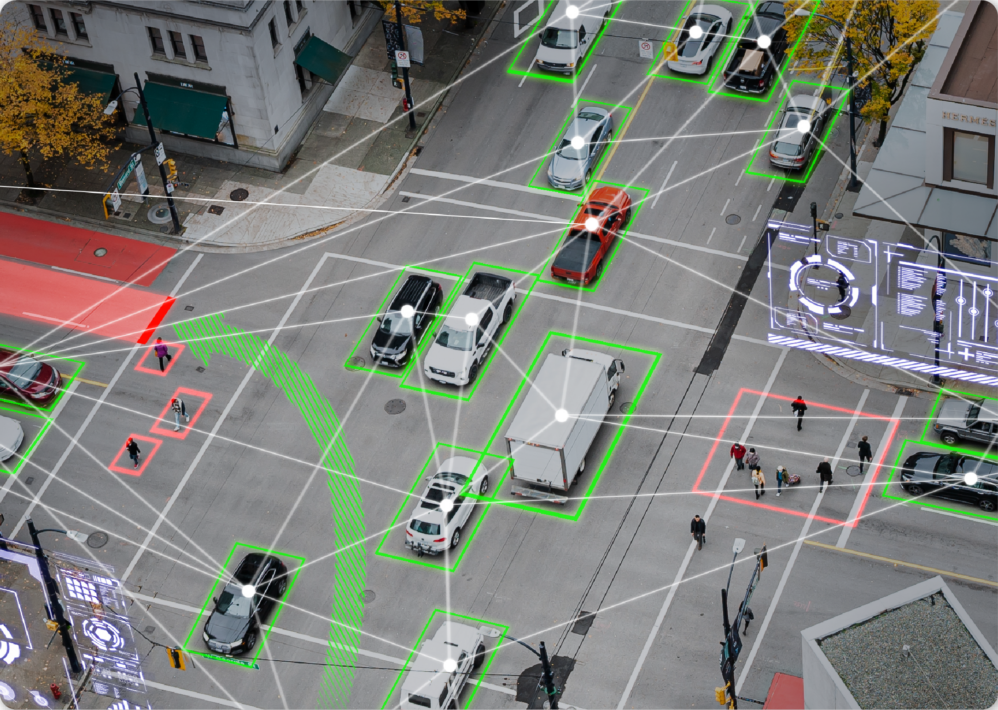
Every CTai LABS engagement runs into this question before architecture is locked in, and getting it wrong is expensive: cloud round-trip latency of 50 to 500 milliseconds makes it unsuitable for ultra-real-time control loops, and picking the wrong deployment strategy can mean overspending on cloud compute by as much as 300 percent (TechAhead, 2026). Edge inference cuts that round trip to single-digit milliseconds by processing data where it’s generated, at the cost of finite on-device compute and more complex fleet-wide model updates. CTai LABS architects most production systems as a hybrid, train and iterate in the cloud, run inference at the Edge, and this guide walks through the specific variables, latency budget, data sensitivity, connectivity reliability, and cost at scale, CTai LABS uses to make that call.
Technical Deep Dives
Edge ai Memory Bandwidth
CTai LABS walks through why two Jetson modules with similar TOPS ratings can perform very differently on the same workload, and how model selection, quantization strategy, and platform choice all get made against bandwidth, not the number on the spec sheet, in every engagement. CTai LABS optimizes against memory bandwidth, not TOPS, because that’s the constraint that actually determines whether a model performs once it’s deployed. LLM and transformer inference splits into two phases with different bottlenecks: prefill is compute-bound and scales with TOPS, but decode, the token-by-token generation phase, is memory-bandwidth-bound, governed by how fast the KV-cache can move. The math is concrete: a 7B parameter model quantized to INT4 needs roughly 3.5GB of weight traffic per generated token, so hitting 10 tokens per second requires at least 35GB/s of sustained memory bandwidth, in practice budget 50 to 80GB/s (Geniatech, 2026).

Technical Deep Dives
Ollama vs. vLLM in Production
CTai LABS runs LLM inference on Jetson hardware directly, and this comparison reflects that experience, not a lab benchmark done in isolation. The two frameworks solve different problems, and the gap widens sharply under load: in enterprise benchmarking, vLLM’s continuous batching delivered a peak of 793 tokens per second against Ollama’s 41, with P99 latency of 80 milliseconds versus 673 (Red Hat Developer, 2025). CTai LABS has found single-user, low-concurrency workloads tell a different story: Ollama’s lighter server overhead often wins on cold-start time and single-request latency, and it’s the framework CTai LABS actually deploys on Jetson Orin Nano-class Edge boards, while vLLM targets GPU-class concurrency most Edge hardware doesn’t have. CTai LABS makes this call against the deployment’s concurrency profile and memory footprint, not which framework benchmarks faster in the abstract.

Deployment Guide
Deploying Physical AI at the Edge
CTai LABS built this checklist from the gap it closes on every engagement: the space between a working model and a production Edge deployment, where most projects stall out. Independent research focused specifically on Edge ai found only 11 percent of Edge ai initiatives had reached full-scale production, with two-thirds of surveyed teams reporting their pilots fail to reach full rollout (Spectro Cloud, cited in Fierce Sensors, 2026). The reasons are rarely the model. They’re the decisions CTai LABS makes explicit at the architecture stage: platform selection that holds up outside a lab, BSP bring-up on the actual target hardware, sensor integration validated under real timing constraints, SIL/HIL testing before field deployment, thermal management for the actual enclosure, and OTA update architecture for a fleet that isn’t sitting on a bench.
Explore Further

Case Studies
Explore Physical ai and Edge ai deployments on Connect Tech hardware, documented from platform selection through production.
Looking for Manuals & Documentation?
Setup guides, technical documentation, and product manuals for Connect Tech hardware, available on each product’s page.
 Backed by Over 40 Years Experience
Follow CTai LABS and Connect Tech
Stay current on announcements, product launches, and Edge ai deployments as they happen.
Start Reading
Explore our technical resources, reference articles, videos, and case studies.
 Learn More
Resources and Frequently Asked Questions
Related
When the research is done and the build is ready to start, these pages are the next step.
CTai LABS Services. Full-stack ai engineering, ai integration, x86 to Jetson migration, model optimization, sensor integration, and dedicated team engagements.
See all CTai LABS Services →Edge ai Solutions. Pre-engineered Physical ai solutions including ROS-Ready Launchpad, 3D Spatial Understanding, Multi-Camera 3D Reconstruction, Agentic Robot Memory, Scene Analyzer Agent, and Physical ai Evaluation Kit.
See Edge ai Solutions →Sources
Edge Infrastructure Review. (2025, November 16). 2025 marks a shift: Data sovereignty and AI drive the next phase of edge deployment.
https://www.edgeir.com/2025-marks-a-shift-data-sovereignty-and-ai-drive-the-next-phase-of-edge-deployment-20251116Fierce Sensors. (2026, April 20). Edge AI survey finds most pilots fail to reach full rollout.
https://www.fiercesensors.com/ai/edge-ai-survey-finds-most-project-rollouts-failGeniatech. (2026, January 20). Beyond the datasheet: How to choose the right hardware for on-device LLM and transformer inference at the Edge.
https://www.geniatech.com/choose-edge-ai-hardware-for-llms/Grand View Research. (2026). Physical AI market size and share, industry report 2026–2033.
https://www.grandviewresearch.com/industry-analysis/physical-ai-market-reportNVIDIA. (2026). Jetson AGX Orin: Next-generation robotics and Edge ai.
https://www.nvidia.com/en-us/autonomous-machines/embedded-systems/jetson-orin/NVIDIA. (2026). Jetson Thor: Advanced ai for physical robotics.
https://www.nvidia.com/en-us/autonomous-machines/embedded-systems/jetson-thor/NVIDIA. (2026). NVIDIA releases new physical AI models as global partners unveil next-generation robots.
https://nvidianews.nvidia.com/news/nvidia-releases-new-physical-ai-models-as-global-partners-unveil-next-generation-robotsRed Hat Developer. (2025, August 8). Ollama vs. vLLM: A deep dive into performance benchmarking.
https://developers.redhat.com/articles/2025/08/08/ollama-vs-vllm-deep-dive-performance-benchmarkingSNS Insider. (2026, May 20). Physical AI market size, share and growth report 2035.
https://www.snsinsider.com/reports/physical-ai-market-9007Statista. (2025). Internet of Things (IoT): Number of connected devices worldwide 2019–2030.
https://www.statista.com/statistics/1183457/iot-connected-devices-worldwide/TechAhead. (2026). Cloud vs edge vs on-prem inference: A practical decision model.
https://www.techaheadcorp.com/blog/cloud-edge-on-prem-inference-compared/Frequently Asked Questions
Do I need to already know the basics of Physical ai or Edge ai to use these guides?
Not necessarily, but these aren’t introductory explainers. What is Physical ai and What is Edge ai are written for readers who already understand the concept and want the technical and market context behind it, not a first-time definition. If you’re brand new to the space, start there anyway. They’re the shortest path into the vocabulary the rest of the guides assume.
Which resource should I start with?
Depends on where you are. New to Physical ai or Edge ai: start with the two foundational guides. Choosing a platform: Jetson Orin vs. Thor. Already committed to Jetson and migrating a codebase: the x86 to Jetson Migration Guide. Model performing worse than expected on Edge hardware: The Edge ai Memory Bandwidth Wall or Ollama vs. vLLM in Production, depending on whether the issue is inference speed or LLM serving.
Do these guides only cover NVIDIA Jetson hardware?
Yes. Every guide is scoped to Edge ai on NVIDIA Jetson platforms, since that’s the hardware CTai LABS integrates and the systems these guides are drawn from actually run on. If you’re evaluating a different Edge compute platform, the concepts (memory bandwidth constraints, Edge vs. cloud tradeoffs) still generalize, but the specifics won’t.
Do you work with other brands?
Yes. While much of our engineering work runs on the NVIDIA Jetson platform, Connect Tech designs, integrates, and deploys across other brands and form factors as well, including Toradex, COM Express®, and SMARC. Our team builds around whatever platform best fits the project, giving customers flexibility across a range of hardware and deployment needs.
Ready to Build Smarter?
Let’s create the intelligent Edge AI solution that moves your business forward.